
Last I checked in, I had gotten mycotoxin results that indicated high levels of some toxins in my body, and I had consulted an orthopedic surgeon about my right hip and labral tear.
On September 10th, someone from a certified company came to our house to do an inspection and collect dust samples to test for various molds. The dust sample is something you can do yourself and send to a lab, but I’m glad I had a professional do it and use a reputable lab. Not all labs test for the same molds, and molds can differ by region. This company uses a lab that tests for a mold common to this region that other labs skip.
Our house has no visible signs of active mold or moisture issues, but there could be mold in unseen places, like inside the walls if windows or plumbing were leaking over time. (Mold spores are microscopic enough that the width of a human hair is like a highway, so it’s easy to understand that mold spores are everywhere. Mold is only a problem when it’s the toxic kind at toxic levels.)
I received the ERMI (environmental relative moldiness index) results on September 21st. Here’s how the inspector explained them to me: “On the worksheet the first data column lists the mold levels in your sample, the second column is the Geometric Mean (average) for each mold as determined by the EPA, and the third column shows how many times the Geometric Mean (average) your levels are for each individual mold. The molds of concern are highlighted either red or orange. As you can see, you have many of the more toxigenic molds at elevated levels; of particular concern is the Stachybotrys [“black mold”]. It is present at the highest level and is an indication of chronic, long-term water damage. Also, you have a high level of Fusarium which produces one of the mycotoxins that you have” [based on my lab results].
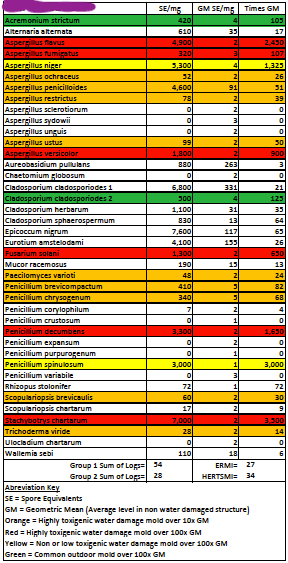
These results were certainly surprising and overwhelming. Once you start reading other people’s mold stories, you learn about people who camp in tents in their backyards or leave all their worldly possessions and start over in the desert. Step one to feeling better is to remove yourself from the moldy environment. That’s simply not feasible for most people.
So. There’s toxic mold in our house and we don’t know where. The next step is to hire a certified remediation company to find and remove the mold. Remove, not kill. The EPA states, “The purpose of mold remediation is to remove the mold to prevent human exposure and damage to building materials and furnishings. It is necessary to clean up mold contamination, not just to kill the mold. Dead mold is still allergenic, and some dead molds are potentially toxic.”
On October 10th, we had a mold remediation expert come to our house. He, too, inspected inside and out and took some pictures and will send us an estimate. Searching for mold involves looking behind (removing) baseboards and other, potentially more destructive sampling. We are also waiting on results from a culture of our original dust sample to see if the mold is still active and growing.
Fortunately, the inspection company also provided us with an “effective cleaning guide” and we won’t have to move to the desert. Ninety percent of belongings are cleanable. It’s large, cushiony items like couches and mattresses that should probably be replaced. Step one was to “ban the broom,” which only spreads spores, and invest in a HEPA filter vacuum. Check.
After we figure out the source of the mold and fix it, step two is to clean. Everything. To remove the mold spores that are covering every surface in our home. I don’t want to think about that right now, so at the moment, we’re still just living in it, as we have been for who-knows-how-long.
At my August appointment with the orthopedic surgeon, he gave me the option of a steroid injection in my hip and offered to refer me to another surgeon who has experience in both arthroscopic and open techniques for labral repair and impingement repair. He told me to think about it and get back to him, but really there was nothing to think about. Yes, try the injection, and yes make the referral.
Still, I waited until a few days later to send a message through the hospital system. I didn’t hear back for a while, and what I got was another appointment with the orthopedic surgeon for the end of September. I’d hoped we’d be able to do injection locally. It seemed odd that the surgeon himself had to do it.
But drive the forty minutes we did. When we arrived, it was essentially “You haven’t had the injection yet? Why are you here?” He himself then put in the order for the injection (locally, as I thought), and the referral, as we watched. With dismay, I realized that the whole thing was a big mix up and that our appointment was over. “Unless you want me to see if I can do it with ultrasound right now?”
Yes, please. So he trundled in the ultrasound cart and someone to assist. It all seemed rushed. He must drink a lot of coffee. I did not have to get undressed from the waist down and put on a gown and climb on a table as I did for the arthrogram. Instead, I sat in the exam chair, hiked up my skirt on the right, and the field was isolated from its surroundings by draping a clean gown over the other leg. Yes, he could visualize everything he needed to without my having to go to radiology. Even I could see the head of my femur on the screen. Clean the site, spray cold numbing spray. In goes an injection of lidocaine. My whole leg (and body) tenses with the sting of the needle. It hurts inside my leg. In goes the steroid. And it’s over. (Well, there’s some grunting and grimacing and deep breaths and making sure not to look. And then it’s over.)
He asks how I feel. Um, the same except now my leg hurts because you just stuck a giant needle into it? He picks up my leg and moves it all around. Any difference now? No.
He says it’ll take up to forty-eight hours to feel the full effect, and that sometimes it can take a week. I’m flabbergasted that I’m supposed to feel immediate improvement. But that’s lidocaine’s job. It is an anesthetic. Then the steroid is supposed to reduce inflammation. So even though neither the labral tear nor the impingement change in any way with this procedure, the pain is supposed to be lessened. Instead, on the drive home I moan about how sore it is now, deep inside my leg.
I’ve started to wonder if my brain and body just don’t respond to medication in a predictable way. But then I remind myself that lidocaine has worked on other parts of my body. I had all four wisdom teeth removed at once with a local anesthetic. I had the birth control implant placed and removed from my upper arm with local anesthetic. And they really had to dig for that thing when it was time for it to come out. So. Maybe it’s just the CP parts of my brain and body that ignore lidocaine. Is that a thing? It seems like it could be a thing.
It’s been about two weeks since the injection and once the initial pain subsided, it felt like nothing at all had been done, and it still feels that way. Worth a shot, I guess. I did read a paper that reported those who responded well to an anesthetic injection also responded well to the surgery. I wonder what that means for me? I wonder if this other surgeon I’ve been referred to will have some positive stories to tell me about the dozens of labral tears and impingements he’s repaired in CP patients. I’m not holding my breath on that one.
Right now, I’m waiting. Waiting for the mold culture results and the remediation estimate. Waiting for an appointment with the new doctor. I have no idea how long all this will take. If surgery is a go, how soon will it be?
I do know that I want my home to be a safe place in which to recover. I’d love to feel like I’m recovering from the mold toxicity (CIRS) before facing surgery. I’d love for my throat not to hurt anymore and for my thumbs to work properly without pain.
If anyone wants a good laugh, watch episodes three and four of The Big Leap on FOX. There’s a dancer whose career ended because of a knee injury and a doctor comes to her office and injects something into her knee and she gets up then and there and dances without pain. Ahahahaha. In the next episode, the dancer does the injection herself. Without, you know, cleaning the area or anything. You gotta love TV. But really. It would have been nice if it had worked for me.


Mycotoxins are naturally occurring toxins produced by certain moulds (fungi) and can be found in food. The moulds grow on a variety of different crops and foodstuffs including cereals, nuts, spices, dried fruits, apples and coffee beans, often under warm and humid conditions.
Regards,
Bonnie
LikeLike