
Life with ExoSyms Day 2: Training Week at Hanger Clinic

Training Day Two: Tuesday, 16 June. 8:00-10:00.

I start the morning with a check-in/ pep talk from Ryan: The body, the mind, and the ExoSym are like three different sheets of music. They’re all doing different things and they need to come together as one. It’s a big ask for me to use muscles I’ve never used before.

While I wait for Jared, Ryan gives me the assignment of walking up and down the length of the gray walkway with poles, in front of a mirror to watch for hip drop. I’m looking forward to continuing to work on my squish and load the devices properly. I hope I get to use the pole-and corset combo again. But it turns out that I’m in for completely different stuff today.

Jared arrives and tells me to continue walking: 10 up-and-backs. Before I finish, he stops me and asks me to walk backward. I knew I’d be asked to do many things I am not comfortable with. That’s the point. I told myself before I came that I would attempt everything without making a big deal out of it. Walking backward first thing on day two is a big ask. I can’t help but remind Jared that I usually have a hand holding on to something at all times. That it feels very likely that I’ll fall over backward in these things. I’ve already had a few suddenly-off-balance, full-body clenches. Not to back out or protest, exactly. Just to let him know that this isn’t going to go smoothly.

My legs aren’t strong enough to step backward without my upper body leaning forward to try to help. “Try not to hinge at the waist,” Jared says. Yeah, no kidding. I put enormous pressure on my hands/wrists/arms leaning so much on the poles. Plus, these things are heavy. Jared tells me to put my hips forward. When I lean my upper body forward, I am not “loading” the devices anymore; my weight comes away from the knee cuffs instead of going into them. I need to do so much work on my core.

I have over two minutes on the vibration plate today. I feel it in my teeth. It’s so weird and exhausting. But nice? When I step off, my lower legs feel completely heated up. The synthetic sleeves under the braces are so hot.

Next, it’s time for balance work. I stand between two vertical metal bars (like for lifting a barbell while standing). Put my feet together and apart. Try to take my hands off the bars. Step up onto a small block. Jared brings over a mirror so I can see if I’m keeping my hips level. I am not. My body and brain do not know how to correct this. Now take one hand off the bar, then the other. My toes and calves clench and my knees want to buckle.

The only thing my body really refuses to do is let me raise my arms over my head or out in front of me. I’m not ready to let go of the bars for that long yet. Mental block or physical limitation? Both, I think. Perhaps I could have done it were I not on the block, or if I were between parallel bars instead. Next, we try the balance board, again trying to stand level and take one hand away.

Following that, I do some ab work on the floor. That means that I have to get down onto the floor. Jared uses a bench and shows me a couple different positions. One is spreading legs far apart and bending one knee. That one is definitely out. The other is going into a lunge position and bending the back knee to the floor. I try that one. Before my back knee is down to the floor, the ExoSym on the front leg bites into the back of my calf. Hmm. Once I’m kind of kneeling, I’m kind of stuck. I’m supposed to move one hand from the bench to the floor and lower myself down the rest of the way. I do it, ExoSyms clattering together as I position myself on my bottom somehow.
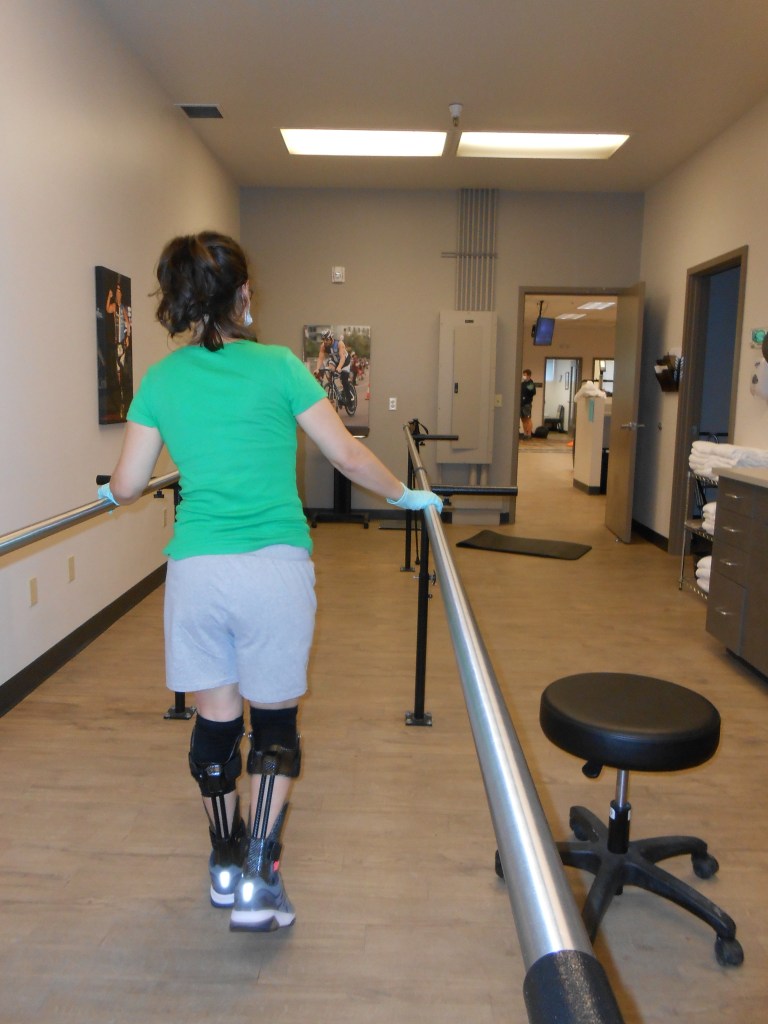
Clear view of the struts up the back.

We try several positions for me to engage my core well. I end up on my back with one leg bent, one straight, a folded yoga mat under the extended foot so it will slide even with my shoe on. I bring the extended leg in and back out, keeping my core engaged, trying to use my hamstring but actually kinda tweaking the front of my hip.

Jared has another patient, so he brings the bench and mat into a side room with parallel bars. He assigns me 9 more sets (eight on the right, twelve on the weaker left). In between each set, I am to stand up (haul myself up using the bench), walk up and down between the bars, and get myself back down onto my back with my foot correctly positioned on the folded mat. Nine times. Sure, no problem. Ryan pops his head in and asks how I’m doing. From the floor, I say I still have seven more. I mean seven more complete sets, but the next time he comes in, I’m up between the bars, and he plucks the mat off the floor and starts sanitizing it. I feel very relieved. My right side is starting to hurt anyway. You can see in the video that Ryan has me progress to only using one hand on the bars. He’s encouraging about my hip drop. Then he tells me he’ll see me tomorrow. I still had four or five more sets to go. Don’t tell Jared.

Walking with two hands and then one. In between sets of ab work on the floor.

I am supposed to come back early in the morning to get my knee sections. I am nervous because I know that they will add so much more bulk and weight. But I’m also ready because they keep telling me how much progress I will make with knee sections. They should be ready by 8am. I will wait for a text from Ryan to confirm.

Food, ibuprofen, journal, meditation, sleep. Day two complete.

Actually Happening: Cerebral Palsy and ExoSyms

My trip begins tomorrow, and I spend next week at the Hanger Clinic in Gig Harbor, Washington, learning to use my ExoSyms.

But first, I must document yesterday, June 10. At 9am I went to my first occupational therapy appointment for my wrists/hands/thumbs. I gave her the whole story about using trekking poles and then having pain and not using them (for months with no improvement). And now I need to use them, so I need help. From behind masks, we did the strength and range-of-motion baseline assessments. My therapist told me that it sounds like I have several things going on (yay). She gave me exercises for De Quervain’s tendonitis and the radial nerve. Showed me how to massage the palm side of my forearm with two tennis balls taped together. I’ve never thought about those muscles being tight before, but she said they were. She massaged them with cocoa butter, which was the first time I’ve had human contact from someone other than my spouse in three months. She showed me how to tape my thumb and wrist and also approved of the brace I’d tried. Made adjustments to my trekking poles to try to keep my wrists in a good position. Sent me on my way. Productive appointment.

Later in the day, my neck and shoulders–the whole trapezius–began to feel different. Tingly. A little like the clamp on my neck that’s been pulling my head and shoulders painfully toward each other for four years was…loosening. Some. I got down onto the floor and carefully went through the stretches I’d been given years ago (and still attempt regularly). And I felt actual stretching, not just fighting against tension. Huh. Perhaps this was how it was supposed to be all along. Perhaps this is why physical therapists often seem a bit skeptical/frustrated when I tell them stretching only feels the same or worse. Because I’m supposed to feel this instead of that. Maybe now all those things I’ve tried before will actually work? Quick, somebody give me some Flexeril! Kidding. Sort of. After stretching, I meditated (third consecutive day!). And darned if I didn’t achieve a full-body floaty relaxation. Wow. What’s going on? This morning, when I sat down to put on my shoes, I think it was just a bit easier to bend over and reach and pick up my shoe from the floor. 

So what did it? Did I just need someone to massage my forearm with something that smelled like chocolate? I’ve had my forearms massaged before. Maybe not for that long in just that way. I am getting better at meditating. Maybe that’s it. Distance learning is finally over for the summer. Maybe that’s it. 

It’s not as though my neck pain is gone. There’s still a long way to go. But now I know that less pain is possible. That I can continue to work to loosen the clamp. 

It’s ExoSym time! I’m trying to be excited and positive, but honestly, I’m scared of how hard this is going to be. I’ve never asked my body to do something like this, and I don’t know how it’s going to handle it. I cannot expect to strap them on and go like so many others. Another ExoSymmer with cerebral palsy pointed out that it’s a little like having surgery. A period of rehabilitation must follow. There might be pain; there will definitely be soreness. We have to give ourselves time to adjust and build our strength. Weeks. Months. Years.

Megan, who blogs at Wheatfield Ramblings, has very helpful advice for people who are just starting their ExoSym journey. One tip she gives is come with goals. Here are mine:

During my week at the clinic, I would like to learn how to:

Walk

Step up and down, as with a curb or onto and off of a bus

Get down onto and up from the floor

After all, I have to start at the very beginning. It’s a very good place to start.

What It Feels Like to Live with Cerebral Palsy

I have cerebral palsy, but it does not have me. 

Sounds nice, doesn’t it? Did it make you feel good to read that? Here’s the thing. It isn’t true. Cerebral palsy absolutely has me. I cannot turn it off or take a vacation from it.  

In my Growing Up with Cerebral Palsy post, I wrote, “Cerebral palsy just affected the way I moved about in my environment. Cerebral palsy was simply my normal.” But there really is no “just” about having a lifelong disability, is there? Cerebral palsy does not affect my movement in isolation, but has shaped who I am in a way that is inseparable from my DNA.

I am going to attempt to describe what it’s like to live with cerebral palsy. But it is like asking an able-bodied person to describe what it’s like to live without cerebral palsy, you see. We really know only our own experience. We can try to articulate it in relationship to another, but how do we know if we are accurate?

This should go without saying, but I will say it again, nonetheless. Every person experiences CP differently, with some commonalities. My CP is mild. I am always aware of that and grateful for my overall independence.

So here we go. I would characterize my life as one of uncertainty. My ability to balance consistently is tenuous at best. I cannot trust my body to hold me up. 

Imagine that you are walking down the sidewalk, and then you are suddenly sprawled on your hands and knees and they are stinging and you know there will be blood and you’re unsure if you will be able to get up by yourself. Imagine that you are standing in your kitchen, holding a cup. Suddenly, equilibrium in your body shifts, all your muscles tense and you flush with heat, your hands fly out, liquid sloshes, balance has flown, and you clutch the edge of the counter in time to keep from going down. Or, the counter is just out of reach and you’re wondering as you fall if you’ll knock your head against the cabinets, mentally bracing for the impact of your backside against the hard floor. The world is not a safe place, you see. Your body is not a safe place. Are you beginning to understand how this affects who you are–influences how you interact with space and things and people? 

Sticking to the edges, where there are fewer people to bump me, a hand always on furniture or the wall, a hand always needed as insurance instead of free to greet, or carry, or hug. Always calculating the risks involved in an action, always cautious. Will my body succeed at that or not? Do I try it? Or not? Split-second decisions all the time. Will that person move away from the railing so I can use it? Or stand from that bus seat before the bus starts moving, so I can maneuver into the seat in time? Do I have to speak up and ask?   

There is no striding confidently into the room. No standing for hours at a party, holding a plate of food or a full glass, and chatting comfortably. No stepping off a curb or over a puddle or a backpack in the aisle. No running to catch up with friends or stopping and turning with ease if someone calls my name. No giving or receiving hugs freely. 

It is not only the constant challenge of staying upright–but upright AND functional. I do not have the strength or balance to stop moving when I need to. My body will keep moving haphazardly forward with my momentum even when I need to stop. Small, uncontrolled steps to keep up with the momentum, or a hand out to stop and steady. If hands are full, then it’s the backs of the hands, the forearms, or the forehead that halt the forward motion. The forehead is not a good brake. Example: emptying the dishwasher. I’m carrying a stack of plates to the cupboard using both hands, and I don’t stop well when I arrive at the open cupboard. Elbows and wrists pitch outward toward sharp cupboard edges in an effort to save my head from using the front edge of the cabinet to stop my body crashing into the stacks of glass dishes inside. Hence, moving through life with one hand functional and one hand occupied by steadying. And only carrying two or three plates at a time.

Let’s acknowledge for a moment bodily needs like toileting and showering and menstruating and intimacy. Cerebral palsy might directly affect these things, or directly affect my ability to address or participate in them. Does CP affect my ability to retain or release urine? I do not know. I do not know if me holding my pee feels the same as you holding your pee. I can tell you that really needing to go makes getting pants down and getting seated properly, without falling on my face, a hundred times harder than when I’m not in a rush.

Emptying the dishwasher, removing a heavy pan of hot food from the oven, scrubbing the toilet. Putting on clothes and taking them off. How will my body handle this today? Will I be able to lift the hot casserole dish with one hand while using the other hand to stop my whole body from tipping forward into the oven? Will I be able to step into my underwear on the first try, or get my foot tangled the first three tries, whole body tipping forward again, leg muscles straining, one hand holding the dresser as I try to hold the leg hole open with the other, to create a wide target for my uncontrolled foot.

The constant navigation and calculation is exhausting, both physically and mentally. I perform every private action and every public interaction with some degree of uncertainty. I literally do not have physical confidence. How can that not affect who I’ve become as a person? 

I’m not trying to say that there are no confident people with physical disabilities. Of course there are. Of course there are extroverted people with cerebral palsy who may indeed walk confidently into a room. I was born a cautious introvert. And I theorize that living with cerebral palsy has intensified my caution and my introversion. 

Cerebral palsy has also made me more observant and detail-oriented. I’m probably more aware than an able-bodied person that there’s lots we can’t see about someone. I readily accept that everyone and every situation has complexities. I think I have more compassion and curiosity than I would have had without CP, and more appreciation. Of course, I’d like to believe that I would have been a kind, observant, compassionate person even without cerebral palsy, and that having CP again only intensified what was already there. 

The world is complicated and being human is complicated. And we can only ever fully know our own experience. I hope this helps you understand a small bit of mine.