Six Years of Searching Ends with One Simple Answer: Disability, Chronic Pain, and Horses

Like many, many adults with cerebral palsy, I learned long ago that “not progressive” means that the damage to the brain does not progress, but cerebral palsy’s effects on the body most definitely DO worsen over time. Because we are told CP is not progressive, and because most healthcare professionals don’t know much about CP, we who are living with it are on a guideless journey of mostly unpleasant discovery. Thankfully, the internet has enabled us to connect with each other. We are each other’s only companions in the dark. Does anyone else…? What do you all do when…? How do you handle…? Of course, each person’s experience with cerebral palsy is different, just like with so many other conditions that are grouped under one gigantic umbrella, so we give each other plenty of contradictory, if well-meaning, advice. By the way, people with CP are taking charge and trying to get healthcare to meet our needs. Check out Cerebral Palsy Grows Up!

Since 2019, I have been on a journey of my own that has often left me feeling in the dark. It’s all been documented here, but I want to bring all the heretofore disparate pieces together now so we can see the big picture. Bear with me and my detailed self-involvement. I want this as a record for myself and might as well put it here, too. (I mean, it is my blog of my life with a disability. What do you expect?)

Here’s a not-so-quick rundown of all the moments I’ve deemed relevant to this particular exercise, timeline-style, kind of:

-Date unrecalled (many years): TMJ (jaw) pain and sharp ear pain.

-June 2008: Neck tension episode so extreme, it caused vomiting. Constant neck and shoulder tension, onset June 2016.

-August 2014: Onset of burning toes, especially when cold or wet. Assumed Raynaud’s. (Turns out it’s not.)

-June 2018: Diagnosed with celiac disease. With positive ANA and high centromere antibody. I’ve had my celiac panel blood test done seven times so far, including the original in 2018, when my tTG result read, “ >250.” Normal is <15. Since then, despite a very strict gluten-free lifestyle, subsequent results have fluctuated between 221 and 81.2. I am happy to say that the 81.2 was from August 2024. The only reason I’m going into this much detail about celiac numbers is that the literature states that when the numbers remain high, look for additional autoimmune diseases.

-May 2019: Ongoing sore throat (months). Faint positive for strep. Took antibiotics, but the pain remained, intermittently. This set off my search. The throat pain didn’t seem connected with anything else.

-October 2019: Ongoing throat pain, now constant. Negative strep; ENT referral.

-December 2019: ENT diagnosed laryngopharyngeal reflux (LPR). Prescribed Protonix for three months. April 2020 follow-up postponed because of the COVID-19 pandemic. Unremarkable esophagram (barium swallow test).

-December 2019: I started using trekking poles to walk longer distances, preparing to use ExoSyms.

-March 2020: Sudden onset of burning forearms, tender/sore thumbs and base of thumb. Loss of grip strength. Suspected cause is trekking poles. Not better with cessation of use. Moderately improved with PT (June–September), but not back to pre-pain function. (This coincided with the pandemic lockdown when everyone’s jobs and lives were upended. I now think that the stress of the sheer number of unprecedented events in 2020 was a big contributing factor.) 

-May 2020: H pylori negative. Checked this because of throat pain and reflux diagnosis.

-July 2020: ENT follow-up. Doctor said the inflammation was gone. But the pain was still there. Referred to gastroenterology.

-September 2020: Dramatic increase in throat pain. Chest pain/burning sometimes. Occasional honking cough. GI referral moved up. Avoided acid and caffeine, tried sleeping propped up, no alcohol, etc. Tried Pepto and Mylanta; didn’t help. (This coincided with beginning “distance learning” with my elementary school students. Have you ever tried to teach six six-year-olds how to read via Zoom? This again, I now think, was connected to the unprecedented stressfulness of the world, and the US, in 2020.)

October 2020: My first upper endoscopy, which was an extremely stressful and emotional experience for me. Results stated “granular mucosa” and “reactive gastropathy with mild chronic inflammation.” No one seemed to think these were concerning or indicative of anything.

-January 2021: GI video visit follow-up. Sent back to ENT (sinuses?). 

-January 2021: ENT appointment with a different doctor. Scope showed minor inflammation. Flonase, Claritin, nasal rinse prescribed.

-February 2021: Tried Claritin and Flonase a couple weeks, didn’t seem to help. Same for nasal rinse.

-22 March 2021: Stomach pain and burning woke me up at 5am. Nausea. Throat/reflux felt very strong. Stomach pain eased some with food.

-Spring 2021–Dec 2021: I decided to try seeing a functional medicine doctor. He ordered loads of labs and diagnosed me with Chronic Inflammatory Response Syndrome due to mold exposure. Hard science re: CIRS lacking, but (inactive/prior water damage) mold was confirmed in our home. Mycotoxin urine test showed elevated levels of four mycotoxins, but the test doesn’t have the science to back it up.

-May 2021: Pop in groin. Had MRIs of lumbar and right hip. Diagnosed with labral tear, mixed type FAI, arthritis, probably trochanteric bursitis. Tried steroid injections. 

-April 2022: Sports medicine referral at UC Davis: gluteal tendonitis, lumbar facet arthropathy. Sent to PT. Referred for EMG. Tried gabapentin June-October 2022.

-March 2022: Significant increase in beverages/saliva, even food, going down the wrong pipe and causing coughing. Over the past six months? Often daily. Leaves chest hurting.

-April 2022: My PCP had originally suggested ENT or allergist for my throat pain, and we had started with the ENT. So now I asked for a referral to an allergist before deciding whether to tear apart our house to do mold remediation. I had been researching my symptoms, and on RareDiseases.org, I saw something that fit. I asked the allergist about granulomatosis with polyangiitis. He chuckled. (And was right that I didn’t have it).

-May 2022: Forearms still burning. My tTG was back to being very high. Since I also had positive ANA, I wondered if I had an additional autoimmune disease. My new PCP at UC Davis looked at my labs and history and agreed to refer me to rheumatology.

-June 2022: First visit with rheumatologist. No obvious signs of scleroderma, lupus, or other autoimmune diseases.

-June 2022: Leg EMG, nerve conduction study (ordered by sports medicine). Testing for neuropathy: findings “essentially normal.”

-July 2022: Referred to pain management by sports medicine.

-June–November 2022: Tried gabapentin, very low dose to start and worked my way up. First time consistently taking pain meds. Once I was on a standard dose, I stayed on it a while, but I didn’t notice any improvement in pain, and thought I might be starting to experience some side effects, like mild dizziness.

-July–August 2022: Spent two months away from home while brain retraining to see if there was a mold connection. No consistent change in throat pain, but interesting meditation experiences with The Gupta Program.

July 2022–January 2023: Used The Gupta Program consistently, but no lasting changes.

-September 2022: Pain management doctor discussed compounding cream, CBDa, duloxetine, baclofen pump, and lumbar radiofrequency ablation (but nerves grow back). Referred me to pool therapy, but there are no facilities I can feasibly get to.

-September 2022: Arm EMG (ordered by PCP). “Normal study” with no evidence of peripheral neuropathy.

-September 2022: Right foot and ankle x-ray, at Sutter, for sharp pain that interfered with weight bearing and a new bulge on the side of my foot, onset July 2022. Referred to PT.

-October 2022: First visit with GI at UCD, for “uncontrolled celiac disease.”

-November 2022: MRI for right ankle, at Sutter. Osteoarthritis and not much else.

-January 2023: Tested for strep just in case, before helping a family member post-op. Faint positive again, just as in 2018, but again, no change with antibiotics.

-February 2023: First neurology visit. She was amazed and concerned by my abnormal reflexes and ordered some MRIs. Sigh. Ugh.

-March 2023: Dexa scan (ordered by GI). Low bone density.

-March 2023: Cervical spine MRI (ordered by neurologist). Various mild-to-moderate degenerative changes in places and disc bulges.

-April 4 2023: First appointment with PM&R, at UCD. Fun thing about a teaching hospital is that I had a group of people analyzing and discussing all my various symptoms, and it’s the closest I’ve felt to being in an episode of House, MD. Too bad there weren’t any helpful revelations. “If it hurts, don’t do it.”

-April 11 2023: Brain MRI (ordered by neurologist) because of “abnormal reflexes” in my hands and arms. Only findings: “Small white matter lesion in right brain” that is unlikely to have caused my symptoms.

-May 24 2023: Neuro follow-up. Doctor’s notes include: Small fiber neuropathy could possibly explain her forearm sensory deficit, although she could have mild cervical sensory radiculopathy given her symptoms improved with OT and MRI of C spine did report mild disc bulging at multiple levels. Since her symptom remained stable, symptomatic care for cervical radiculopathy or small fiber neuropathy is recommended, no matter if she does skin biopsy or not. “Symptomatic care” means topical ointment or lidocaine patches.

-June 2023: Endoscopy #2, UCD this time. Very little signs of damage from celiac disease.

-July 2023: I brought up the possibility of fibromyalgia with my UCD PCP. Started Savella in September. Didn’t help. I guess it’s not fibromyalgia.

-September 2023: I was casted at my local Hanger Clinic for a left AFO (recasted and padded in February 2024). Already had one on the right side.

-October 2023: I fractured my right shoulder in a kitchen fall. First panic attack.

-March 2024: I purchased a posterior walker. Started trying it around the neighborhood. Much less labor intensive than using trekking poles, but I’m still not comfortable using it in public (it’s bulky and rattles loudly).

-April 2024: First visit to a new podiatrist. He HELPED my excruciating left big toe!

-May 2024: Appointment with a new neurologist (referred by rheumatologist?) Re: throat and arms. “You have CP.” Referred to otolaryngology and PM&R.

-May 2024: First Teledoc appointment with psychiatrist, because I’m finally open to medication for anxiety. Tried Lexapro. Didn’t seem to help. Tried Prozac next for a few months. Helped but too many side effects.

-June 2024: First Teledoc meeting with counselor. Weird and unhelpful. Had three appointments with her before trying another, who was also weird and unhelpful. Stalled on my quest to find a good therapist.

-October 2024: First visit to UCD otolaryngology for an esophagram and scope. After the scope, he said I have mild laryngeal dystonia/dysphonia. Referred to voice therapy.

-November 2024: PM&R visit #2, with new doctor. No gaggle of students this time. Just a long, detailed one-on-one session, with a few standard strength/tone assessments. Started oral baclofen. Referred to acupuncture.

-December 2024: PM&R follow-up. Increased baclofen. Referred to urology for lifelong, basically, frequency and urgency.

-13 December 2024: First appointment with voice therapist (SLP). He said it doesn’t seem like laryngeal dystonia, but rather just spasticity/increased tone. 

There’s a saying in medical school. Well, I’ve never been to medical school, but I heard this way before it was on Grey’s Anatomy, so it must be an established maxim: “When you hear hoofbeats, think horses, not zebras.” In case it isn’t obvious, this saying means that symptoms are most likely caused by a common condition, not an obscure one. You’ve got your overzealous interns coming up with rare diseases, and statistically, it’s more likely to be something that isn’t rare. Horses, not zebras.

Of course, we all secretly think we must be the one zebra in a herd of horses. Just because something is rare doesn’t mean it’s never that thing. It just means that it’s rarely that thing. Someone has to be a zebra sometime. Maybe it’s me. Having access to the internet only encourages our zebra suspicions.

According to my imperfect memory, I grew up without a primary care provider, only seeing physical therapists and an orthopedic surgeon. I never got “sick,” so I didn’t need a doctor. Okay, it’s true that my dad was a GP, so I had a live-in doctor. And he did give me stitches both times I needed them. But my point is, I was, generally, a very “healthy” kid. 

I didn’t even know how one went about getting their own primary care doctor, and it felt like a very big step for me in my twenties when I finally did it. I had my own doctor who wasn’t related to me. I had my first pelvic exam. (We in the CP community discuss this adventure regularly. Stirrups are not required!)

I was a kid who almost never needed a doctor, and now I am someone who not only has a primary care doctor and gynecologist but who, in the past six years, has also seen ENT/otolaryngology, an allergist, gastroenterology, rheumatology, sports medicine, pain management, integrative medicine, functional medicine, internal medicine, physical medicine & rehabilitation, podiatry, and neurology. There’s an undeniable element of absurdity in this list. I fully acknowledge that.

I decided to look outside family medicine and seek integrative medicine in my thirties because I was experiencing more and more chronic pain, fatigue, and general decline, and I hoped something more, well, integrative, would help. It was the integrative medicine doctor who tested me, to my surprise, for celiac disease in 2018. If I hadn’t gone to her, I think I would still be undiagnosed. I did not go to her for gastrointestinal issues, but her office took the most thorough history I have ever experienced. Because I do have celiac disease–with panel numbers that have always been out of range, no less–I have a legitimate reason to have a gastroenterologist. Because I have two markers indicating the potential development of other autoimmune disorders (again discovered by integrative medicine), I also see a rheumatologist twice a year (Although these markers were discovered in 2018, I didn’t see a rheumatologist until 2022). It’s still a little weird to me that I have these two specialists that I see regularly now, after being so outwardly healthy my whole life.

The constant throat pain that appeared in 2019 kicked off the ENT/GI journey, and the addition of the burning forearms in 2020 eventually added rheumatology and neurology to my “care team.” Various CP-related issues and injuries led me to sports medicine, pain management, podiatry, and PM&R. Sprinkled throughout were numerous procedures and MRIs that were all the more fraught for being rather inconclusive, except showing that I am, like everyone–but more and earlier–experiencing lots of “degenerative changes.”

It was June of 2022 that I switched over from Sutter Health to UC Davis. When I had chosen my first long-term primary care provider in 2012, I called up Sutter because that was the hospital in town, and I knew how to get there on the bus. I liked my doctor, and after a decade with her, it felt weird to decide to see someone else. Furthermore, because of my childhood associations, I thought of UC Davis as the place you go when you are having surgery, not the place you go for regular healthcare. But I was feeling frustrated and positively worn out, and I wanted to see if I could find answers elsewhere. I didn’t like the idea that one medical establishment could really be better than another, but I decided to find out.

Overall, my experiences at UC Davis really have been more positive than my interactions with doctors at Sutter. The doctors I’ve seen at UC Davis have been more willing to admit when they don’t know something, and therefore also seem more open and friendly, and to genuinely care, for the most part.

I saw a second neurologist in May this year after asking my primary care doctor about vagus nerve stimulation. I have continued trying to find relief for my throat pain–it’s the one thing that still feels unbearable indefinitely. I have tried lots of “acceptance and surrender” with The Gupta Program (which brings together pieces of many different systems, including Buddhism). I do agree with the Gupta Program that “what you resist, persists” (borrowed from Carl Jung). There are plenty of pain studies about meditation and mindfulness. The less you focus on pain, the better you’ll feel. And of course it isn’t easy. There are minutes and hours I don’t think about my throat, and other minutes and hours when I notice my attention on the sensation continually. 

After trying Gupta, I kept searching for answers and relief, and I’ve learned a little bit about the vagus nerve. The vagus nerve goes down both sides of the neck, and affects almost every system in the body. There is such a thing as vagus nerve dysfunction, and vagus nerve stimulation (VNS). I thought that maybe I could do 72-hour heart rate monitoring to check my heart rate variability (HRV) and the health of my vagus nerve activity, as suggested by the doctor in this video on the vagus nerve

However, when you go to a neurologist and ask about vagus nerve stimulation, they are thinking of it in the context of a surgically implant, for treatment of such varied conditions as seizures, depression, and stroke. I was not under any impression that I needed a device implanted in my body. There are many ways of stimulating the vagus nerve that are non-invasive. I just wanted to talk to someone who was knowledgeable about the vagus nerve system as a whole, and how it may or may not be affecting different parts of me.

I have been planning to write about this appointment since it happened in May. By planning, I mean avoiding. So much so, that I had several other appointments that followed it, and I thought, well, I’ll just wait until after this next one and then write about all of it. And here we are on December 31st, and I do not want this task to follow me into the new year (I’ve been writing off and on for weeks). This appointment was hard for me. It was hard because after we talked about my chronic pain and fatigue and increased muscle tone and decrease in function, and also my forearms and my throat, the doctor concluded, “You have CP.” As if this fact explains everything. I sat in the chair and I stuttered, “But, my diagnosis is mild spastic diplegia…” The notes from the appointment state that the doctor suspects “spastic laryngeal muscles.” He referred me to otolaryngology and also back to physical medicine & rehabilitation. 

I’ve held on to those words, “mild spastic diplegia,” for my whole life. I heard them as a child while doctors and physical therapists spoke over my head after testing my reflexes and my dorsiflexion and watching me walk up and back, up and back. I’ve read them in my medical records. They are the words I use to explain myself to people and to introduce myself to new doctors. Mild spastic diplegia, affecting my legs. 

Over the years I had come to accept that because my spastic diplegia influences my gait and my posture, it will therefore affect my back and shoulders and neck and jaw. However much I didn’t want my CP to affect my upper body, it does. Everything is connected. I was even adjusting to the pain and tension in my forearms being a CP thing. But my throat, too? My throat? No, no, no thank you. If my neverending throat pain is a CP thing, that means I am likely stuck with feeling like I have strep throat for the rest of my life. There, I have written it down now. It only took me about seven months.

Also in May, I had my first appointment with a mental health professional (made months before, not as a result of the neuro visit). I have been wanting to go to therapy for years. I finally decided I was ready to try medication for anxiety, and the psychiatrist I had my virtual appointment with readily diagnosed me with generalized anxiety disorder and prescribed medication. That journey will be a separate post, if I ever get around to it. But it’s been interesting, and has influenced this journey as well. Did you know anxiety meds can cause increased muscle tension? Me either, until I read the long list of possible side effects and then experienced it for myself.

In October, I went to my first otolaryngology appointment. The lovely “barium barista” who guided me through my swallow study told me the doctor I would be seeing was highly regarded. Patients from all over the country came to him when other doctors were at a loss. I talked with the doctor and he put a scope up my nose and down my throat. Then he had me say sentences like, “Please pass the peas and potatoes to papa,” and the other one that is more voiced that I forget, about rain. (That one was harder for me to say.)

He said that it looks like I have mild laryngeal dystonia. Not at the level where he would inject botox into my vocal chords (that’s what he does). I have a diagnosis! Laryngeal dystonia! It is not mold, I am not sick. I just have tight muscles. What was devastating in May almost felt like a relief in October. I think this had a lot to do with the Prozac I was trying at the time, actually. Cue some research as I learned a new word to fold into my identity:

Dr. Judy Gooch

Is it Spasticity, Dystonia or Rigidity

Spasticity and Dystonia: What does it look like?

In November, I saw a new doctor at physical medicine & rehabilitation. She thought trying oral baclofen was a fine idea. Just to recap, the pain management doctor I saw in 2022 was ready to surgically place a baclofen pump, but when I asked about oral baclofen he only said it wasn’t as effective. Two years later, I’m trying oral baclofen. It’s…doing something? On her referral to voice therapy and acupuncture, I saw that she had written laryngeal dysphonia, not dystonia. Cue more research:

Laryngeal Dysphonia from Dystonia Europe

In a talk through Dysphonia International, Dr. H. A. Jinnah said there are terms often used interchangeably: spasmodic dysphonia and laryngeal dystonia: “Laryngeal dystonia is a group of disorders and spasmodic dysphonia is one of them.” The treatment is often botox injections into the vocal cords, but the doctor I saw said mine was too mild for that. While, after seven months of sitting with it, I can wrap my mind around my “mild spastic diplegia” cerebral palsy affecting darn near every muscle group in my body at this point, I still struggle with the expression of spasticity in my throat equaling a constant, strep-throat-like pain. The various manifestations of pain in the rest of my body do not feel like this. And there is something about it being in my throat, my voice, that is less ignorable than in my extremities. My voice feels like me, and for it to hurt all the time, for me to find, not pleasure in singing along with musicals, but pain, has been really hard.  

This month I went to my first voice therapy appointment with a speech and language pathologist. He doesn’t have experience with CP, but based on my history of trying all the things and nothing having a lasting effect, he doesn’t think there’s anything he can do. Voice therapy isn’t what I need. It takes muscular strength and breath work to produce sound. He gave the example of a gramophone. The box at the bottom is the muscles, diaphragm, etc. in the torso, and the horn is the muscles in the throat. The vocal cords are just the itty-bitty needle. He’s willing to try massage and muscle taping and teach me (& spouse) to do it ourselves. There are lots of tight muscles in my throat. The pain signal comes from nerves, and there are lots of nerve endings in the throat as well. The baclofen hasn’t decreased my muscle tone enough to reduce the pain of the tension anywhere in my body. I’m back to thinking of round two of The Gupta Program to work on calming my nervous system and its hypersensitivity and constant loop of pain signals.

This year, I also watched the documentary Joan Baez: I am a Noise. I may be completely misremembering this, but I think in an interview segment she watched a clip of herself singing in her early days, and then she was asked straight out if she could still sing like that. She answered, No, I can’t sing like that anymore, and yes, I miss it. Of course, Joan is 83, not 43. I think she didn’t sing publicly for quite a while. Instead, she stayed connected to music by finding joy in dancing. And she painted, because some people get to live lives full of remarkable ability and talent like that. More recently, she has given concerts again. She seems to have reached a truce/peace/acceptance of her voice and her abilities as they are now. It is natural for us to look back and to marvel and wonder at the way things used to be, at what we used to do. For all of us. I can hardly believe I used to walk more than a mile unaided and work for hours straight and then walk some more. (In my twenties. In my thirties I vividly remember the feeling of my pelvis being full of cement and wanting to lie down on the bike path on my way home.) 

I think coming to terms with a decline in ability is perhaps easier when you’ve already come to terms with never having had full able-bodiedness in the first place. For me, it’s the pain that’s hardest. And that no matter what, it’s always there. It’s the lack of respite that is exhausting at best and overwhelming at worst. And that is why I’ve spent the last six years searching for an answer to my throat pain. In the hope that one of these things is not like the other. (Throat pain is not like all the other body pain.)

After six years of searching, I finally know that one of these things is like the other. My spastic diplegia isn’t only diplegia. I have to accept that a major part of my identity is no longer what it was. I am not who I was. We continue to be new versions of ourselves, and often we miss parts of the old ones.

I am a horse, not a zebra. I do not have some rare condition with an easy cure. I have cerebral palsy, a very common lifelong disability that affects my muscle tone. Even in my throat. 

Now that I sit here on the final day of 2024, after procrastinating and processing for the last seven months, I’m relieved to have finally written it all out. Thank you for reading, if indeed you made it this far!

May we all find moments of peace and happiness in the year to come.
Don’t Go Chasing Water Falls

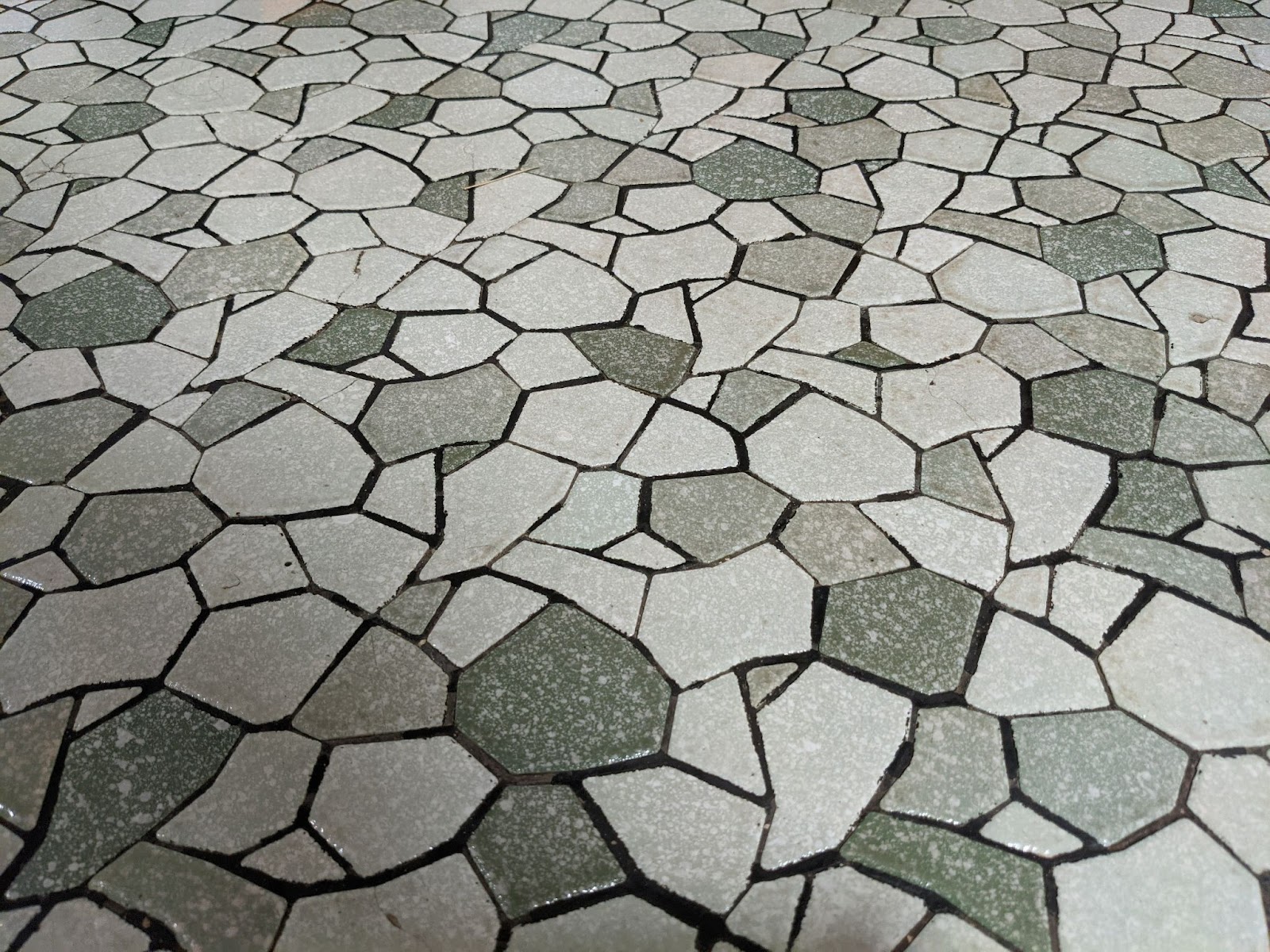
I made it into the fourth month living in our new place before falling in the kitchen. Going that long without a fall is pretty good because our kitchen has its original 1969 tile in it. I love the light and darker shades of green, but the shape and texture is a problem. It’s real tile cut in different shapes in a repeating pattern. Over the decades it’s been cracked and chipped. One spot has gone through an attempted repair and sticks up above the rest, with a mess of maybe rubber cement around it. 

The lighting isn’t great here. You’ll have to trust that it looks more green than grungy in person.

I could tell that spot in the tile was going to be a problem. My shoe kept catching on it. Fortunately, it’s right against the counter, so I’m usually already hanging on to the counter when I encounter this tile. On the day of the fall I was making myself oatmeal and I decided to return both the milk and the oats to the fridge at the same time. This is a risky and adventurous move because I know it’s safer to carry only one thing at a time and have one hand available for guidance and stability. Feeling apparently confident, I picked up the shelf-stable almond milk in one hand and the Bob’s Red Mill zip-closure package of GF oats in the other.

As I turned from the counter, I felt my shoe catch on the raised tile and milk and oats went flying as I lost my balance. Inwardly I grimaced, preparing both for the pain of impact and the potential splatter of milk and shower of oats that might be coming. On the floor, I breathed a sigh of relief and gratitude when the contents of both packages remained inside their vessels and I was not much worse for wear. I deemed my first kitchen fall a great success, and I was relieved to have gotten it out of the way, finally.

The very next day was the second kitchen fall, but this time it was a water fall. You see, we had gotten a cat. (Rest assured, this fall was not directly caused by the cat.) 

My husband and I had long wanted a cat but I was adamant that there was not enough room for a cat, her food dishes, and her litter box in our previous dwelling. In order for me to welcome an animal into my home, I had some requirements. (Remember, I grew up in a rural area, with an “animals live outside” perspective.) The biggest requirement was that we have an attached garage so that we could put a cat door in it and have the litter box outside of our living space. Lucky for us, our new house did have that, though the existing cat door had been sealed off and would need to be replaced. It took us a while to replace the door and to create an area inside the garage that was enclosed for the cat alone. I had thought about it and was afraid that she would get out when we opened the garage door or would be sleeping under the car when we tried to back out. I wanted a place in the garage to be sectioned off for her so that we didn’t have to be always nervous of where she was when we were coming and going.

After adventures in putting up cat netting and installing a new door, we took ourselves to the county animal shelter and met the only one-year-old cat who was available for adoption. No kittens for us. My other requirements were that she be small and short-haired, and amazingly, this cat checked all the boxes.

We brought her home on a Saturday and named her Maddie. On the following Tuesday morning, October 3rd, I was refilling her water dish. 

Have I mentioned our house was built in 1969? Along with the pretty, but problematic tiles, the kitchen floor is also rather…undulating. There are a couple of places that are not level underfoot. It is of course enough of an alteration in terrain for me to be hyper aware of it and for most people not to notice it much.

I want to take a moment here to emphasize that I also fell in our previous kitchen, which was indeed very flat both in terrain and in type of flooring. The problem seems to occur when I am carrying something. Even with one hand free as a guide, it is enough to throw me off, especially if I am also turning.

And so I filled her water dish, turned from the sink, and as I was passing by the refrigerator, I lost my balance. Again. My attempt to steady myself using the refrigerator was unsuccessful. This time, it was bad. I can only be grateful that I had just switched her water dish from something breakable to something metal. The dish went flying out of my hand and I–and the floor–became drenched in water. I was aware that, at the same moment my right hand made contact with the floor, it was also sliding away from me. The rest of my body landed when my arm was fully extended, my forward momentum adding additional force to the point of impact. My hand pushed against the bag of cat food, which pushed against a dining chair, and I watched, from my vantage point on the floor, as the chair tilted and finally landed on its side next to me with a clatter. What a racket-producing round of dominoes.

Again, I felt relief that I was okay, as I had not been knocked on the head or anything serious. There was pain, but nothing too terrible. But “Ow.” I realized I hurt my shoulder. My husband appeared, and I was ever-so-thankful he was working from home that day instead of the day before, as was his usual schedule. “I’m okay,” I said. “I just hurt my shoulder.” 

He righted the chair and held out his hands to me to help me up. “No,” I said, breathing heavily. “I think I need to lie here for just a moment longer.” As he started mopping up the impressive amount of water, I made jokes about this being one way to get the floor mopped. I realized that I truly was having trouble moving my right arm and that I really didn’t want to put any pressure on it. “I don’t know how to get up,” I said, struggling to bring myself to a sitting position and scoot to the edge of the tile. Bradley set a chair behind me and I managed to kneel in front of it, now on living room carpet. 

Suddenly, I didn’t feel great. Sweaty, a bit woozy. I lay my head on the seat of the chair and took deep breaths. “My fingers are starting to tingle,” I said worriedly, concerned that I had some kind of nerve injury on my right side. Then the fingers on my other hand and my toes started to tingle too and I realized I was having the same kind of vasovagal syncope response that I’d had when I attempted to donate platelets recently.

At my first-ever platelet donation, they’d told me I might feel tingly and provided Tums because the calcium helps. I ate my Tums but I only got about halfway through the donation process before awfulness descended upon me: I was sweaty, nauseated, woozy. Three or four people sprang into action, raising my feet, getting a fan, a barf bag, juice, and “syncope towels,” wet paper towels to put on the back of my neck and my forehead. I had always been fine donating blood, and I hadn’t expected platelets to be such a different experience.

The only other time I’d felt so awful was when I was in a lot of pain, from menstrual cramps in my teens and twenties, and also sometimes with neck pain. During those times, I would actually vomit, and I may or may not have passed out for a second in an elevator once. (Huge side note here, period cramps like this aren’t normal, aren’t just “part of being a girl.” If you or someone you love is vomiting or passing out from pain each month, something is wrong, and it can be helped. It could be hormonal imbalance, vitamin or mineral deficiency, endometriosis, or something else. Read a book like The Period Repair Manual; there are many resources out there now. Rather than going on the Pill, which is doctors’ default treatment option, advocate for yourself and get your body feeling better. Your pain is real, it’s telling you something, and you shouldn’t have to live in agony. Yes, I am passionate about this. Women’s pain has been dismissed for far too long.)

So I knelt there, hunched over the chair, breathing heavily and feeling a bit dizzy, knowing that I was having a syncope reaction, either from pain or stress or a combination. Bradley got me a barf bowl, and I asked for an ice pack for the back of my neck.

I did not vomit, and I eventually stabilized enough to get myself into a sitting position on the chair, awkwardly using only my left arm. “Do we need to go to the emergency room?” my husband asked. I just wanted to rest. So I took two extra strength Tylenol (after the ‘mild chronic stomach inflammation’ result of my first endoscopy, I stopped my infrequent ibuprofen use in case that helped anything), got into bed and put an ice pack on my right arm. I sat there propped up and took lots of deep breaths, feeling rather unhappy that my shoulder hurt kind of a lot.

Eventually, the pain lowered a bit and Bradley brought me my laptop, since I actually had some work to do. We slept terribly that night. Maddie, our new cat, hopped right onto the bed with us right from the start. So there I was, having thought my whole life that letting your pets onto your bed was downright gross, to now having a cat asleep on my legs, as I tried to sleep on my back with an injured shoulder. (I am not a back sleeper.)

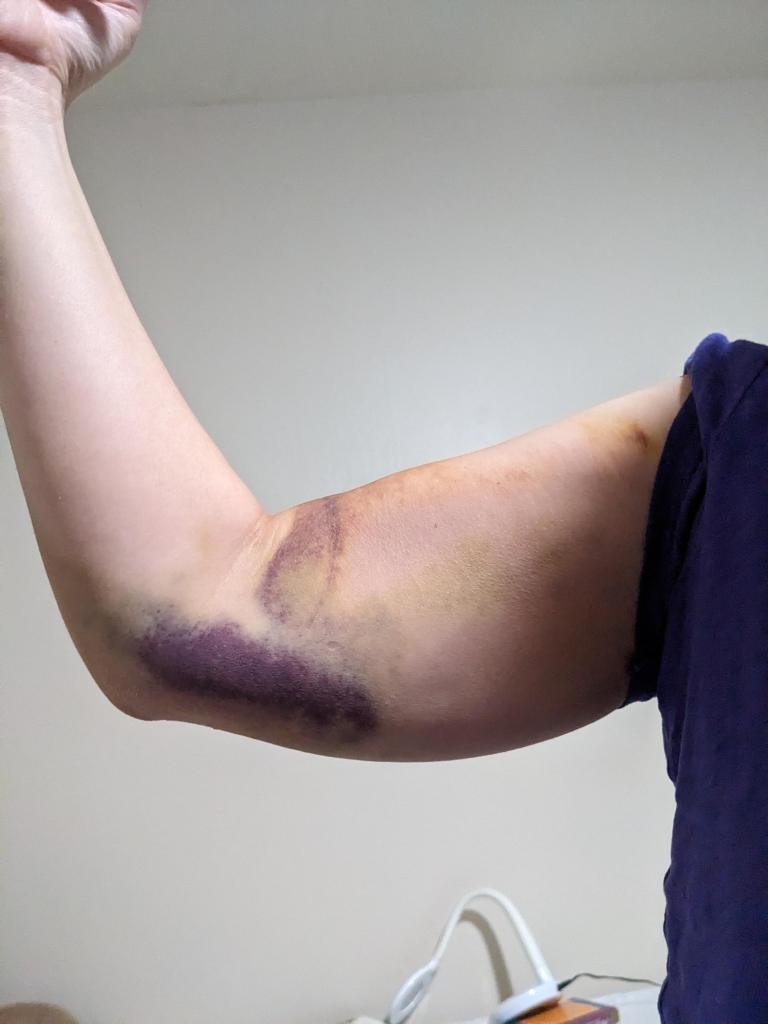
On Wednesday, the pain hadn’t lessened any further, my whole upper arm was swollen, and a bruise was starting to form on the front of my bicep near the elbow. Over the course of the day, I watched the bruise spread upward and darken into a mottled purple. I continued to take Tylenol and use ice, and I tutored my online student from bed. 

By Thursday, when I woke up and the pain and my lack of range of motion still hadn’t changed at all, I decided to get it looked at. Bradley had to take the day off to take me to my medical facility. First he had to tie my shoes for me. I took the next available appointment with any doctor there, since my PCP was out anyway. This doctor was a nice guy. It felt very different than my usual appointments to see a doctor for an acute issue with very visible signs of trauma. I could tell him exactly what happened and when, and show him the aftermath of the incident. He examined the arm, ordered x-rays, and provided me with a sling. He asked about my pain and was ready to prescribe medication. I told him I was taking extra strength Tylenol, and that I couldn’t tell if it was helping or not. But it didn’t hurt too much while I was still. When I tried to move my arm outward from my body, or if I was startled, causing myself to jolt, then it hurt a lot. People with CP often retain their startle reflex from infancy, and let me tell you, it’s not great. The doctor advised me to continue taking the Tylenol every six hours for the next week. (I’d only taken one dose the day before, but I didn’t tell him that part.)  

I’ve never worn a sling before. On one hand, it felt better to have the injured arm supported. On the other, I felt even more disabled with my dominant arm bound to my side. I walked, holding on to Bradley, to the other side of the same building to get my x-rays.

On the way home, we stopped at a CVS. We were going to need more Tylenol, and I was in desperate need of two other important items: baby wipes and stick deodorant. I often bemoan the poor design of our bodies that puts our armpits so close to our noses. I sweat. A lot. And it stinks. I’ve always run warm, and since it takes people with physical disabilities much more energy than able-bodied people to do, well, everything, I sweat even more. The couple days of 90-something-degree heatwave wasn’t helping; my sling was already feeling sweaty. 

I’m used to giving my armpits a wash at the sink when I don’t have it in me to take a shower. But that wasn’t working. My injured arm couldn’t really lift high enough for a washcloth to fit, nor was that arm able to fully scrub the opposite pit. (I tried washing my left pit with my left hand, too. Boy, was that awkward.) And I’ve got the kind of stench that needs to be really scrubbed before it’s gone. Usually twice. For deodorant, I currently have Schmidt’s in a glass container. I like it, but you’ve got to stick your finger in there and then warm up the deodorant on your fingers before rubbing it in. I also have my homemade powder deodorant in an old plastic spice jar: baking soda, corn starch, and several drops of tea tree oil. I love this, and it smells great, but again, you’ve got to sprinkle it onto your fingertips and then apply. Too painful and tricky.

In the baby supplies aisle, we discovered that some baby wipes are now called “cleansing wipes” because they’re useful for so much more than babies’ bottoms. I appreciate that. It’s long been a strategy for people with mobility issues, and chronic illness and/or pain to use wipes when showering or bathing isn’t possible. The wipes we chose were unscented and 100% plant-based. Yes, amazingly, these were not made with plastic. They were made with cotton, even with some post-consumer content. And while throwing away single-use cotton only feels slightly better than throwing away single-use plastic, it’s what was necessary for me to be able to function.  

I needed to be able to clean my armpits, yes, but let’s acknowledge that that’s not the only place on my body that needed my attention. While eating and brushing my teeth with my left hand was slow and frustrating, trying to wipe my bottom with my left hand was nearly impossible. In fact, without my right hand to stabilize myself for the proper lean, if you will, it didn’t even feel safe. (Let’s remember that my feet barely touch the floor when I’m seated, and that they don’t help too much with balance, since they’re not fully under my control.) I quickly figured out that if I did what I could with toilet paper while seated, and then for the cleansing wipe part, stood up and braced myself against the counter, I could safely and fully clean my backside. Whew. (I am aware of bidet attachments, and I know they help many with mobility issues, but that’s just not the direction I decided to go in right now.)

By the time we arrived home from our essential errand, my x-ray results were already in. I had fractured my greater tubercle (the most sticky-outy part of the shoulder). 

The doctor I had seen told me in a message to keep wearing the sling and that he was putting in an urgent referral to ortho/sports medicine. Huh. I’d managed to fracture my shoulder. Well, that was unfortunate.

I tried not to panic about what the next month or two of my life was going to look like, as I realized that Bradley was going to have to take over all of the cooking and cleaning, and also now the cat’s litter box, food, and water. Without my right hand, I felt so much more disabled.

Without my right hand as a guide, I was barely able to get myself out of bed, or reposition myself at night. Without my right hand, I could not make myself carry anything made of glass with my left. I did not want to carry anything at all because I would have no second steadying hand to use while walking. I need my hands in order to walk safely.

I was afraid of walking on the kitchen floor. I was afraid of falling again, and I tried not to imagine the pain that would flash through me if (when?) I landed on my fractured right side. I tried not to imagine taking the impact on my face in an effort to protect my shoulder.

After finding out about the fracture, I decided to convert the PT table in my office into guest bed mode and sleep there. Bradley took the foam gym tiles off the top and slid them under the mattress topper. Added sheets, and voila; I had a recovery room. This bed was lower and the mattress topper firmer than our bed, and I found it much easier to maneuver myself in and out of this guest bed. I was also steps from the bathroom instead of down the hall from it. I could toss and turn (sans actual tossing or turning) without worrying about waking Bradley. And Maddie would be sleeping on my husband’s legs instead of mine. Before he left for work Bradley, put food for me in our one plastic container on the middle shelf of the fridge so I could reach it without reaching up, and filled water bottles for me. I was able to refill my water at the bathroom sink, but it often involved a bit of wrenching to the arm when I took the lid off. 

One week after x-rays, on Thursday, October 12th, I met with the sports medicine doctor. Bradley had to leave work early and bring his laptop into the waiting room in order for me to make it to my appointment. Because we were at a teaching facility, a less experienced doctor came in first. He showed me one of my x-ray images. It looked like a very little chip was missing from the greater tubercle. I told him that the bruising and soreness extended to my collar bone and down my chest a little, and also that the area around my shoulder blade hurt quite a bit. He said that there’s all sorts of nerves involved so it’s not surprising that there’s pain in those areas. I felt that it was more likely that the muscles had been strained with the combination of full extension plus down-and-forward impact, but what do I know? I hoped that I didn’t also have a small fracture in my collar bone, but I figured treatment is probably the same if I had.

“You’ve been able to keep it pretty mobile?” the doctor asked.

“Keep it immobile?” I said, assuming I had misheard him. “I’ve kept it as still as possible because it hurts to move it.”

We then had a long discussion about pain medication, as I explained that I’m taking Tylenol, but that I’m in chronic pain from CP and have tried many things that haven’t worked, so what’s the point? He acknowledged that my experience with chronic pain complicates things but pointed out, “You have a broken bone,” and recommended that my body should have anti-inflammatories whether I could feel them helping or not. So I took ibuprofen for a while and I’m still using lots of ice packs.

When the higher ranked doctor came in, he said I had the good kind of fracture that’s not surgical and that I should start taking off the sling and doing gentle arm circles while I lean to the side and my arm hangs. It’s important to keep as much range of motion as I can to avoid “frozen shoulder.” They wanted me completely out of the sling by two weeks, three at the lastest. I felt simultaneously relieved that I was allowed to move my arm, and scared to move it.

A couple days later, on the 14th, I was carrying a glass spray bottle (it has a silicone sleeve on the bottom for added safety) into the kitchen. Dear Maddie jumps on our kitchen counter regularly, and I was making an attempt to keep it clean. As I stepped from carpet to tile, Maddie herself was near my feet and it was enough for me to lose my balance. Three things flashed in my mind at once: The glass spray bottle is going to fly out of my hands just like the water dish. I’m going to fall on Maddie. I’m going to fall on my shoulder. I reached desperately for the back of a dining chair with my left hand, my thumb and two fingers grabbing hold while the others were stuck under the plastic trigger of the spray bottle. My right arm stayed against my side, and I stayed on my feet. I let out a big breath, then another. Phew, that was close. Bradley continued on his way into the garage once he saw that I was stable.

I set the spray bottle on the counter and anchored myself there, my whole left forearm making contact as I gripped the edge. I took another deep breath. And another. I thought I was taking calming breaths to slow my pounding heart, but I realized I was kind of gulping air. My breathing didn’t feel fully in my control. I wondered if this is what it feels like to hyperventilate. Then I was crying and gulping and feeling just a little light-headed. I told myself I was okay, I was safe. No one was hurt. Nothing was broken. (Well, except my shoulder.) And still I stood there, gripping and gulping. I wasn’t ready to let go, and I didn’t feel safe. Was this a panic attack? I thought it must be.

I was deeply sad, and shaken: My shoulder hurts. I don’t feel like I can walk in my kitchen. I can’t carry things safely. Maybe we shouldn’t have gotten a cat. It’s probably time for me to get a walker, especially if we keep the cat. How do I carry things if I start using a walker in the house? Is this my life now? Already?

The days continued. Maddie staying in our bedroom so that I could try to sleep on the guest bed didn’t really work out for Bradley. We started saying, “Who gets Maddie tonight?” She was still waking up at 4:30 or 5:00am most days. So some nights, I had a cat on my pelvis as I tried to learn to become a back sleeper, and I had to be okay with pushing off when I needed to heft myself onto my left side, pillow under my right arm.

On the 18th, I washed my hair! I stood at the laundry sink in the garage because using the shower or the bathtub did not feel safe or feasible. By the 20th, I wasn’t wearing the sling at all anymore. On the 21st, I went with my husband on some errands. This was the first time I’d left the house for something other than a doctor’s appointment since the injury. I felt very tentative and unsafe walking through stores, trying to look at items with one hand and gently steadying myself with the injured one.

On the 26th, three weeks after the fracture, I moved back into the bedroom. Getting out of our bed was still a turtle-on-its-back kind of maneuver, but I felt better able to do it. With all three of us together again, Maddie let us sleep until 5:59am! 

Somewhere during this time, I fell again. I knew it would happen, and I knew it would involve Maddie. Cats weave their way back and forth in front of you. They stop in front of you as you’re walking. That’s what they do. They’re cats. I already walk with a hand on the wall or furniture most of the time, or with a hand ready to grab hold if needed. But I can’t always be within arm’s reach of a sturdy object. And people with CP often have trouble stopping forward motion. We’re essentially falling toward one wall or chair, and on to the next, and it kinda looks like walking if we make it. So, I’m walking from the couch to the kitchen table, and there’s about a foot or two of no man’s land where I’m on my own. Maddie, naturally, walks in front of me and stands still. I cannot stop, so rather than step-falling on her, I lean to the left and do a nice, semi-controlled kind of tuck-and-roll onto the living room floor. I succeed in landing safely without jolting the right shoulder. I laugh in relief and announce to my husband that I am on the floor, as from his location in the u-shaped kitchen, he did not witness my spectacular reflexes.

It took me a full month after the injury to attempt filling Maddie’s water dish again. I picked it up from one end of our small kitchen, walked past the fridge and stove, dumped it in the sink, rinsed it, filled it, and turned carefully around to retrace my steps. I crept along, inching my hand along the counter, toward the stove. When I reached it, my whole body seized up, my heart pounded, and my hand shot out to grip the stove handle. I was definitely psyching myself out. I had to be able to complete everyday tasks like this. I took a breath and made it past the jutting out bulk of the refrigerator until my free hand could grab the back of my chair at the dining table. I had made it across my kitchen with the water bowl. Barely.

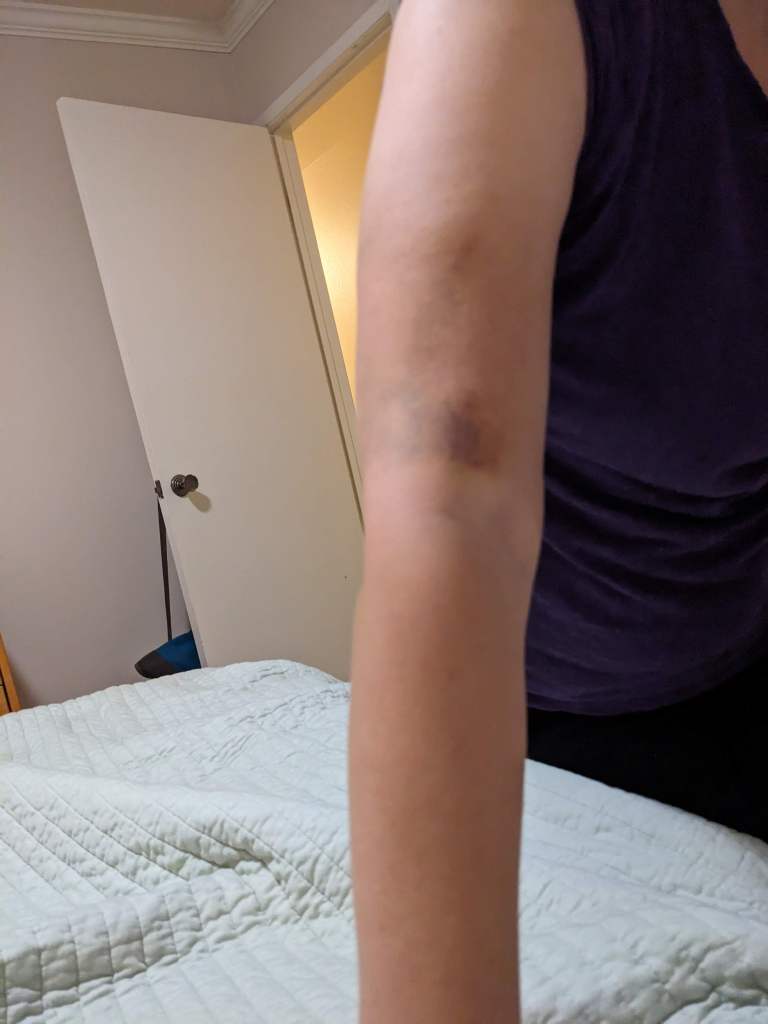
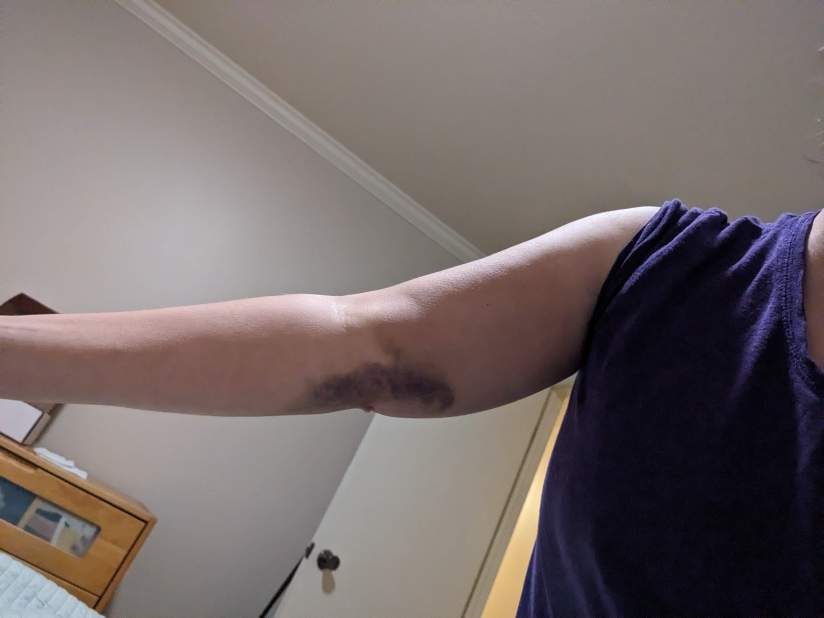
On November 2nd, I had my follow-up appointment for my shoulder, just over four weeks after the fall. My bruises were still pretty visible. As I turned my arm to show the way the bruises had settled into my inner elbow and continued to drain into my forearm, the doctor was impressed with my range of motion. He said I was doing really well and assured me that the pain I was still feeling into my collarbone and shoulder blade, as well as my arm, was normal, and that I could expect to be in pain for another four or five weeks. He gave me a referral to physical therapy and sent me on my way. Good job, me, for healing well! Nice to have a fully positive appointment for a change.

Today, as I finally, finally finish this post, it is six weeks past my injury. Bones take six weeks to heal. The pain is slowly, slowly lessening. I’m still using ice packs at some point almost every day. The pain feels similar to the deep ache and lack of ability to move the arm after a vaccine, just more and constant, with sharp spikes when I do too much. The only good thing about new, acute pain is that it eclipses all the old, chronic pain, so that it’s barely part of my consciousness most of the time. 

As for the rest of things, I was able to return to my right-handed bathroom routine at around two-and-a-half weeks. I still do not use the shower, preferring the safety, relaxation, and two-free-hands-ness of sitting in the bath, which my husband has to help me into and out of. Typing with both hands came back after a couple weeks, I think. I haven’t used my trekking poles at all (which means I have barely walked outside), because that’s a very shoulder-intense activity. I very much want to sleep on my right side again, but cannot yet do so. My relationship with my kitchen, and my kitchen floor, is slowly returning to its pre-fall state, with pre-fall levels of caution and care, plus cat location awareness. I load and empty the dishwasher, I chop and stir, I fill my own water glass. But I very much prefer to sit still.

These past six weeks have been the most sedentary of my adult life, and filled with lots of dark chocolate and vegan ice cream. And I am absolutely okay with that. 

What I’m struggling with now is the same thing I struggled with when I was doing to The Gupta Program: How do I convince my nervous system that I’m safe and can get out of fight/flight/freeze mode and into the parasympathetic state when the physical obstacles and dangers I face are very real? (See my post Safety Dance for more on this.) One of the main ideas of The Gupta Program is to tell your worried part that you are safe, that “Whatever happens, I will handle it.” You’re not trying to convince yourself that everything will always go well, but that it’s okay when it doesn’t. I would try telling myself “Whatever happens, I will handle it,” and invariably, an image of myself falling outside, away from anything I could pull myself up on, would come into my mind. An image of myself getting hurt. And I would say, “When I fall, I will handle it.” (Not if, when.) “Even if I get hurt, I will be okay. My body knows how to heal.” That’s a big one in Gupta, the body healing, because the nervous system is sensing all this danger, sending all these signals like “I’m sick, I’m hurt, I’m not okay.” You’re supposed to remind yourself that your body can heal, is healing at this very moment. And so it happened. I fell, and I got hurt for real. I am healing. I don’t know how long the pain will linger, but I’m trying to stay positive and believe that my nervous system won’t turn it into something chronic even after the injury has healed, a pain loop in the brain. I want to achieve full recovery, and get back to where I was before, which was enough of a challenge to navigate in itself. The dangers are real, the pain is real, but I can handle it, right? 

Right.  

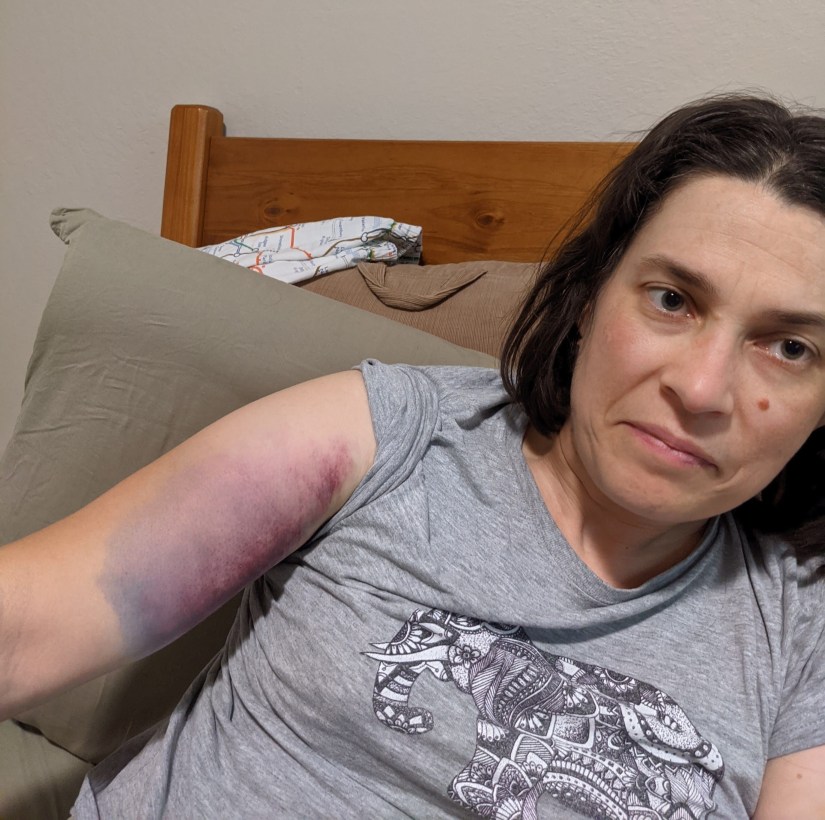
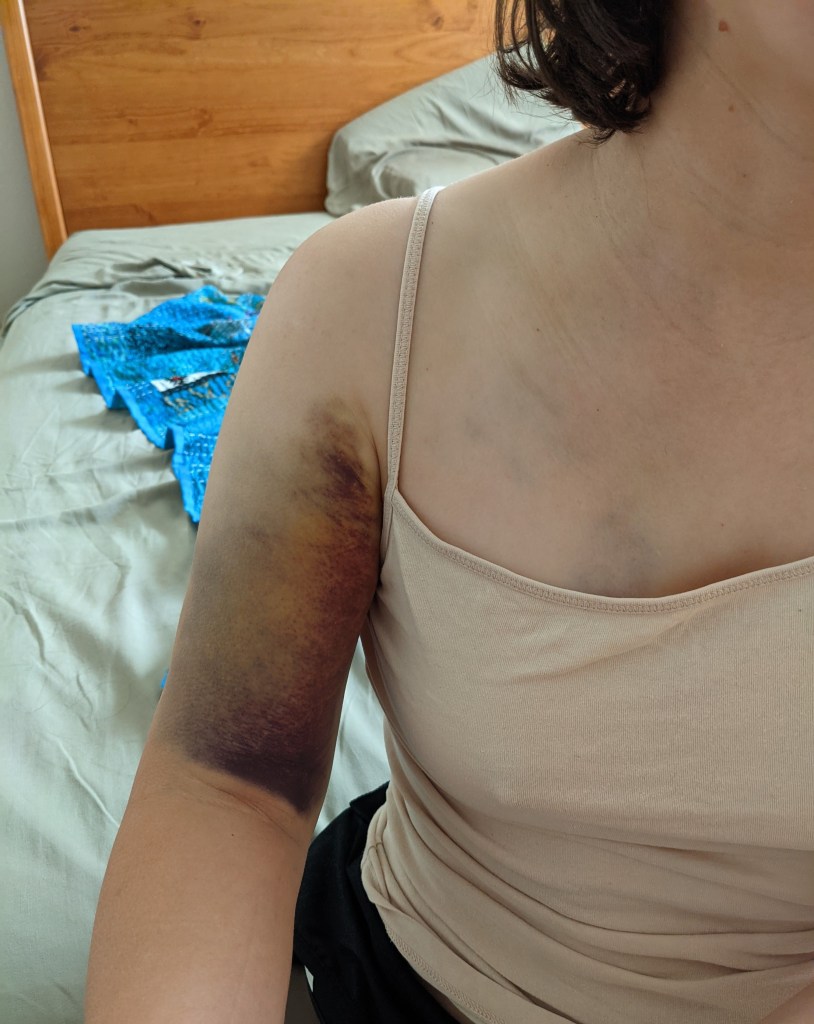
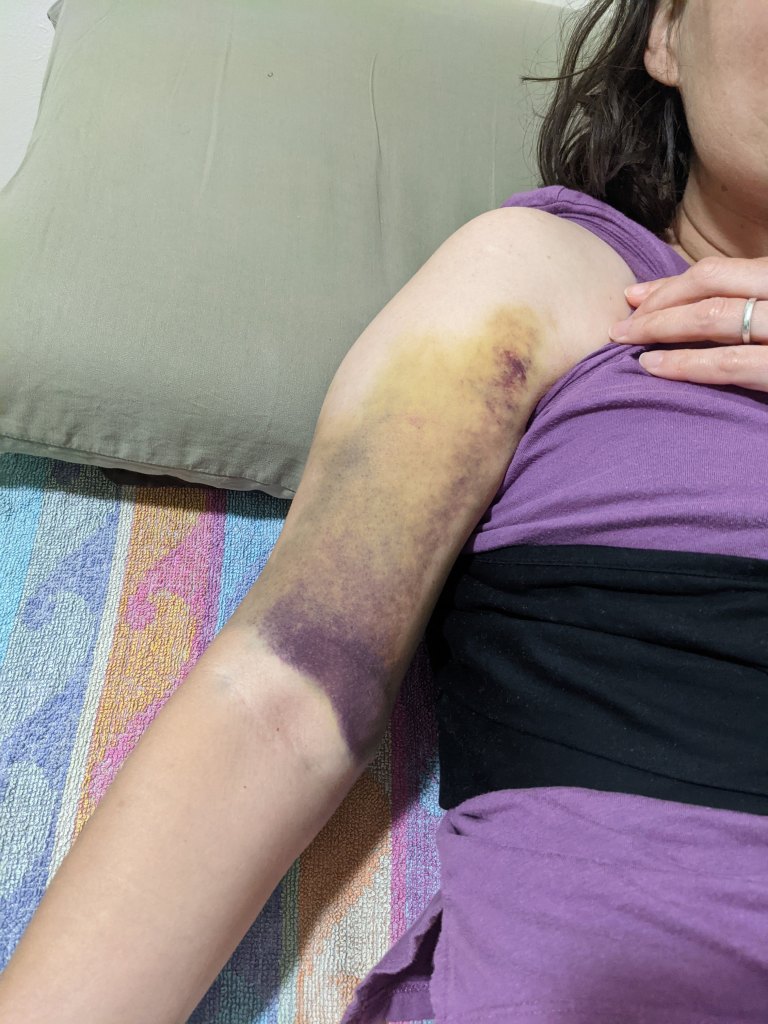
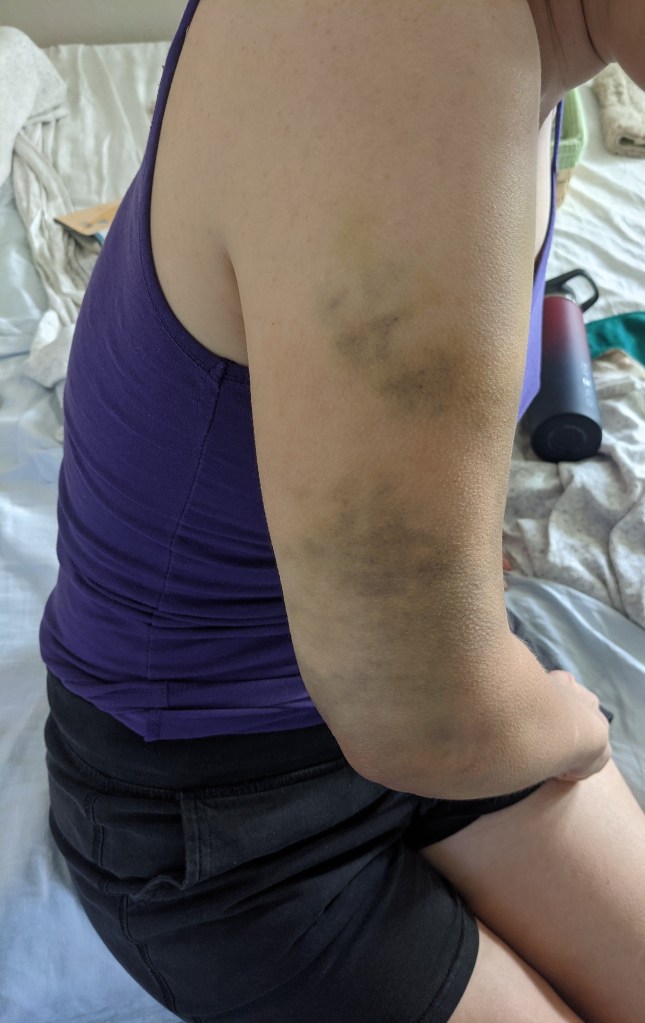
*Photos ahead* I find bruises fascinating because they can look so gruesome and then fade to nothing. I asked my husband to take lots of pictures. These are by far the worst bruises I’ve ever sustained. Please scroll on to the plethora of cat pictures if you’re not also fascinated by bruises like I am.

Day 2. Bruising starts to appear. Never mind how I look. Look at those colors! You will see that I love purple.
Day 5. Some collar bone and chest bruising appear too.
Day 10
Day 12 . Outside view.
Day 17. Inside view. Everything’s moving down and inward.
Day 28. Outside fading nicely. Sorry for the blurry focus.
Day 28. Still pretty purple on the inside.
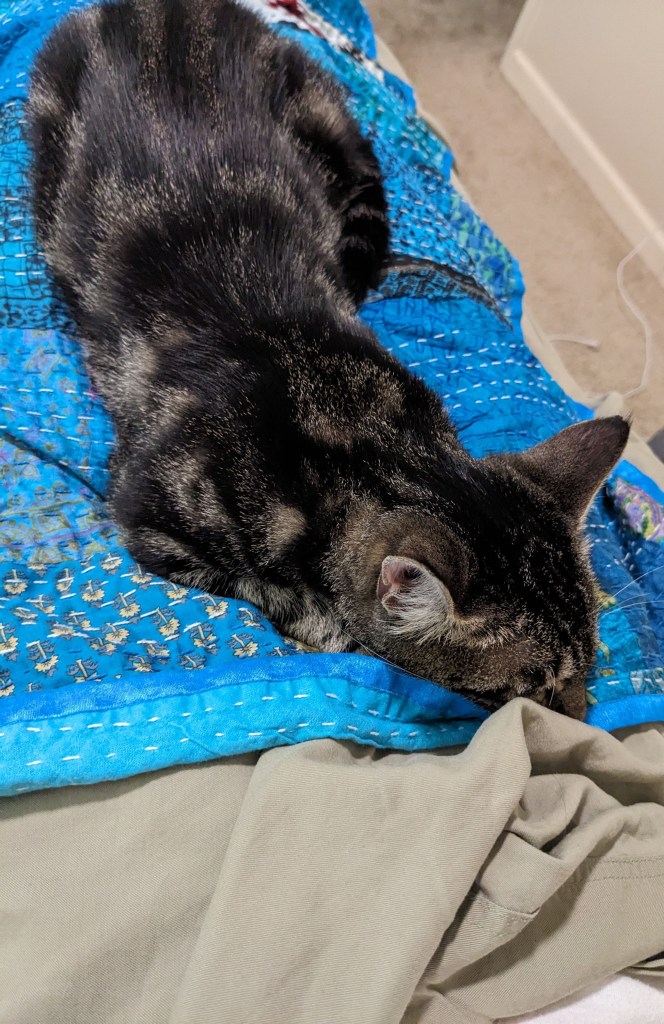
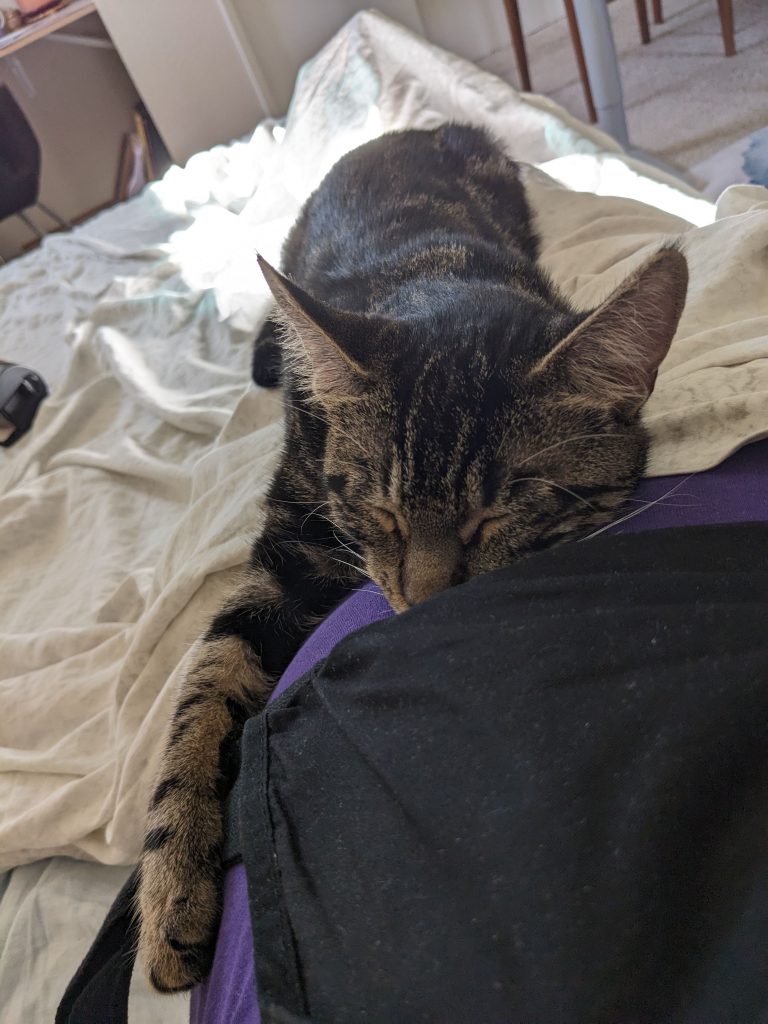
Maddie entered our lives on 30 September 2023, age estimated at 1 year and 3 months.
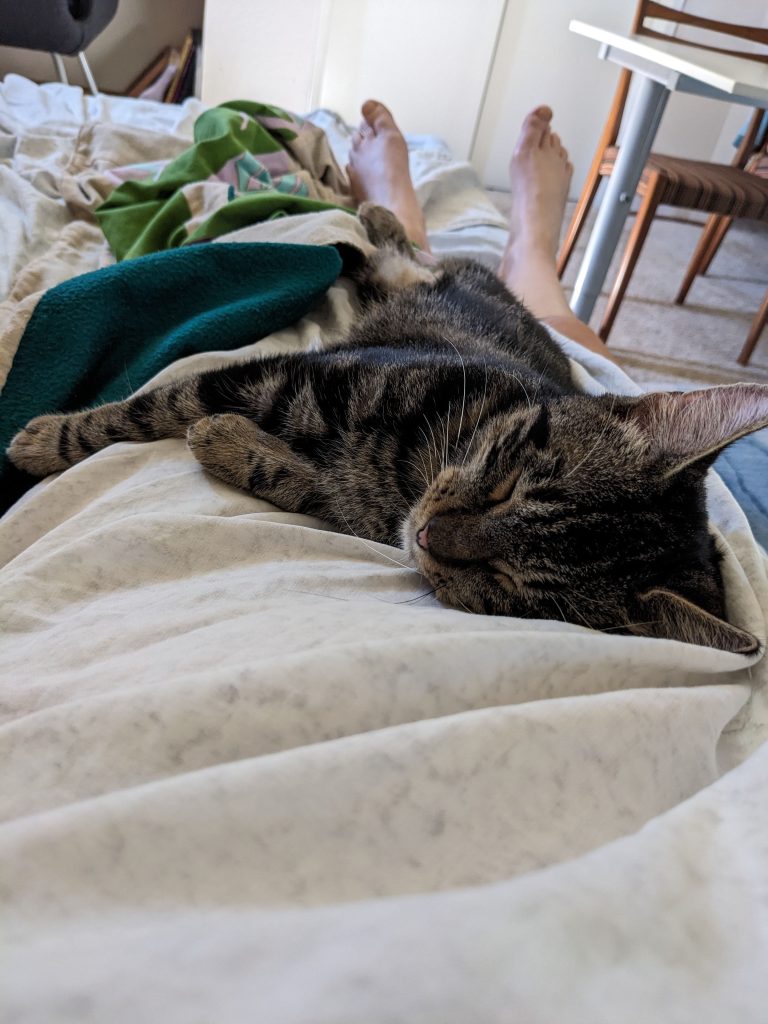
She became an “I’ll lie down on you when you lie down” cat on 3 October when I climbed back into bed with a fractured shoulder. It’s hard to tell, but she’s on my outstretched legs.
I moved into the guest room and this became my view.
You can see my tutoring table on the right and my built-in work desk on the left! Maddie in the middle.
Paw on sling.
The weather finally cooled down and we’re sharing my weighted blanket.
Wanting me to leave my desk and play with her favorite shoelace. She carries it around the house in her mouth.

*The title of this post is a nod to the lyrics of the 1994 song “Waterfalls” by TLC.

Danielle Gets a Brain MRI: Brain MRI with Cerebral Palsy

On the night of April 11th, I had my dreaded brain MRI. The day before, I woke up with a stomach already tense. On the day of, I tried to keep busy and also stay calm. We are having exceptionally beautiful, truly spring-like weather, so I reclined in a lounge chair outside and did a meditation, a yoga nidra, and a tapping session consecutively. 

Yoga nidra is relatively new to me. It’s like a compassionate body scan, which I love, but it includes having an intention in mind and is a little more in-depth. You listen to a calming voice telling you to notice the tip of your tongue, your teeth and gums, the inside of your right cheek, the inside of your left cheek…. All through the body, each toe and finger. Then hemispheres of the body and brain. It’s interesting and takes a lot of focus and concentration. Which is exactly the point, to be grounded in the present moment and in your body. I really recommend trying it; there are lots online, and they vary in length. Here’s one I like.

As the afternoon slid closer and closer to evening, I kept imagining going into the MRI machine with the coil over my face. I didn’t know how close it would be to my face, or how close the coil would be to touching the inside walls of the machine, and I was very anxious. I didn’t feel stomach-twisty nervous, but very quiet and subdued. I didn’t know if all my nervous-system-calming prep work had helped at all. 

When I’d gotten my c-spine MRI last month, the tech told me that I should use “the mobile unit” for the brain, because it’s newer and has more “bells and whistles.” I did indeed get scheduled for the mobile unit. I hoped that the bells and whistles included headphones with which I could choose music to listen to.

Walking into a nearly empty hospital at 7:30pm is weird. But nicer than walking into a crowded hospital. We got to the room to check in, and a sign outside instructed us to go downstairs. Did that. Then the nurse (?) came and took us back upstairs, through the first darkened room, past the sign outside it, and down the length of the entire hallway. There my husband sat while I was escorted through some doors and then through doors to the outside, where, in a parking lot two “mobile” MRI units sat. They had some very solid ramps leading up to them, and I assume they are no longer mobile. They are big metal boxes that remind me of blood donation vans, but way bigger.

In a room the size of a small shower stall, I had to get undressed (except socks and underwear) and put on paper shorts and a gown. The chair took up 85% of the space, and when I lifted one leg onto the other knee to remove shoes and pants, there was no longer any room to complete the maneuver. Fun.

Too soon, I was led past the tech area and into the room with the machine. This one was close enough to the floor that I could sit on the bed part/get myself onto it without needing a stepstool to be brought over. I explained that I have cerebral palsy and have very strong reflexes in response to loud noises. Weight on my legs helps. They didn’t have additional weight in the form of blankets. The nurse put the bolster under my calves, and the tech guy strapped my legs down. A little too tightly. Once he loosened it a bit, I figured it wasn’t as comfortable as a weighted blanket–type sensation, but that it would help overall. Earplugs in. Then he put cushioned blocks on either side of my head to hold it in place. And without a word, he placed the coil next. 

The coil was over my face, the emergency squeeze ball was in my hand, and I was heading into the tube. As far as I could tell from my vantage point, the face coil was similar to the one below, but without the little screen attached over it. 

I was so relieved not to feel panic welling up within. The coil was a manageable distance from my face. With gentle pressure on both sides of my head, and a warm blanket over me, moving into the tube I felt almost…cozy? If it hadn’t been for the upcoming prolonged and unpredictable loud noises, I would have felt just fine in there. Because of the nearness of the single bar up the middle of the coil, I had to close one eye or the other to have an unobstructed view of the inside of the machine, so this time, I felt calmer keeping my eyes closed. (In my previous experiences, when I closed my eyes, my mind raced more and I felt closer to panic.)

Just like getting through last month’s cervical spine MRI, I won’t say this experience was easy. But it was easier than last time and the time before that. I was surprised to be able to think, “I’m doing this and I am okay.” The noise was still too much, and felt neverending, and I did still have images of myself breaking free of the enforced stillness and getting out, but though my mind had those thoughts and impulses, I was able to resist them and breathe through it.

The cushioned blocks holding my head still really helped me feel more secure and calm, rather than restrained as one might imagine. I was able to relax into them rather than holding myself rigid as I would without them. If I ever have to have another MRI, no matter the body part, I think I will ask for them, if they can be used without the face coil. Maybe I should try sleeping with something like that. I’m not able to sleep on my back because I feel like I have to hold my head up, but switching sides throughout the night means I wake up each time.

I came out for the contrast injection, not allowed to move at all, and then went back in for three more pictures, about ten minutes. I only heard one break in the barrage of sound, so I thought I had one more picture to go when instead, the tech appeared in my peripheral vision and I was set free. I had survived. 

When I made it back into the building, I told my husband with surprise, a lot of relief, and a little pride, “That was my best one.” 

The next day, I felt happy. I had a bit more energy than usual, and I just felt better. Happy. All the pain was absolutely still there: throat, forearms, hip, back, neck and shoulders, but I had a bit of energy anyway. I was happy anyway. I was looking forward to taking a walk rather than positively forcing myself to go because I know I should. 

I thought, well if I could feel like this every day, then I could totally “accept and surrender” and live with the pain and still feel like I was living rather than existing. That’s what The Gupta Program’s goal is–if you can make it to that state, where your nervous system is feeling safe and good, then maybe it’ll stop sending all these unnecessary danger/pain signals. I don’t know what the change was, and it only lasted for that day. Was it the sheer relief of making it through that dreaded MRI? Did I manage to get my brain a boost of the feel-good chemicals? Maybe that boost is where my brain is supposed to be at, and I need to correct a chemical imbalance… It’s not the first time I’ve had that thought. I had a similar (but even more extreme) experience several years ago, where, for one day, I was a better version of myself. My brain felt clearer. I was happy. When I worked with a group of rowdy students, I was patient without having to make myself respond in a patient way. I realized with atonishment that the kid who usually tried my patience was not having a particularly good day; it was I who was having a good day. I understood that people who were able to be upbeat and energetic in the face of a classroom full of kids must feel like this most days. They operate at a higher level of aliveness that I have only glimpsed. 

So–what’s going on in my brain? Have I got lesions or whatever else the neurologist was looking for? Here are the results:

FINDINGS: 

Brain: No evidence of hemorrhage, mass, shift, or extra axial fluid collection. No restricted diffusion. The ventricles are normal in size and morphology. A focus of abnormal T2/FLAIR signal hyperintensity in the right periventricular white matter, with differential remote sequelae of periventricular leukomalacia, migraines, posttraumatic, or less likely inflammatory causes. Flow voids at the skull base are preserved. There is no abnormal enhancement. 

Bones and soft tissues: There is a reniform-shaped T2 hyperintense lesion located immediately posterior to the left parotid gland, measuring up to 8 mm and demonstrating restricted diffusion and enhancement, likely a benign lymph node.

The note from the doctor says the “small white matter lesion in right brain” is unlikely to cause my symptoms. It’s a nonspecific finding that could be “related to headache, prior injury, et al.” Dr. X does not mention anything about the thing that is “likely a benign lymph node.” (Looked it up and the parotid gland is a salivary gland just in front of the ear.) Dr. X seems unconcerned and I was asked to schedule a follow up, which is not available until September.

So, again, I am left with, well, you’ve got hyperreflexia that suggests things that we have now ruled out, as far as spinal compression or brain lesions. Okay then. No one’s saying it could be a CP thing that I just wasn’t aware of until now. (These are upper body reflexes, and officially my CP affects my lower body.) 

I’ve been through so many information-gathering appointments, without any revelations to show for it.

Such is life.

Danielle Visits Physical Medicine & Rehabilitation (PMR)

On April 4th, I had my first ever PMR appointment. Quick recap: Once upon a time, I made an appointment for myself at the adult clinic at UCLA Center for Cerebral Palsy, just to see what it was like, and if they had a more knowledgeable perspective than my primary care doctor. The CP clinic referred me to UC Davis sports medicine. Sports medicine doc tried a couple injections and when those did nothing referred me to pain management. Pain management tried a couple medications, and when those did nothing, referred me to PMR. I’m not angry or surprised by any of this (mostly); I’m just pursuing various care options as an adult with CP who is experiencing (expected but not able to be fully understood until it happens to you) decline in function and increase in pain.

The excellent thing about the PMR appointment was that the experienced doctor, Dr. S, came in with the intern/fellow/resident/whoever the young doc, Dr. W, was and the medical student, rather than the young’uns doing everything and then reporting to Dr. S outside the room before they all came back to me. It’s much better having the experienced one there from the get-go. It feels more productive having them all there teaching/learning/discussing in the room. It also just feels better to the patient when there’s a team of people who are trying to help you and taking you seriously and playing detective. They asked about my celiac disease and my throat pain and my arm pain in addition to CP stuff because they were trying to rule out other causes of my fatigue and pain. They could see the EMGs, neurologist notes, etc. 

When they transitioned to the CP side of things, they watched me walk up and down the hallway with and without poles. Most doctors don’t do this, and I think it’s weird. If a sitting-down patient tells you they have CP and various chronic pains, don’t you think you should ask that patient to walk more than zero to four steps? I felt it was a thorough appointment, that young Dr. W was on top of things as far as actually looking into my history, and that the medical student probably learned a lot. Dr. S said that the labral tear/impingement probably isn’t causing my pain, and that my hip issues on the right are most likely coming from the iliopsoas lengthening procedure done in 1989: “​​The pain could be due to the prior history of iliopsoas release as they have to cut part of the tendon to elongate it. So the pain could be coming from the tendon or myotendinous junction. The restricted range of motion in the hips with tonic tension on that structure when standing could be increasing the pain. Unfortunately, there is not a whole lot that can be done if that is the source of hip pain.”

As far as the pain and arthritis in my lumbar spine, my pelvis is tilted in a way that accentuates the lumbar curve, adding more pressure there, and my gait has always exacerbated the area. The doctors were rather taken aback by the pain management doctor’s offered options of a baclofen pump and nerve ablation (which I had already decided against). Dr. S’s opinion is that if the tizanidine (muscle relaxant) did nothing, then medicating for spasticity (baclofen) isn’t going to help me. For doctors who understand the range of CP, my spasticity is not extreme, and relaxants would only increase my fatigue. I could pursue an injection in my back. (Young Dr. W cut in with this, and Dr. S didn’t disagree.) The overall suggestion Dr. S had for my back was to “modify activity,” meaning “do things in a way that hurts less.” I probably could have come away with a physical therapy referral, but talked about how much PT I’ve already had and what I’d been assigned in my home programs. Water therapy is a popular idea, since being on land hurts, but it’s not readily available around here. 

I asked Dr. S how to work on my tight hip flexors in a way that doesn’t aggravate the rest of what’s going on in my hip. He said, “If it hurts, don’t do it.” I felt relief and validation then. The tough truth is, I’m in the least amount of pain when I am least active. When I move my body, the hip and the back flare up because the way I move hurts those places. Of course I know that exercise is the best way to keep my body and my heart and my brain healthy, so I’m not going to become completely sedentary. It’s just good to hear that, yes, these exercises that have been given to over and over may be causing damage and that, yes, it really is sometimes damn near impossible to exercise one area without hurting another. 

When the pop in my hip led to a labral tear/hip impingement diagnosis, and more pain, I held to this idea that this new condition, and new pain, could be helped. But these doctors have said that my pain isn’t coming from the tear and impingement. When I leaned over a bit sideways to pick up something off the floor and hurt my back more than I ever had, I held to this idea that this new condition, and new pain, could be helped. But these doctors have said that I have facet arthropathy and age-related degeneration, and that the pain isn’t from an acute injury. I don’t know why my body hasn’t returned to its prior state, the way it was before these identifiable incidents. It’s like the new pains alerted my brain to these areas in a new way, and I haven’t been able to calm down my hypersensitive nervous system to the previous levels of pain. If true, this is something I could use The Gupta Program for. I have fallen off the Gupta wagon, however–except for meditation–and it’s exhausting to think about getting back to it when seven months of trying did not help my pain. (It’s “a six month program,” and some people use it for several years before they start feeling better. I imagine the ones that try it for years and don’t feel better aren’t writing about it in the online group forum.)   

At least I can accept now that this hip and back pain is here to stay and that it’s up to me to manage it the best I can. Acceptance and surrender, right? Just like Gupta says. Except that complete acceptance remains elusive. I still feel that it would be nice if OTC medication, heat, ice, etc. actually helped. I just want a little help. Sometimes I feel that if I could have a minute or two of true relief, it would help me be able to handle it the rest of the time.     

When I returned home from my PMR appointment, I signed in to a free UC Davis Health webinar on “pain and wellness.” Because why not?

As I watched this webinar and listened to an expert promote the benefits of (get ready to be shocked!) meditation, healthy diet, and regular exercise…I just felt so exhausted. He is talking to people who, most likely, were once able-bodied. The amount of activity that’s advised–cardio, strength training– I’m just so tired. I already understand the benefits of exercise and vegetables. Everyone does, but that doesn’t mean we follow through. Studies show meditation is an effective method for pain relief. I know this. It’s just not simple and straightforward. It’s not as if I meditate and feel better, end of story.

Healthy diet, exercise, meditation. I DID DO these things, to the extent of my ability, for years. I walked, I did adapted yoga and pilates. I handcycled and did seated arm-workouts. I tried. I meditate. And my body has continued, step by step, part by part, to decline.

As I watched the webinar, I felt like the doctors were not talking to me, but only to the once-able-bodied audience, who have the potential to return to that state. Most of me feels that I am stuck here and that it’s just going to get worse. And that’s not a great headspace to be in. As Gupta says, “The mind believes what you think about your body and carries it out as instructions.” This is why we are supposed to interrupt negative thoughts and replace them with a hug for our worried part, basically. 

I don’t know how to apply what I know and what I’ve learned to my own life, other than all the ways I’ve already tried. And I know that I’m not so special that nothing will work; I’m not so far outside of regular human experience. I can still apply The Gupta Program to myself, and mindfulness meditation should still be able to me too. I am just tired of trying. And I’m tired of trying to accept and surrender. I am tired of “discomfort.” (One of the ways to help chronic pain is to “reframe” it. And while I mock this, I also understand that it can work.)

One of the ways I am struggling is that it isn’t just cerebral palsy that I’m dealing with. I do think I can succeed at acceptance and surrender there, and live a good life with the ever-present “discomfort.” It’s the other parts, the throat pain and the forearms, the neck and shoulders, the constantness of it all, that is hard for me to understand and to accept. Feeling like you have strep throat every second for years isn’t healthy and normal. I want there to be a reason for it, even if it is my hypersensitive nervous system that I haven’t yet successfully calmed. But no one can tell me for sure, so I am just here, flailing in the dark, tired and struggling. 

I didn’t plan to end on such a low note. But it’s not my job to spin my life into some inspirational lesson learned, now is it? I feel my purpose here is to document my experiences, to not feel alone and to let others know they’re not alone either. So, here I am with my discomfort, reaching out to you and yours.

Getting an MRI with Cerebral Palsy

In my last post, I wrote about my first ever neurologist appointment. Dr. X wanted me to have an MRI of my c-spine, and if that came back normal, of my brain. All because of some suspiciously robust reflexes (hyperreflexia) in my upper body that may signal a herniated disc or spinal compression in my neck. 

I was dreading another head-first-into-the-machine MRI. This would be my second head-first, and my fifth overall. I tried to get medication a couple weeks beforehand. But using the messaging system in the patient portal takes a long time. I asked the neurologist for something to help me get through it, and let her know I was currently taking tizanidine. This is a new pain medication I was trying, a muscle relaxant that was having no effect whatsoever. She wrote back that I should just take that and it should help. I wrote back that in fact I had just spoken to pain management and they told me to stop taking it since it wasn’t helping. She wrote back and said that she couldn’t prescribe medication to me and that I should ask my primary care doctor for one dose of ativan. I did. All of this took days, the back and forth. Because of course it’s not actually the doctor reading or writing the messages, but a nurse or some other go-between. By the time I wrote to my primary care doctor, I think it was the Thursday before my Tuesday MRI, and I had little hope of getting the medication. Yes, I probably could have called the office and sped things up. I did not.

My MRI was at 6:45pm. I liked that the hospital was nearly empty. I did not like that I had to get undressed and put on two gowns and put my shoes back on. (By now I know not to wear anything with metal.) I had decided to leave my walking poles in the waiting room with my husband. 

My MRI tech, Jeff, was nice. I told him that I have cerebral palsy, and have very strong reflexes in response to loud noises. My MRIs tend to be “motion degraded.” I asked for help with the earplugs, because I can never get them to stay very well. Jeff obliged and really shoved them in there. I also asked for some extra weight on my legs, and he put a significant amount of weight on my lower legs (folded blankets, I think). I would have about fifteen minutes in the machine, then out for the contrast injection, and then back in again. He told me that it was okay if I needed to move during the quiet parts, and that it was only when the machine was making noises that it was taking a picture. Swallowing was okay, and there was no need to hold my breath. (Depending on the MRI, sometimes this is necessary. Yikes.)

I find that it’s less uncomfortable if I keep my eyes open. When I close my eyes, then my brain really starts revving up. There were two scratches on the smooth white surface above my face, and focusing on them helped me, rather than looking at a plain white expanse. I think doing the Gupta Program helped me stay calmer than my first experience. I breathed and I told myself, “I am absolutely safe. It’s okay to feel anxious.” I was reminding myself that everything was under control and that there really was no danger, while also accepting my feelings. Repeating this steadily to myself helped more than singing a song in my head or doing grounding exercises (focusing on what I could see or feel).

That’s not to say that it was an easy experience. My legs absolutely tensed up with the loud, unpredictable noises. And once they were tense, even with the weight, they didn’t want to relax. I sometimes felt a near panic that I needed to move and couldn’t hold still against the barrage of sound any longer. When I swallowed, sometimes they were giant, anxious swallows. 

Jeff kept me updated: “The next one will be three minutes.” Then, “This one’s longer. About four minutes.” Then, “This is the last one, but it’s a long one. Five minutes.” Have you ever tried to hold absolutely still for five minutes? While horrendously loud, electronic, machine-gunnish sounds assault you? In a small space?

When I was let out for the contrast injection, I still had to hold my head absolutely still. No moving. Then back in. At the end he said, “It was nothing you did, but I’m not satisfied with that last one. If you can tolerate it, I’m going to recalibrate the machine and do that one again.” Okay. The back of my head was hurting, stinging from lying on the same surface for so long.

When it was finally over, Jeff told me to sit up and stay there a moment to get my bearings. I told him that if this MRI came back normal I would have to get a brain one next. I asked if I could see the thing that goes over your face. I thought that if I saw it in person, rather than on an informational video, it wouldn’t seem so horrible. I was wrong. It does seem really, really horrible. I crossed my fingers for this MRI to show something.

It did not. Well, it showed some things, but nothing to explain the symptoms that prompted the neurologist to order it (forearm pain and hyperreflexia). The skeletal system peaks at thirty, so everyone over thirty is going to have something show up in their spine.

Here are my “findings”:

Slightly motion degraded study. [Only “slightly” motion degraded this time. Yay me!]

Alignment: There is normal alignment of the spine.

Vertebral body heights and marrow: Normal.

Spinal Cord:The craniocervical junction is unremarkable. The questionable areas of signal alterations versus artifact scattered through cervical spinal cord probably artifactual. There is no abnormal enhancement within the limits of motion degradation.

Soft tissues: Normal. 

At C2-3: Unremarkable.

At C3-4:Unremarkable.

At C4-5:Mild disc bulge. Uncovertebral joint hypertrophy and facet arthropathy with left mild to moderate foraminal narrowing.

At C5-6:Mild disc bulge. Mild left foraminal narrowing.

At C6-7:Mild disc bulge and thickening of ligamenta flava.

At C7-T1:Unremarkable.

IMPRESSION:

1. Mild degenerative changes of cervical spine with no significant spinal canal or foraminal stenosis.

2. No obvious cord signal abnormality or abnormal enhancement within the limits of motion degraded study.

Look at all the normal, unremarkable stuff going on in my neck. And sure, for a neurologist “mild disc bulge” is no big deal. For me, it confirms a lot. My neck has hurt intermittently since 2008 and every moment of every day since June 2016. I infer that these mild degenerative changes aren’t supposed to be enough to cause the kind of pain and issues I’m having, and that my brain is just being hypersensitive about it all. I’m glad I don’t have a herniated disc or a compressed spinal cord. That’s great.

But it does mean that I’m having a brain MRI with and without contrast next month. No use worrying about it, but that won’t stop me. Time to meditate. 

So How Much Therapy Do I Need?

Content Warning: this post contains descriptions and mentions of animal deaths, the Holocaust/genocide and WWII, and school shootings. Brains are complicated things. Please don’t read about my brain if it will upset yours. 

I have dreams about my childhood home all the time. I lived in that house from the age of four to nineteen (and a half), and then for smaller periods of time in my twenties. 

The house was on five acres, and though we were in no way a true working farm, we had an assortment of cats, dogs, some sheep and chickens, and for a while, turkeys, ducks, and geese. Just for fun. My dad enjoys eating lamb (though he did not slaughter the sheep himself). We always had fresh eggs, and we hatched chicks in an incubator on our kitchen counter in the spring. We had frequent lessons on the circle of life when lambs or chicks didn’t make it, and when coyotes/hawks/raccoons disappeared various animals and perhaps left a trail of feathers behind. Two of my very own kittens disappeared without a trace, and I am still sad about it. Why didn’t we let the cats inside at night, you ask? Because animals live outside, of course. 

Often, my childhood-home dreams involve wildfire and needing to evacuate, or some other kind of disaster or intrusion that seems perfectly normal in dreamworld. Almost without fail, there are small children or animals who need help. 

In last night’s dream, I was showing an incubator full of fluffy chicks to a girl about five years old. But upon a closer look, there were a couple birds in there that didn’t belong. A skinny little black thing whose feathers reminded me of a shrimp, and some other kind of songbird. I wondered how we’d get the wild birds out of the incubator without them flying around the house. I got a cardboard box ready, and when Dad opened the incubator, I pointed out the skinny one that was definitely not a baby chicken. He was able to pick it up, and I noticed it now had blue painter’s tape wrapped around its body. I asked Dad if he wanted help removing the tape and followed him to the front door. I stood in the open doorway while he leaned over the porch railing, and though his body blocked my view, I could see feathers falling. I realized way more feathers were dropping than if I had helped, and that the bird was probably now very hurt. My mouth opened in a silent cry, and I made sure the girl inside couldn’t see. My grief felt overwhelming, and I woke up.

I have realized in my adulthood that there were small-T traumas in my growing up with all those animals, experiences I had that stayed with me. Experiences that are not the norm for kids who didn’t grow up in the country. My siblings also had these experiences, but don’t seem to be affected the same way I was. 

My dad is a doctor and an anatomist, and as both a scientist and a man of religious faith, perhaps he has a different view of life, death, and suffering than I have.

He wanted us to see and learn and experience all that the natural world has to teach us. He delighted in using the chicken bones on his dinner plate to illustrate the way joints moved. He invited us to watch him slaughter the Thanksgiving turkey so that we could see the way the body moved even after the head was cut off. I watched him snap the neck of a tiny chick who was not going to make it. And perhaps most gruesome, one night he called us out onto the porch to show us something. There, by our front door, lay a deceased lamb whose whole underside had been eaten, probably by a coyote. He wanted us to see the way the predator ate the warm insides and left the rest of the body intact. “On the porch?” I asked, confused and staring. He chuckled and said, no, that he’d brought the body up to the house. My dad does not remember this, but I can’t seem to forget it.

I have snapshot memories of these three events: the dancing turkey, the dying chick, and the dead, eviscerated lamb. I have come to the conclusion that it was not appropriate for me to see these things. I’m not sure that it would even cross my parents’ minds to shield me from these parts of country life. Maybe they warned me and asked me if I wanted to see, and because my older siblings did, I did too. Maybe there was no warning. I don’t remember. I’m sure many young children could experience these events and not have any lasting negative effects. All three of my siblings grew up to earn master’s degrees in something sciencey. One even became a doctor like my dad. I majored in English and history.

I remember the moment that my kid-brain integrated the information that the Holocaust and the US dropping atomic bombs on Japan happened in the same war. I was in the car with my mom. Apparently, we were talking about World War II. I felt it like a gut punch. How could these horrifying events happen one right after the other? How could groups of people commit these atrocities against other groups of people intentionally? It was probably that moment that turned me into a history major.

There were two classes dedicated solely to the Holocaust at my university, and I took both of them. On the first day of the first class, we discussed the meaning of the word “genocide.” The term was coined in 1944 by Polish lawyer Raphäel Lemkin and genocide was recognized as a crime under international law in 1946. Lemkin created the term in response to Nazi policies, but also as a way to define previous targeted actions against other groups of people. I knew about the Rwandan genocide against the Tutsi in the 1990s, but I’d had no idea there had been so many others. We in the United States, for example, have a hard time recognizing the genocide of the Native Americans. I never heard it talked about in school using those terms, though books that call it what it is have been around since at least the 1990s. I have several memories of my Holocaust classes as well. One is of an old man coming slowly down the steps of the lecture hall to take a seat near the front. My professor introduced him to the class as a Holocaust survivor who came to sit in on the class whenever he liked. The other memory is of the professor reading aloud the poem “Death Fugue,” by Paul Celan. I still feel compelled, twenty years later, to read Holocaust memoirs and stories set during the second world war. 

I know there are so many more historical events that, if I knew about them, I would feel a compulsion to learn more, to keep reading, horrified. It’s like I have to keep looking, keep learning. If we look away, if we ignore it, we forget. We forget what we’ve done and what we’re capable of. And we can’t do that, because we have to change.

I was watching a documentary (yes, it was about indigenous genocide), and the narrator mentioned a good friend who died in a plane crash, whom he still misses. That the maker of this film mentioned his friend struck me, and I looked her up. The wikipedia article about the commuter flight she was on included a video simulation of the crash, that stopped a second before the plane hit the ground. I read the article through and clicked on the simulation. And then I clicked it again. And again. And I imagined the people on board, and the mistakes the pilot made. And now it’s a tragedy I carry, in my catalog of tragedies. 

In 2018, when a young man in terrible need of help went to Marjory Stoneman Douglas High School and killed seventeen people, I felt compelled to read about every other school shooting I’ve been alive for. I worked at a school then, and yes, we helped the first graders and kindergarteners when we held shelter-in-place drills. I developed shingles after that shooting, and the doctor who diagnosed me at urgent care chuckled, said I needed to work on my stress, and left the room. In May 2022, when another young man in great need killed twenty-one people at an elementary school in Texas, I again felt compelled to read about all the school shootings. But this time, I did not. It doesn’t help you, I told myself. It doesn’t change anything. I’m trying not to dive head first into every horrible thing that happens anymore. I try not to read the news, because we only publish horrible things. 

Almost every day since I started The Gupta Program last July, I do a “Soften and Flow” meditation, often twice a day. During this meditation, I’m supposed to focus on an area of tension. That tension is trapped energy or “trapped emotion” that needs to soften, and flow through the body instead of being stuck. The idea that I have emotion trapped in my jaw and neck and shoulders simultaneously sounds incredibly hokey and makes perfect sense to me. 

Recently, during my Soften and Flow meditation, I lay there, and I told my tension to soften and flow; I told my body it was okay to let go. I told myself that I could let go. I could let those childhood memories that bothered me go and keep all the good ones; I could let my childhood house go because we don’t live there anymore. And I told myself I could let the Holocaust go. It’s over. It’s long over, and I can’t change it. All that gut-wrenching, world-altering tragedy has happened; we will feel the effects of it forever. And I’m allowed to let it go. I don’t have to carry it. It doesn’t help me to carry it and it doesn’t help the victims for me to carry it. These are lovely, new ideas to my subconscious, and she doesn’t quite believe me yet, but I’m working on it.

When I was in seventh grade, a teacher informed me and my best friend that we didn’t have to save the world. I think that’s still the crux of what I’m struggling with. How can I live my life and be happy when there’s so much horrible stuff happening and so much to be done? But I cannot be AOC, even though the world needs thousands more like her. 

In fact, I don’t have the energy or ability to be much of any kind of activist right now. But it is okay that I am just myself. I am allowed to experience moments of peace and contentment. I am allowed to feel joyful even while tragedy is happening at this very second. My happiness doesn’t ignore someone’s sorrow or pain. The world will always contain multitudes of simultaneous joy and tragedy. I and my highly sensitive nervous system have to find a way to reconcile that unconscionable truth. I will try to remember that in the face of our current overwhelmingly dire circumstances, our world full of fear and pain, that joy is rebellious action.

Something’s Afoot

November and December have been busy, and in very tiring, healthcare-type ways.

I now have my own gastroenterologist, following the spike in my tTG number earlier this year. To recap, it started out at >250 in 2018 when I was diagnosed with celiac disease. In January 2021, it was 156. The next time I was tested, April 2022?, it was 221. I was shocked, and referred to GI. 

The GI doctor wanted to do another endoscopy, and I really didn’t want to do that. I got the celiac panel done again (September?) and my tTG was 98. Under 100! Hooray. (It’s supposed to be under 15.) We can hold off on another endoscopy. I did get referred to their dietician because the ONLY POSSIBLE ANSWER is that I’m still being exposed to gluten somewhere. I recently had that appointment, and I talked to the dietician for an HOUR. She also took my info to her celiac group and asked for their input. I came away with these three things: double bag anything containing gluten that my husband eats, don’t eat “modified food starch,” as that can be from wheat, and …stop eating certified gluten free oats. Oats have a protein in them similar to gluten that a very small percentage of people with celiac react to. So, I will stop eating oats and get tested again in April 2023. We’ll see if the number comes down. She said that the 221 result must have happened right after I was accidentally exposed to gluten, and then the number came down again. I want the number to be under 15, of course, but I also don’t want to eliminate oats from my diet. If you don’t eat gluten, oats are often used for pancakes, baking, etc. They’re not just a breakfast food. Sigh.

I also had my six-month follow-up with the rheumatologist. He didn’t find any evidence of another autoimmune disease in June, and he didn’t this month either. But because I have a positive ANA and a positive centromere antibody, I get to check in with him every six months in case I develop lupus or scleroderma. He had referred me to a neurologist in June, and that appointment is coming up in February. At least I like this rheumatologist. He is not condescending, and he seems sincere when he wishes me well.

Furthermore, I got up to a 600mg 3x/day dose of gabapentin before deciding to come off of it. It wasn’t doing anything good, and I think I was experiencing a couple side effects (though it’s hard to know for sure). I wanted to come off gabapentin before trying duloxetine (or a gelatin-free alternative?). So, I had a follow-up appointment with the pain management doctor, but he couldn’t tell me much except that I’d have to talk to the compounding pharmacy to see if I could get an animal-free one, or if I could just remove it from the capsule and ingest the contents. My insurance doesn’t cover compounding pharmacies, so I’m wary of the cost. And I still haven’t been given their contact info, so no progress has been made on that front. I was also referred to physical medicine and rehabilitation, who can help me go in another direction (like oral baclofen), months from now, if duloxetine doesn’t end up helping. 

And finally, something else is afoot. My right foot. In August, it had begun to hurt with no known precipitating factor. Except that I spent the summer in bare feet or slippers rather than snug footwear with lots of support. My feet will periodically “give out” or “collapse” and be really painful and then it will go away. Sometimes I can’t put weight on it, but it eventually works itself out. This time, it did not. There was no fracture or sprain. But there was a small, painful bulge that did not go away with cold or elevation. Hmm. I now wear “inside shoes” in the house, and I don’t like it, but I need to. 

I was referred to an orthopedist. He did not know what the bulge was, and I was sent away with a lace up ankle brace, a PT referral, and a follow up appointment. Sometimes I could walk on it without much pain at all, and sometimes it was extremely painful and I could bear no weight at all. PT did not help much. I went to my follow up appointment with a new tactic. This time, I drew a map of the pain on my foot and ankle. You can see the swollen part–it’s the squiggle rather than the straight lines. Just below all the blue on the side is the scar/indentation from my 1992 calcaneal neck osteotomy with lengthening. This area has for years periodically produced a sharp pain, and I’ve wondered about the integrity of the bones following the procedure.

Sorry if feet gross you out; pictures coming:

The doctor didn’t blink at the marker on my foot, nor did it seem to elucidate anything for him. I felt frustrated going to a follow up when nothing had changed or improved. He suggested that the next step would be an articulated (hinged) AFO. That’s a little funny, but fine with me, if it will actually help. Funny in that I had lots of different AFOs as a kid, and then tried to use two ExoSyms with knee sections as an adult. And now we’re here. 

I wanted to know why I have a seemingly permanent bulge on my foot, and I wanted this doctor to be able to tell me what it was. As in, my foot felt fine, and now it doesn’t and I actually have something visibly different/wrong. Help, please? He said he could order an MRI if I wanted. 

I had an MRI (My fourth now, but at least the top half of my body was out and the ceiling was pretty.) I went to see the orthopedist for the third time to discuss the results. He had me take off my shoe and point to where it hurt, again. I wanted to bring up the marker picture and show it to him, again. 

“It’s the swollen area,” I said, pointing to but not touching the bulge.

“Here?” he asked, touching a bony protrusion that’s been there for years and is not the new mysteriously swollen area that I’ve seen him for twice already.

When I touched the correct spot he said sometimes people get fat deposits, “though you have a pretty thin foot.” Yeah, it’s not a fat deposit. I wouldn’t think those would be painful to the touch and render you unable to bear weight. 

I know he’s got loads of patients and he’s doing his job and he’s trying to figure it out and be thorough. But I am still frustrated by the whole thing. The MRI didn’t seem to help him with anything. Well, it ruled some things out. It showed I do have arthritis. In case anyone is keeping track, I have arthritis everywhere we’ve looked so far: lumbar spine, hip, foot. So the prediction of arthritis by 40 with CP is spot on. It was probably there at 30.

We’re still proceeding with the AFO, just as we would have done without the MRI. I asked him, “Is this just for the right foot?”

He seemed surprised that I’d want anything on my left foot. I explained that usually, whatever happens on the right side of my body happens on the left eventually. And my left side is more affected and usually needs more support than the right. He did ask me to walk like three steps in our first appointment, and he asked me to take off my left shoe and sock and stand right then. “Yeah, that’s pretty flat.” And also, “Wow, your calf is really tight.” Yes, yes it is. Yes, I stretch it. No, that doesn’t do much of anything.

I tried to impress upon him that I do NOT want to wait until I have chronic, horrible pain on the left side too before we do anything for that side. I would like to PREVENT if possible. And I do sometimes feel twinges on that side that I’m trying to just let be whatever they are and not worry. I try to see my future with a walker or a wheelchair and see that future as absolutely okay. Because that may be where I’m headed, sooner than I’m prepared for. Thousands of people use different mobility devices and aids for different situations. I use poles now, and they won’t be enough if this foot thing progresses. So. AFOs coming up next month, at least for my right foot, with possibly some other kind of insert for my left. It would be lovely if they actually helped.

I have continued working with The Gupta Program. I have not had any other spectacular breakthroughs like the one in October. I still love meditating, and I do often have tingles and sensations on my jaw and neck and shoulders. But no big releases and no change in my throat. And I’m really tired. I’m supposed to just have faith that I’m on the right path and let all the fear go. Because “what you resist, persists.” I am supposed to accept and surrender and then my nervous system will calm down. It’s a lovely idea and it makes a lot of sense, but I am struggling with it.

I’m finding a central idea of the whole thing fascinating and quite the tangle. I said before that doing The Gupta Program feels a little like doing therapy on yourself. Because what you’re doing is calming your mind (or attempting to) whenever a worry or fear comes up. 

Probably anyone who’s taken psychology or been to therapy already knows this, but if I ever learned, I don’t remember it. Apparently, humans have the core fear of Separation or Abandonment (from parents or the tribe). This then leads to fear of rejection (being unlovable) and fear of failure (not being good enough)

So, even though I had a pretty darn secure and loving childhood, there’s still this subconscious fear there. I mean, at some point as a kid I heard that long ago sickly babies were just left out in the elements to die. That stuck with me. Then I learned that Hitler first experimented with poison gas on the mentally and physically disabled. That stuck with me, too. And of course, it’s not just literal abandonment; it’s fear of failure. That, I totally get–I was absolutely afraid of making mistakes and doing something “wrong” as a kid, and that perfectionism has stuck with me. 

My question is this: if it’s part of the human condition to have these deep, unconscious fears, even if we haven’t been abandoned or abused by a caregiver, then how are we supposed to truly convince our subconscious to let them go? 

I keep telling my worried inner self that I’m safe (I can do that without lots of mental gymnastics now), that I’m loved, and that I’m good enough just the way I am (just like Mister Rogers said). But I don’t think my inner self believes me yet. I mean, consciously, I know those things. Apparently, though, I haven’t convinced my nervous system. It makes me really sad, actually, to look around and imagine each one of us carrying around these fears and worries. Being human is such a struggle. 

May 2023 be a better year for all of us. May it be full of moments of peace and contentment, love and joy.

Wonder of Wonders

After I posted my last blog, I couldn’t stop thinking about my realization that my tight muscles in my upper body aren’t trying to hurt me but help me. I went to bed at 10:00 pm that night and lay there talking to my muscles in my mind, just as I had done earlier in the day during my Soften and Flow meditation.

I told my muscles that it is okay to let go and I thanked them for helping me. I used language from the Soften and Flow meditation and from the brain retraining exercises to let the muscles know that I am safe now and that it’s okay to relax. Similar to my experience in meditation, I began to feel tingling in my jaw. I put focus on my jaw, my neck, my throat, my forearms. Each area began to feel different. My forearms tingled and ached deeply. Other parts of my body softened and tingled as well, not only the front of my hips as before, but also new places like my calves and my feet. Muscles were doing all sorts of things I’d never felt before. 

I was rather surprised but tried to keep up my calming mantra and reassurances and not get ahead of myself. My jaw / TMJ has been tight for years without ceasing. No amount of moist heat or muscle ointments or cannabis has had any effect. Now I could feel all those muscles letting go, up to my eye sockets, up the side of my face to my temple, around the back of my head and my scalp. My shoulders tingled, and my neck. On the right side of my face where my jaw connects to my skull, for years I have felt a bruise-like sensation anytime I accidentally touched it. I’m truly amazed to say that it is no longer there.

I felt shifts in my throat. At some point, I felt loosening in the space between my inner ear and my throat–something actually shifted inside my body. I felt that my hearing was suddenly sharper, then it went dull, and cleared again. I looked up at the ceiling in wonder, perfectly awake at 1:00 am.

When I woke up on October 21st, I found that my forearms and my trapezius had not let go completely. But the ease with which I could open my mouth without any tightness or startling pain in my ear was so lovely. My throat pain wasn’t gone, though it was greatly lessened. I didn’t really care, because I knew now that I could help my body relax, and that’s all that mattered.

I went for a slow, careful walk, as I try to do most mornings. My left calf was so noticeably softened. How delightful the change felt. How amazing to use my poles and feel my step go gently from heel to toe, heel to toe. (Lots and lots of people with spastic diplegia, including me, land toe first or flat-footed.) I felt like laughing. I was full of joy.

I am so unbelievably grateful for this experience. I’m amazed that I get to be one of the brain retrainers who can say that there was an immediate physical change as a result of meditation. A great shift. And I did it, without drugs or procedures, just me and my own brain. 

Has it lasted? Well, not exactly. In fact, I’ve managed, through a new physical activity, to tighten up my neck and shoulders until they’re all more painful than they’ve been in years. The difference is, I have hope now.


But exactly HOW did I manage to achieve this wonderful change? How the heck did I stay awake until 1am when I usually go right to sleep during a twenty minute meditation? What was it I said? How did I say it? Can I do it again? We shall see.

Soften and Flow

In my Safety Dance post, I wrote about using The Gupta Program to calm my hypersensitive amygdala and get back to a parasympathetic state instead of nearly always being in a state of fight/flight/freeze. I wrote about how complicated it feels to use this program while living with cerebral palsy. 

There’s been no magical transformation and I’m still working on it. In this post, I’ll refer to many of the core messages in the program. There are over a dozen lessons, with several recordings to watch in each session, and there’s also a 12-week webinar, which is live. I started the program in July, and the next webinar series began at the end of September, so I’m only four weeks into that, while the recordings are obviously self-paced. All that to say, when I use quotations, I’m quoting Ashok Gupta, either from a video recording, a meditation audio track, or a webinar.

I signed on to the Gupta Program to help with Chronic Inflammatory Response Syndrome brought on by exposure to mold. I’ve always been skeptical of CIRS, as it seems only to exist in functional medicine circles and lacks scientific research. But brain retraining can be used for all sorts of conditions, including chronic pain and anxiety, so I figured it was worth a try, especially since the main CIRS symptom I want to ease is my chronic, sharp, neverending throat pain.

Early on in the program, Ashok says, “You don’t have this condition anymore.” If you’re comfortable, he says, you can let the diagnosis go. Sometimes labels are helpful because they provide validation and reasons for symptoms. But it can also be liberating to let go of the label and stop thinking of yourself as sick. Instead of bearing the burden of a chronic illness, you can reframe and think, “It’s just a loop in the brain!” (See the Safety Dance post linked above for more explanation about this “loop.”) It felt good for me to release the CIRS label and stop thinking about mold. My brain is just being hypersensitive and reactive, and I’m retraining it. Great.

But. Cerebral palsy is not “just a loop in the brain” that I can learn to unloop. At first I was trying to only use the program for my throat, for what I thought was mold-related. I figured I was doing fine with CP stuff; those pains are there and I’m okay with them. 

Then I did something that really flared up my right SI joint and gluteal tendonitis. You know how it happens–you’ve got a chronic issue, but you don’t realize how good it’s been until it’s bad again. Apparently, I’d been dealing with regular glute/groin/hip stuff, but my SI joint had actually been pretty quiet. Until it wasn’t. Wow, did it hurt. Oh THERE you are, SI joint pain. I did not miss you at all. In fact, now that you’re back, I’m LOSING MY MIND. It really threw me. (Mostly because I feel I could have/should have avoided it, and I did not.) I was angry and sad and so frustrated, and I did not want to deal with it all over again. I knew it would ease eventually, I just didn’t know how long it would take. And I DID know that, now that it was flared, it was going to be easy to continue to mess with it, just by doing daily tasks. Like moving. I realized that I needed to use the Gupta program for all my symptoms, and stop trying to separate the different conditions. I needed to meditate and calm down because panicking about this new pain spike was definitely not helping.

I keep reminding myself that this program can help with chronic pain. And then I automatically think, “But since I’ll always have cerebral palsy, and it’s my ‘maladaptive’ movement that’s creating the pain, how is this going to help?” Then I remind myself for the hundredth time that “We’re not changing our symptoms; we’re changing our worry about the symptoms.”

The goal is not to treat the pain, but to change the brain’s perception of the body, to train the brain to recognize that, yes we have this sensation, but we are not in danger: “Thank you for sending warning signals, but stand down, I’m okay.” Yes, indeed, I DO and always WILL have chronic pain. And what’s more, it’s going to change and shift throughout the day, and through the months and years. I am experiencing and will continue to experience a decline in function. And that’s OKAY; I will handle it. I have to teach my amygdala that all that is simultaneously true and okay. And that’s not easy. Acceptance of pain is really, really hard, but that’s what we’ve got to achieve in order to calm down this overactive response. If we succeed in changing the brain’s perception, THEN the pain may lessen. But we have to be okay with whatever happens. We have to not be attached to the outcome. If we resist the sensation (pain), then we haven’t accepted it. And it’s the resistance, in part, that the brain is reacting to; the brain is perceiving danger.

Have I succeeded in accepting my pain? Nope. Some days I’m better at it than others. Honestly, my throat pain drives me to distraction. Partly because it doesn’t make any sense and I don’t want it to be there. Years ago, I took a cannabis sleep gummy and woke up and it was gone. I was a new person. It was such a relief; I felt lighter and happier and just so much better. It came back a few hours later, and cannabis doesn’t do anything for it now. The idea that I’ll never be rid of it is unbearable. So you can see how well acceptance has been going. 

During the day I’m supposed to stop and retrain my brain every time I notice “a negative thought pattern.” This can be anything I think about my body that a healthy person wouldn’t think. For my throat that’s easy: “My throat hurts so much.” “What if this never goes away?” “Maybe it’s another illness we haven’t figured out yet.” “I need to google xyz.” “I wish I could sing along to musicals like I used to.”

But for cerebral-palsy-related thoughts, it’s a completely different story. We’re supposed to retrain “body scanning” (checking the body for symptoms) or any kind of attention on the body that a healthy person wouldn’t have. Attention on the body? My attention is almost ALWAYS on my body! I’m not exaggerating. 

People with CP have a constant flow of thoughts like, “Watch out for that ___ in the path. Can I step over/around___, or should I go the other way? Do I bother trying to pick that up or should I save my energy? Whoops, don’t put your hand down by that hot pan; hold on to the oven door handle instead. Stand with your feet farther apart. Careful of your left knee. Engage your core; your back is really hurting. At least try to stand up rather than leaning your belly against the counter.” And at least a half dozen almost-fall-and-catches. It’s really nearly nonstop in order to function. There’s always an undercurrent of the awareness of pain in various places. And of course, if you actually do your recommended physical therapy exercises, that’s more, perscribed fixation on the body. I know able-bodied people have awareness and attention on their bodies, too, throughout the day. So where’s the line? I’ve realized that my addiction to YouTube is my coping mechanism. It’s one thing I can do where I can just relax and be entertained and engaged, and later I’ll realize I didn’t think about my body at all. (It doesn’t always work, but often.)

The program is made from the point of view of a once healthy, able-bodied person who is trying to get back to that healthy, energetic body and mind. The videos say things like, “Have faith that your body knows how to get better and return to health and energy.”

“But I’ve never had energy. My body doesn’t know how to get better. It’s never been ‘better,’” I think in response. I struggle because I know that my body is only going to continue to deteriorate, not return to some kind of amazing state of physical fitness. Then I remembered that as a kid, I truly thought it was weird when a peer would ask, “Does it hurt?” For the first 25ish years of my life, I wasn’t in any kind of chronic pain. I’ve been concentrating so hard on the ways that my body and my abilities and my energy are declining and the ways my pain is increasing. I’ve been grieving. I’ve been worrying about the future. But my brain DOES remember what it’s like for my body not to be in pain. I’m so grateful for those first twenty-five years. Hey, that means I’m only retraining 16 years of brain patterns. Piece of cake. 

Ashok says again and again that we need to relax and let go and “Have that belief and faith that you’re on the path to health, that you’re on the road to recovery.” But of course, I’m not going to “recover” from cerebral palsy. So my version of “health” or “recovery” will be different. That’s fine–I’ve just got to get it straight in my brain. Health for me isn’t energetic or pain-free. It’s LESS pain and MORE energy in general. I do think brain retraining can help me with chronic pain from CP. If I can lessen my attention on my body even a little, if I can stop worrying about the future even a little, I can show my brain that I am safe right now, even with CP, and that’s all that my amygdala needs to calm down. Even just a little improvement would be a huge win for me. Furthermore, the potential for better mental health is phenomenal, so I am able to tell my brain with conviction, “You are on the path to better health.” And that’s good.

During the “Soften and Flow” meditation, which we are supposed to listen to at least once a day, Ashok tells us to scan the body (this is the appropriate time to have attention on the body) and find a place of tension. Of course that’s not a problem for me. I usually focus on my jaw and the back of my neck and scalp, sometimes on my forearms. Sometimes on my throat–hey, it could be that everything around my head and neck is so tight that my throat is out of whack. We “become one with the sensations.” We “feel them fully.” Ashok says, “They can’t hurt you.” Here, I used to automatically respond, “It IS hurting me.” I really try to just be with it and not think that anymore. We’re supposed to “welcome them” and treat the sensations “like a guest in our home.” It’s trapped energy/emotion and we’re going to let it go, let it soften and flow throughout the body.

Meditation is really wild. Sometimes my jaw will tingle, sometimes all the way up my face into my eye socket. Sometimes the fronts of my hips will let go and tingle too. Sometimes I’ll feel a giant whoosh through my body and float away. Sometimes my hands will disappear. Sometimes I’ll feel nothing at all. Often, I will cry. Very often, I will fall asleep. Whatever happens physically is gone when it’s over, but the calmness might last for a bit.

I’ve done this meditation nearly 100 times now. Today I scanned my body, and focused as usual on my forearms, trapezius, neck, scalp, throat, jaw. All upper body. When I got to the part where Ashok says, “They can’t hurt you. Welcome them,” I thought, “They aren’t hurting me. They’re trying to HELP me. My entire upper body is trying to help my lower body.” 

Now of course I realize that the tension that I have in my upper body is related to the cerebral palsy in my lower body. I know that my shoulders and neck are like a permanent vise I can’t loosen because of my gait and my posture. But you see, I’ve been thinking of them as a vise, and not a help. How is my brain supposed to know that I am safe if it thinks my neck is in a vise? For twenty, thirty, forty minutes, I thanked my muscles for helping me and told them it’s okay for them to let go now. I told them I have the help and support that I need. Did I fall asleep? Yep, I think so. Did the muscles release? No, of course not. We’re talking about twelve or fourteen years of tension here. It’ll take time. And I’m not focusing on the outcome, right? Right. 

It just feels so much better to think of these sensations as a help rather than a hurt. Goes a long way toward acceptance. That’s a darn good step. Progress is not linear. I do think I’m heading in that general direction, with each jaw or neck tingle a sign that my brain is learning that I am safe, and that I can continue to be safe even when my body has pain.

Pain Management and Another EMG

My husband brought me home from my parents’ house on September 4th. My two months away was at an end, and I was home again, trying to keep my routine, do my Gupta Program, and not think about mold.

On September 6th, I had two doctor’s appointments in the big city. So once again, my husband “worked from home” in waiting rooms. 

First, I had an x-ray of my lumbar spine again. This was ordered by the sports medicine doctor. He referred me to Pain Management after the injections didn’t work and the EMG on my legs was normal. (Which feels to me an awful lot like, “If injections don’t work and you don’t have a pinched nerve, I have no idea what else to do with you. Next.”)

At my pain management appointment, I had to fill out a LOT of forms, including ones about whether or not I was a drug seeker. I filled in the little person diagram showing where my pain is. Do they even look at any of that? 

I saw a young woman doctor, who was doing her fellowship, and who would report back to the doctor who was certified in anesthesiology/pain medicine. I told her my whole history, and I feel that she could learn to be a little more tactful and gentle. She pushed me to strengthen my core and stop wearing my lumbar support brace so that I’m not dependent on it forever. I agree with everything she said. But of course she does not fully understand what her patients are going through. It’s not like I’ve never tried to strengthen my core. 

Eventually she picked up a model of some vertebrae and explained what radiofrequency ablation is. I think. This is what the sports medicine doctor thought the next step might be. I’d have to come in three times for different parts of the procedure. They burn nerves in the spine, which stops them from sending pain signals to the brain. I mean, sure, stopping the pain signals sounds really good. But it also sounds a little ridiculous. “We can’t help you with your back, but we do know how to destroy some nerves so you don’t feel the pain anymore, but everything that’s going on in there is still going on and progressing. Also, you’ll have to come back once a year because the nerves grow back.” Yikes. Is it worth it? My pain doesn’t hurt that bad, does it? It’s just that it’s always there. So maybe ablating the nerves is exactly what I need.

She left and talked to the doctor. By this time, we’d been talking so long I was afraid that I’d have barely any time with the specialist himself. 

When they came back in together, the specialist introduced himself and said something like, “We’ve been talking and really trying to figure out what would work best, kinda throwing everything out there and seeing what sticks. And I really debated whether to even bring this up. I really debated it, but I want to ask if anyone’s ever suggested a baclofen pump.”

I was definitely not expecting that. I told him no, and I wondered why he went straight to the pump (which is surgically placed inside your body) when there’s oral baclofen. He said oral baclofen isn’t as effective. His thought process was that while there are drawbacks to the pump, maybe because my spasticity isn’t so profound, I’d need less medication for a bigger return. The first step to figuring out whether to get the pump placed is to have an injection into your spine to see if it works for you. Not wild about that either. So, I’m not ready to go that route, but I’d look over more information about it.

What else? Besides those two rather invasive options, there were also compounding cream (out of pocket, $100 a tube; I’m not optimistic that it would do anything), and CBDa. I’ve tried loads of different CBDs, but not this one, and of course it’s supposed to be stronger and better and etcetera. Maybe I’ll give that one a shot. 

And then there’s Cymbalta (duloxetine). I’m trying gabapentin now, and I’m still on such a low dose that I don’t notice anything. I guess we’ll work our way up to the max dose before we decide it does or doesn’t work. I’m not really comfortable with starting a new medication while also increasing the dose on an existing one, because then how do we know which one is doing something? This doctor is fine with me being on both medicines together and seems to really like duloxetine; it works differently than gabapentin, which targets nerves. This doctor thinks that my pain is more muscular, which makes sense, based on the injections that haven’t worked so far. Sigh. I don’t know. His job was to give me all the options and send me back to my primary care doctor to make the decisions. I did also come away with a referral to pool therapy. Sounds nice, sure, but logistically, there aren’t many options.

After that my husband and I had enough time to go have lunch before returning to the hospital for the EMG on my arms. 

I was much calmer this time because I knew what to expect (and because I’d been doing SO MUCH meditation over the last couple of months). And because I’m able to actually relax or contract muscles in my arms and hands when asked. Which is a big plus. Well, I’m able to relax the muscles when they aren’t under extreme duress. It’s possible that this one was more painful than the leg one. Needles going into my hands seem to have trouble. Like they’ve really got to dig. Ugh. Lots of attempted deep breathing. My hands still ached for an hour or two afterward.

It’s kinda rough to go through all that just to be told that everything looks good. I’m glad it looks good though. It’s what I expected. But now what? The doctor who performed the EMG suggested an MRI on my neck and other possible tests. But I don’t want to keep doing these time-consuming, expensive, small t traumatic procedures just to be told everything looks good. 

I just had a followup with my primary care doctor today and we discussed these two appointments. She followed my lead on not moving forward with the neck MRI, and not starting duloxetine until we figure out the gabapentin. Now, the pain specialist really thought the duloxetine had a good chance of working better than the gabapentin. And the real reason I don’t want to take it (which my doctor knows) is that it only comes in a gelatin capsule and I don’t eat gelatin. I understand that gelatin capsules are cheaper than non-animal capsules, but that excludes several populations. Not that drug companies care about people’s religious guidelines, dietary preferences, or moral imperatives, I know. The skins and bones of others are not for me. Will I end up making the choice to consume the skins and bones of others every single day? For now, I’m stepping up the gabapentin.

Transitioning back home hasn’t been easy. I am still not working outside the house. I have not gone back to the school district, so my days are still wide open. And yet, I’m finding it difficult to fully do the Gupta Program, to do my 7-Step rounds as much as the program advises me to be doing them, to do the meditations during the day instead of falling asleep to them at night, to watch the videos and really take in the material. To make a daily practice of it all. To focus on anything. It’s a struggle.