Life with ExoSyms Days 15–35: Physical Therapy Begins

29 June–19 July

Once I settle in at home, I realize that any kind of shoulder/neck release that I had felt before the trip to Hanger is definitely gone. I am sad. I need to schedule a follow-up OT appointment to have another forearm massage. (And hope it creates magic again.)

I do set up my first physical therapy appointment. I had been doing some pre-ExoSym prep in the early part of the year, but I hadn’t seen my therapist since March because of shelter-in-place orders.

The Sunday prior to my Wednesday appointment, my husband and I do some reconnaissance. My PT office is walking distance from my house. Or it was. Without ExoSyms, it takes me thirteen minutes, along a not-very-smooth bike path. Lots of undulations and patched cracks. With an eye on the time, we set off. I want to see how many streets I have to cross (how many curb cuts I have to navigate). The good news is, there’s only one set. The bad news is, I don’t make it all the way to the office because I also have to make it back home. After practicing the curb cuts, we turn back and cut over one block to try neighborhood sidewalks instead of the bike path.

I still feel stiff and lopsided. It’s like my left leg refuses to function. Several times I stop moving and try to gather myself, remember how to walk. It is very hot and I am very tired. And I am literally saying to myself, “What is my body doing? Go forward!”

We make it home and record another video update for Ryan before I go inside and take the ExoSyms off for the rest of the day. We estimate that, had I made it all the way to the office, it would have taken thirty minutes. Walking in my ExoSyms to my appointment is definitely out, as I predicted it would be.

July 5. Day 21.

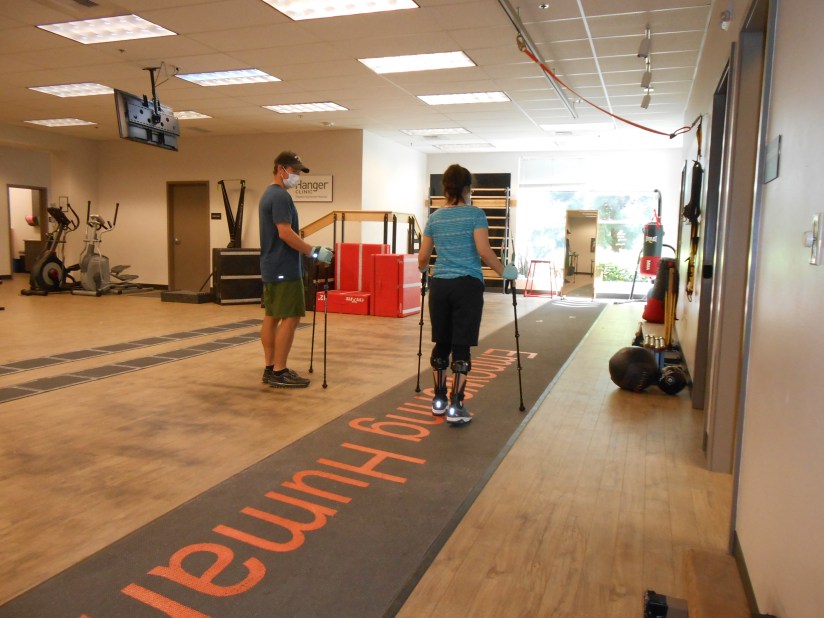
When Wednesday morning, July 8th, arrives, I put on my knee sleeves and my non-Exo shoes. My big shoes and knee sections fill up a large backpack and my ExoSyms are strapped to the outside. Mask on. Check. Sunhat. Check. I get the backpack on, take up my poles, and try to fit myself sideways through the doorway, carbon fiber Exos knocking against the glass front door on my way out. With the poles, the walk is no problem. Except that I can’t see because of the glasses-and-mask situation. 

At the office, nice and early, I have my temperature taken, answer no to all the questions, and then maneuver myself into a seat. Set poles down. Take off hat. Take off backpack. Take off shoes. Get the darn braces out of the darn straps. Pull up the knee sleeves that had pooled attractively around my ankles. Brace. Shoe. Other brace. Other shoe. Knee section. Knee section. Sanitize hands because I had to touch the bottom of my shoes. Put original shoes in backpack. Backpack on. Stand. Get poles. I am ready to be called back.

I fill my therapist (let’s call her C) in on training week and the time since, how things feel, what I’ve been doing, how much I’m wearing them.

I get the impression that she thinks I’m not wearing them enough. I should have them on whenever I’m awake. Yeah, that’s the goal. But not yet. I admit that I’m doing Jared’s ab exercise without them on. It’s so much easier to slide my feet in socks than it is to put something slippery under my shoe and switch it back and forth between sets since I can barely lift my weighed-down legs. Again, C thinks that whatever I’m doing, I should be wearing my Exos. They are part of me now. And we don’t want to reinforce any of the “compensatory patterns.” I understand this. We’ll see if I can force myself to get up and down from the floor in all my gear to do these ab exercises. 

To the two exercises I’m doing from Jared, we add a standing plank-type thing where I practice my “squish,” and some marching in place, weight-shifting practice. Well, the marching was downgraded to standing and holding on to the counter while I weight shift, trying to keep my hips level.

I go back to the lobby and schedule twice-a-week appointments for the remainder of July. Then I sit down and do everything in reverse so I can carry my ExoSyms back home. Sigh.

On Friday, the 10th, I have my second appointment. We do the baseline strength tests to see where I’m at. All the, “Push against my hand. Now don’t let me push your knees in” type things. They wear me out. Immediately, when I begin to walk home, I feel extremely tired and sore. We also add the dreaded bridge to my “home program.” The bridge sounds simple, and it is, if you’re not doing it right. Lie on back, bend knees, and lift bottom. However. Rather than simply “lift bottom,” I am supposed to tuck my pelvis (the “squish”) and “peel my tailbone up off the mat one vertebrae at a time.” Don’t tense neck or shoulders. Hold for several breaths. Then lower back down, one vertebrae at a time. The down is definitely a plop. Usually, this exercise aggravates my SI joints. But it is exactly the thing to do to strengthen the muscles around the SI joints. Go figure. Sure enough, after this session, my left SI joint starts to flare.

I have been given the bridge to strengthen my outer hips/glutes since the dawning days of my physical therapy career. And here we still are. Because those muscles always have been (and always will be) weak. But I can make them less weak.

July 10. Day 26.

Monday, the 13th, I have my third appointment. The thing about aggravating the SI joint is that once it’s angry, it stays angry. We don’t practice the bridge this time; we just do the pelvic tilt and hold it without lifting the tailbone. That’s challenging enough to get right anyway. After that, still on my back, I bend one knee and try to let it move side to side slightly without letting my hips come up along with it. This also employs the squish. The goal is to get the leg moving independently of the pelvis. C says that these two exercises are probably going to be more comfortable without my Exos on. Ah ha! Validated! She has realized rather quickly that my being weighed down by clunking, clattering carbon fiber is not always conducive to accurate, focused exercise. 

One thing I notice is that since I have to take my Exos off to walk home from PT, I definitely don’t feel like putting them back on again once I get home. But I need to actually do the home program, ideally doing the exercises several times throughout the day. With lots of walking practice. 

I tend to suit up again in the late afternoon and do one long practice session. But because “ten good steps are better than 100 bad steps,” C suggests I break it up into shorter chunks throughout the day to not wear myself out, eventually adding more chunks overall. She recommends that I keep a journal of what I’m doing and how I feel as I try out different combinations of walking time.

Because I like notebooks, and I have the perfect one, I do this.

By my fourth session on Wednesday, the 15th, my SI joint flare gets worse and better throughout the day, and my low back starts to hurt. We practice on stairs a bit, and also on powering through the step to take longer strides, with poles of course. I succeed in coming home from PT (these are really only about 25 minutes), doing my no-Exos stretching and exercises, and then putting my Exos back on to do the rest of the exercises and walking and weight-shifting practice in the afternoon. 

July 17. Day 33.

Some days, I have my Exos on for eight hours. I am mostly sitting in front of my computer. Saturdays, I just want to rest and read and watch Netflix. So I do.

Although my SI joint pain seems to be abating, my low back hurts, and so does my left side. My upper hip, almost my torso. This is not a pain I usually have. But I’m changing the way I move and walk. And right now, the ExoSym and knee section are just too much for my left side to handle well, so I won’t be surprised at any new pain that arises. 

At home, I move around without poles, and it feels easier some days than other days. When I’m washing dishes or chopping a vegetable, I have to remind myself not to lean against the counter. I have to remember that I can stand up now. Sometimes I turn it into a challenge for myself: Can I chop this pepper and transfer it into the pan without using a hand to assist? Can I fill the water glass and set it on the table? Often, the answer is yes.

It’s hard to believe I’ve had my Exos for more than a month already.

Life with ExoSyms Days 9–14: First Days at Home

24–28 June

When I complete my training week at the Hanger Clinic, I have this idea that I need to keep up the momentum. The whole summer is ahead of me, and I have nothing but time. I need to wear my ExoSyms for a minimum of two hours in the morning and two hours in the afternoon, just like at the Clinic, and build up from there.

And then there’s two days of driving, and a trip to the redwoods. Then I’m tired and it’s hot and I haven’t been home in ten days. First, I’ll rest. I’ll practice later. Already, I’ve lost the momentum. Life is not a montage.

Even though it’s nowhere near four hours a day, I do practice walking in my ExoSyms. I can move around the house in them without poles, but I find that I am lurching from furniture to furniture. It’s almost as if I’m wearing roller skates, and I don’t know how to stop. Or steer. It’s hard for my brain to realize I have more balance in these, not less. That I can let go of the table and stand up straight.

After the unexpected calf swelling, it’s taken a full week for my calves to feel like they fit properly into the cuffs, that the cuffs can close without squeezing them. 

I’m doing the ab exercises that Jared assigned. And I took a couple furniture sliders from my parents’ house to use under my feet for the exercise he had me doing on rectangles of carpet. Pointing my toes inward and then outward. The hardest thing ever. I am definitely not doing thirty. Maybe I’ll work my way up to that. 

On Friday June 26th, a week after leaving Hanger, I send videos to Ryan of me walking with and without poles. The first of many weekly updates. I have so much work ahead of me.

Saturday, it’s cooler, so I take myself outside to practice walking. My husband comes with me in case I face-plant because there’s no way I can get up by myself (yet. I hope it’s yet.) It feels so different, walking outside. Textured sidewalk, uneven blacktop. My left side feels so stiff. I am lopsided. I cannot seem to move in a functional manner. So much work. It’s a full week later, and it doesn’t seem very much improved. I spend about an hour walking up and down outside. 

I am finally brave enough to try putting my wrists through the straps on my poles and twisting them tight before gripping the handles. Both Ryan and Jared suggested this method to give my wrists more support. It seems very dangerous in the event of a fall, but it really does help my wrists and make me feel more stable. 

Inside, I put on my Leonard Bernstein playlist and practice for another hour. I have about a dozen steps of floor space from the front door to the table. Do a lap. Pause. Wiggle-dance. Lap. Pause. Wiggle-dance.

This week I discover that I can:

  • Stand up from a chair with no hands. I can do this without ExoSyms sometimes, if the chair is supportive enough and exactly the right height. It usually takes a few tries and is the result of momentum rather than actual ability. It still might take a couple tries with the ExoSyms, but they definitely give me a boost. When I discovered I could do it, I did it over and over and started laughing. Standing up is fun.
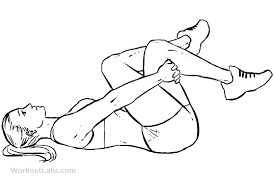
  • Stretch my hamstrings while standing. Usually, I stretch my hamstrings lying on my back with one leg in a yoga strap. I really dislike this position because it’s a strain on the rest of my body to pull my leg up. Sometimes, I do a modified downward dog instead, but it’s not as good a stretch. With my ExoSyms on, I can put my heel on the floor out in front of me and bend toward it, toes up. The brace keeps my ankle flexed, so the stretch is really good. So simple. I can stretch my hamstrings ten times a day now, if I want.

Life with ExoSyms Day 4: Training Week at Hanger Clinic

Training Day Four: Thursday, 18 June. 9:30–12:30, 2:15–4:00.

I wake up on this morning, having had enough upper-back-tension pain yesterday, in the night, and this morning–and knowing that I won’t have the knee sections–that I just want to get today over with. With these two significant bumps in the road, I’m feeling done. Ready to rest. But I have to do it.

What a doozy. 

Ryan texted last night and this morning to check on my back. At the clinic, he asks how I’m doing. I tell him I’m doing better than yesterday. Pain is about a four. He does not like that at all and talks to Jared about having more of a recovery day. I am a little surprised. A four is pretty good. I thought we’d do the regular stuff, with fewer reps. But they seem intent on trying to help the pain go away. This belief that we can successfully improve the pain is a little bewildering to me. Especially here, with all the military connections, I figured it would be a “Work through the pain!” kind of environment.

Jared and I stay in a side room with parallel bars. He asks if I’ve ever had an adjustment. “Like at a chiropractor? No.” I’ve thought about it, but I’ve never been comfortable with that whole relax-on-command-even-though-you-know-I’m-about-to-do-something-sudden-to-your-body idea. He describes what he’s proposing, assures me no one has ever had a bad experience with it, and asks if I’d like to try it. Sure, might as well. I stand between the bars and put my hands behind my head (that is a challenge). Then he stands behind me and somehow reaches around me and up behind my head too. I then lean back into him, give him all my weight, and crack, crack, crack, he lifts me off my feet for a second. And one more time, crack crack. Do I feel much different? No. But it is satisfying to hear all those cracks.

We stand against a wall with the parallel bars in front of us. He wants me to flatten the small of my back against the wall (knees bent), and then push against the bar to flatten my back all the way up, doing a kind of chin tuck at the end to stretch out my neck. It’s really hard to maintain the pelvic tilt and do all the rest. The bar is a little too far away for me to use it effectively. Jared tries attaching big foam bolsters around the bar to make the distance smaller. When that doesn’t work, we spend a lot of time taking this huge long bar out of its three legs, flipping it over so it extends toward me more, and trying to get it back into its three legs at the same height again. All so I could push off of it to do a stretch that I can’t really feel stretching anything. This chin-tuck neck stretch is something I was given years ago. Why am I not just lying down to do this? 

He asks about the (semi) daily stretches I already do, several for the upper back and shoulders, and quads, calves, hamstrings, and hips. “Well, those all sound good.” Yes, and even though I’ve improved at them, my body doesn’t feel noticeably better. 

We go out into the gym to work on the exercise my physical therapist calls, “T-bar with bobble head.” At home, I lie on a yoga mat, knees bent, arms straight up, Theraband in my hands. I then take my arms out into a T until my hands reach the floor. Shoulder blades are back and down “in my back pocket.” Once I’m in the T, I shake my head. This is to get the neck to relax while still engaging the traps. My shoulders blades are squeezed together, chest out. Does my neck relax? No.

Jared has me try variations of this. I lie down under a parallel bar. He drapes a giant, thick, stretchy band over the bar. It has so much resistance, I can barely move it. He has to add an extra loop so it’s longer.

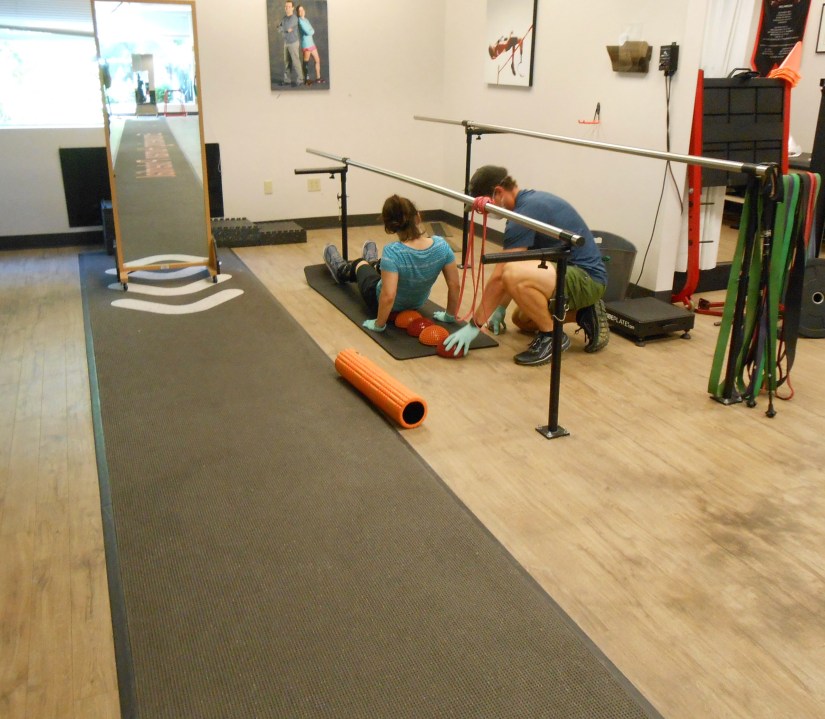
Trying to work on a foam roller.

I try lying on a foam roller. It supports my spine while my feet stay on the floor. But it rolls too much for me to balance well. (Or, I am unable to balance well, so it rolls too much.) Jared tells me to carefully lower myself to the floor. I scoot/roll/slide gracefully off the roller. “Or that,” Jared says. Hey, that is “carefully lower” in CP Land. 

They don’t have a half roller anymore because it got destroyed as an element in obstacle courses. So Jared improvises with a line of spiky half ball things up my spine. I like these. They feel pretty good. 

Spiky balls are nice.

“I’m realizing that’s about as high praise as you give,” Jared says. 

Well, I mean, ExoSym training week is not a place for tons of great fun. Maybe for other, once-able-bodied people. Not for CPers with spastic diplegia. I do ten reps with the band on the spiky balls. 

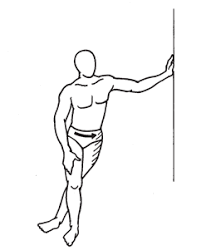
Jared also shows me a standing piriformis stretch that I really like. See? Really like. You stand on the side you want to stretch and cross the other leg over (or the picture shows behind) the standing leg. Then you just stick your hip out and twist your upper body until you feel a good stretch. I twist and bend over the parallel bar, holding on with both hands.

Twist the upper body and bend at the waist.
This one is not easy. But it is better with a foot against the couch.

So much easier than getting down onto the floor and somehow achieving the right amount of stretch by pulling on my own leg. “It’s a good stretch, and I don’t have to get on the floor,” I say, wondering why no one had shown me this before.

“I’m sensing that’s a big thing with you,” Jared remarks.

At first I’m surprised that it’s not immediately clear that getting down onto and up from the floor is indeed a big thing with me, but then I remind myself that although Jared can see the way I move–and understands the mechanics very well–that doesn’t mean he knows what it feels like to operate this body. I wonder if he’s familiar with Spoon Theory?

It’s time to get to walking again. Jared talks about putting all my weight on the stepping leg and swinging the other one forward–letting the device swing it forward if I’m doing it right. We talk about my poles. Apparently, I haven’t been moving opposite arm and leg together consistently. I’ve been doing Pole. Foot. Pole. Foot. Four separate movements. I know I’ve had the poles pretty far out in front of me to create a wide base for stability, like the four legs of a chair. But this instinct has me leaning forward, straining my arms, and not keeping my weight into the devices. I understand that I need to be standing straighter, with the poles closer to me. It makes sense. That doesn’t mean I can actually do it yet.

Jared shows me options for pole technique. Poles in unison, like a skier. (Nope.) Or alternating hand and foot, like I thought I was doing. He wants me to keep my elbows by my sides and angle the poles back, which puts my wrists in a much better position. “Use them to propel you forward!” I’m not ready to be propelled forward. I completely understand the why behind this method. But I cannot do it. When I angle my poles back, I cannot move. I cannot step forward with the support behind me instead of in front of me.

Jared continues to explain and encourage, and I keep trying, taking deep breaths, emotions running high. I do not have the balance or strength yet to move this way. I put my poles back again. “There! That’s good!” he says, even though my lower body has not moved. I feel one hundred percent truly and actually stuck with the poles in the “correct” position.

Have you ever had the experience of helping a child with math, or something else they struggle with? You’re explaining with enthusiasm, thinking it’s rightfully complex but things are going well, and then the child is crying. Frustrated? Overwhelmed? 

I keep trying to breathe through my feeling of “I literally cannot do this.” I try to simply let him know my present reality of “I don’t have the stability to do this right now.” The tears come anyway. I am grateful that my mask and glasses cover my weepy face and my snot. 

Jared politely ignores the tears and acknowledges my struggle. He wonders if it’s a mental block/fear. 

I say, “Maybe partly, but it also feels legitimately physical.”

He asks if I’d be willing to try it in between the parallel pars, lowered to hip height and positioned closer together. Yes, of course, I’ll try again. Jared leaves me in the safety of the bars and goes to meet another patient. I am able to use the bars to steady myself without letting go of the poles, so I’m more comfortable trying the new technique. But I still really struggle with the mechanics of it all with my muscles so weak. 

I’ve only been at it a few minutes when Ryan stops by to check in and release me from this PT session. He asks how I’m doing. 

“Physically, better. Emotionally, it’s been a tough day.”

“What about it has been tough?”

“Trying to do stuff I just can’t do yet,” I answer, getting a bit teary again. I always say “yet” or “right now.” I understand I am at the beginning.

Ryan acknowledges that I have emotions to process. “And I’m all for that.” He reminds me again that it’s a process. That I’ll be sending videos to him every week, that he’ll still be there. He wants me to know that I’m doing well, that I’m actually doing better than other CP cases he’s had. He assures me of this. Asks how I feel about it. 

When it’s clear that he’s waiting for an answer, I say, “Um. Well, it’s kind of irrelevant because we’re not supposed to compare ourselves to people.” I would have liked it to come out more eloquently than that, but it didn’t. 

I wasn’t upset that I was doing badly or that other people had done better. I wasn’t upset that I couldn’t do this thing. I’ve lived my whole life with limitations. I have no problem recognizing my limits, and I had no delusions that they would disappear. It wasn’t that I couldn’t do it–I’ve got that down. I was overwhelmed because all of Jared’s effort, expertise, enthusiasm, and good intentions were focused on me alone, and I was being asked/urged to do these things right now. I needed more practice, more time, to process and to try, without pressure.

Ryan tells me to go eat and rest and that I’m welcome to come back after lunch. “How do you feel?”

“Right now I don’t want to,” I acknowledge. “But I know I need to use this time.”

“You don’t have to.” He really means it. “I’ll leave it up to you.”

Of course I have to come back. We didn’t come all the way here for me to decide to not keep working.

I switch to my regular shoes and Dad and I walk back to the hotel. I am able to use my poles slanted back and alternating on this walk. After lunch I go straight to sleep, still feeling emotional. I wake up with drool on my pillow. Good nap.

In the afternoon, Dad walks me back to the clinic, and I go in alone. I change into my ExoSyms in the lobby and manage to put my backpack away in the room with the cubbies (first door on the right) by myself and make my way across the gym. I have the room with the really short parallel bars, a chair at one end. I practice with the poles between the bars. I’m able to do the slanted thing somewhat, sometimes.

I realize that what I need is to fall. I need to experience a fall. I need to know what it sounds like–carbon fiber clattering together–and what it feels like. It needs to be somewhere I know I can get back up. Not here, on linoleum. In the ExoSyms, even with poles, several times a day, I have the full-body clench, loss-of-balance moment, but so far I’ve caught myself. A fall will happen. The certainty of it looms, couched in suspense and the unknown.

Ryan checks in and advises me to step and squeeze my glute, really focusing on a good heel-toe on the left. I set aside my poles, and I am left alone to practice between the parallel bars. Six steps. Turn. Posture. Relax toes. Again. Trying to do hips forward like Jared said and glutes like Ryan said. Calm and careful. Feeling better.

I just needed time and a safe space to make friends with my devices. Slow, curious. No hurry. No audience or analysis. I stand between the bars, spend time learning how far forward or backward I can shift my weight before my balance goes. Yes, I can let go of the bars and raise my arms when I’m alone. 

I practice getting my weight over my hips and keeping it there with each step instead of hinging forward. Squeeze each glute. Put all the weight into one foot, and let the other swing through, heel-toe. Forge new neural pathways. Walking feels different when I successfully use these techniques. Not so much like cement ski boots. Good different. Better.  

I walk up and back for about an hour and a half, taking pauses in the chair. I feel like I can start experimenting with taking one hand off the bar. My left side locks up and I can’t swing my right leg through. But a few times I get it. Two steps with just one hand hovering over the bar before I lose it. 

If I move my arms like a power walker, it helps me keep my forward momentum, even though my left leg wants to tense up and halt everything. I have a tiny taste of achieving an actual walking stride. I try again and again. I’m just finishing a full length of the bars with no hands when Ryan checks in. 

He is properly excited for me and praises my accomplishment with feedback: “What you did with your arms looked better than with your sticks!”

I do a few more laps with poles to continue to try to coordinate those, already stiffening up and losing my rhythm. Ryan, like Jared, suggests putting my hands through the straps and twisting the straps to give my wrists support. I mention my concerns about falling with my wrists through the straps. “Don’t fall,” he says. If that isn’t perfect able-bodied advice.

I get the right ExoSym adjusted again because the heel still burns. Fortunately, it doesn’t take an hour this time, and then we walk back to the hotel. 

Food, ibuprofen, journal, meditation, sleep. Day four complete.

Actually Happening: Cerebral Palsy and ExoSyms

My trip begins tomorrow, and I spend next week at the Hanger Clinic in Gig Harbor, Washington, learning to use my ExoSyms.

But first, I must document yesterday, June 10. At 9am I went to my first occupational therapy appointment for my wrists/hands/thumbs. I gave her the whole story about using trekking poles and then having pain and not using them (for months with no improvement). And now I need to use them, so I need help. From behind masks, we did the strength and range-of-motion baseline assessments. My therapist told me that it sounds like I have several things going on (yay). She gave me exercises for De Quervain’s tendonitis and the radial nerve. Showed me how to massage the palm side of my forearm with two tennis balls taped together. I’ve never thought about those muscles being tight before, but she said they were. She massaged them with cocoa butter, which was the first time I’ve had human contact from someone other than my spouse in three months. She showed me how to tape my thumb and wrist and also approved of the brace I’d tried. Made adjustments to my trekking poles to try to keep my wrists in a good position. Sent me on my way. Productive appointment.

Later in the day, my neck and shoulders–the whole trapezius–began to feel different. Tingly. A little like the clamp on my neck that’s been pulling my head and shoulders painfully toward each other for four years was…loosening. Some. I got down onto the floor and carefully went through the stretches I’d been given years ago (and still attempt regularly). And I felt actual stretching, not just fighting against tension. Huh. Perhaps this was how it was supposed to be all along. Perhaps this is why physical therapists often seem a bit skeptical/frustrated when I tell them stretching only feels the same or worse. Because I’m supposed to feel this instead of that. Maybe now all those things I’ve tried before will actually work? Quick, somebody give me some Flexeril! Kidding. Sort of. After stretching, I meditated (third consecutive day!). And darned if I didn’t achieve a full-body floaty relaxation. Wow. What’s going on? This morning, when I sat down to put on my shoes, I think it was just a bit easier to bend over and reach and pick up my shoe from the floor. 

So what did it? Did I just need someone to massage my forearm with something that smelled like chocolate? I’ve had my forearms massaged before. Maybe not for that long in just that way. I am getting better at meditating. Maybe that’s it. Distance learning is finally over for the summer. Maybe that’s it. 

It’s not as though my neck pain is gone. There’s still a long way to go. But now I know that less pain is possible. That I can continue to work to loosen the clamp. 

It’s ExoSym time! I’m trying to be excited and positive, but honestly, I’m scared of how hard this is going to be. I’ve never asked my body to do something like this, and I don’t know how it’s going to handle it. I cannot expect to strap them on and go like so many others. Another ExoSymmer with cerebral palsy pointed out that it’s a little like having surgery. A period of rehabilitation must follow. There might be pain; there will definitely be soreness. We have to give ourselves time to adjust and build our strength. Weeks. Months. Years.

Megan, who blogs at Wheatfield Ramblings, has very helpful advice for people who are just starting their ExoSym journey. One tip she gives is come with goals. Here are mine:

During my week at the clinic, I would like to learn how to:

Walk

Step up and down, as with a curb or onto and off of a bus

Get down onto and up from the floor

After all, I have to start at the very beginning. It’s a very good place to start.