Life with ExoSyms Day 2: Training Week at Hanger Clinic

Training Day Two: Tuesday, 16 June. 8:00-10:00.

I start the morning with a check-in/ pep talk from Ryan: The body, the mind, and the ExoSym are like three different sheets of music. They’re all doing different things and they need to come together as one. It’s a big ask for me to use muscles I’ve never used before.

While I wait for Jared, Ryan gives me the assignment of walking up and down the length of the gray walkway with poles, in front of a mirror to watch for hip drop. I’m looking forward to continuing to work on my squish and load the devices properly. I hope I get to use the pole-and corset combo again. But it turns out that I’m in for completely different stuff today.

Jared arrives and tells me to continue walking: 10 up-and-backs. Before I finish, he stops me and asks me to walk backward. I knew I’d be asked to do many things I am not comfortable with. That’s the point. I told myself before I came that I would attempt everything without making a big deal out of it. Walking backward first thing on day two is a big ask. I can’t help but remind Jared that I usually have a hand holding on to something at all times. That it feels very likely that I’ll fall over backward in these things. I’ve already had a few suddenly-off-balance, full-body clenches. Not to back out or protest, exactly. Just to let him know that this isn’t going to go smoothly.

My legs aren’t strong enough to step backward without my upper body leaning forward to try to help. “Try not to hinge at the waist,” Jared says. Yeah, no kidding. I put enormous pressure on my hands/wrists/arms leaning so much on the poles. Plus, these things are heavy. Jared tells me to put my hips forward. When I lean my upper body forward, I am not “loading” the devices anymore; my weight comes away from the knee cuffs instead of going into them. I need to do so much work on my core.

I have over two minutes on the vibration plate today. I feel it in my teeth. It’s so weird and exhausting. But nice? When I step off, my lower legs feel completely heated up. The synthetic sleeves under the braces are so hot.

Next, it’s time for balance work. I stand between two vertical metal bars (like for lifting a barbell while standing). Put my feet together and apart. Try to take my hands off the bars. Step up onto a small block. Jared brings over a mirror so I can see if I’m keeping my hips level. I am not. My body and brain do not know how to correct this. Now take one hand off the bar, then the other. My toes and calves clench and my knees want to buckle.

The only thing my body really refuses to do is let me raise my arms over my head or out in front of me. I’m not ready to let go of the bars for that long yet. Mental block or physical limitation? Both, I think. Perhaps I could have done it were I not on the block, or if I were between parallel bars instead. Next, we try the balance board, again trying to stand level and take one hand away.

Following that, I do some ab work on the floor. That means that I have to get down onto the floor. Jared uses a bench and shows me a couple different positions. One is spreading legs far apart and bending one knee. That one is definitely out. The other is going into a lunge position and bending the back knee to the floor. I try that one. Before my back knee is down to the floor, the ExoSym on the front leg bites into the back of my calf. Hmm. Once I’m kind of kneeling, I’m kind of stuck. I’m supposed to move one hand from the bench to the floor and lower myself down the rest of the way. I do it, ExoSyms clattering together as I position myself on my bottom somehow.
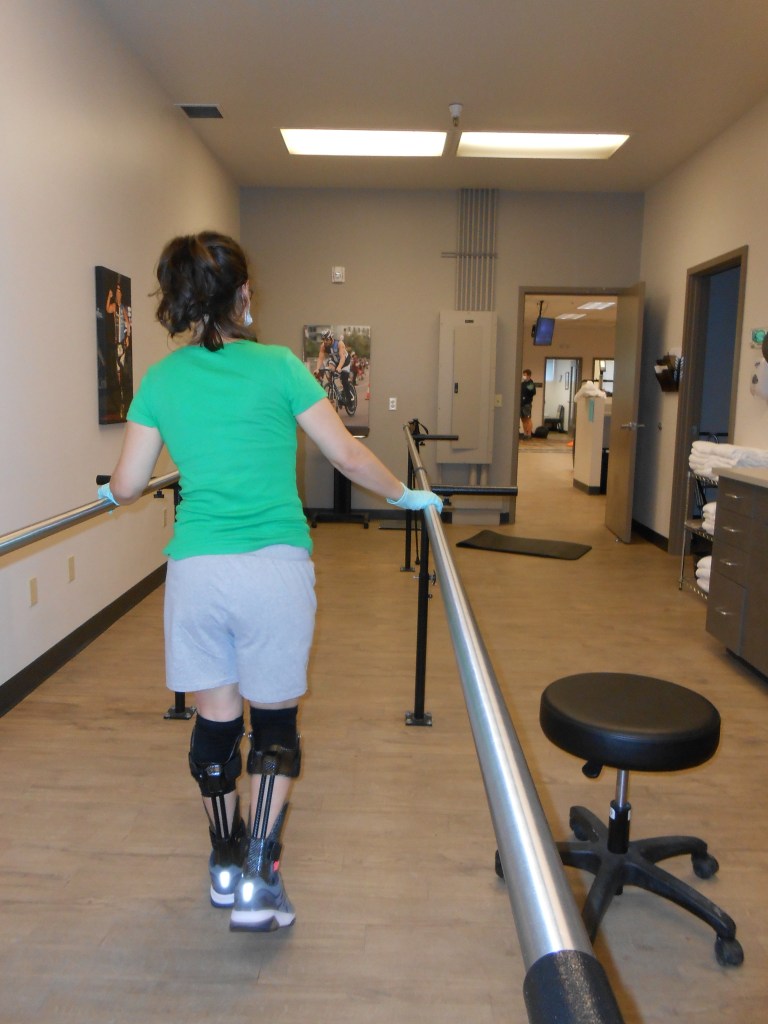
Clear view of the struts up the back.

We try several positions for me to engage my core well. I end up on my back with one leg bent, one straight, a folded yoga mat under the extended foot so it will slide even with my shoe on. I bring the extended leg in and back out, keeping my core engaged, trying to use my hamstring but actually kinda tweaking the front of my hip.

Jared has another patient, so he brings the bench and mat into a side room with parallel bars. He assigns me 9 more sets (eight on the right, twelve on the weaker left). In between each set, I am to stand up (haul myself up using the bench), walk up and down between the bars, and get myself back down onto my back with my foot correctly positioned on the folded mat. Nine times. Sure, no problem. Ryan pops his head in and asks how I’m doing. From the floor, I say I still have seven more. I mean seven more complete sets, but the next time he comes in, I’m up between the bars, and he plucks the mat off the floor and starts sanitizing it. I feel very relieved. My right side is starting to hurt anyway. You can see in the video that Ryan has me progress to only using one hand on the bars. He’s encouraging about my hip drop. Then he tells me he’ll see me tomorrow. I still had four or five more sets to go. Don’t tell Jared.

Walking with two hands and then one. In between sets of ab work on the floor.

I am supposed to come back early in the morning to get my knee sections. I am nervous because I know that they will add so much more bulk and weight. But I’m also ready because they keep telling me how much progress I will make with knee sections. They should be ready by 8am. I will wait for a text from Ryan to confirm.

Food, ibuprofen, journal, meditation, sleep. Day two complete.

Actually Happening: Cerebral Palsy and ExoSyms

My trip begins tomorrow, and I spend next week at the Hanger Clinic in Gig Harbor, Washington, learning to use my ExoSyms.

But first, I must document yesterday, June 10. At 9am I went to my first occupational therapy appointment for my wrists/hands/thumbs. I gave her the whole story about using trekking poles and then having pain and not using them (for months with no improvement). And now I need to use them, so I need help. From behind masks, we did the strength and range-of-motion baseline assessments. My therapist told me that it sounds like I have several things going on (yay). She gave me exercises for De Quervain’s tendonitis and the radial nerve. Showed me how to massage the palm side of my forearm with two tennis balls taped together. I’ve never thought about those muscles being tight before, but she said they were. She massaged them with cocoa butter, which was the first time I’ve had human contact from someone other than my spouse in three months. She showed me how to tape my thumb and wrist and also approved of the brace I’d tried. Made adjustments to my trekking poles to try to keep my wrists in a good position. Sent me on my way. Productive appointment.

Later in the day, my neck and shoulders–the whole trapezius–began to feel different. Tingly. A little like the clamp on my neck that’s been pulling my head and shoulders painfully toward each other for four years was…loosening. Some. I got down onto the floor and carefully went through the stretches I’d been given years ago (and still attempt regularly). And I felt actual stretching, not just fighting against tension. Huh. Perhaps this was how it was supposed to be all along. Perhaps this is why physical therapists often seem a bit skeptical/frustrated when I tell them stretching only feels the same or worse. Because I’m supposed to feel this instead of that. Maybe now all those things I’ve tried before will actually work? Quick, somebody give me some Flexeril! Kidding. Sort of. After stretching, I meditated (third consecutive day!). And darned if I didn’t achieve a full-body floaty relaxation. Wow. What’s going on? This morning, when I sat down to put on my shoes, I think it was just a bit easier to bend over and reach and pick up my shoe from the floor. 

So what did it? Did I just need someone to massage my forearm with something that smelled like chocolate? I’ve had my forearms massaged before. Maybe not for that long in just that way. I am getting better at meditating. Maybe that’s it. Distance learning is finally over for the summer. Maybe that’s it. 

It’s not as though my neck pain is gone. There’s still a long way to go. But now I know that less pain is possible. That I can continue to work to loosen the clamp. 

It’s ExoSym time! I’m trying to be excited and positive, but honestly, I’m scared of how hard this is going to be. I’ve never asked my body to do something like this, and I don’t know how it’s going to handle it. I cannot expect to strap them on and go like so many others. Another ExoSymmer with cerebral palsy pointed out that it’s a little like having surgery. A period of rehabilitation must follow. There might be pain; there will definitely be soreness. We have to give ourselves time to adjust and build our strength. Weeks. Months. Years.

Megan, who blogs at Wheatfield Ramblings, has very helpful advice for people who are just starting their ExoSym journey. One tip she gives is come with goals. Here are mine:

During my week at the clinic, I would like to learn how to:

Walk

Step up and down, as with a curb or onto and off of a bus

Get down onto and up from the floor

After all, I have to start at the very beginning. It’s a very good place to start.

Spoon Theory and Cerebral Palsy Time

You know how there are dog years and human years? A thirteen-year-old dog is old, but a thirteen-year-old human is not. 

There is also cerebral palsy time. Generally speaking, people with physical disabilities use more energy than their able-bodied peers to do the same tasks. I don’t know for certain how much more energy I use to walk a mile than a nondisabled person. But I’m pretty sure it’s a significant amount. My fitbit says my heart rate is 90 or more, while my husband’s is in the neighborhood of 70.

Spoon Theory was originally coined by Christine Miserandino when she was trying to explain to a friend what it feels like to live with lupus. It’s meant to help someone understand invisible disabilities, or conditions that are disabling but are not immediately visible. It has since been applied to disabilities in general, and some even embrace the term “Spoonie.” I do not, because I do not need any cutesyfication of my life.

Spoon Theory goes something like this. Everyone starts out the day with a certain number of spoons. Various tasks use up various numbers of spoons. When you’re out of spoons for the day, you are done. Let’s say I have twelve spoons. For me, taking a shower uses up two spoons, getting dressed one, putting on shoes, one. Getting to work could be one or two or three, depending on whether I walk or bus and whether I have a seat on the bus or stand. So let’s say I’ve used up six spoons and it’s only 8:30 in the morning. Time to start my day. Able-bodied people maybe use–one or two? So, I don’t shower in the mornings. I conserve those spoons for the work day and shower later. Cooking takes spoons. Standing, chopping, getting chopped food into pot without spilling. Going back and forth for ingredients and utensils. Emptying the dishwasher, as I’ve described before, takes spoons. Laundry. Spoons. If you sleep well, you can replenish your spoons. If you don’t, you may start out the next day with fewer spoons. Chronic pain affects sleep, etc. etc. Some days might be better than others and you seem to use fewer spoons on the same tasks. 

Story time: I stayed with my sister for a week and did the cooking. We picked out some tasty new recipes that were more complex than my usual beans-and-rice fare. Her kitchen is way bigger than mine and I didn’t know where anything was. Sure, new recipe, bigger kitchen, and new layout will take some getting used to. But wait, the stove is in the corner, with no countertops next to it. It’s one of those cool antique gas ones, and I literally cannot touch its surface safely once the burner is going. So I’m supposed to bring a dish of mixed ingredients/liquids over to a bubbling pot and pour it in. Remember, I have trouble stopping my body’s forward motion. Enough with the excruciating minutiae. The meal took many spoons.

Sometimes I feel like I should/could be doing more. I work 23 hours a week (well, I did when school and tutoring were held in person). I know that all of you who work full time and more can hardly imagine the luxury of working part time. So much time to fill with all the things you actually want to be doing! 

But really, when I make it through the day, even if that day ends at “only” 2pm, I feel done. Twenty-three hours in CP time has to be close to forty in able-bodied time. 

Most nights, I call from the bedroom to my husband in the living room, “Did I make it?”

And he’ll respond, “9:02.”

“Yes! Good night.”

Sometimes, it will only be 8:43, and I’ll have to make myself stay awake for seventeen more minutes. 

Functioning takes energy. Fatigue is real. Pain is real. Working part-time is okay. A person’s value is not measured by how many paid hours are in their day. That’s a hard one, American people, but it’s true. 

Not all disabilities are immediately apparent like mine. I’ve had to grow and learn and discover that there are many, many conditions out there that are disabling. What’s more, chronic conditions are loads of unpredictable fun. People can feel okay to walk one day, and need assistive equipment another.

If someone uses disabled seating, or restrooms, or parking–believe them. Remember that you do not know this person or what they live with or what it feels like to inhabit that body and that brain. Let’s all try to be kinder, more empathetic. Let’s all try to imagine others complexly.

Counting Down (Again): Cerebral Palsy and ExoSyms

We are in week…ten?…of state/county sheltering in place because of COVID-19. My March 30th trip to the Hanger Clinic was postponed. I can now say (again) that next month I get my ExoSyms. I am excited and nervous, exhausted and frustrated.

Remember back in December when I finally started making myself use trekking poles so that I could be used to them when I got my ExoSyms? It turned out I really liked using them, and I was walking more and feeling really good about it.

Middle of March comes around, and I realize that my right thumb and wrist are really bothered. The soreness even travels up my forearm. I had injured my hand last September/October by repeatedly lifting a heavy bin off a shelf one-handed, thumb stretched up over the lip of the bin. When I recognized this was causing a problem, I rearranged things and figured out how to use two hands without tipping myself out of my chair. But the pain lingered and showed itself in daily life. I had trouble opening jars. I love opening jars. I’m good at opening jars. It makes me feel strong and capable. Not being able to do it is scary because it’s tangible evidence that there’s really a problem.

So, I was used to my thumb hurting when I did something strenuous, but now it was hurting when I did nothing. And…my left hand hurt too. The backs of my hands ached as I fell asleep and the inside of my wrists hurt when I woke up in the morning. It had to be the poles. My unaligned posture and muscle weakness must be causing me to put extra strain on my hands and arms as I grip the poles, try as I might to use a light touch. 

With sadness, I put the poles away to give my hands a rest. I used ice and heat and muscle rub and NSAIDs. I even bought a wrist brace with thumb support, knowing that it wouldn’t “fix” things, but that it would help me really go easy on my right hand. I knew I had to use the brace consistently for 4-6 weeks to expect any changes. It did seem to help with the pain sometimes. 

I’m going to be honest. I left off writing the post at this juncture three weeks ago. I didn’t feel like recording the minutiae of my body and its pain anymore. But here we are, and it’s almost June so I’d better just acknowledge how things stand and be done with it.

I’ll say this: don’t google “burning forearms.” Doing so will make you worry that you might have MS. I don’t think I actually have MS, but I do probably have tendonitis in both arms. I have not made a video chat appointment with my doctor, and by now I could probably make an in-person one. I just kept waiting and hoping it would get better. Instead, both arms hurt about the same now, rather than the right being worse. And the pain has traveled up the forearms into the biceps and armpit. So, you know, I used to think I had rough days, and now I don’t have a single limb that I can trust to function properly and not hurt. It’s a lot to take mentally and emotionally. Pain is draining. New pain draining and unsettling. My nose feels good. My chin too.

I don’t know how the tendonitis will affect my use of trekking poles and learning to walk with ExoSyms. I don’t know how using trekking poles will affect my efforts to heal the tendonitis.

I would like this particular journey not to have been affected by first, a pandemic, and second, new and heretofore unknowable physical ailments. I would have liked to be able to go into my week at the Hanger Clinic energized, excited, in good shape, and in as little pain as is reasonably possible.

Instead, I am here. Tired, out of it, unfocused, sad. My eyeballs want to fall into my skull. 

So, I am adjusting my hopes for the whole experience. The important thing now, I tell myself, is just to get the braces and get the training. We will work on all the rest as we can. 

Life is Not a Montage

I love a good movie montage. An upbeat or inspiring song begins and our protagonists embark on a series of impressive and exhausting feats over a period of many days, weeks, or months. By the song’s close, gains have been made, goals achieved. Progress. Transformation. All within the space of a single song.

My favorite montages come from 

Dirty Dancing. Johnny teaches Baby to dance. (“Wipeout” and “Hungry Eyes”)

The Cutting Edge. Doug learns to partner, and Kate and Doug push each other in training. (“Groove Master” and “Ride on Time”)

Girls Just Wanna Have Fun. Janey and Jeff learn to dance together. Janey teaches Jeff gymnastics. (“I Can Fly”)

Footloose. Ren teaches Willard to dance. (“Let’s Hear it for the Boy”)

Honorable mention:

The Mirror Has Two Faces. Rose makes a change. (“The Power Inside of Me”)

Are you seeing the theme here? Clearly, I love stories in which people learn to dance. I’ll save writing about dance for another day. Today’s topic is time and progress. 

With fewer than thirty days until my second trip to the Hanger Clinic, where I will receive and be trained in my new ExoSyms, now is my time for a montage. Time for an uplifting beat to float out of the ether and start me off. Or, if source music works better for you, time for me to pop my earbuds in and get to work:

Cut to me getting up early to stretch and strengthen. 

Cut to me attempting to plank, and side plank.

Close up on my determined face.

Cut to me walking with my trekking poles. 

Cut to me stretching out my calves while I microwave my lunch at work.

Cut to me at my PT appointment.

Planking at home.

Using my DIY balance board.

Sleeping.

Waking early to stretch again.

Making smoothies. Eating vegetables.

Planking again.

Planking again–and succeeding?

This is where the vision falls apart, with the progress and transformation. Once February arrived and I had about two months to go, I knew I needed to buckle down and really be dedicated. But I was working, and editing, and tutoring. Cooking and cleaning and laundering. Reading and sleeping. Spending way too much time online. Living my daily life. Can any regular person, who isn’t an athlete as their life’s work, maintain enthusiasm, drive, energy, commitment for so long? Well, yes. Of course there are people who do. Not montage-level dedication, sure, but there are people who set goals and reach them. I am not one of those people, historically speaking. 

I’ve always found January and February more challenging motivation- and healthwise than November and December. With the holidays approaching there’s excitement and anticipation, activity. With the holidays past, there’s winter and work, and several breaks from work which are full of Netflix and the mountain of chocolate and treats resulting from Christmas, birthday, and Valentine’s Day. There was also cake. And ice cream. As there should be. I savored the gluttony and the slothfulness, but I can’t be surprised I’m having to claw my way out of it now.

Not gonna lie–the first three weeks of February were rough for my body. It’s always an interesting exercise to try to quantify and describe pain. Last month, my piriformis and SI joints were making themselves known. I go through some periods of time when that’s not the case. When my hips just feel tight and achy, but not in pain. So when one is set off, in that sharp, strong way, it feels like, “Oh, right, there it is. What I was feeling before wasn’t really pain at all.” And I remind myself that even though I never know quite how to get things to calm down again, they eventually do. The trouble is, once these areas are aggravated, so many movements throughout the day keep them aggravated, and after one week, two, three, I was beginning to wonder if this was the time that they were just going to stay angry forever. Usually if both sides are upset, one side hurts, and then the other, throughout the day. And I’m so grateful for that. I think I might lose my grip if both hips were screaming at once. But then they did (in different ways and to different degrees) and I still have my grip. 

The pain is dynamic, changing from minute to minute. Sometimes it’s sharp, almost burning. Sometimes it feels muscular, sometimes it doesn’t. It travels down my IT band. It pulls at my inner knee. It moves down to clamp onto everything that meets at the head of my femur. Occasionally it throbs. Or it feels like a bit of stabbing, quick jolts cutting through the rest. Once or twice it has felt like what I can only describe as a second of gurgling, or a gargling. And I wonder what the heck is going on in there. 

Mostly, I stretch it and I stretch it and I breathe. The pain itself is not so bad. Never would I rate it an 8 or a 9 or a 10. Because pain can always be worse. What’s bad is that it does not stop. That I cannot help it ease. No heat, rest, NSAID, muscle rub, or stretch will provide relief. I’m very aware that I could be stretching incorrectly, and that lying in bed is sometimes the exact wrong thing to do. Sometimes I start pounding on it with the side of my fist, hardly realizing I’m doing it. I want to drive a hot poker into the pain. I want to pop my leg out of its socket and put in a new one.

Meanwhile, I have new PT exercises (that are probably aggravating things) that I am supposed to be doing twice a day (ha!) in order to make the most out of what might possibly be the most important and most challenging five days of my life. I skip them a lot.

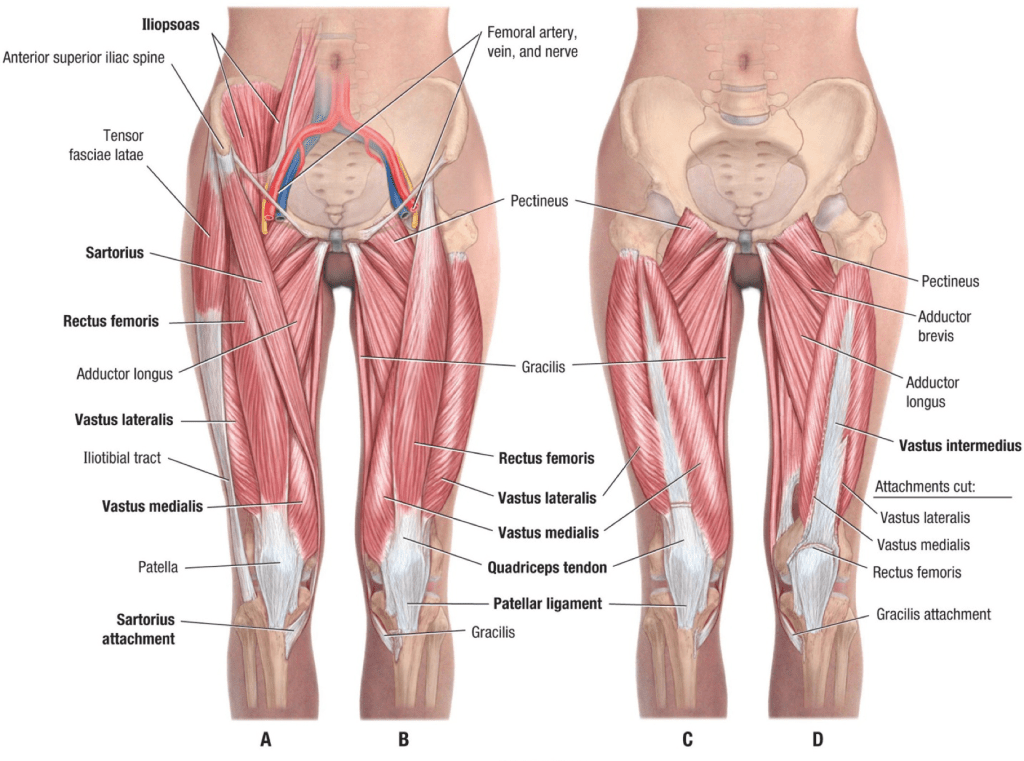
Here are some images just so we all have an idea of what I’m dealing with. On my body, obviously, there’s spasticity and lack of control. Several of these muscles have been lengthened (weakened), and there’s been a muscle transfer as well. Check out all those muscles under the gluteus maximus! Much of my pain is in that mess.

So, with March looming, I cut back on sugar, and on screen time, and I finish my editing project. I meditate and I stretch and do my exercises the best I can. One day (Sunday, February 23rd), I found a stretching position that I could manage to relax in while still maintaining it, that felt like it was hitting the spot. And it felt better. Noticeably better. I almost cried with relief and gratitude. Excitement. Triumph. Hope. Hope that I could keep these muscles and joints happy until I made it to Washington and the Hanger Clinic. Of course it hasn’t exactly gone that way. But my muscles and joints are still noticeably better than they were before. When I stretch lately, it feels like the muscles are actually stretching, instead of me fighting a brick wall. One morning after stretching, I took up my poles and did a turn about the neighborhood. As I walked, I felt a tingling at the back of my neck and down into my shoulders. Unlike anything I’ve ever felt. What is this magic? I wondered. Is my neck actually relaxing? While I’m walking? Will my neck feel less tight? Am I currently receiving the amount of blood flow to my head that I’m supposed to? There was no momentus decrease in overall neck tension, but it was a lovely moment.

The montage is a fabulous storytelling device, but real life is not a montage. I know I’m not the only one who’s ever wished to speed through (to a motivating tune) the daily grind and just finally be there–wherever the there is. Day by day, I’m nearing my “there.” And I am getting stronger. I am making progress. It’s tiny, but it’s there. My stint at the Hanger Clinic will arrive. In the meantime, I’m not living in a constant state of motivated, dedicated, driven, inspirational activity. I’m incorporating a reasonable–for me–amount of daily preparation. Could I do more? Absolutely. Will I wish I had? Don’t know. Would it really make a difference if I did? Perhaps.

What It Feels Like to Live with Cerebral Palsy

I have cerebral palsy, but it does not have me. 

Sounds nice, doesn’t it? Did it make you feel good to read that? Here’s the thing. It isn’t true. Cerebral palsy absolutely has me. I cannot turn it off or take a vacation from it.  

In my Growing Up with Cerebral Palsy post, I wrote, “Cerebral palsy just affected the way I moved about in my environment. Cerebral palsy was simply my normal.” But there really is no “just” about having a lifelong disability, is there? Cerebral palsy does not affect my movement in isolation, but has shaped who I am in a way that is inseparable from my DNA.

I am going to attempt to describe what it’s like to live with cerebral palsy. But it is like asking an able-bodied person to describe what it’s like to live without cerebral palsy, you see. We really know only our own experience. We can try to articulate it in relationship to another, but how do we know if we are accurate?

This should go without saying, but I will say it again, nonetheless. Every person experiences CP differently, with some commonalities. My CP is mild. I am always aware of that and grateful for my overall independence.

So here we go. I would characterize my life as one of uncertainty. My ability to balance consistently is tenuous at best. I cannot trust my body to hold me up. 

Imagine that you are walking down the sidewalk, and then you are suddenly sprawled on your hands and knees and they are stinging and you know there will be blood and you’re unsure if you will be able to get up by yourself. Imagine that you are standing in your kitchen, holding a cup. Suddenly, equilibrium in your body shifts, all your muscles tense and you flush with heat, your hands fly out, liquid sloshes, balance has flown, and you clutch the edge of the counter in time to keep from going down. Or, the counter is just out of reach and you’re wondering as you fall if you’ll knock your head against the cabinets, mentally bracing for the impact of your backside against the hard floor. The world is not a safe place, you see. Your body is not a safe place. Are you beginning to understand how this affects who you are–influences how you interact with space and things and people? 

Sticking to the edges, where there are fewer people to bump me, a hand always on furniture or the wall, a hand always needed as insurance instead of free to greet, or carry, or hug. Always calculating the risks involved in an action, always cautious. Will my body succeed at that or not? Do I try it? Or not? Split-second decisions all the time. Will that person move away from the railing so I can use it? Or stand from that bus seat before the bus starts moving, so I can maneuver into the seat in time? Do I have to speak up and ask?   

There is no striding confidently into the room. No standing for hours at a party, holding a plate of food or a full glass, and chatting comfortably. No stepping off a curb or over a puddle or a backpack in the aisle. No running to catch up with friends or stopping and turning with ease if someone calls my name. No giving or receiving hugs freely. 

It is not only the constant challenge of staying upright–but upright AND functional. I do not have the strength or balance to stop moving when I need to. My body will keep moving haphazardly forward with my momentum even when I need to stop. Small, uncontrolled steps to keep up with the momentum, or a hand out to stop and steady. If hands are full, then it’s the backs of the hands, the forearms, or the forehead that halt the forward motion. The forehead is not a good brake. Example: emptying the dishwasher. I’m carrying a stack of plates to the cupboard using both hands, and I don’t stop well when I arrive at the open cupboard. Elbows and wrists pitch outward toward sharp cupboard edges in an effort to save my head from using the front edge of the cabinet to stop my body crashing into the stacks of glass dishes inside. Hence, moving through life with one hand functional and one hand occupied by steadying. And only carrying two or three plates at a time.

Let’s acknowledge for a moment bodily needs like toileting and showering and menstruating and intimacy. Cerebral palsy might directly affect these things, or directly affect my ability to address or participate in them. Does CP affect my ability to retain or release urine? I do not know. I do not know if me holding my pee feels the same as you holding your pee. I can tell you that really needing to go makes getting pants down and getting seated properly, without falling on my face, a hundred times harder than when I’m not in a rush.

Emptying the dishwasher, removing a heavy pan of hot food from the oven, scrubbing the toilet. Putting on clothes and taking them off. How will my body handle this today? Will I be able to lift the hot casserole dish with one hand while using the other hand to stop my whole body from tipping forward into the oven? Will I be able to step into my underwear on the first try, or get my foot tangled the first three tries, whole body tipping forward again, leg muscles straining, one hand holding the dresser as I try to hold the leg hole open with the other, to create a wide target for my uncontrolled foot.

The constant navigation and calculation is exhausting, both physically and mentally. I perform every private action and every public interaction with some degree of uncertainty. I literally do not have physical confidence. How can that not affect who I’ve become as a person? 

I’m not trying to say that there are no confident people with physical disabilities. Of course there are. Of course there are extroverted people with cerebral palsy who may indeed walk confidently into a room. I was born a cautious introvert. And I theorize that living with cerebral palsy has intensified my caution and my introversion. 

Cerebral palsy has also made me more observant and detail-oriented. I’m probably more aware than an able-bodied person that there’s lots we can’t see about someone. I readily accept that everyone and every situation has complexities. I think I have more compassion and curiosity than I would have had without CP, and more appreciation. Of course, I’d like to believe that I would have been a kind, observant, compassionate person even without cerebral palsy, and that having CP again only intensified what was already there. 

The world is complicated and being human is complicated. And we can only ever fully know our own experience. I hope this helps you understand a small bit of mine. 

What I Used to Do

I used to

  • Do pull-ups. Many. When I was eight.
  • Do that bridge thing where you lie on your back with your knees bent, hands by your ears, and push up off the floor
  • Jump rope. Kind of.
  • Touch my toes (sitting with legs out straight)
  • Play “tennis” at summer camp / be a batter during PE baseball
  • Pick up nickels from the sidewalk
  • Sit cross-legged on the floor
  • Step up curbs. Even down!
  • Walk up stairs without a railing. Sometimes.
  • Walk down a stair or two with my hand hovering over the railing, just to see if I could.
  • Handcycle for miles
  • Walk without pain
  • Travel solo, knowing that I would be okay
  • Live without constant neck tension and pain
  • A little hiking, with help
  • Climb ladders
  • Jump off a diving board
  • Look over my shoulders
  • Walk comfortably in bare feet, without my left big toe trying to kill me
  • Know that I could get up off the ground if I fell
  • Carry groceries for blocks

Some changes happen so slowly we don’t even notice them. Now, I need to walk out of my way to get to a curb cut, because I can’t trust my body to take me safely up a curb (and certainly not down!). Now I walk on by nickels and dimes on the sidewalk; might just tip right over if I tried to pick them up.

I know that most every adult can look back on themselves as children and ponder their lost agility. I don’t expect that I should be able to do pull-ups the way I did when I was eight. I would like to feel confident that I can step over an obstacle in my path or pick up something off the floor. Full disclosure, I can sometimes pick stuff up without needing to hold on to something. If I’m in my own home and I give my back enough time to slo-o-o-wly bend forward, I can do it. But if I’m walking to work and someone drops something, I don’t pick it up for them. Not with my backpack on. Not when it needs to be quick. Rather than moving them out of harm’s way, I simply apologize to the worms and snails in the middle of the path, who will soon be flattened by oblivious cyclists’ tires.

It’s difficult for me to acknowledge that some of these changes have been over, not decades, but only a handful of years. I’m not doing enough, right? I’m not being consistent enough with my physical therapy, nor do I push myself enough to stay active. But sitting on the floor, on the rug in the living room, or in my bedroom. In the past, that’s where I liked to be. Didn’t I do it every day? When did I stop?

Applying for the ExoSym

I first heard about the ExoSym device from CerebralPalsyStrong, a website that started out as Teen Cerebral Palsy, run by a young woman with hemiplegia, Katy Fetters. The video of her experience and the links she shared convinced me to contact the Hanger Clinic in September 2019. There are Hanger Clinics all over the place, but the only one that does the ExoSym is in Gig Harbor, Washington. That’s where the guy who invented the device works, and he reviews every case himself.

Prosthetist Ryan Blanck designed the ExoSym in 2009. His goals were to reduce pain and restore mobility to active-duty and retired service members with limb salvage conditions as a way to avoid amputation. The device provides increased dynamics and energy return. In 2013, Ryan joined Hanger Clinic to bring the ExoSym to civilians with severe lower-extremity conditions or injuries (info from Hanger Clinic).

I emailed them expressing interest, and they responded with the application, instructions, and a long list of articles and video links about others’ experiences. Suddenly, I’m learning about a woman from New Zealand who was born with clubfeet, now walking miles, and a man with spina bifida now going hiking. And they all say the same thing: the ExoSym is life changing.

I got started on the paperwork, which was a series of PDFs I needed to print, fill out, scan, and email back. One document was a four-page questionnaire about my abilities, similar to a PT intake form where I rated my ability to perform various tasks from “extreme difficulty” to “no difficulty.” Rolling over in bed? Moderate difficulty. Squatting? Unable to perform. Sitting for one hour? That I can do. After another twenty questions about strength and range of motion (limited and limited), it was time to record a video of the way I walk. I’ve included it below so you can see it in all its glory.

Let me say this. I know that I look different than those with typical gait. Obviously. But to me, I’m just walking. I can feel that I’ve got a significant side-to-side sway if I pay attention. Do I make myself feel a bit seasick if I walk around after eating too much? Yes, yes I do. But do I really know what it looks like? No. I think many ambulatory cerebral palsians out there will relate when I say I’ve been startled by my reflection when I walk past a store window. So there’s nothing quite like walking for the camera and then watching it back. I mean, geez! Do you see that right hand? So helpfully flexing at the wrist while the fingers point? This is what I look like. It looks rather laborious, doesn’t it? It is.

I sent all my questionnaires, and my insurance info, and my photos and video. And I waited. What would Ryan say? Could the Exosym help me? Would I be a good match? Would I have one on just my left leg, the more affected side? Or both? Or would he say no, it’s not for me?

Finally, I hear back. I’m a good candidate! Excitement floods through me. But my insurance doesn’t cover it. Here is what I understand from the explanation given to me: the ExoSym has been coded by the insurance company as a regular AFO, which are much less expensive to make than the ExoSym device. If Hanger Clinic were to accept my insurance, then they, the Clinic, would be on the hook for most of the cost. Which they cannot afford to do. The woman from Hanger assured me that I could come to Washington, get casted and try the test devices, just to see if it’s worth it to move forward, at no cost. Then I could take time to save or raise money, use their in-house payment plan, and make my first payment only upon receiving the real devices. 

Okay, don’t panic. Maybe I could get a different insurance? We were just in the enrollment window for me to be added to my husband’s insurance for next year. When I email Hanger and ask whether his insurance would cover it, I receive a form reply in bold, all caps, and underlined: 

The ExoSym® program is a PRIVATE PAY PROGRAM; the current description and associated reimbursement from insurance companies does not correctly describe nor compensate for the Program. As such, we are no longer able to provide the ExoSym® Program through any private or commercial insurances with the exception of Worker’s Comp, Standard Medicare (not replacement plans), Cigna, United Healthcare Commercial Plans, our local Premera (WA/AK) only.  

Now I feel that I have been yelled at. I wonder why she hadn’t just explained this to me in the first place. I understand that they don’t want to scare potential patients away. But I also think that people need to be prepared and not have their hopes for, literally, a better (quality of) life dashed because of money. If they know the facts going in, they can start planning, saving, crowdfunding.

I know you’re wondering. How much is it? I will need two devices, and mine will come with the addition of knee joints. As of September 2019, each device (no knee) is $9,000. That’s $18,000, plus $1,704 for two knees. A grand total of $21,408 for the devices and several days of training at the clinic. Not to mention travel and lodging. No big deal for some. A very big deal for most. 

With the in-house payment plan and some very generous family members, I will be able to afford my ExoSyms, and I am so grateful.  

Growing Up with Cerebral Palsy

My mother tells me that I was eighteen months old when I realized I was different. I was playing on the floor with another toddler, and I stared after him as he stood up from the floor and walked across the room. 

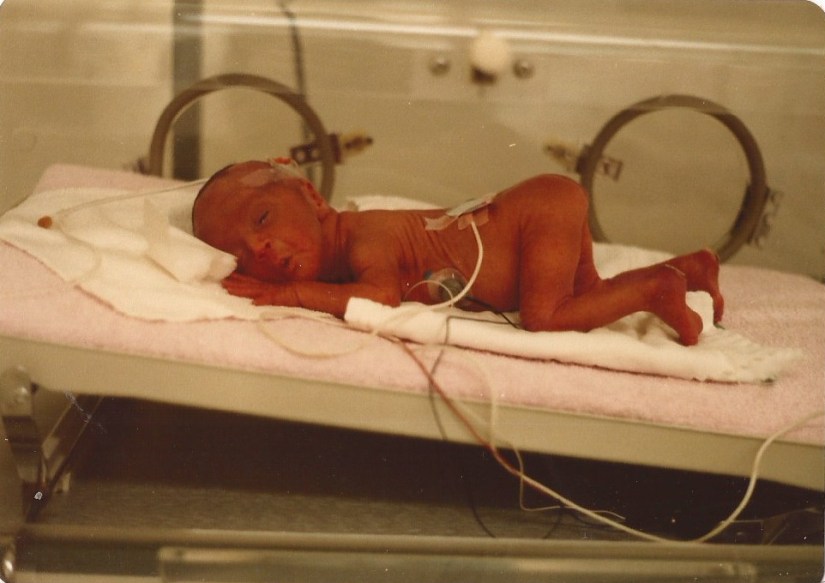
Five days old. 3 lbs. 10 oz.

I have no story of great tragedy or great inspiration. I was born premature. I have a mild disability. My life as a kid was very privileged and very stable. My dad worked hard as a doctor, and my mom worked hard raising four kids and keeping the house running. We lived on five acres outside a city in Northern California. We did chores feeding our sheep and chickens and cats and dogs. I fought with my older brothers and looked up to my older sister.  I had good friends. I did well in school. I wasn’t bullied, or even teased much. Cerebral palsy just affected the way I moved about in my environment. Cerebral palsy was simply my normal.

Danielle at two with walker and metal and leather braces on both legs below the knee.
Me in 1983, complete with walker and leather and metal braces.

In the early 1980s, leg braces were still made out of metal, with leather cuffs. Doctors even tried snapping elastic tethers to the toes of my shoes and to a belt at my waist to attempt to keep my toes from turning in. It took me several years to realize that doctors try out lots of different things without knowing what the outcome will be. They guess and experiment when it comes to CP. They just do it with more education than the rest of us. The elastic tethers from waist to toes did not last long. 

Looking through old photos, I see that I was either held up for the picture, holding on to something myself, or on the ground. Maybe you wouldn’t even notice unless you were looking for it, the evidence that my physical abilities were not at the same level as those of my non-disabled counterparts.

Danielle sits in the sand while her three siblings stand.
Photos like these are typical of my young childhood. I am usually sitting, holding on to something, or being held.
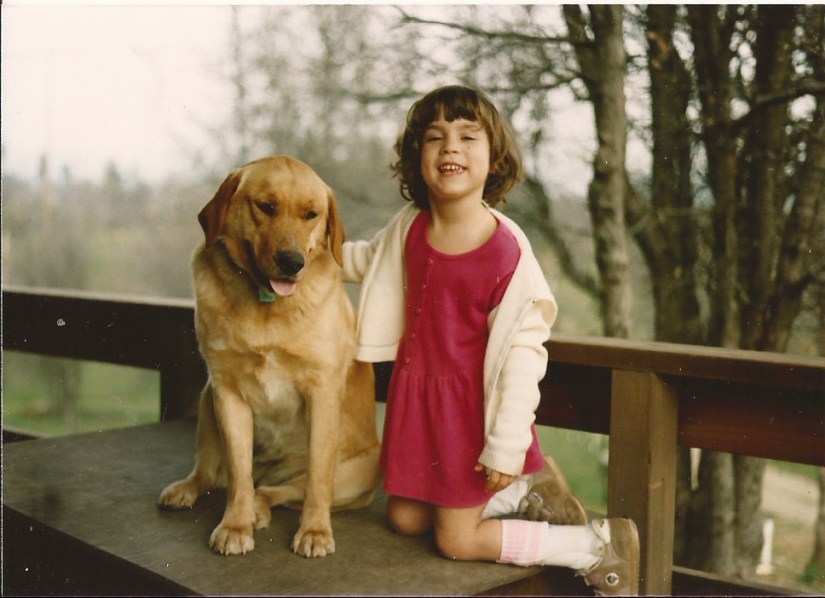
Danielle at five, kneeling with her dog. She's wearing AFOs and Velcro shoes.
Me at five with AFOs and Velcro shoes.
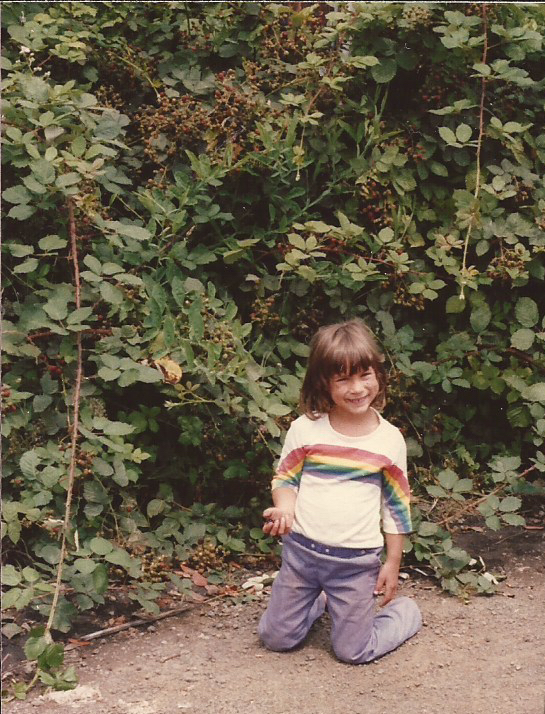
picking blackberries with cerebral palsy
Picking blackberries…on my knees.
Standing, with cerebral palsy, in a parking lot.
Me trying to be “stable.” (I’m not.)

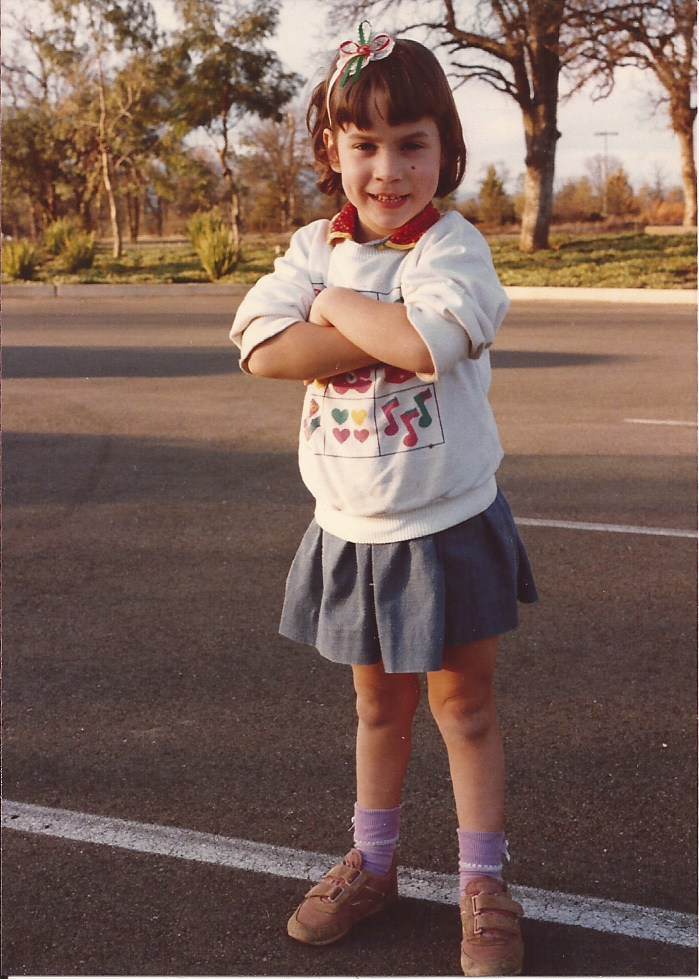
In fact, it was remarkable enough when I was freestanding, that that itself was worthy of documentation. I remember practicing this, being able to stand straight and still. There’s a photo of me at the age of six standing in our church parking lot (a smooth, flat surface). My mother wrote on the back of the photo, “The most stable person in the world.” Funny. It should have been, “Look, Mom, no hands!” 

In my young childhood, I used a walker, and tried forearm crutches. I’ve had several different AFOs (ankle-foot orthotics) and experimented with a cane. I didn’t learn to tie shoelaces until I was old enough to be embarrassed at not knowing how, because all my shoes had Velcro closures to make it easier to wear them with orthotics. 

Casting for AFOs
Getting casted for AFOs. Maybe this guy didn’t use a cast saw and that’s why I’m smiling.

I wasn’t teased much, and I wasn’t in pain, but I was different. I remember in preschool not being able to put my right leg in and shake it all about during the Hokey Pokey. Nor could I “turn myself about” fast enough to clap on “That’s what it’s all about!” I remember getting smooshed green peas stuck to my hand when I crawled up the two wooden steps between the lunchroom and the playroom. There was no handrail, let alone a ramp, in those days. I remember being stuck in the mush pot when we played Duck, Duck, Goose in kindergarten because I could never tag the person that I had to chase. There were lots of things I just plain couldn’t do (though you’re not supposed to admit that when you have a disability). But, I had good upper-body strength, and could hold my own in push-ups and pull-ups during PE. Besides, I liked reading better than anything else, anyway.

Danielle on the monkey bars.
I had good upper-body strength as a kid, and it felt good to be able to do some parts of a jungle gym.
Typical stance for my spastic diplegia.
Here’s my typical stance before my first surgery. Left foot turned in and up on toes.

I went to regular physical therapy. My spastic hip and leg muscles turned my left leg in and up onto its toes. My right leg too, just not as severe. Lots of time and effort were spent trying to strengthen my outer hips and stretch out my inner thighs and hamstrings. I walked up and down the cool linoleum, up and down, while adults analyzed. Sometimes, embarrassingly, my shorts were tucked up into the elastic in the legs of my underwear, the better to see the mechanics of my hips and pelvis. In third grade, I listened as everyone talked about the surgery* that I would have. It would help me walk better. It would fix me? No, my mother said. She had to let me know as I cried, that even after the surgery, I would still have cerebral palsy.

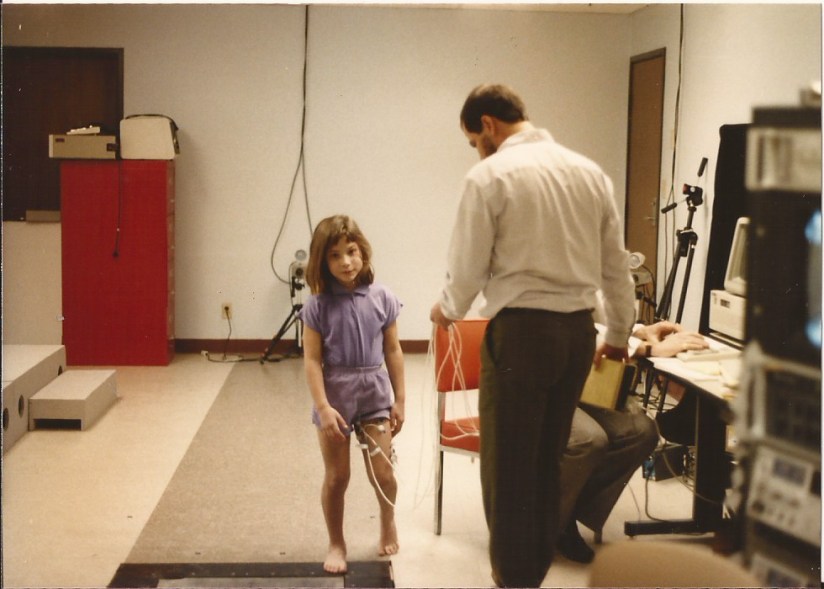
Gait lab for cerebral palsy
This is what a fancy gait lab looked like in 1989.
In the hospital after surgery for cerebral palsy.
My first surgery was very painful. My physical therapist gave me that teddy bear in the pink hoodie to take to the hospital with me. I still have him.
cerebral palsy surgery recovery
Home from the hospital after surgery.

The surgery was very painful, with a long recovery. But it did help my heels come down and gait to be less crouched. 

In sixth grade, I elected to have surgery number two**. My orthopedic surgeon was on the fence about whether the procedure was worth it, and left it up to us to decide. 

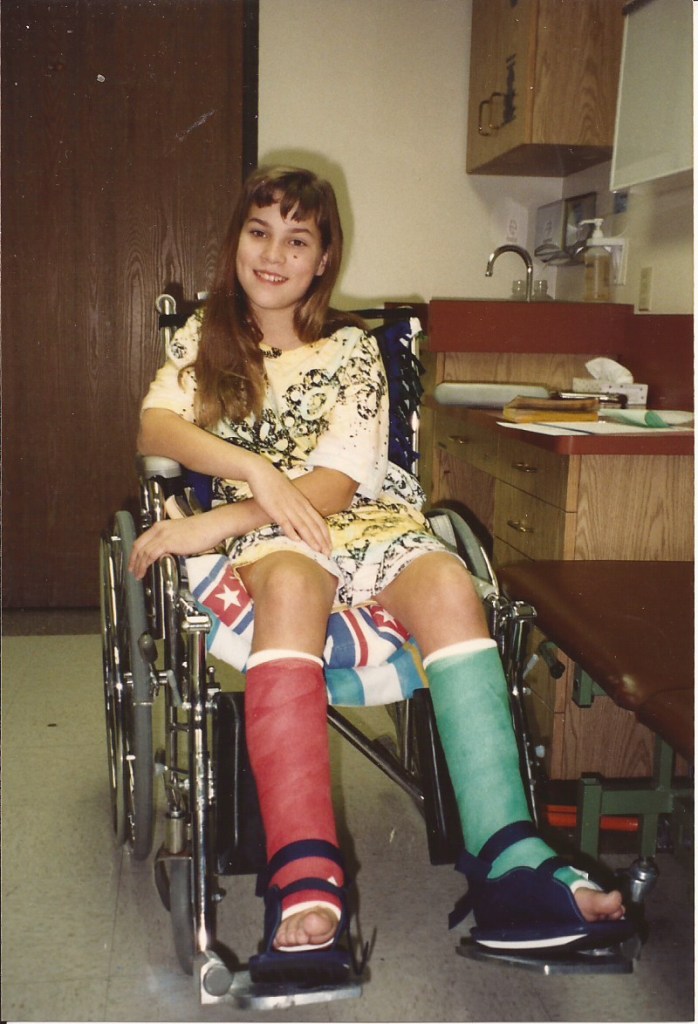
This one was on both feet, which rolled to the inside. Although it wasn’t as major a procedure as the first, nor as painful, it was another long recovery, from wheelchair to walker, to walking on my own again.

In a wheelchair after getting new casts. After surgery for cerebral palsy.
Don’t be fooled by the smile and festive colors. Being in casts (with a pin sticking out both heels) for the holidays was no fun at all.

Kids used to ask me if having CP hurt. I would say no. It didn’t hurt when I walked; it just looked different. I cannot tell you precisely when that changed. Sometimes I wonder if, ironically, it was my lack of physical activity as a kid that held at bay the pain that would come. Don’t get me wrong, over the years I had been given several at-home programs of stretching and exercises to do. We had a stationary bike for me. Dad just used a generous amount of duct tape to get my feet to stay in position on the pedals. Mom dutifully took me to the gym once or twice a week throughout high school, where we worked our way through the program set up by my physical therapist. No, it wasn’t at all embarrassing to be the youngest person in the gym, and the only one with a disability like CP. I hated it all. I resisted. I was a ball of adolescent sunshine.

It wasn’t until college, when I moved to a walkable town with a large university campus, that I really took myself places on foot. Eventually, I moved to a bigger city and walked forty minutes to work (a little over one mile). Anything within a mile radius was doable, and I loved being able to walk around downtown on my own. I learned the public transit system and felt independent, grown up, and fatigued. Somewhere around the age of twenty-five, my legs ached, my muscles were tired. I took naps. Was it thanks to all that I did do growing up that I was able to walk miles on my own? Or should I have been more active and fit throughout my life to be able to better handle this much increase in physical activity? Was it simply the inevitable wear and tear of CP on an adult body? Whatever the cause, I got used to it. So my legs were tired. Just part of life with CP. But it didn’t stop there. 

As I matured, I realized the importance of maintaining physical fitness even when my parents weren’t there to make me. I got another stationary bike, a recumbent one this time, and fashioned my own system, with one side of Velcro on the bottom of my shoes, and the other side of the Velcro on the pedals. No more duct tape! But, I think it was this time with the recumbent bike that injured my SI joints, back in 2010, and they’ve never quite recovered. In 2014, my inner knees began to ache. No particular event set them off, they just…hurt. In 2016, it was my neck. This one really threw me. Hip and knee pain with spastic diplegia? Sure, that makes a certain amount of sense. But constant neck pain was too much to take. I knew my posture wasn’t great, and I knew I spent too much time in front of a laptop. But shouldn’t I be able to help this?

And so I have been trying to address my ongoing pain for most of my adult years. I’ll have a separate post about all the methods I’ve tried. What I’m cautiously hopeful about now, and what has inspired me to start this blog, is the ExoSym. The ExoSym is a hybrid prosthetic‐orthotic, originally designed for service members with injuries severe enough to consider amputation. The device increases mobility and decreases pain for these candidates. More recently, civilians with injuries and disabilities have used it. And if all the videos are to be believed, it’s a life-changing experience. 

Later this month, I’m traveling to the Hanger Clinic in Gig Harbor, Washington, to be casted for and test, my own set of ExoSyms. Here’s to a new chapter in this journey.

* at eight years old: bilateral iliopsoas aponeurotic lengthenings; bilateral medial and lateral hamstring lengthenings; left grasilis lengthening; rectus femoris to sartorius transfers

** at eleven years old: bilateral calcaneal neck osteotomies with lengthening

Introducing Myself

Me in 1983

My name is Danielle. I was born ten weeks premature in 1981. I have mild cerebral palsy (spastic diplegia). Everyone’s CP is unique. Cerebral palsy is a physical disability that affects the body’s ability to control its muscles. There are different kinds of CP, and within each type, varying degrees, from mild to profound. When I was young I was told that CP is permanent, but  “not progressive.” That is, it does not worsen over time. However, it’s more accurate to say that while the damage to the brain does not progress, how CP affects the body over time, can and does change. For me, mild spastic diplegia means that the muscles in my hips and legs are very tight. I have limited control of my pelvis/legs/ankles/feet, and I have very little balance. My left side is more affected than my right. For more information about cerebral palsy in general, visit the Cerebral Palsy Foundation.

The most common question I got as a child was, “What happened to your legs?” By about third grade, after many conversations with my parents, I had developed a short, straightforward response that my peers could understand: “I was born too early. Some blood vessels in my brain broke, and now my brain can’t tell my legs what to do very well.”

These days, when a child asks, “Why do you walk like that?”–or often, “Why do you walk like this?” followed by an imitation–I say, “I have a disability. This is the way I was born.” That’s usually all the explanation they want or need in the moment.

Often, adults still discourage their kids from asking me questions. But not always. One awesome mom in the grocery store, to her child’s loud, whispered, “Why is she walking like that?” said, “I don’t know. Why don’t you ask her?”

I generally welcome questions. Do I always feel like talking about my disability? Of course not. But I understand questions and stares. I find myself inclined to stare at new and different things too. People are curious. I meet the starer’s eyes. I smile. It’s my way of letting them know, I see you too. I’m a person like you. I’m friendly.