So What SHOULD I Hope For?

My first trip to the Hanger Clinic is coming soon. I will be casted on day one, and try out mock-ups, or “test devices” on day two. My last post included a list of actions or activities I used to be able to do. Now, let’s take a quick body scan and assess some chronic pain, shall we? Listening to someone’s aches and pains is not interesting. I know that. This catalogue is so I have my own “before.”

Feet: my left big toe started to send me sharp pain somewhere around…two?…years ago. About a year ago, I realized I was unable to step on it walking barefoot on my laminate flooring. This year, I went to my first podiatrist. He told me to wear stiff-soled shoes and thick, soft insoles. And don’t walk barefoot. I do not walk heel-toe; rather, my whole foot comes down at once, mostly on the big toe. So, I’m grinding the bottom of my toe into the ground with every step. After 38 years, I guess it’s had enough.

Ankles: these are mostly fine, unless I walk too much at once. Hooray!

Knees: One or the other of these aches often. The right started clicking and aching in June 2014, and the left followed in July. A doctor told me to ice them, twenty minutes on, twenty minutes off. What, forever? When I got referred to PT, I asked the therapist if some kind of knee support would help. She had me stand up and put her hands firmly around my knee. “Does that help?” she asked. I almost laughed. You mean if a knee support were going to help me, the pain would lessen right now? Just from that?

Hips and legs: Hips are always very tight. Sometimes I have strong, almost burning, pain in my right IT band. Other times an inner quad might hurt. Often, my right SI joint will give me sharp pain. It changes day to day, sometimes hour to hour. Sometimes I know what set it off; usually I don’t. I know I should avoid twisting while standing. Trying to do anything while bent over, wiping up a spill on the floor for example, is a really bad idea unless I take the strain off my hips and legs by holding onto something.

Back: I do not think of myself as having back pain. But sometimes at the close of a long walk, there is a pain and stiffness in my lower back that makes it hard to breathe. I stagger to a seated position and bend over my lap. A few cracks and a deep breath and I can straighten up again. I realized the other day that I “don’t have back pain” because I can make it go away. Apparently, I only count chronic pain as real pain.

Trapezius: If you’ve never looked at an image of the trapezius, check it out. It’s a giant muscle from the base of the skull, out to the shoulders, tapering to the middle spine. Since 2016, my neck and shoulders have been painfully tight. I know I have terrible posture. Telling me to sit up straight isn’t helpful. It takes a tremendous amount of energy to maintain good posture. Certainly while walking, it’s nearly impossible for me. Is PT helping? Can’t say for sure.

Jaw and ear: Yes, my jaw and ear hurt sometimes, just the right ones. It’s all connected. I think the constant neck tension is pulling my jaw and ear out of alignment. The years of extra strain on my stronger right side as it compensates for the left is taking its toll. If you’ve never had sharp, intense pain in your ear, be grateful. 

This is the state of things. Pain from head to toe. Perhaps not all directly related to cerebral palsy, but definitely indirectly affected by it. I have tried many modalities to address the issues.

The ExoSym is life-changing. All the people in the videos say so. But what about all the people who aren’t in videos? How many try out the test device and decide not to move forward? Maybe it won’t be life-changing for me. Maybe I’ll still have chronic pain and very limited balance. It won’t do a thing for my muscle spasticity. It won’t make cerebral palsy disappear. The people who put on the test device and are “pain free”  right then and there are usually people who were able-bodied before having some kind of foot or ankle injury. 

My pain comes from a lifetime of atypical body mechanics. It’s going to be a different kind of experience for me. How can an hour or two in the test devices show me how they might affect my body long-term? I don’t expect any of my chronic pain to be immediately relieved. I’ve never felt an immediate improvement in anything physical in my life. Never have I been able to report back to a doctor or therapist, “Yes, _______ definitely helps.” 

So what will the ExoSym do for me? What is a realistic hope? I hope that I feel lighter, that I can feel the “energy return” that the brace is designed to provide.

I hope that I feel something. That I can tell the devices are doing something.
What I Used to Do

I used to

  • Do pull-ups. Many. When I was eight.
  • Do that bridge thing where you lie on your back with your knees bent, hands by your ears, and push up off the floor
  • Jump rope. Kind of.
  • Touch my toes (sitting with legs out straight)
  • Play “tennis” at summer camp / be a batter during PE baseball
  • Pick up nickels from the sidewalk
  • Sit cross-legged on the floor
  • Step up curbs. Even down!
  • Walk up stairs without a railing. Sometimes.
  • Walk down a stair or two with my hand hovering over the railing, just to see if I could.
  • Handcycle for miles
  • Walk without pain
  • Travel solo, knowing that I would be okay
  • Live without constant neck tension and pain
  • A little hiking, with help
  • Climb ladders
  • Jump off a diving board
  • Look over my shoulders
  • Walk comfortably in bare feet, without my left big toe trying to kill me
  • Know that I could get up off the ground if I fell
  • Carry groceries for blocks

Some changes happen so slowly we don’t even notice them. Now, I need to walk out of my way to get to a curb cut, because I can’t trust my body to take me safely up a curb (and certainly not down!). Now I walk on by nickels and dimes on the sidewalk; might just tip right over if I tried to pick them up.

I know that most every adult can look back on themselves as children and ponder their lost agility. I don’t expect that I should be able to do pull-ups the way I did when I was eight. I would like to feel confident that I can step over an obstacle in my path or pick up something off the floor. Full disclosure, I can sometimes pick stuff up without needing to hold on to something. If I’m in my own home and I give my back enough time to slo-o-o-wly bend forward, I can do it. But if I’m walking to work and someone drops something, I don’t pick it up for them. Not with my backpack on. Not when it needs to be quick. Rather than moving them out of harm’s way, I simply apologize to the worms and snails in the middle of the path, who will soon be flattened by oblivious cyclists’ tires.

It’s difficult for me to acknowledge that some of these changes have been over, not decades, but only a handful of years. I’m not doing enough, right? I’m not being consistent enough with my physical therapy, nor do I push myself enough to stay active. But sitting on the floor, on the rug in the living room, or in my bedroom. In the past, that’s where I liked to be. Didn’t I do it every day? When did I stop?

Applying for the ExoSym

I first heard about the ExoSym device from CerebralPalsyStrong, a website that started out as Teen Cerebral Palsy, run by a young woman with hemiplegia, Katy Fetters. The video of her experience and the links she shared convinced me to contact the Hanger Clinic in September 2019. There are Hanger Clinics all over the place, but the only one that does the ExoSym is in Gig Harbor, Washington. That’s where the guy who invented the device works, and he reviews every case himself.

Prosthetist Ryan Blanck designed the ExoSym in 2009. His goals were to reduce pain and restore mobility to active-duty and retired service members with limb salvage conditions as a way to avoid amputation. The device provides increased dynamics and energy return. In 2013, Ryan joined Hanger Clinic to bring the ExoSym to civilians with severe lower-extremity conditions or injuries (info from Hanger Clinic).

I emailed them expressing interest, and they responded with the application, instructions, and a long list of articles and video links about others’ experiences. Suddenly, I’m learning about a woman from New Zealand who was born with clubfeet, now walking miles, and a man with spina bifida now going hiking. And they all say the same thing: the ExoSym is life changing.

I got started on the paperwork, which was a series of PDFs I needed to print, fill out, scan, and email back. One document was a four-page questionnaire about my abilities, similar to a PT intake form where I rated my ability to perform various tasks from “extreme difficulty” to “no difficulty.” Rolling over in bed? Moderate difficulty. Squatting? Unable to perform. Sitting for one hour? That I can do. After another twenty questions about strength and range of motion (limited and limited), it was time to record a video of the way I walk. I’ve included it below so you can see it in all its glory.

Let me say this. I know that I look different than those with typical gait. Obviously. But to me, I’m just walking. I can feel that I’ve got a significant side-to-side sway if I pay attention. Do I make myself feel a bit seasick if I walk around after eating too much? Yes, yes I do. But do I really know what it looks like? No. I think many ambulatory cerebral palsians out there will relate when I say I’ve been startled by my reflection when I walk past a store window. So there’s nothing quite like walking for the camera and then watching it back. I mean, geez! Do you see that right hand? So helpfully flexing at the wrist while the fingers point? This is what I look like. It looks rather laborious, doesn’t it? It is.

I sent all my questionnaires, and my insurance info, and my photos and video. And I waited. What would Ryan say? Could the Exosym help me? Would I be a good match? Would I have one on just my left leg, the more affected side? Or both? Or would he say no, it’s not for me?

Finally, I hear back. I’m a good candidate! Excitement floods through me. But my insurance doesn’t cover it. Here is what I understand from the explanation given to me: the ExoSym has been coded by the insurance company as a regular AFO, which are much less expensive to make than the ExoSym device. If Hanger Clinic were to accept my insurance, then they, the Clinic, would be on the hook for most of the cost. Which they cannot afford to do. The woman from Hanger assured me that I could come to Washington, get casted and try the test devices, just to see if it’s worth it to move forward, at no cost. Then I could take time to save or raise money, use their in-house payment plan, and make my first payment only upon receiving the real devices. 

Okay, don’t panic. Maybe I could get a different insurance? We were just in the enrollment window for me to be added to my husband’s insurance for next year. When I email Hanger and ask whether his insurance would cover it, I receive a form reply in bold, all caps, and underlined: 

The ExoSym® program is a PRIVATE PAY PROGRAM; the current description and associated reimbursement from insurance companies does not correctly describe nor compensate for the Program. As such, we are no longer able to provide the ExoSym® Program through any private or commercial insurances with the exception of Worker’s Comp, Standard Medicare (not replacement plans), Cigna, United Healthcare Commercial Plans, our local Premera (WA/AK) only.  

Now I feel that I have been yelled at. I wonder why she hadn’t just explained this to me in the first place. I understand that they don’t want to scare potential patients away. But I also think that people need to be prepared and not have their hopes for, literally, a better (quality of) life dashed because of money. If they know the facts going in, they can start planning, saving, crowdfunding.

I know you’re wondering. How much is it? I will need two devices, and mine will come with the addition of knee joints. As of September 2019, each device (no knee) is $9,000. That’s $18,000, plus $1,704 for two knees. A grand total of $21,408 for the devices and several days of training at the clinic. Not to mention travel and lodging. No big deal for some. A very big deal for most. 

With the in-house payment plan and some very generous family members, I will be able to afford my ExoSyms, and I am so grateful.  

Growing Up with Cerebral Palsy

My mother tells me that I was eighteen months old when I realized I was different. I was playing on the floor with another toddler, and I stared after him as he stood up from the floor and walked across the room. 

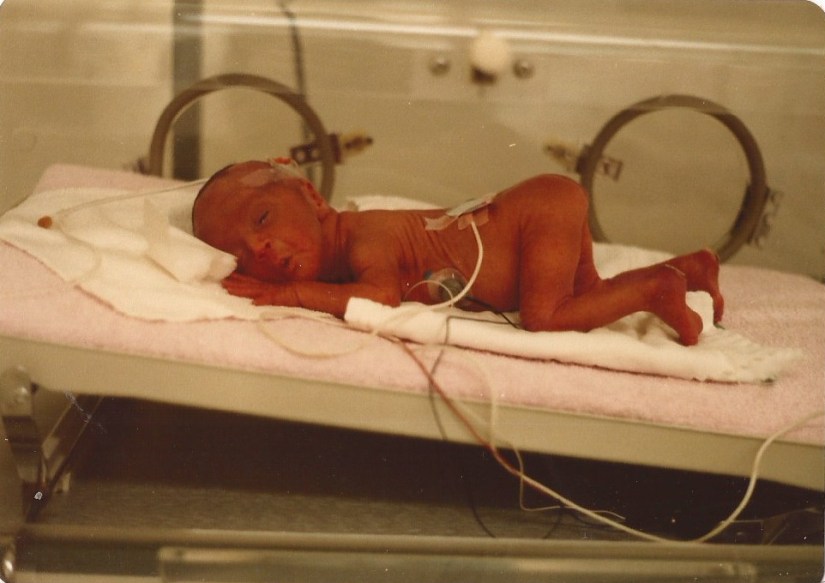
Five days old. 3 lbs. 10 oz.

I have no story of great tragedy or great inspiration. I was born premature. I have a mild disability. My life as a kid was very privileged and very stable. My dad worked hard as a doctor, and my mom worked hard raising four kids and keeping the house running. We lived on five acres outside a city in Northern California. We did chores feeding our sheep and chickens and cats and dogs. I fought with my older brothers and looked up to my older sister.  I had good friends. I did well in school. I wasn’t bullied, or even teased much. Cerebral palsy just affected the way I moved about in my environment. Cerebral palsy was simply my normal.

Danielle at two with walker and metal and leather braces on both legs below the knee.
Me in 1983, complete with walker and leather and metal braces.

In the early 1980s, leg braces were still made out of metal, with leather cuffs. Doctors even tried snapping elastic tethers to the toes of my shoes and to a belt at my waist to attempt to keep my toes from turning in. It took me several years to realize that doctors try out lots of different things without knowing what the outcome will be. They guess and experiment when it comes to CP. They just do it with more education than the rest of us. The elastic tethers from waist to toes did not last long. 

Looking through old photos, I see that I was either held up for the picture, holding on to something myself, or on the ground. Maybe you wouldn’t even notice unless you were looking for it, the evidence that my physical abilities were not at the same level as those of my non-disabled counterparts.

Danielle sits in the sand while her three siblings stand.
Photos like these are typical of my young childhood. I am usually sitting, holding on to something, or being held.
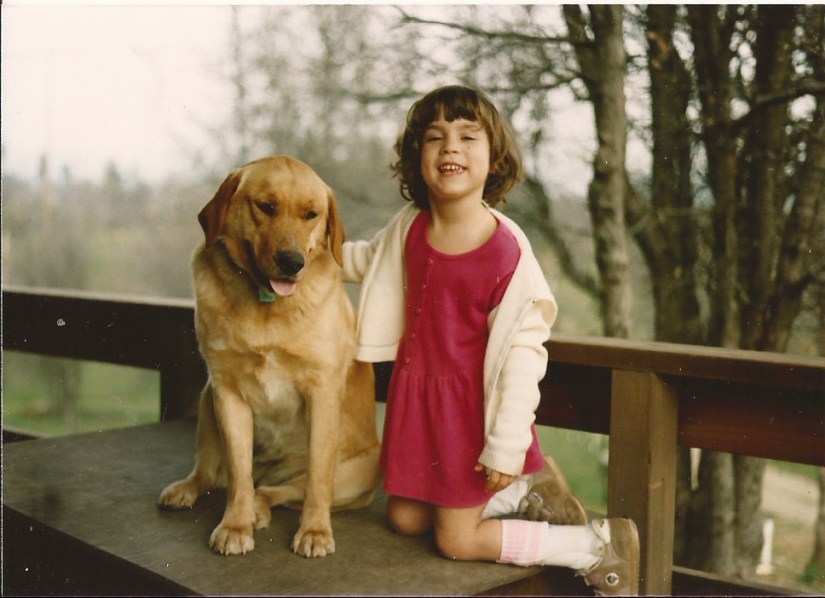
Danielle at five, kneeling with her dog. She's wearing AFOs and Velcro shoes.
Me at five with AFOs and Velcro shoes.
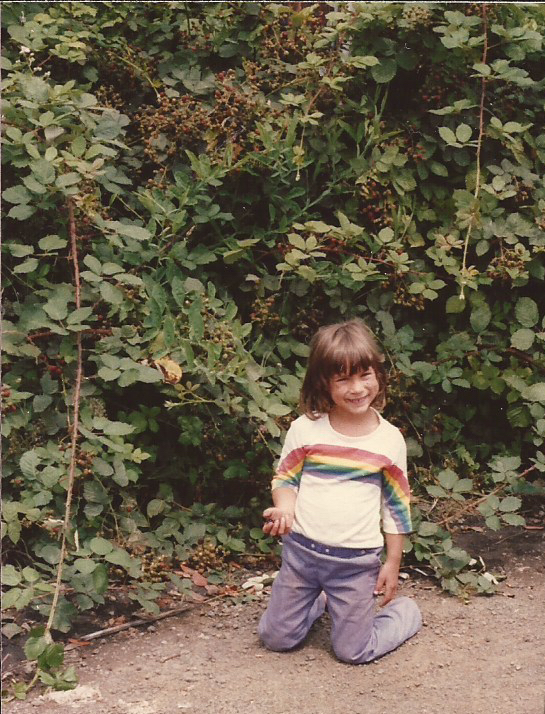
picking blackberries with cerebral palsy
Picking blackberries…on my knees.
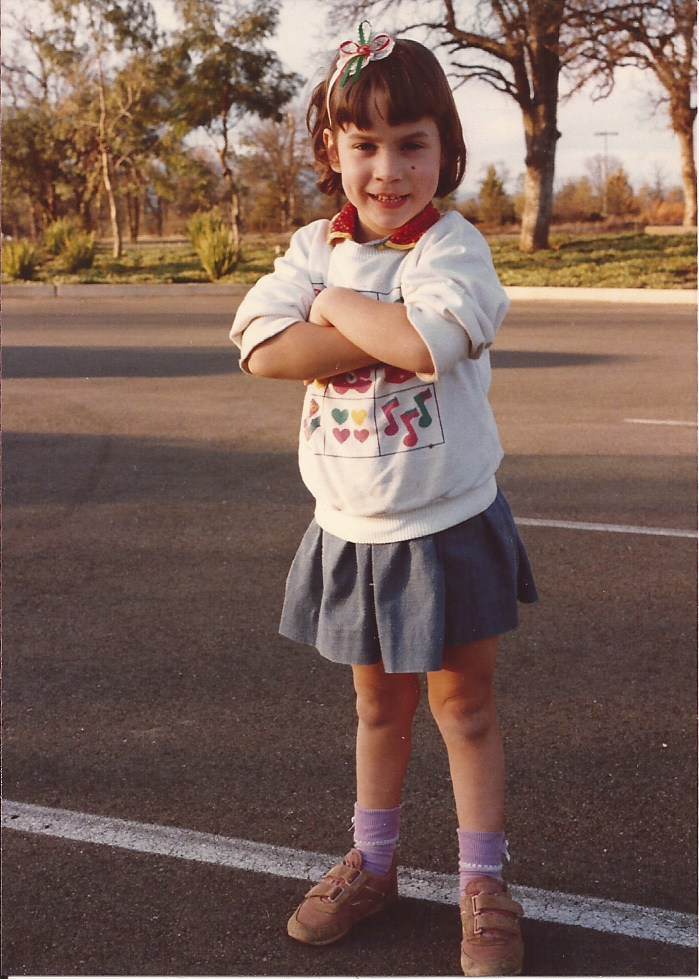
Standing, with cerebral palsy, in a parking lot.
Me trying to be “stable.” (I’m not.)

In fact, it was remarkable enough when I was freestanding, that that itself was worthy of documentation. I remember practicing this, being able to stand straight and still. There’s a photo of me at the age of six standing in our church parking lot (a smooth, flat surface). My mother wrote on the back of the photo, “The most stable person in the world.” Funny. It should have been, “Look, Mom, no hands!” 

In my young childhood, I used a walker, and tried forearm crutches. I’ve had several different AFOs (ankle-foot orthotics) and experimented with a cane. I didn’t learn to tie shoelaces until I was old enough to be embarrassed at not knowing how, because all my shoes had Velcro closures to make it easier to wear them with orthotics. 

Casting for AFOs
Getting casted for AFOs. Maybe this guy didn’t use a cast saw and that’s why I’m smiling.

I wasn’t teased much, and I wasn’t in pain, but I was different. I remember in preschool not being able to put my right leg in and shake it all about during the Hokey Pokey. Nor could I “turn myself about” fast enough to clap on “That’s what it’s all about!” I remember getting smooshed green peas stuck to my hand when I crawled up the two wooden steps between the lunchroom and the playroom. There was no handrail, let alone a ramp, in those days. I remember being stuck in the mush pot when we played Duck, Duck, Goose in kindergarten because I could never tag the person that I had to chase. There were lots of things I just plain couldn’t do (though you’re not supposed to admit that when you have a disability). But, I had good upper-body strength, and could hold my own in push-ups and pull-ups during PE. Besides, I liked reading better than anything else, anyway.

Danielle on the monkey bars.
I had good upper-body strength as a kid, and it felt good to be able to do some parts of a jungle gym.
Typical stance for my spastic diplegia.
Here’s my typical stance before my first surgery. Left foot turned in and up on toes.

I went to regular physical therapy. My spastic hip and leg muscles turned my left leg in and up onto its toes. My right leg too, just not as severe. Lots of time and effort were spent trying to strengthen my outer hips and stretch out my inner thighs and hamstrings. I walked up and down the cool linoleum, up and down, while adults analyzed. Sometimes, embarrassingly, my shorts were tucked up into the elastic in the legs of my underwear, the better to see the mechanics of my hips and pelvis. In third grade, I listened as everyone talked about the surgery* that I would have. It would help me walk better. It would fix me? No, my mother said. She had to let me know as I cried, that even after the surgery, I would still have cerebral palsy.

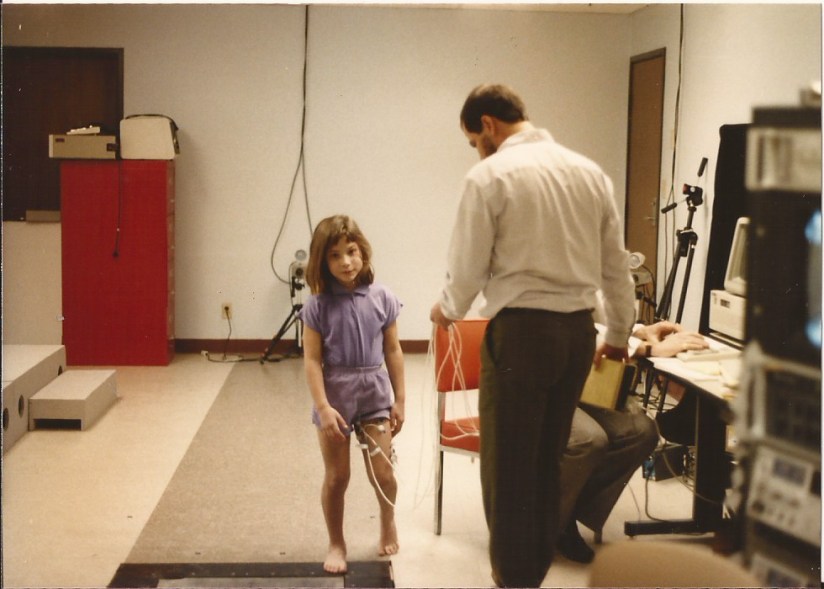
Gait lab for cerebral palsy
This is what a fancy gait lab looked like in 1989.
In the hospital after surgery for cerebral palsy.
My first surgery was very painful. My physical therapist gave me that teddy bear in the pink hoodie to take to the hospital with me. I still have him.
cerebral palsy surgery recovery
Home from the hospital after surgery.

The surgery was very painful, with a long recovery. But it did help my heels come down and gait to be less crouched. 

In sixth grade, I elected to have surgery number two**. My orthopedic surgeon was on the fence about whether the procedure was worth it, and left it up to us to decide. 

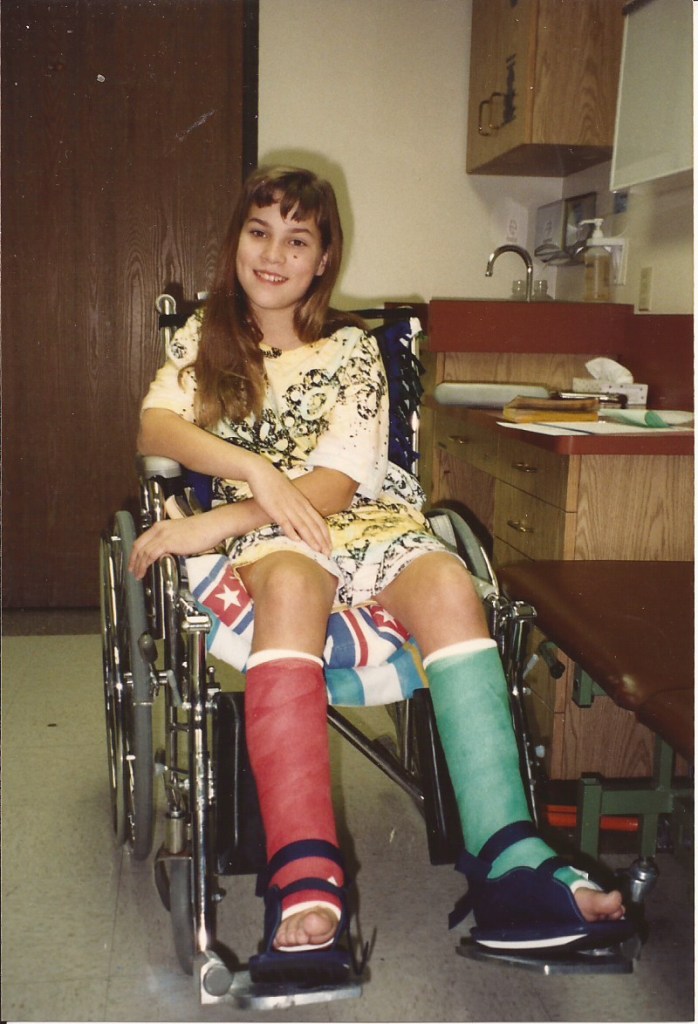
This one was on both feet, which rolled to the inside. Although it wasn’t as major a procedure as the first, nor as painful, it was another long recovery, from wheelchair to walker, to walking on my own again.

In a wheelchair after getting new casts. After surgery for cerebral palsy.
Don’t be fooled by the smile and festive colors. Being in casts (with a pin sticking out both heels) for the holidays was no fun at all.

Kids used to ask me if having CP hurt. I would say no. It didn’t hurt when I walked; it just looked different. I cannot tell you precisely when that changed. Sometimes I wonder if, ironically, it was my lack of physical activity as a kid that held at bay the pain that would come. Don’t get me wrong, over the years I had been given several at-home programs of stretching and exercises to do. We had a stationary bike for me. Dad just used a generous amount of duct tape to get my feet to stay in position on the pedals. Mom dutifully took me to the gym once or twice a week throughout high school, where we worked our way through the program set up by my physical therapist. No, it wasn’t at all embarrassing to be the youngest person in the gym, and the only one with a disability like CP. I hated it all. I resisted. I was a ball of adolescent sunshine.

It wasn’t until college, when I moved to a walkable town with a large university campus, that I really took myself places on foot. Eventually, I moved to a bigger city and walked forty minutes to work (a little over one mile). Anything within a mile radius was doable, and I loved being able to walk around downtown on my own. I learned the public transit system and felt independent, grown up, and fatigued. Somewhere around the age of twenty-five, my legs ached, my muscles were tired. I took naps. Was it thanks to all that I did do growing up that I was able to walk miles on my own? Or should I have been more active and fit throughout my life to be able to better handle this much increase in physical activity? Was it simply the inevitable wear and tear of CP on an adult body? Whatever the cause, I got used to it. So my legs were tired. Just part of life with CP. But it didn’t stop there. 

As I matured, I realized the importance of maintaining physical fitness even when my parents weren’t there to make me. I got another stationary bike, a recumbent one this time, and fashioned my own system, with one side of Velcro on the bottom of my shoes, and the other side of the Velcro on the pedals. No more duct tape! But, I think it was this time with the recumbent bike that injured my SI joints, back in 2010, and they’ve never quite recovered. In 2014, my inner knees began to ache. No particular event set them off, they just…hurt. In 2016, it was my neck. This one really threw me. Hip and knee pain with spastic diplegia? Sure, that makes a certain amount of sense. But constant neck pain was too much to take. I knew my posture wasn’t great, and I knew I spent too much time in front of a laptop. But shouldn’t I be able to help this?

And so I have been trying to address my ongoing pain for most of my adult years. I’ll have a separate post about all the methods I’ve tried. What I’m cautiously hopeful about now, and what has inspired me to start this blog, is the ExoSym. The ExoSym is a hybrid prosthetic‐orthotic, originally designed for service members with injuries severe enough to consider amputation. The device increases mobility and decreases pain for these candidates. More recently, civilians with injuries and disabilities have used it. And if all the videos are to be believed, it’s a life-changing experience. 

Later this month, I’m traveling to the Hanger Clinic in Gig Harbor, Washington, to be casted for and test, my own set of ExoSyms. Here’s to a new chapter in this journey.

* at eight years old: bilateral iliopsoas aponeurotic lengthenings; bilateral medial and lateral hamstring lengthenings; left grasilis lengthening; rectus femoris to sartorius transfers

** at eleven years old: bilateral calcaneal neck osteotomies with lengthening

Introducing Myself

Me in 1983

My name is Danielle. I was born ten weeks premature in 1981. I have mild cerebral palsy (spastic diplegia). Everyone’s CP is unique. Cerebral palsy is a physical disability that affects the body’s ability to control its muscles. There are different kinds of CP, and within each type, varying degrees, from mild to profound. When I was young I was told that CP is permanent, but  “not progressive.” That is, it does not worsen over time. However, it’s more accurate to say that while the damage to the brain does not progress, how CP affects the body over time, can and does change. For me, mild spastic diplegia means that the muscles in my hips and legs are very tight. I have limited control of my pelvis/legs/ankles/feet, and I have very little balance. My left side is more affected than my right. For more information about cerebral palsy in general, visit the Cerebral Palsy Foundation.

The most common question I got as a child was, “What happened to your legs?” By about third grade, after many conversations with my parents, I had developed a short, straightforward response that my peers could understand: “I was born too early. Some blood vessels in my brain broke, and now my brain can’t tell my legs what to do very well.”

These days, when a child asks, “Why do you walk like that?”–or often, “Why do you walk like this?” followed by an imitation–I say, “I have a disability. This is the way I was born.” That’s usually all the explanation they want or need in the moment.

Often, adults still discourage their kids from asking me questions. But not always. One awesome mom in the grocery store, to her child’s loud, whispered, “Why is she walking like that?” said, “I don’t know. Why don’t you ask her?”

I generally welcome questions. Do I always feel like talking about my disability? Of course not. But I understand questions and stares. I find myself inclined to stare at new and different things too. People are curious. I meet the starer’s eyes. I smile. It’s my way of letting them know, I see you too. I’m a person like you. I’m friendly.