One of Many

I’m still here, still struggling both mentally and physically. I haven’t felt like there’s anything much I want to say. But Disability Pride Month has come around again, so here’s a link to last year’s post which still sums up things for me nicely.

I have been feeding my YouTube addiction with some new content. I already follow several people with disabilities, and YouTube recently suggested a new one to me. Brooke Eby (@limpbroozkit) who is mainly on Instagram and TikTok, I think, as her content is usually short form. She started making videos 3 years ago when she was diagnosed with ALS. I was sucked into her story because she’s a fast talker with deadpan humor and great hair.  Brooke was 29 when she started having symptoms and 33 when she was diagnosed. It started with weakness in her left leg, which is also my weakest limb. She has a video that shows the progression of her symptoms and mobility aids. She starts by wearing a small brace on the left foot, then a bigger brace and a cane, then braces on both legs, a walker, a wheelchair. In later videos, she displays her stiffening fingers, how she can no longer lift her arms, and how she discovered that with a weak core, it’s difficult to cough and blow your nose.

ALS can start in a limb, like it did with Brooke, or it can start in the throat and affect your ability to speak and eat from the beginning. Every three months Brooke goes to the hospital for her breathing test and every three months she gets to know how much worse she’s doing. When she started, her lung capacity was over 100 (out of 100), and now it’s in the 30s. Or it was when she last made a video about it. She wears her bipap (a noninvasive ventilation device) almost all the time now. And she recently got a feeding tube because even though she doesn’t need it yet, she needed to do the surgery while her breathing was still strong enough that it was safe to be under anesthesia. 

It’s been a decade since the ALS Ice Bucket Challenge, which dramatically increased awareness of ALS and raised a lot of money for research, but has not yet led to effective treatment. The average lifespan after diagnosis is two to five years. We think of ALS as a rare disease, but it is not. It occurs in 1 in 300 people. It’s just that it kills people so quickly that there aren’t many people with ALS alive at one time. 

YouTube doesn’t feed me these short videos in chronological order, and it’s so disconcerting to see a more recent one and then watch an older one in which the disease hasn’t progressed as far. First, she’s showing us tools that she uses to make her solo apartment in New York more accessible, and then she makes a video about moving back in with her parents. From watching Brooke and her dad demonstrate how they use a lift, to going back in time to Brooke putting accessible shoes on, doing her makeup and brushing her hair. It’s wild to have this video record of the speed at which ALS changes someone. Brooke says that hers is a slower-progressing form and that it’s slow enough for her to make the mental adjustments and get used to it. For me, it’s hard to watch someone show off their new electric can opener in a video from a couple years ago, and know that now she cannot grip the can opener at all. It seems that as fast as she and her family acquire the right equipment to help them live, her needs change again. One in 300. 

So why am I obsessing over Brooke’s story, checking for updates, wondering how much longer she’ll be able to use her voice? ALS reminds me so much of CP. Only it’s like the person with ALS is going through CP in ALL its forms, on fast forward: the muscle weakness and stiffness, lack of control, the various mobility aids, the need to constantly adapt. But CP doesn’t kill you and ALS does. Why haven’t we figured out an effective, accessible treatment yet?

There’s a quote, apparently by Theodore Roosevelt that proclaims, “Comparison is the thief of joy.” If we compare ourselves to other people who seem to have it better than we do, we feel sad, frustrated, jealous, inadequate, etc. But often, in the context of disability content, we’ll see lots of comments like, “I thought I had it bad, but after seeing what you’re going through, my life is looking pretty good!” It’s insensitive and insulting. Basically, “Wow, sucks to be you!” A terminal disease, while disabling, is very different from other physical disabilities. ALS does suck. We actually do need a cure for ALS. Am I seeing my cerebral palsy from a different perspective after following Brooke’s journey? Yes. I think people with CP are good at not taking the abilities they do have for granted. I have always been so very aware of, and so very grateful for, my ability to use my hands and fingers, to speak clearly, to use the bathroom alone, to roll over in bed even though it isn’t easy. But after learning more about ALS, I have also been savoring my ability to take a deep breath, to swallow, to scratch my nose. It’s a different feeling, a more accepting one. Yes, my body hurts. My throat pain is a constant because the muscles are tight. It’s true that my body can no longer do what it once did and that it will continue to decline. That is not unique to me, or to cerebral palsy. So many people are living with unpredictable, undependable, painful bodies. For so many reasons and in so many ways. I am in good company. It feels better, to not be struggling alone, but to be one of many who are living on the “my body is not typical” spectrum. When I stand up from a chair and my feet and back are so stiff and painful that I can barely straighten up and move, I try to remember that that is just fine. That is how things are, and it’s okay for my feet and back to be stiff, to hurt. It’s part of being me, of being alive. It’s as if all those years of meditation practice, about acceptance and surrender, might just be starting to mean something to me.

People with disabilities are the largest minority and the only minority that anyone can join at any time. That may sound ominous or threatening, but it is only the truth. After I watched Brooke’s videos, YouTube’s algorithm suggested other people with ALS to me. One is a 21-year-old girl, whose whole body is affected already, and who, if I didn’t know her diagnosis, I would think had CP. But she is dying, both slowly, and much too quickly. YouTube continued to suggest other people with disabilities, too, paraplegics and quadriplegics. A skiing accident, a car accident, even a hammock accident (which is more common than you think), and people’s lives become so different than they could have imagined or planned for. Every spinal cord injury is unique; there’s so much variation in how much sensation and movement is recovered. Some people are still very independent with their activities of daily living (ADL) and some people need almost complete care. And some of those people choose to share their lives online and show us what it’s like to use a catheter to pee, have a “bowel program” to poop, or have a preferred person feed them because that person takes the time to create a well-balanced bite. From an able-bodied (and probably uninformed) perspective, it’s all about walking again, but there’s so much more to life and to living than walking. 

So many people with illnesses, injuries, and disabilities don’t have the option of choosing braces today or not, walking poles today, or walker. They use the tools they need to use to live, whatever those tools are. I’m still at a place in my life and my disability where I have a choice in some ways. The choice to walk out the door without a mobility aid is gone, but options still abound in other ways. And that’s simply how life is. All these statements I’m making are not revelatory. I’ve thought these thoughts before. They’re just making a softer landing in my mind these days, and settling in.

How to Be a Functional Adult When Your Mind and Body Don’t Want To

Hello, my name is Danielle, and I am a YouTube addict. I love watching people declutter and organize their closets, turning chaos into something functional and nice. I love watching people mow and trim overgrown yards and sidewalks, turning chaos into something functional and nice. I watch people restore furniture and renovate houses and make food, I watch the Vlogbrothers, I watch people with disabilities share their lives, I watch dance and music. And I do it all sitting down. Or lying down. My mind and body are at rest and there are stories and journeys unlimited to jump into and I could stay there in that cocoon forever and ever amen.

Sometimes I remind myself as I click on one more video that this is my one life. Is this how I want to spend it? Is this video enriching my life in any way beyond passing enjoyment? I know it’s time to close my laptop and do other things. But it’s so hard. I know it’s not just me. I know that it’s a worldwide cultural phenomenon, with the internet in our hands, our heads bent to our phones, scrolling and scrolling and scrolling. I’ve been very careful to not join Instagram or tiktok or whatever else is out there because Facebook and YouTube are already too much. They are almost magical places where we can create our own bubbles of people who love what we love and we can immediately find a site or a video on anything that piques our interest. This kind of internet was unfathomable to me in 2005.

I think about 2005 me sometimes, and not just because I was in my twenties and had more energy and less pain. In 2005, I walked from my apartment to the public library and I logged on to a computer to check my email. I checked my beloved message boards where fans of figure skating and Broadway musicals gathered. Then I logged off and checked out books. Paper ones. Or movies on disc, or CDs! That was the time of listening to every Beatles album and finally hearing Leonard Bernstein’s MASS. Oh, my heart. The way the internet and our lives have changed since then makes my head spin and my heart ache. The internet has been a tool for so much good, for connecting people and making political movements like #metoo and #BlackLivesMatter, and so many others, globally accessible. Accessibility is one of the greatest positives of the internet. I watched Joan Baez dance on her 80th birthday! I saw the original cast of Ragtime share their memories and the cast of The West Wing come together to play trivia and encourage people to vote. These moments brought me joy. 

But my daily consumption of YouTube and Facebook does not typically make my heart sing. 2005 me could not conceive of YouTube and Facebook. 2005 me was reading, journaling, listening to music, and going outside, for goodness’ sake. (And watching a lot of TV and movies, too. Let’s not be too rose-colored about the past.) 

The title of this post is utterly laughable because I don’t know how to be a functional adult when my mind and body don’t want to. We all know what we should do. Of course we know. I know that I should go for a walk and do my PT and eat less sugar and more vegetables and put my phone down and do deep breathing. I have tried to curb my internet addiction. The truth is, I do not want to give up Facebook and YouTube entirely because there is real value in them for me. 

I have tried no phones in bed, no screen time after 9pm, only allowing myself access on one or two days a week, or only after 5pm, or for only thirty minutes a day. All of these self-imposed limits work for a while and then I gradually let them slip away.

Now that I am legitimately middle-aged, only working a few hours a week, and finally back on SSDI (hooray!), I have the kind of time so many people dream of. Everyone out there who’s working full time and raising kids, they wish for some free time to work on labors of love or to rest and read.

But what am I doing with my one life? I am existing. I am tired. Sometimes I take a shower and sometimes I don’t. Some days I cook and do laundry and some days I don’t. Some days I read and listen to music. Some days I don’t. I am not alone in this, and my company isn’t only others with disabilities.

When did we become a society that makes half-serious jokes about earning a sticker for putting on pants? When did “adult” become a verb? Why does everything feel so hard? Not just for those of us with disabilities, but for so many?

I did not create this sticker. I found it here: https://bigmoods.com/products/i-put-on-pants-today-trophy-sticker

I don’t think social media is helping, with its ocean of “morning routines” and “night routines” and “how to be productive” videos. There is literally–and this is the correct use of the word–only one task I consistently complete every day of my life. I brush my teeth. That is it, the single task that is my daily routine. I can almost add one more thing to that list. Since adopting Maddie, I have fed her and scooped her litter box. Because she, through no choice of her own, is dependent on our care, and she needs and deserves food and water and pleasant conditions in which to carry out her bodily functions, I have met those needs out of love and respect for her. But I have not done these tasks every day. On days when I’ve been injured or my knees have been hurting, my husband has taken over. (We need to help out my body by raising the litter boxes off the floor, but we haven’t gotten there yet). 

Meeting the most basic of bodily needs, my own and my cat’s, seems to be what I am capable of. Will this ever get better, or continue to slowly get worse? Even when I successfully avoid endless scrolling, it doesn’t mean I have the energy to complete the tasks required in order for us to stay clothed, and fed, with a clean-enough body and a clean-enough home. 

It’s not that I feel I must be productive. Let’s continue to dispel the idea that one’s productivity is tied to their value as a person. It’s not productivity that I want, but to live a good life, to not feel that I’ve squandered precious time, to live with care and gratitude, to be present, and to nourish and love myself and others.

I love making lists. Yes, I am absolutely one of those people who will write something on the list that I have already completed, just so that I can cross it off. The items on the list might be as simple as taking my vitamins or journaling. Lists are not only for “chores,” but also for self-care. There are so many little things to remember to do every day, even things that I genuinely want to do, or to incorporate into my life, that I just don’t seem to be able to make stick.

My latest method has been the kanban board. This method of project management is not new; there are lots of versions out there, and it can be as simple or as complex as needed. Mine is simply three columns: To Do, Doing, Done. I found a magnetic whiteboard and ordered some magnetic dry-erase rectangles to use in place of sticky notes, and I put it up right next to my desk. The idea was to have the visual there for me, and to have an interactive component (moving the magnets across the columns).

I liked it for a while, but I’ve learned that it works well for some things and not for others. I put things that I want to become part of my everyday life in the To Do column: vitamins, PT, meditation, tapping. (I set up my environment so that I have the time and space to do them, and yet…) I added in other tasks as they came up, like laundry or vacuuming or making phone calls. Then, after the billionth time I kicked some of the clutter under my desk, I added “Hang art on the walls,” and “list XYZ on Buy Nothing.”  There are big and little, short- and long-term to dos, like taking old medication to the drop-box at the pharmacy and getting caught up with printing photos and putting them into albums. Or writing a blog post and updating a website. Soon the To Do column was full and daily goals were next to long-term, procrastinator-extraordinaire projects. I stopped moving the magnets over and went back to paper lists. I look at the board guiltily. I still have not updated my website. 

Having things that I theoretically want to do mixed with things I’m actively avoiding, well, that didn’t work. Or was it the smaller daily goals mixed with the big long-term projects that didn’t work for my brain? A week ago, I got fed up with myself wasting time on YouTube, as I sat right next to my kanban board that was reminding me that I still hadn’t done any stretching or meditating that day.

These aren’t all chores, I reminded myself. These are actions my body and my mind need, and I can’t expect to ever feel any different if I don’t at least try to be consistent with at least some of them. I needed this shift in my perspective. So I created something like a kanban board, but with self-care as its only focus. True tasks, different from self-care, will go on short-term and long-term paper lists somewhere else. I find pleasure in writing with a pencil on paper, and crossing items off lists, so I’m going to keep doing that.

I’d tell you that the picture below is the rough prototype, but I’ve never been into crafting, and I’m trying to let go of perfectionism, so here we have the new system, laid right atop the old one.

The three sections are Body, Mind, and Soul. I want to stretch and do breathing and tapping and meditation. I want to journal and listen to music and put my bare feet in the grass. But often I do none of these things. I’ve learned so many kinds of mindful breathing! Just do one. So I’m trying to see if I can get myself to do just one thing (or two?) for each part of myself each day. 

If I simultaneously take the pressure off myself to do all the things every day, and also provide the visual reminder–Why, yes it would be nice to do some journaling today–maybe I’ll be more likely to do some of the things, some of the time?

Furthermore, I have once again reinstated the “YouTube only on Fridays” rule, and the “For the love of sanity, don’t click on Facebook every hour of every day” rule. We’ll see how long it works this time. Scratch that, it sounds a bit self-defeating. What I mean is “Good job, me, for setting realistic goals, for switching things up, and for trying again.”

Trying again is all we’ve got really.

Cerebral Palsy Awareness Month 2024: Free Fitness for Those with Limited Mobility

This post has been brewing for months, so here it is, finally. It’s already March, 2024, and it’s Cerebral Palsy Awareness Month, so let’s pretend my timing was completely intentional.

In August and September last year, I was settling in to our new house and discovering new free (or low-cost) resources. I was doing my best to both stay active and keep my nervous system calm, even with the heat and chronic pain and fatigue and life. I’d found a few tools I was really grateful for and I wanted to share them. Then I fractured my shoulder and I stopped doing those new things. I’m not back to them all yet, but they are still good. Good for all brains and bodies, and available to anyone with internet access.

First, I looked up free meditation apps and tried some. Since my one-year membership to The Gupta Program ended, I missed all those meditation choices. YouTube has changed things, and my favorite meditations I saved there are now interrupted by ads. The free app I like best is the Insight Timer. There are loads of different guided meditations, and you can filter by topic or length or male or female voice. I always choose body scans or a yoga nidra.

The second amazing resource I found is the AARP. No kidding. I saw a FB advertisement for a free virtual exercise class, and I looked it up. Did you know you don’t have to be over fifty or a member to participate in AARP classes? They have loads and loads! And not just exercise classes, but cooking, and educational ones, and music and film ones. It’s called the AARP Virtual Community Center and it’s awesome! So often I am overwhelmed by everything that is awful in the world, and then I find something like this, and I think, sometimes, we do things right. Sometimes, we are amazing. Use the filter to find the ones you’re interested in. I’ve done chair fitness and qi gong, and I even tried laughter yoga. That was super….weird and fascinating. I can’t use my shoulder as an excuse anymore–though five months later it’s still not back to pre-fracture function–and I’ve got to get back into trying new things!

The third thing I discovered is not free. But it’s nearly free, so I’m including it. Over the years, physical therapists and doctors have suggested water therapy. There isn’t anything in my town, and the place in the next town over doesn’t take my insurance. So, I didn’t think it’s something I’d ever be able to try. Then I looked at my city recreation page. Again. There are a couple public pools attached to parks here, and there are classes like water aerobics. But I lived on the west side of town, and the pool with the aerobics was on the east side. Now I live on the east side, so I looked it up again. I saw on the “Aquatics” calendar that there was a water aerobics class twice a week. The cost per session? Four dollars. The location? A twenty-minute walk. So even though I positively deeply dislike taking off my clothes and putting on a bathing suit and putting on my shoes and walking to a pool and switching my shoes for water shoes (or else my toes will get torn up on the bottom of the pool), climbing into a pool and climbing out of a pool and being in a wet bathing suit and switching my shoes again but with wet feet, and walking home and taking off my shoes and taking off a wet bathing suit and putting on clothes, and then rinsing out my suit and hanging it up, I had to give it a try. And don’t get me started on having to pee. I pee before I leave the house. I pee when I get there. (I hate using a public restroom in a bathing suit.) Can I make it home before I pee again, or do I have to use a public restroom in a wet bathing suit? It was positively exhausting. But the 45 minutes that I was in the water? That was good. The participants are 98% senior citizens and they all chat and know each other and are friendly, and the instructor is enthusiastic and encouraging. 

For August and September on Tuesdays and Thursdays, I was someone who did water aerobics. “Hydrotherapy” for $8 a week. And it’s year-round! In a “heated” outside pool. I didn’t know if I was still going to make myself go at 8:30am when it got cold, but it was still hot on October 3rd as I lay on the kitchen floor with a fractured shoulder. I thought, well, maybe I can still go if I’m careful. And then I realized, no, that’s not going to happen. And I haven’t been back since. Sometimes I think, my shoulder is good enough for pool therapy now, and it would probably benefit from aerobics. But I just don’t wanna face the whole process again, but colder. Someday, not now. 

My point is though, that your town or city might also have super cheap classes that you don’t know about! Go on the official website and find recreation. My town also has an adaptive recreation program, and a really active senior center. I’ve never tried to take classes there, and they are a little pricier than water aerobics, but I’m pretty sure they’d let me in even though I’m not a senior yet. I also know that people who participate in community classes are generally awesome and would likely be happy to carpool if transit options are limited.

Because I didn’t want to leave you with only two free resources and one not-free, local one, I looked up a few more. Here they are, all together:

Insight Timer app

AARP Virtual Community Center . Filter by Category rather than Date and select “Exercise & Wellness.”

Adaptive Wellness through Disability Partnerships has a calendar of classes!

The Cerebral Palsy Research Network’s MENTOR Program is free.

The National Center on Health, Physical Activity, and Disability (NCHPAD) has a free fitness program that you can register for as well. They also have some interesting videos on things like fall prevention, and a directory of programs by state and country. I find the website confusing, but there’s lots there, so poke around!

Here’s my own playlist of inclusive workouts that I like on YouTube. I’m sure there are lots more. Use search terms like “chair fitness” or “seated workouts.”

Finally, I have updated my About Danielle page and my CP and Chronic Pain pages to reflect recent events. (The government finally agrees with me that I’m disabled! Again/still. Yay!)
Happy Women’s History Month and Cerebral Palsy Awareness Month to all the women with CP out there! If you want to read books that feature cerebral palsy, check out–and add to–my cerebral palsy book list on goodreads!

The Gift of Space

I’ve always loved the idea of tiny houses. I love the way everything fits together like a puzzle, the thoughtfulness that goes into functionality and design. I love that tiny houses are the antithesis of the “more and bigger” mentality that pervades our culture, that smaller living spaces save money and energy and preserve habitat.

Ten years ago, I moved into my future husband’s 673 square foot home. Though not a tiny home, it’s a small one by US standards. This home has three rooms: a vaulted-ceiling living room/kitchen, a sizable bathroom/laundry room, and an adequate bedroom with a pretty big closet. I love the neighborhood and the transit options, and while it took some finegaling to make room for me and my stuff, we eventually made it feel comfortable and functional-ish there. When I had an editing job, I worked at the kitchen table, and when I tutored, I was able to use the community room nearby.

Then the pandemic happened, and we both needed to work from home. My husband worked in the living room, and we squeezed a tiny desk into the bedroom between the foot of the bed and the dresser for me. My part-time job at the elementary school went remote, and I know Bradley could hear every word of my phonics lessons as I attempted to teach reading over Zoom.

We needed office space. Bradley’s job stayed remote two days a week even after sheltering-in-place lifted, and the kitchen table was not a good long-term solution. We started to think about moving more seriously. I didn’t want a big place. “Just one more room,” I kept saying. Just an additional office/guest room. I certainly had no desire to clean more than one bathroom.

But when three-bedroom places came up on Zillow, my ideas started to evolve. What if I had an office too? What if I had a dedicated room where I could edit and tutor rather than making it work at the kitchen table? What if that room had a permanent space for physical therapy, so I wasn’t always trying to use the bed or floor? Beds are not an ideal surface, and the floor is hard to get down to and up from, and, let’s face it, usually needs vacuuming. It doesn’t take much of a deterrent to stop me from doing something I don’t actually want to do, and I was far from consistent with my PT.

A three-bedroom place for two people? Was it ridiculous, wasteful, upsizing so much? I struggled to justify the increased load on the planet, but still dreamed. Bradley could have a room that was just his, for work and hobbies, without having to shove everything into a closet when guests came. I could have a multi-purpose room to meet all my needs, which could also be a guest room when needed. Our bedroom would be just for sleeping. It sounded positively magical.

On July first this year, my husband and I moved from a 673 square foot home to a 1023 square foot one. Though it is far from our dream home, our 1969 three-bedroom two-bath house feels so big. There’s even an attached two-car garage. What a luxury. In order to have both a PT table (a queen platform bed with a mattress topper and foam gym tiles atop it), and a tutoring table, I get to have the primary bedroom as my office, and it feels completely extravagant and special. There was already a built-in desk, so I don’t even have to clear away my computer and piles of papers when it’s time to tutor.

There’s been a lot to adapt to in this house. The two bathrooms are both small and a bit awkward to maneuver in. Maneuverability is important when you need to pee. Grab bars went into the shower stall in one and around the bathtub in the other. We had remodeled our previous bathroom to take out the bathtub and have a barrier-free shower, but I must admit that I enjoy taking a bath and that it feels a lot safer to wash my hair sitting down than standing in the shower stall. (I’ve never liked the idea of a shower chair, and even if I did use one, the shower is so small here that there’s barely room, and nowhere to put it when someone else showers.)

There are steps to get into the house and steps down into the garage, which is where the laundry is. Laundry has always been a very laborious task for me and now I have fancy front loaders that came with the house. My legs find it excruciating to bend and crouch when removing laundry from the machines and this is something I hope will get better with time. My husband added a handrail to the garage stairs right away, and we managed to fit a storage bench in front of the laundry machines, so that I can kinda sit while crouching and reaching, though room for the washer’s open door means the bench is far away from it.

Perhaps one of the hardest things to adjust to after moving to this side of town is the lack of transit options. At our old place, a bus stop with four bus lines was steps from our house. Here, while the bus stop is close, there is only one line that serves this neighborhood. And there’s nowhere to sit while waiting. Transit riders know that taking buses is generally much slower than driving, at least in smaller towns, so we factor lots of travel time (and wait time) into our daily lives. But this particular bus line is not designed to connect to many others, so I either just miss the next bus I need, or wait 20-30 minutes for it. Or I take one bus and walk 30 minutes, which is exhausting. I recently had a twenty-minute appointment that ended up taking me four total hours to get to and from by myself. If you’re wondering why I don’t drive, you can read the About Danielle page. I also don’t want to spend money on a rideshare service when transit is free for people with disabilities, and I believe in it and want it to be better. (I wrote a letter after that four-hour debacle.)

The goal of this post is not to complain about all the new and inaccessible things I have to adjust to after moving. Rather, it’s to recognize that we are still the same people that we were before we moved. Obvious? Maybe. People (especially this person) tend to dream and then fixate on their fabricated logic: If we had more room, we’d actually have a place to put XYZ. If I had an office, maybe I’d write more/be more productive. If I didn’t have to get down on a dirty rug, I’d stretch more. When we move to a quieter neighborhood (living next to a busy bus stop has its cons), I’ll sleep better and have more energy. Et cetera.

It didn’t take me long to realize that, yes, more space is truly a wonderful gift that I’m so grateful for, and despite that gift, we are still fundamentally the same. I did not transform into some elevated version of myself. We still leave our mail in a neglected pile, still have ever-evolving drifts of crap on our tiny dining room table. (Our additional 350 square feet does not mean there’s a better dining area.) There are still phone calls to avoid making, and odds and ends to avoid unpacking. There are still endless dishes and endless laundry that we don’t stay on top of. Why do humans need to eat so often? And wear so many clothes? 

Existing and functioning still feels really hard, even with more space.

There’s so much that I love and don’t love about our new house, just as there was so much I loved and didn’t love about our old house. That’s how life goes, if you’re lucky.

And so I continue to tutor, at my dedicated tutoring table. I continue to provide my perspective as a sensitivity reader, at my built-in desk. I continue to do PT and meditate on my “therapy table.” I continue to be grateful that my living room is now separate from my kitchen. I continue to marvel at how much safer I feel emptying the dishwasher in a narrower kitchen. I am here, still me, in a new environment, making it through the days, living in an ever-constant stew of fatigue and gratitude.

Danielle Gets a Brain MRI: Brain MRI with Cerebral Palsy

On the night of April 11th, I had my dreaded brain MRI. The day before, I woke up with a stomach already tense. On the day of, I tried to keep busy and also stay calm. We are having exceptionally beautiful, truly spring-like weather, so I reclined in a lounge chair outside and did a meditation, a yoga nidra, and a tapping session consecutively. 

Yoga nidra is relatively new to me. It’s like a compassionate body scan, which I love, but it includes having an intention in mind and is a little more in-depth. You listen to a calming voice telling you to notice the tip of your tongue, your teeth and gums, the inside of your right cheek, the inside of your left cheek…. All through the body, each toe and finger. Then hemispheres of the body and brain. It’s interesting and takes a lot of focus and concentration. Which is exactly the point, to be grounded in the present moment and in your body. I really recommend trying it; there are lots online, and they vary in length. Here’s one I like.

As the afternoon slid closer and closer to evening, I kept imagining going into the MRI machine with the coil over my face. I didn’t know how close it would be to my face, or how close the coil would be to touching the inside walls of the machine, and I was very anxious. I didn’t feel stomach-twisty nervous, but very quiet and subdued. I didn’t know if all my nervous-system-calming prep work had helped at all. 

When I’d gotten my c-spine MRI last month, the tech told me that I should use “the mobile unit” for the brain, because it’s newer and has more “bells and whistles.” I did indeed get scheduled for the mobile unit. I hoped that the bells and whistles included headphones with which I could choose music to listen to.

Walking into a nearly empty hospital at 7:30pm is weird. But nicer than walking into a crowded hospital. We got to the room to check in, and a sign outside instructed us to go downstairs. Did that. Then the nurse (?) came and took us back upstairs, through the first darkened room, past the sign outside it, and down the length of the entire hallway. There my husband sat while I was escorted through some doors and then through doors to the outside, where, in a parking lot two “mobile” MRI units sat. They had some very solid ramps leading up to them, and I assume they are no longer mobile. They are big metal boxes that remind me of blood donation vans, but way bigger.

In a room the size of a small shower stall, I had to get undressed (except socks and underwear) and put on paper shorts and a gown. The chair took up 85% of the space, and when I lifted one leg onto the other knee to remove shoes and pants, there was no longer any room to complete the maneuver. Fun.

Too soon, I was led past the tech area and into the room with the machine. This one was close enough to the floor that I could sit on the bed part/get myself onto it without needing a stepstool to be brought over. I explained that I have cerebral palsy and have very strong reflexes in response to loud noises. Weight on my legs helps. They didn’t have additional weight in the form of blankets. The nurse put the bolster under my calves, and the tech guy strapped my legs down. A little too tightly. Once he loosened it a bit, I figured it wasn’t as comfortable as a weighted blanket–type sensation, but that it would help overall. Earplugs in. Then he put cushioned blocks on either side of my head to hold it in place. And without a word, he placed the coil next. 

The coil was over my face, the emergency squeeze ball was in my hand, and I was heading into the tube. As far as I could tell from my vantage point, the face coil was similar to the one below, but without the little screen attached over it. 

I was so relieved not to feel panic welling up within. The coil was a manageable distance from my face. With gentle pressure on both sides of my head, and a warm blanket over me, moving into the tube I felt almost…cozy? If it hadn’t been for the upcoming prolonged and unpredictable loud noises, I would have felt just fine in there. Because of the nearness of the single bar up the middle of the coil, I had to close one eye or the other to have an unobstructed view of the inside of the machine, so this time, I felt calmer keeping my eyes closed. (In my previous experiences, when I closed my eyes, my mind raced more and I felt closer to panic.)

Just like getting through last month’s cervical spine MRI, I won’t say this experience was easy. But it was easier than last time and the time before that. I was surprised to be able to think, “I’m doing this and I am okay.” The noise was still too much, and felt neverending, and I did still have images of myself breaking free of the enforced stillness and getting out, but though my mind had those thoughts and impulses, I was able to resist them and breathe through it.

The cushioned blocks holding my head still really helped me feel more secure and calm, rather than restrained as one might imagine. I was able to relax into them rather than holding myself rigid as I would without them. If I ever have to have another MRI, no matter the body part, I think I will ask for them, if they can be used without the face coil. Maybe I should try sleeping with something like that. I’m not able to sleep on my back because I feel like I have to hold my head up, but switching sides throughout the night means I wake up each time.

I came out for the contrast injection, not allowed to move at all, and then went back in for three more pictures, about ten minutes. I only heard one break in the barrage of sound, so I thought I had one more picture to go when instead, the tech appeared in my peripheral vision and I was set free. I had survived. 

When I made it back into the building, I told my husband with surprise, a lot of relief, and a little pride, “That was my best one.” 

The next day, I felt happy. I had a bit more energy than usual, and I just felt better. Happy. All the pain was absolutely still there: throat, forearms, hip, back, neck and shoulders, but I had a bit of energy anyway. I was happy anyway. I was looking forward to taking a walk rather than positively forcing myself to go because I know I should. 

I thought, well if I could feel like this every day, then I could totally “accept and surrender” and live with the pain and still feel like I was living rather than existing. That’s what The Gupta Program’s goal is–if you can make it to that state, where your nervous system is feeling safe and good, then maybe it’ll stop sending all these unnecessary danger/pain signals. I don’t know what the change was, and it only lasted for that day. Was it the sheer relief of making it through that dreaded MRI? Did I manage to get my brain a boost of the feel-good chemicals? Maybe that boost is where my brain is supposed to be at, and I need to correct a chemical imbalance… It’s not the first time I’ve had that thought. I had a similar (but even more extreme) experience several years ago, where, for one day, I was a better version of myself. My brain felt clearer. I was happy. When I worked with a group of rowdy students, I was patient without having to make myself respond in a patient way. I realized with atonishment that the kid who usually tried my patience was not having a particularly good day; it was I who was having a good day. I understood that people who were able to be upbeat and energetic in the face of a classroom full of kids must feel like this most days. They operate at a higher level of aliveness that I have only glimpsed. 

So–what’s going on in my brain? Have I got lesions or whatever else the neurologist was looking for? Here are the results:

FINDINGS: 

Brain: No evidence of hemorrhage, mass, shift, or extra axial fluid collection. No restricted diffusion. The ventricles are normal in size and morphology. A focus of abnormal T2/FLAIR signal hyperintensity in the right periventricular white matter, with differential remote sequelae of periventricular leukomalacia, migraines, posttraumatic, or less likely inflammatory causes. Flow voids at the skull base are preserved. There is no abnormal enhancement. 

Bones and soft tissues: There is a reniform-shaped T2 hyperintense lesion located immediately posterior to the left parotid gland, measuring up to 8 mm and demonstrating restricted diffusion and enhancement, likely a benign lymph node.

The note from the doctor says the “small white matter lesion in right brain” is unlikely to cause my symptoms. It’s a nonspecific finding that could be “related to headache, prior injury, et al.” Dr. X does not mention anything about the thing that is “likely a benign lymph node.” (Looked it up and the parotid gland is a salivary gland just in front of the ear.) Dr. X seems unconcerned and I was asked to schedule a follow up, which is not available until September.

So, again, I am left with, well, you’ve got hyperreflexia that suggests things that we have now ruled out, as far as spinal compression or brain lesions. Okay then. No one’s saying it could be a CP thing that I just wasn’t aware of until now. (These are upper body reflexes, and officially my CP affects my lower body.) 

I’ve been through so many information-gathering appointments, without any revelations to show for it.

Such is life.

Danielle Visits Physical Medicine & Rehabilitation (PMR)

On April 4th, I had my first ever PMR appointment. Quick recap: Once upon a time, I made an appointment for myself at the adult clinic at UCLA Center for Cerebral Palsy, just to see what it was like, and if they had a more knowledgeable perspective than my primary care doctor. The CP clinic referred me to UC Davis sports medicine. Sports medicine doc tried a couple injections and when those did nothing referred me to pain management. Pain management tried a couple medications, and when those did nothing, referred me to PMR. I’m not angry or surprised by any of this (mostly); I’m just pursuing various care options as an adult with CP who is experiencing (expected but not able to be fully understood until it happens to you) decline in function and increase in pain.

The excellent thing about the PMR appointment was that the experienced doctor, Dr. S, came in with the intern/fellow/resident/whoever the young doc, Dr. W, was and the medical student, rather than the young’uns doing everything and then reporting to Dr. S outside the room before they all came back to me. It’s much better having the experienced one there from the get-go. It feels more productive having them all there teaching/learning/discussing in the room. It also just feels better to the patient when there’s a team of people who are trying to help you and taking you seriously and playing detective. They asked about my celiac disease and my throat pain and my arm pain in addition to CP stuff because they were trying to rule out other causes of my fatigue and pain. They could see the EMGs, neurologist notes, etc. 

When they transitioned to the CP side of things, they watched me walk up and down the hallway with and without poles. Most doctors don’t do this, and I think it’s weird. If a sitting-down patient tells you they have CP and various chronic pains, don’t you think you should ask that patient to walk more than zero to four steps? I felt it was a thorough appointment, that young Dr. W was on top of things as far as actually looking into my history, and that the medical student probably learned a lot. Dr. S said that the labral tear/impingement probably isn’t causing my pain, and that my hip issues on the right are most likely coming from the iliopsoas lengthening procedure done in 1989: “​​The pain could be due to the prior history of iliopsoas release as they have to cut part of the tendon to elongate it. So the pain could be coming from the tendon or myotendinous junction. The restricted range of motion in the hips with tonic tension on that structure when standing could be increasing the pain. Unfortunately, there is not a whole lot that can be done if that is the source of hip pain.”

As far as the pain and arthritis in my lumbar spine, my pelvis is tilted in a way that accentuates the lumbar curve, adding more pressure there, and my gait has always exacerbated the area. The doctors were rather taken aback by the pain management doctor’s offered options of a baclofen pump and nerve ablation (which I had already decided against). Dr. S’s opinion is that if the tizanidine (muscle relaxant) did nothing, then medicating for spasticity (baclofen) isn’t going to help me. For doctors who understand the range of CP, my spasticity is not extreme, and relaxants would only increase my fatigue. I could pursue an injection in my back. (Young Dr. W cut in with this, and Dr. S didn’t disagree.) The overall suggestion Dr. S had for my back was to “modify activity,” meaning “do things in a way that hurts less.” I probably could have come away with a physical therapy referral, but talked about how much PT I’ve already had and what I’d been assigned in my home programs. Water therapy is a popular idea, since being on land hurts, but it’s not readily available around here. 

I asked Dr. S how to work on my tight hip flexors in a way that doesn’t aggravate the rest of what’s going on in my hip. He said, “If it hurts, don’t do it.” I felt relief and validation then. The tough truth is, I’m in the least amount of pain when I am least active. When I move my body, the hip and the back flare up because the way I move hurts those places. Of course I know that exercise is the best way to keep my body and my heart and my brain healthy, so I’m not going to become completely sedentary. It’s just good to hear that, yes, these exercises that have been given to over and over may be causing damage and that, yes, it really is sometimes damn near impossible to exercise one area without hurting another. 

When the pop in my hip led to a labral tear/hip impingement diagnosis, and more pain, I held to this idea that this new condition, and new pain, could be helped. But these doctors have said that my pain isn’t coming from the tear and impingement. When I leaned over a bit sideways to pick up something off the floor and hurt my back more than I ever had, I held to this idea that this new condition, and new pain, could be helped. But these doctors have said that I have facet arthropathy and age-related degeneration, and that the pain isn’t from an acute injury. I don’t know why my body hasn’t returned to its prior state, the way it was before these identifiable incidents. It’s like the new pains alerted my brain to these areas in a new way, and I haven’t been able to calm down my hypersensitive nervous system to the previous levels of pain. If true, this is something I could use The Gupta Program for. I have fallen off the Gupta wagon, however–except for meditation–and it’s exhausting to think about getting back to it when seven months of trying did not help my pain. (It’s “a six month program,” and some people use it for several years before they start feeling better. I imagine the ones that try it for years and don’t feel better aren’t writing about it in the online group forum.)   

At least I can accept now that this hip and back pain is here to stay and that it’s up to me to manage it the best I can. Acceptance and surrender, right? Just like Gupta says. Except that complete acceptance remains elusive. I still feel that it would be nice if OTC medication, heat, ice, etc. actually helped. I just want a little help. Sometimes I feel that if I could have a minute or two of true relief, it would help me be able to handle it the rest of the time.     

When I returned home from my PMR appointment, I signed in to a free UC Davis Health webinar on “pain and wellness.” Because why not?

As I watched this webinar and listened to an expert promote the benefits of (get ready to be shocked!) meditation, healthy diet, and regular exercise…I just felt so exhausted. He is talking to people who, most likely, were once able-bodied. The amount of activity that’s advised–cardio, strength training– I’m just so tired. I already understand the benefits of exercise and vegetables. Everyone does, but that doesn’t mean we follow through. Studies show meditation is an effective method for pain relief. I know this. It’s just not simple and straightforward. It’s not as if I meditate and feel better, end of story.

Healthy diet, exercise, meditation. I DID DO these things, to the extent of my ability, for years. I walked, I did adapted yoga and pilates. I handcycled and did seated arm-workouts. I tried. I meditate. And my body has continued, step by step, part by part, to decline.

As I watched the webinar, I felt like the doctors were not talking to me, but only to the once-able-bodied audience, who have the potential to return to that state. Most of me feels that I am stuck here and that it’s just going to get worse. And that’s not a great headspace to be in. As Gupta says, “The mind believes what you think about your body and carries it out as instructions.” This is why we are supposed to interrupt negative thoughts and replace them with a hug for our worried part, basically. 

I don’t know how to apply what I know and what I’ve learned to my own life, other than all the ways I’ve already tried. And I know that I’m not so special that nothing will work; I’m not so far outside of regular human experience. I can still apply The Gupta Program to myself, and mindfulness meditation should still be able to me too. I am just tired of trying. And I’m tired of trying to accept and surrender. I am tired of “discomfort.” (One of the ways to help chronic pain is to “reframe” it. And while I mock this, I also understand that it can work.)

One of the ways I am struggling is that it isn’t just cerebral palsy that I’m dealing with. I do think I can succeed at acceptance and surrender there, and live a good life with the ever-present “discomfort.” It’s the other parts, the throat pain and the forearms, the neck and shoulders, the constantness of it all, that is hard for me to understand and to accept. Feeling like you have strep throat every second for years isn’t healthy and normal. I want there to be a reason for it, even if it is my hypersensitive nervous system that I haven’t yet successfully calmed. But no one can tell me for sure, so I am just here, flailing in the dark, tired and struggling. 

I didn’t plan to end on such a low note. But it’s not my job to spin my life into some inspirational lesson learned, now is it? I feel my purpose here is to document my experiences, to not feel alone and to let others know they’re not alone either. So, here I am with my discomfort, reaching out to you and yours.

Life with ExoSyms Days 15–35: Physical Therapy Begins

29 June–19 July

Once I settle in at home, I realize that any kind of shoulder/neck release that I had felt before the trip to Hanger is definitely gone. I am sad. I need to schedule a follow-up OT appointment to have another forearm massage. (And hope it creates magic again.)

I do set up my first physical therapy appointment. I had been doing some pre-ExoSym prep in the early part of the year, but I hadn’t seen my therapist since March because of shelter-in-place orders.

The Sunday prior to my Wednesday appointment, my husband and I do some reconnaissance. My PT office is walking distance from my house. Or it was. Without ExoSyms, it takes me thirteen minutes, along a not-very-smooth bike path. Lots of undulations and patched cracks. With an eye on the time, we set off. I want to see how many streets I have to cross (how many curb cuts I have to navigate). The good news is, there’s only one set. The bad news is, I don’t make it all the way to the office because I also have to make it back home. After practicing the curb cuts, we turn back and cut over one block to try neighborhood sidewalks instead of the bike path.

I still feel stiff and lopsided. It’s like my left leg refuses to function. Several times I stop moving and try to gather myself, remember how to walk. It is very hot and I am very tired. And I am literally saying to myself, “What is my body doing? Go forward!”

We make it home and record another video update for Ryan before I go inside and take the ExoSyms off for the rest of the day. We estimate that, had I made it all the way to the office, it would have taken thirty minutes. Walking in my ExoSyms to my appointment is definitely out, as I predicted it would be.

July 5. Day 21.

When Wednesday morning, July 8th, arrives, I put on my knee sleeves and my non-Exo shoes. My big shoes and knee sections fill up a large backpack and my ExoSyms are strapped to the outside. Mask on. Check. Sunhat. Check. I get the backpack on, take up my poles, and try to fit myself sideways through the doorway, carbon fiber Exos knocking against the glass front door on my way out. With the poles, the walk is no problem. Except that I can’t see because of the glasses-and-mask situation. 

At the office, nice and early, I have my temperature taken, answer no to all the questions, and then maneuver myself into a seat. Set poles down. Take off hat. Take off backpack. Take off shoes. Get the darn braces out of the darn straps. Pull up the knee sleeves that had pooled attractively around my ankles. Brace. Shoe. Other brace. Other shoe. Knee section. Knee section. Sanitize hands because I had to touch the bottom of my shoes. Put original shoes in backpack. Backpack on. Stand. Get poles. I am ready to be called back.

I fill my therapist (let’s call her C) in on training week and the time since, how things feel, what I’ve been doing, how much I’m wearing them.

I get the impression that she thinks I’m not wearing them enough. I should have them on whenever I’m awake. Yeah, that’s the goal. But not yet. I admit that I’m doing Jared’s ab exercise without them on. It’s so much easier to slide my feet in socks than it is to put something slippery under my shoe and switch it back and forth between sets since I can barely lift my weighed-down legs. Again, C thinks that whatever I’m doing, I should be wearing my Exos. They are part of me now. And we don’t want to reinforce any of the “compensatory patterns.” I understand this. We’ll see if I can force myself to get up and down from the floor in all my gear to do these ab exercises. 

To the two exercises I’m doing from Jared, we add a standing plank-type thing where I practice my “squish,” and some marching in place, weight-shifting practice. Well, the marching was downgraded to standing and holding on to the counter while I weight shift, trying to keep my hips level.

I go back to the lobby and schedule twice-a-week appointments for the remainder of July. Then I sit down and do everything in reverse so I can carry my ExoSyms back home. Sigh.

On Friday, the 10th, I have my second appointment. We do the baseline strength tests to see where I’m at. All the, “Push against my hand. Now don’t let me push your knees in” type things. They wear me out. Immediately, when I begin to walk home, I feel extremely tired and sore. We also add the dreaded bridge to my “home program.” The bridge sounds simple, and it is, if you’re not doing it right. Lie on back, bend knees, and lift bottom. However. Rather than simply “lift bottom,” I am supposed to tuck my pelvis (the “squish”) and “peel my tailbone up off the mat one vertebrae at a time.” Don’t tense neck or shoulders. Hold for several breaths. Then lower back down, one vertebrae at a time. The down is definitely a plop. Usually, this exercise aggravates my SI joints. But it is exactly the thing to do to strengthen the muscles around the SI joints. Go figure. Sure enough, after this session, my left SI joint starts to flare.

I have been given the bridge to strengthen my outer hips/glutes since the dawning days of my physical therapy career. And here we still are. Because those muscles always have been (and always will be) weak. But I can make them less weak.

July 10. Day 26.

Monday, the 13th, I have my third appointment. The thing about aggravating the SI joint is that once it’s angry, it stays angry. We don’t practice the bridge this time; we just do the pelvic tilt and hold it without lifting the tailbone. That’s challenging enough to get right anyway. After that, still on my back, I bend one knee and try to let it move side to side slightly without letting my hips come up along with it. This also employs the squish. The goal is to get the leg moving independently of the pelvis. C says that these two exercises are probably going to be more comfortable without my Exos on. Ah ha! Validated! She has realized rather quickly that my being weighed down by clunking, clattering carbon fiber is not always conducive to accurate, focused exercise. 

One thing I notice is that since I have to take my Exos off to walk home from PT, I definitely don’t feel like putting them back on again once I get home. But I need to actually do the home program, ideally doing the exercises several times throughout the day. With lots of walking practice. 

I tend to suit up again in the late afternoon and do one long practice session. But because “ten good steps are better than 100 bad steps,” C suggests I break it up into shorter chunks throughout the day to not wear myself out, eventually adding more chunks overall. She recommends that I keep a journal of what I’m doing and how I feel as I try out different combinations of walking time.

Because I like notebooks, and I have the perfect one, I do this.

By my fourth session on Wednesday, the 15th, my SI joint flare gets worse and better throughout the day, and my low back starts to hurt. We practice on stairs a bit, and also on powering through the step to take longer strides, with poles of course. I succeed in coming home from PT (these are really only about 25 minutes), doing my no-Exos stretching and exercises, and then putting my Exos back on to do the rest of the exercises and walking and weight-shifting practice in the afternoon. 

July 17. Day 33.

Some days, I have my Exos on for eight hours. I am mostly sitting in front of my computer. Saturdays, I just want to rest and read and watch Netflix. So I do.

Although my SI joint pain seems to be abating, my low back hurts, and so does my left side. My upper hip, almost my torso. This is not a pain I usually have. But I’m changing the way I move and walk. And right now, the ExoSym and knee section are just too much for my left side to handle well, so I won’t be surprised at any new pain that arises. 

At home, I move around without poles, and it feels easier some days than other days. When I’m washing dishes or chopping a vegetable, I have to remind myself not to lean against the counter. I have to remember that I can stand up now. Sometimes I turn it into a challenge for myself: Can I chop this pepper and transfer it into the pan without using a hand to assist? Can I fill the water glass and set it on the table? Often, the answer is yes.

It’s hard to believe I’ve had my Exos for more than a month already.

Life with ExoSyms Day 2: Training Week at Hanger Clinic

Training Day Two: Tuesday, 16 June. 8:00-10:00.

I start the morning with a check-in/ pep talk from Ryan: The body, the mind, and the ExoSym are like three different sheets of music. They’re all doing different things and they need to come together as one. It’s a big ask for me to use muscles I’ve never used before.

While I wait for Jared, Ryan gives me the assignment of walking up and down the length of the gray walkway with poles, in front of a mirror to watch for hip drop. I’m looking forward to continuing to work on my squish and load the devices properly. I hope I get to use the pole-and corset combo again. But it turns out that I’m in for completely different stuff today.

Jared arrives and tells me to continue walking: 10 up-and-backs. Before I finish, he stops me and asks me to walk backward. I knew I’d be asked to do many things I am not comfortable with. That’s the point. I told myself before I came that I would attempt everything without making a big deal out of it. Walking backward first thing on day two is a big ask. I can’t help but remind Jared that I usually have a hand holding on to something at all times. That it feels very likely that I’ll fall over backward in these things. I’ve already had a few suddenly-off-balance, full-body clenches. Not to back out or protest, exactly. Just to let him know that this isn’t going to go smoothly.

My legs aren’t strong enough to step backward without my upper body leaning forward to try to help. “Try not to hinge at the waist,” Jared says. Yeah, no kidding. I put enormous pressure on my hands/wrists/arms leaning so much on the poles. Plus, these things are heavy. Jared tells me to put my hips forward. When I lean my upper body forward, I am not “loading” the devices anymore; my weight comes away from the knee cuffs instead of going into them. I need to do so much work on my core.

I have over two minutes on the vibration plate today. I feel it in my teeth. It’s so weird and exhausting. But nice? When I step off, my lower legs feel completely heated up. The synthetic sleeves under the braces are so hot.

Next, it’s time for balance work. I stand between two vertical metal bars (like for lifting a barbell while standing). Put my feet together and apart. Try to take my hands off the bars. Step up onto a small block. Jared brings over a mirror so I can see if I’m keeping my hips level. I am not. My body and brain do not know how to correct this. Now take one hand off the bar, then the other. My toes and calves clench and my knees want to buckle.

The only thing my body really refuses to do is let me raise my arms over my head or out in front of me. I’m not ready to let go of the bars for that long yet. Mental block or physical limitation? Both, I think. Perhaps I could have done it were I not on the block, or if I were between parallel bars instead. Next, we try the balance board, again trying to stand level and take one hand away.

Following that, I do some ab work on the floor. That means that I have to get down onto the floor. Jared uses a bench and shows me a couple different positions. One is spreading legs far apart and bending one knee. That one is definitely out. The other is going into a lunge position and bending the back knee to the floor. I try that one. Before my back knee is down to the floor, the ExoSym on the front leg bites into the back of my calf. Hmm. Once I’m kind of kneeling, I’m kind of stuck. I’m supposed to move one hand from the bench to the floor and lower myself down the rest of the way. I do it, ExoSyms clattering together as I position myself on my bottom somehow.

Clear view of the struts up the back.

We try several positions for me to engage my core well. I end up on my back with one leg bent, one straight, a folded yoga mat under the extended foot so it will slide even with my shoe on. I bring the extended leg in and back out, keeping my core engaged, trying to use my hamstring but actually kinda tweaking the front of my hip.

Jared has another patient, so he brings the bench and mat into a side room with parallel bars. He assigns me 9 more sets (eight on the right, twelve on the weaker left). In between each set, I am to stand up (haul myself up using the bench), walk up and down between the bars, and get myself back down onto my back with my foot correctly positioned on the folded mat. Nine times. Sure, no problem. Ryan pops his head in and asks how I’m doing. From the floor, I say I still have seven more. I mean seven more complete sets, but the next time he comes in, I’m up between the bars, and he plucks the mat off the floor and starts sanitizing it. I feel very relieved. My right side is starting to hurt anyway. You can see in the video that Ryan has me progress to only using one hand on the bars. He’s encouraging about my hip drop. Then he tells me he’ll see me tomorrow. I still had four or five more sets to go. Don’t tell Jared.

Walking with two hands and then one. In between sets of ab work on the floor.

I am supposed to come back early in the morning to get my knee sections. I am nervous because I know that they will add so much more bulk and weight. But I’m also ready because they keep telling me how much progress I will make with knee sections. They should be ready by 8am. I will wait for a text from Ryan to confirm.

Food, ibuprofen, journal, meditation, sleep. Day two complete.

Life with ExoSyms Day 1: Training Week at Hanger Clinic

Disclaimer: This post and the ones that follow are going to recount my ExoSym Training Week at Hanger Clinic in great detail. They are meant to be a record for me and provide an account for CPers who are embarking on their own ExoSym journey.

I’m back from the Hanger Clinic with my ExoSyms. 

Burning question: Was I able to walk out of there, ready to start my new life wearing the devices all the time? 

Short answer: No. It’s going to be a very long process.

Saturday and Sunday are travel days. When we left off, I was lamenting new arm/wrist/thumb pain. And then I was marveling at improvements after an OT session. I have kept up with my new stretches pretty well, even though it feels a little silly to exercise my thumb. I love that I can do these stretches sitting at a table. No getting onto the floor and contorting and straining. Just movin’ my thumb. During the long hours in the car from California to Washington, I am amazed that my shoulder blades feel somehow lubricated. That when I stretch my neck, I can feel the muscles stretch rather than stay clenched in tension. I just hope it will last.

As a point of reference, here is what I look like in mid-June walking on my own and with poles. (After seven months of trying to work on core and glute strength with a home program set up by my PT.) I don’t often see myself walking, and honestly, it doesn’t feel as tough as it looks. It’s my normal. But man, that looks laborious. With the poles, I can see that I’m standing taller, with less side-to-side sway.

Training Day 1: Monday, 15 June. 9:30–2:15.

Monday morning, I feel curiosity and a cautious anticipation. It’s just going to be how it’s going to be. Mostly, as I do my stretches, I am super happy that my body is feeling pretty good, that my neck still feels like the vise has loosened.

My parents and I (my husband stayed home working this time) walk the few blocks from our hotel to the Hanger Clinic, where we are required to don not only masks, but also gloves. I quickly realize my cloth mask isn’t going to work with my glasses if I also want to see, even though it was supposed to mold to my nose. So I switch to the disposable provided. Hands are immediately sweaty. Not the most fun way to begin, but I appreciate the extra caution.

Prosthetist and ExoSym creator Ryan Blanck begins the day reiterating everything from my first trip last November. I have some permanent limitations and I have some weaknesses that have occurred, not because of the original cerebral bleed at birth, but because of the resulting body mechanics and compensations. For example, I have spasticity (increased muscle tone) that’s not going anywhere. I also have a weak core, but I should be able to strengthen that. It’s nice to hear someone tell me a lot that I already know about my body because it’s rare to meet someone who really understands how CP works. The devices are designed for a stronger, future me. It will be tough in the beginning and it will take time. Ryan also emphasizes that we are partners in this, for years to come. He wants text updates and weekly videos showing my progress. He wants to be in contact with my physical therapist. And he really means it.

At 10am, he brings in my ExoSyms, real carbon fiber now, with struts and all. He also brings in my shoes and heel lifts that go inside them from last November. He helps me put the devices on and checks the fit. “I’ll be impressed if you get the shoes on,” he says as he walks out the door to another patient. Maybe he just likes setting people up for success. Shimmy the shoe back and forth until it goes over the heel of the device, and it’s not too hard. He did let me know that it’s easier to do one device and one shoe before starting on the other leg, otherwise your carbon-fiber covered feet just slip everywhere. 

Putting on my ExoSyms for the first time
Ready to take my first steps

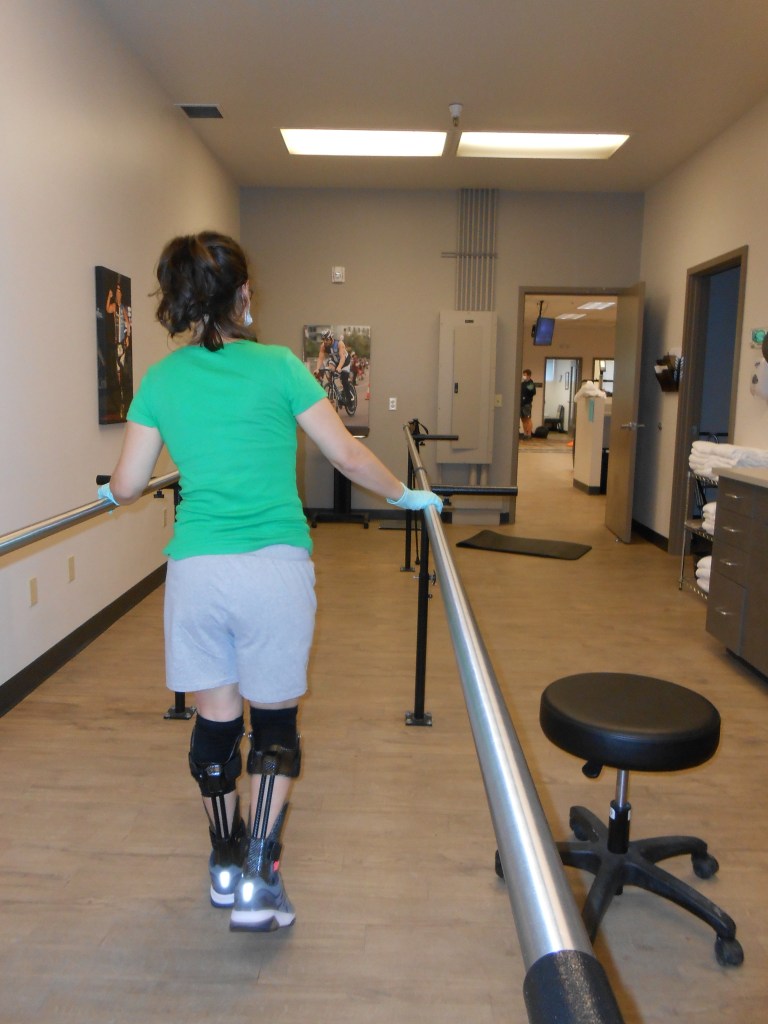
Yes, the devices are heavy and bulky. They still feel like ski boots, but this time I am prepared for that. Ryan is still not in the room, but I pull myself up between the parallel bars and start walking up and down. Heavy, awkward, loud. But now I know that I need to learn to use them and to build up muscles over time. I am not able to imagine, right now, what it will feel like to move in them more freely, but I believe that it will happen.

ExoSyms are clunky and loud. But you can see the heel-toe gait that I feel rather indifferent about in this moment.

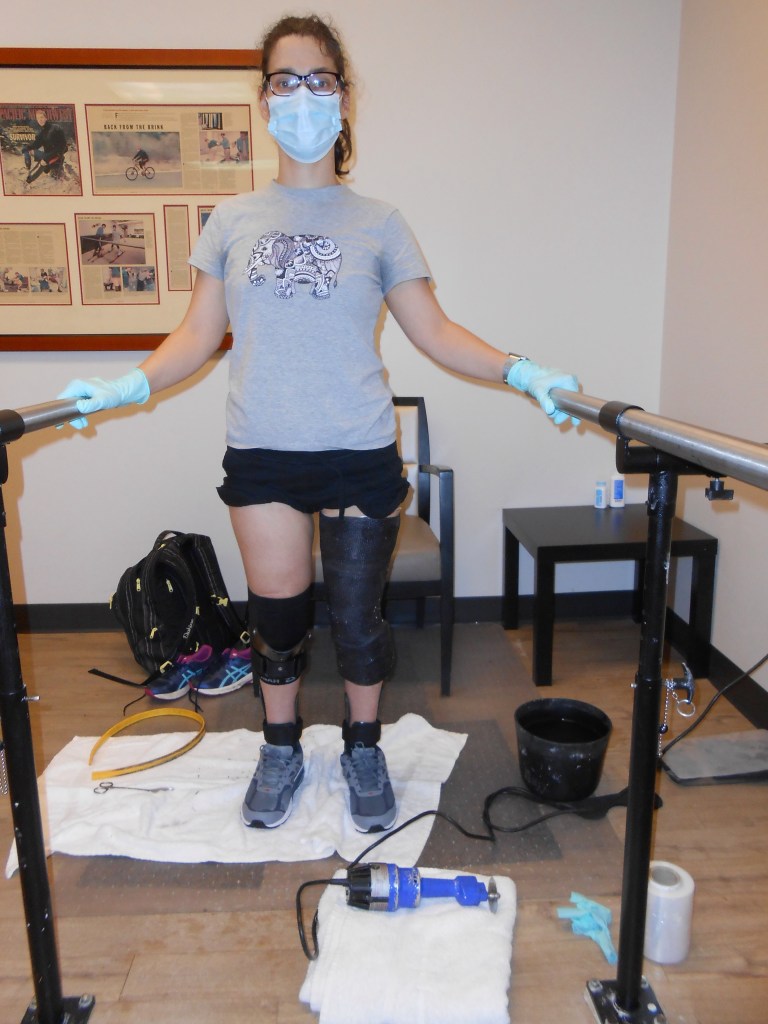
When Ryan returns, it’s time to get casted for the knee sections. Aha, that explains why there is a cast cutting saw and casting supplies by my chair. Somehow it didn’t occur to me that the knee sections are just as customized as the ExoSyms themselves. Ryan starts by wrapping my leg in plastic wrap, starting at the bottom of the knee cuff on the ExoSym and going all the way to my upper thigh. It’s certainly an interesting, rather intimate experience. We roll the legs of my shorts up, with my consent. I can barely stand with my legs far enough apart for him to squeeze the roll of plastic between and around my thighs. After the plastic wrap comes the plaster. Then I have to stand there, keeping my knees as straight as possible while the casts dry.

The yellow strips that he uses to guide the saw are up the back of my leg this time, so I cannot see him as he cuts the casts off. I grip the parallel bars tightly as the saw starts up, and the noise of it cutting into the plaster, combined with the intense vibration, takes me straight back to getting casted for AFOs as a child. The dreaded “tickler.” It does actually tickle, because the back of my thigh is very ticklish. But not in a good way. At all. I breathe through it, and one and then the other are done. Ryan takes the casts away and I practice walking more, with my poles this time.

Trying to walk with poles

Next, we go out to the front desk to hand over the cashier’s check for half the total amount. (I chose the in-house payment plan of half up front and the other half spread over nine months.) Thanks, Mom and Dad. I sign some papers and receive a hard copy for myself.

Then we return to the gym area. During this time, because of COVID-19, they ask that patients only have one support person in the gym, so Mom and Dad take turns being the photographer/videographer.

Ryan introduces us to Jared, the physical therapist. He then introduces me and my cerebral palsy to Jared. Ryan recommends training on flat surfaces only until my knee sections are ready, and then he’s off to other patients. Jared tells me a little about himself and his approach. He lets me know that, though he may seem like a drill sergeant sometimes, he has enough in his repertoire that if there’s something I’m not comfortable with, he will be able to adapt it. He reiterates that these devices are designed for a future, stronger me. He realizes that sometimes our minds understand actions that our bodies don’t know how to do yet. He asks what I want out of training, and I tell him my three goals: walking, stepping up and down (as from a curb or bus), and getting down onto and up from the floor.

We go over to the parallel bars, and the first thing he teaches me how to do is “load” the devices. This means leaning into the knee cuffs, putting your weight into them and keeping it there throughout the step. First, he has me lean forward onto my hands until my heels come up. Then I take steps on the balls of my feet, trying to keep my shins into the cuffs and engage my core. Next I come down from the balls of my feet, and I’m supposed to do the same thing–no leaning forward. I’m doing better keeping my weight into the device with one side than with the other. Jared demonstrates what I’m doing wrong, and I try to fix it. Then he gives me a different verbal cue, and that works better. I am praised for being able to modify my gait successfully. Synthesizing verbal and visual instructions into a physical outcome is no joke.

After learning to load the devices, it’s time to work more on core engagement. Jared asks if I’m willing to try wearing a tight belt with a pole down my back. Sure. When he returns with the equipment, he asks my permission to put the belt around my waist. When I say yes, he does so, and tightens it. It’s REALLY tight. The pole goes between my shoulder blades and through the belt, creating a gap at my lower back. Jared puts a mini bottle of baby powder into the gap, telling me to squish the bottle using my core. Let me be clear. Intellectually, I understand the action. It’s a pelvic tilt. I have never been able to do this well, especially while standing. (My pelvis is busy when I’m standing, and you want me to tilt it?) 

I don’t know that I actually squish the bottle, but my back contacts it, at least. As I “squish,” my heels come up off the floor. This is what everyone means when they say “engage your core” when walking. It actually helps power each step. Huh. 

Jared tells me, “Do 100 please.” Then he amends, “You already did ten, so do ninety more.” So I stand there holding on to the parallel bars and do ninety more squishes. Jared had already let me know that he only counts to one, so I knew to keep track myself and never ask him what number I’m on. When I make it to 100, I walk. It takes several tries to put the squishes together with walking between the bars. 

Next Jared gives me my poles and takes off my corset. I immediately feel like I’ve lost the squish, even though I’m keeping my weight into the knee cuffs. I ask if it’s possible to cheat somehow, because I seem to be doing it, even though I can’t feel it. Jared assures me that there are several indicators that I am doing it correctly and asks for one of my poles to demonstrate. I hand it over and I feel, right at that moment, as if I’m teetering on the edge of staying upright. I can barely listen and feel a little panicky. I want to reach out and take my pole back from him. Relief floods me upon its return. 

I walk along the gray walkway really trying to load my devices, really careful and concentrating. Then he asks me to walk as fast as I can, without thinking about all that. It’s maybe half my typical speed? I don’t know. Extremely slow and laborious. And not yet possible at all without poles.

We return to the parallel bars and Jared has me step up onto a very low box and down. Up again and down backwards. You can see in the video that I do a double take at that. (Yes, we did discuss how Ryan distinctly said flat surfaces only.) I can do this, stiffly and slowly, as long as I am holding on tightly with both hands. 

I tell him at some point, during some activity, that my toes are gripping and my calves are tightening up. Ah, he says, in recognition. He has me step up onto an electric vibration plate next to the parallel bars. I hold on to one bar with both hands, nervous. I have heard of these, but I’ve never used one. He asks whether I want him to start in at full speed, or go low to high. I say start low. He turns it on, and before I can process any sensations, it’s all the way up. Holy moly! Almost indescribable. My vision is vibrating. My brain. If I shift, I feel it in my vertebrae. By turns amazing and completely unpleasant. Jared leaves me there, vibrating for two minutes or more. This is a very long time. When he returns, I am more than ready to get off. I suppose it could relax me if it didn’t freak me out.

We try to do more balance work, like raising my arms above my head. My toes are relaxed for one or two seconds before they grip up again. Lastly, he tells me to grip a very thick band in both hands that’s looped around one bar and raise it straight up. This I cannot do at all, but I am stronger on one side than the other. Jared is noting how my body functions.

My first session with Jared is over! I practice walking some more while waiting for Ryan. When he asks how everything is going, I tell him that my right heel is burning, and my left a little, too. He has me take off my ExoSyms to make some adjustments. We wait a long time, about an hour. If Ryan tells you “a few minutes,” be prepared to wait longer.

He brings back my ExoSyms with more arch support, to offload the heel. When I put them back on, the arches feel very noticeable, hard and uncomfortable, but the heels are better. Soon, I don’t notice the arches so much. Ryan bids us goodbye, telling me to do ten good steps in the hotel room, without letting the left hip sink. “Ten good steps are better than 100 bad ones.” It’s 2:15 by the time we leave, and we’d been there since 9:30. Lesson: If something hurts, tell Ryan as soon as you realize it, just in case he’s less busy then. Also, if you have downtime and you’re mobile, use it for restroom/water/food, even if you think it’s just going to be a minute. You’ll probably have plenty of time.

Recall that we had walked to the Hanger Clinic from the hotel. Recall that I had just put on my ExoSyms again to check the heel/arch. Mom and I walk out of the clinic, so relieved to take off our masks and gloves and breathe freely again. I figure I might as well try walking back to the hotel. I don’t want to sit down and take everything off and switch to my other shoes. It’s not that far, and it’s flat. Sure. 

As soon as we leave the building and reach the parking lot, I realize it’s a bad idea. I am tired. I can’t remember any of the pointers I’ve been given, and my gait feels so uneven. Like I’m lopsided. Then I reach the first curb cut–up–and I almost fall over backward. Unlike any experience I’ve had. No wonder Ryan told me to stay on flat surfaces. There is no ankle flexion when in an ExoSym, and inclines need a special technique. I haven’t learned to do that yet. There are several more curbs to come. I walk so slowly, inching along, trying not to panic at the course I’ve set myself on. 

We make it to the hotel, finally. And I’m never doing that again.

I am very tired, and I have VERY sore glutes medius. Food, ibuprofen, journal, meditation, sleep. Day one complete.

Actually Happening: Cerebral Palsy and ExoSyms

My trip begins tomorrow, and I spend next week at the Hanger Clinic in Gig Harbor, Washington, learning to use my ExoSyms.

But first, I must document yesterday, June 10. At 9am I went to my first occupational therapy appointment for my wrists/hands/thumbs. I gave her the whole story about using trekking poles and then having pain and not using them (for months with no improvement). And now I need to use them, so I need help. From behind masks, we did the strength and range-of-motion baseline assessments. My therapist told me that it sounds like I have several things going on (yay). She gave me exercises for De Quervain’s tendonitis and the radial nerve. Showed me how to massage the palm side of my forearm with two tennis balls taped together. I’ve never thought about those muscles being tight before, but she said they were. She massaged them with cocoa butter, which was the first time I’ve had human contact from someone other than my spouse in three months. She showed me how to tape my thumb and wrist and also approved of the brace I’d tried. Made adjustments to my trekking poles to try to keep my wrists in a good position. Sent me on my way. Productive appointment.

Later in the day, my neck and shoulders–the whole trapezius–began to feel different. Tingly. A little like the clamp on my neck that’s been pulling my head and shoulders painfully toward each other for four years was…loosening. Some. I got down onto the floor and carefully went through the stretches I’d been given years ago (and still attempt regularly). And I felt actual stretching, not just fighting against tension. Huh. Perhaps this was how it was supposed to be all along. Perhaps this is why physical therapists often seem a bit skeptical/frustrated when I tell them stretching only feels the same or worse. Because I’m supposed to feel this instead of that. Maybe now all those things I’ve tried before will actually work? Quick, somebody give me some Flexeril! Kidding. Sort of. After stretching, I meditated (third consecutive day!). And darned if I didn’t achieve a full-body floaty relaxation. Wow. What’s going on? This morning, when I sat down to put on my shoes, I think it was just a bit easier to bend over and reach and pick up my shoe from the floor. 

So what did it? Did I just need someone to massage my forearm with something that smelled like chocolate? I’ve had my forearms massaged before. Maybe not for that long in just that way. I am getting better at meditating. Maybe that’s it. Distance learning is finally over for the summer. Maybe that’s it. 

It’s not as though my neck pain is gone. There’s still a long way to go. But now I know that less pain is possible. That I can continue to work to loosen the clamp. 

It’s ExoSym time! I’m trying to be excited and positive, but honestly, I’m scared of how hard this is going to be. I’ve never asked my body to do something like this, and I don’t know how it’s going to handle it. I cannot expect to strap them on and go like so many others. Another ExoSymmer with cerebral palsy pointed out that it’s a little like having surgery. A period of rehabilitation must follow. There might be pain; there will definitely be soreness. We have to give ourselves time to adjust and build our strength. Weeks. Months. Years.

Megan, who blogs at Wheatfield Ramblings, has very helpful advice for people who are just starting their ExoSym journey. One tip she gives is come with goals. Here are mine:

During my week at the clinic, I would like to learn how to:

Walk

Step up and down, as with a curb or onto and off of a bus

Get down onto and up from the floor

After all, I have to start at the very beginning. It’s a very good place to start.