
Happy New Year? 

I’d love to be able to write that since October, there’s been much progress and improvement on fronts cerebral palsy– and mold-related. But I am not able to write such things.

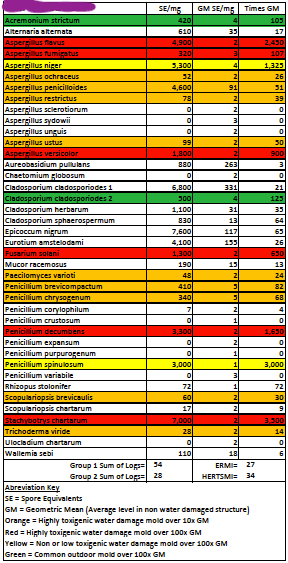
With the mold, we had been waiting, waiting for results and estimates. We got the mold culture back later in October. The culture was taken from the original dust sample, and then it took a while to see what was still active and growing in that sample. Out of all the scary oranges and reds on our ERMI (see previous post), there were only five active molds in the culture. And the alarming “black mold” was not one of them. So we don’t have any active black mold, but there’s still lots of old black mold spores that need to be cleaned out of our house. At least, that’s what I gathered from the whole thing.

After the culture, we then had “Pathways” testing done. Rather than have someone come and start pulling up baseboards and just look for the mold, we had the whole interior perimeter of our house sampled (and around windows) to see where the mold might be coming from in a nondestructive way. We found, unsurprisingly, that there’s a strong indication for mold under our sink/dishwasher, and around our skylight, as well as a couple other odd places. (Even though we’ve not seen water damage it doesn’t mean it isn’t there.) But since then in early December, we’ve made no progress. We are still waiting for the remediation company to give us an estimate based on the Pathways results. Should be any day now.

We have been advised that our original 1980s skylight will need to be replaced once remediation is complete. Did you know that no one makes ten-foot skylights anymore? No? Neither did we. We have one long, narrow skylight above our front door. Lots of light. Lots of trouble. We are going to have to put in two or three smaller ones, in place of the big one. That just means more potential for leaking skylights in the future, though. Skylights are notorious for leading to water damage. One smaller one, and close up the extra space? We could close it up altogether, but we do like the light. I do not enjoy this part of adulting/home ownership.

I do very much want to get the mold dealt with so that I can see if I will indeed start feeling less sick. I’m so tired all the time. Exhausted by the throat pain, like I have strep throat every day of my life, tired of my forearms and my hands hurting. These aren’t CP things, so I need them to be mold things. I want CIRS to be what’s happening, because that means I have a chance of someday feeling better than this.

On the cerebral palsy front, I had been waiting on a referral to UC Davis to see a pediatric orthopedic surgeon who is familiar with both (younger) patients with cerebral palsy, and open surgery techniques in case that is what my hip was going to need. Eventually, I received a letter from UC Davis turning down my referral. I’ve never been given a flat-out no like that. They said they just don’t have the time/doctors. I let my doctor know, and they said they’d keep looking for other options for me. But, I didn’t hear anything.

I recalled that from my own research, there are two places I know of in the United States that specifically state that they work with adults with CP: the Weinberg Cerebral Palsy Center in New York and the Center for Cerebral Palsy at UCLA. They hold two clinics weekly and one of them is a “lifespan clinic,” meaning that they see adults.

It sounded very fancy and hard to get into. I filled out the online form and was never contacted. So I had my doctor send a referral and was never contacted. Then I called the number and it was the general UCLA Health number (“If this is a medical emergency, hang up and dial 9-1-1. If you are calling about COVID testing…”). Eventually, I stumbled upon the right number to make an appointment. I thought it might be months away, especially given that the clinic is only held weekly. But I got an appointment for February 16th. Hooray! The man on the phone gave me the address and parking information and asked if I had any questions. I asked how long the appointment would be.

“They’re usually about fifteen minutes.”

“Fifteen minutes?” I repeated, shocked. This world-renowned cerebral palsy clinic, where you’re fully evaluated and referred to any number of specialists goes by the same maddenly inadequate fifteen-minute increments as a regular doctor’s appointment? “This is for the adult cerebral palsy clinic?” I clarified.

I was assured that yes, it was, and that was that.

So, we are now making a six- (seven, eight, who knows) hour drive to Santa Monica and staying overnight for a morning doctor’s appointment that might only last fifteen minutes. What, then, am I hoping is the outcome? I am hoping, at the very least, that this doctor will be able to refer me to someone who is experienced in doing labral tear and FAI repair on someone with cerebral palsy. Maybe somewhere closer to us than LA, like UCSF. I’d also like someone to care and understand and listen and not just suggest a new pain medication, but that is asking too much in this culture.

So, I am still struggling, in all areas of my life, as I know so many of us are. I am still making some efforts to stretch and exercise. Occasionally, I even put on my ExoSyms. I had been trying, through November and December, to put them on and practice more regularly like I had been before the labral tear. But when I do, then it hurts more for days afterward. I think I am just not in a place mentally or physically to use them right now. I want to return to them someday soon, but just now, I’m putting what little energy I have into, you know, basic functioning.

I am reading The Book of Joy and using its accompanying gratitude journal. I am trying to meditate regularly, but not succeeding. I’m also looking into calming the vagus nerve, and I think it’s amazing and weird that a nerve can affect so much of the body and mind. 

Caring for mental health is always important, and it’s even more vital when physical health feels so precarious. Do what you can to take care of yourselves, everyone. I’ll be here, trying to do the same.
Inspections and Injections

Last I checked in, I had gotten mycotoxin results that indicated high levels of some toxins in my body, and I had consulted an orthopedic surgeon about my right hip and labral tear.

On September 10th, someone from a certified company came to our house to do an inspection and collect dust samples to test for various molds. The dust sample is something you can do yourself and send to a lab, but I’m glad I had a professional do it and use a reputable lab. Not all labs test for the same molds, and molds can differ by region. This company uses a lab that tests for a mold common to this region that other labs skip.

Our house has no visible signs of active mold or moisture issues, but there could be mold in unseen places, like inside the walls if windows or plumbing were leaking over time. (Mold spores are microscopic enough that the width of a human hair is like a highway, so it’s easy to understand that mold spores are everywhere. Mold is only a problem when it’s the toxic kind at toxic levels.) 

I received the ERMI (environmental relative moldiness index) results on September 21st. Here’s how the inspector explained them to me: “On the worksheet the first data column lists the mold levels in your sample, the second column is the Geometric Mean (average) for each mold as determined by the EPA, and the third column shows how many times the Geometric Mean (average) your levels are for each individual mold. The molds of concern are highlighted either red or orange.  As you can see, you have many of the more toxigenic molds at elevated levels; of particular concern is the Stachybotrys [“black mold”]. It is present at the highest level and is an indication of chronic, long-term water damage. Also, you have a high level of Fusarium which produces one of the mycotoxins that you have” [based on my lab results].

These results were certainly surprising and overwhelming. Once you start reading other people’s mold stories, you learn about people who camp in tents in their backyards or leave all their worldly possessions and start over in the desert. Step one to feeling better is to remove yourself from the moldy environment. That’s simply not feasible for most people. 

So. There’s toxic mold in our house and we don’t know where. The next step is to hire a certified remediation company to find and remove the mold. Remove, not kill. The EPA states, “The purpose of mold remediation is to remove the mold to prevent human exposure and damage to building materials and furnishings. It is necessary to clean up mold contamination, not just to kill the mold. Dead mold is still allergenic, and some dead molds are potentially toxic.”

On October 10th, we had a mold remediation expert come to our house. He, too, inspected inside and out and took some pictures and will send us an estimate. Searching for mold involves looking behind (removing) baseboards and other, potentially more destructive sampling. We are also waiting on results from a culture of our original dust sample to see if the mold is still active and growing.

Fortunately, the inspection company also provided us with an “effective cleaning guide” and we won’t have to move to the desert. Ninety percent of belongings are cleanable. It’s large, cushiony items like couches and mattresses that should probably be replaced. Step one was to “ban the broom,” which only spreads spores, and invest in a HEPA filter vacuum. Check. 

After we figure out the source of the mold and fix it, step two is to clean. Everything. To remove the mold spores that are covering every surface in our home. I don’t want to think about that right now, so at the moment, we’re still just living in it, as we have been for who-knows-how-long.

At my August appointment with the orthopedic surgeon, he gave me the option of a steroid injection in my hip and offered to refer me to another surgeon who has experience in both arthroscopic and open techniques for labral repair and impingement repair. He told me to think about it and get back to him, but really there was nothing to think about. Yes, try the injection, and yes make the referral.

Still, I waited until a few days later to send a message through the hospital system. I didn’t hear back for a while, and what I got was another appointment with the orthopedic surgeon for the end of September. I’d hoped we’d be able to do injection locally. It seemed odd that the surgeon himself had to do it. 

But drive the forty minutes we did. When we arrived, it was essentially “You haven’t had the injection yet? Why are you here?” He himself then put in the order for the injection (locally, as I thought), and the referral, as we watched. With dismay, I realized that the whole thing was a big mix up and that our appointment was over. “Unless you want me to see if I can do it with ultrasound right now?”

Yes, please. So he trundled in the ultrasound cart and someone to assist. It all seemed rushed. He must drink a lot of coffee. I did not have to get undressed from the waist down and put on a gown and climb on a table as I did for the arthrogram. Instead, I sat in the exam chair, hiked up my skirt on the right, and the field was isolated from its surroundings by draping a clean gown over the other leg. Yes, he could visualize everything he needed to without my having to go to radiology. Even I could see the head of my femur on the screen. Clean the site, spray cold numbing spray. In goes an injection of lidocaine. My whole leg (and body) tenses with the sting of the needle. It hurts inside my leg. In goes the steroid. And it’s over. (Well, there’s some grunting and grimacing and deep breaths and making sure not to look. And then it’s over.)

He asks how I feel. Um, the same except now my leg hurts because you just stuck a giant needle into it? He picks up my leg and moves it all around. Any difference now? No.

He says it’ll take up to forty-eight hours to feel the full effect, and that sometimes it can take a week. I’m flabbergasted that I’m supposed to feel immediate improvement. But that’s lidocaine’s job. It is an anesthetic. Then the steroid is supposed to reduce inflammation. So even though neither the labral tear nor the impingement change in any way with this procedure, the pain is supposed to be lessened. Instead, on the drive home I moan about how sore it is now, deep inside my leg.

I’ve started to wonder if my brain and body just don’t respond to medication in a predictable way. But then I remind myself that lidocaine has worked on other parts of my body. I had all four wisdom teeth removed at once with a local anesthetic. I had the birth control implant placed and removed from my upper arm with local anesthetic. And they really had to dig for that thing when it was time for it to come out. So. Maybe it’s just the CP parts of my brain and body that ignore lidocaine. Is that a thing? It seems like it could be a thing.

It’s been about two weeks since the injection and once the initial pain subsided, it felt like nothing at all had been done, and it still feels that way. Worth a shot, I guess. I did read a paper that reported those who responded well to an anesthetic injection also responded well to the surgery. I wonder what that means for me? I wonder if this other surgeon I’ve been referred to will have some positive stories to tell me about the dozens of labral tears and impingements he’s repaired in CP patients. I’m not holding my breath on that one.

Right now, I’m waiting. Waiting for the mold culture results and the remediation estimate. Waiting for an appointment with the new doctor. I have no idea how long all this will take. If surgery is a go, how soon will it be? 

I do know that I want my home to be a safe place in which to recover. I’d love to feel like I’m recovering from the mold toxicity (CIRS) before facing surgery. I’d love for my throat not to hurt anymore and for my thumbs to work properly without pain. 

If anyone wants a good laugh, watch episodes three and four of The Big Leap on FOX. There’s a dancer whose career ended because of a knee injury and a doctor comes to her office and injects something into her knee and she gets up then and there and dances without pain. Ahahahaha. In the next episode, the dancer does the injection herself. Without, you know, cleaning the area or anything. You gotta love TV. But really. It would have been nice if it had worked for me.        

Good news! I’m toxic. (Maybe.)

Let’s return to my adventures in functional medicine, to which I turned after years of chronic sore throat that became dramatically worse in September 2020, and ENT appointments and an upper endoscopy did not help.

First, I want to reiterate that I am frustrated by and skeptical of medicine in general for various reasons. It drives me over the edge that Western medicine takes patients in fifteen-minute increments and that nothing is done to find the cause of the illness, only to treat the symptoms. It’s just completely and utterly the wrong approach to healing someone and giving them a better quality of life.

Second, while functional medicine does try to find the root cause, those offices often don’t take insurance, making that kind of care prohibitive for most people. 

Third, so much of chronic illness is unknown/disbelieved/underfunded/unresearched. It can’t be addressed in fifteen-minute increments. But just because there isn’t research to back something up, it doesn’t mean it isn’t real. It just means the research hasn’t been done. 

The first time I went to a functional medicine doctor was in the summer of 2018. I was shocked by a positive result on my celiac disease blood panel. I removed gluten from my diet and looked forward to how I might feel. Many people experience a nearly miraculous improvement. Perhaps the fatigue and muscle and joint pain wasn’t all CP-related? But no, I didn’t feel any great difference. (The gastroenterologist took me more seriously in 2021 when he looked back at my original TTG Ab,IgA result of >250, the highest he had seen, he said.)

This time, with my new, local functional medicine practice, after all my intake forms and one appointment each with the nutritionist and the doctor, the doctor was pretty sure I have CIRS.

CIRS stands for Chronic Inflammatory Response Syndrome, but many doctors aren’t trained in diagnosing it (and therefore don’t think it’s a thing). CIRS is also called Mold Biotoxin Illness. Around 25% of the US population have the genes that put them at risk of developing CIRS if brought into contact with mold. From Moldy to Healthy (.com), CIRS “happens when two things occur — there is an exposure to a biotoxin, like mold, or a Lyme tick (those are the most common), or eating reef fish contaminated with Ciguatera toxin, as well as a couple more. Combined with a genetic susceptibility to being unable to clear the toxin, the body’s inflammatory response can’t shut off. This chronic inflammation impacts multiple other systems in the body, causing dysregulation everywhere.” 

From National Integrated Health Associates:

“Chronic Inflammatory Response Syndrome (CIRS) is a collection of symptoms which is also sometimes referred to as Biotoxin Illness, or Mold Illness, and was initially thought to be caused by mold exposure only. However, further research indicates bacteria, fungus, and various viral infections are also implicated in the development of Chronic Inflammatory Response Syndrome.

It is quite a dilemma for both patients and physicians in dealing with such a complex illness as CIRS, which overlaps and can mimic symptoms associated with other conditions such as Lyme Disease, Ehrlichiosis and some autoimmune disorders. CIRS may often be misdiagnosed, or underdiagnosed.”

So, do I truly have tons of toxins built up in my body, causing chronic inflammation and all sorts of seemingly unrelated symptoms?

The problem is that I live in a very dry environment, where mold seems unlikely. However, mold isn’t always visible or odorous. If I’m genetically predisposed, maybe my house doesn’t have a big problem, just a big problem for me. My symptoms have gotten worse since the pandemic. Perhaps my anxiety and inability to focus and my exhaustion aren’t all because of the pandemic itself, but because I have been sheltering in my house. The pain and weakness in my fingers, hands, wrists, that I went to months of PT for–maybe it’s not from using trekking poles. It started after I began sheltering in place and wasn’t using my trekking poles at all.

Further, the mold isn’t necessarily coming from my environment. I suppose I was naive to think that food we buy in the grocery store is free of mold unless visibly moldy. It turns out that many foods, especially long-traveling foods like grains can have molds that then produce high levels of mycotoxins. See this peer-reviewed chapter, “Mycotoxins: The Hidden Danger in Foods.”

I want so much to have clear answers, to have clear next steps. I have results from a mycotoxin urine test that seem to confirm that I do indeed have high levels of toxins. Normal levels of citrinin are less than 25 (units unclear). My result was 790. Yikes, right?  That certainly sounds bad. 

According to the information included with my results from The Great Plains Laboratory, Inc., “Citrinin (Dihydrocitrinone DHC) is a mycotoxin that is produced by the mold genera Aspergillus, Penicillium, and Monascus. CTN exposure can lead to nephropathy, because of its ability to increase permeability of mitochondrial membranes in the kidneys. The three most common exposure routes are through ingestion, inhalation, and skin contact. CTN has been shown to be carcinogenic in rat studies. Multiple studies have linked CTN exposure to a suppression of the immune response.”

So citrinin is carcinogenic and can suppress the immune response. What else? Authors of an article in the journal Foods state, “Citrinin (CIT) deserves attention due to its known toxic effects in mammalian species and its widespread occurrence in food commodities, often along with ochratoxin A, another nephrotoxic mycotoxin. Human exposure, a key element in assessing risk related to food contaminants, depends upon mycotoxin contamination levels in food and on food consumption.”

Which foods have high levels of citrinin? According to an article from the Journal of Plant Pathology & Microbiology, “Citrinin has mainly been found in rice, wheat, flour, barley, maize, rye, oats, peanuts and fruit.” Guess what vegans eat a lot of? It doesn’t seem coincidental that three of the top foods I keep coming across in my search for citrinin information are wheat, barley, and rye. Those are also the three foods that contain gluten. Is there a connection between mycotoxins and gluten intolerance? I did find a doctor who believes so. But of course, I can find anything on the internet. Celiac disease can develop at any time in the lifespan, and although I only miss bread occasionally, it would have been really great if my celiac gene had never expressed itself. Even though I’ve adapted well to a gluten-free diet over the last three years, I eat large amounts of the other foods on the citrinin list: rice, oats, fruit. Often all of them every day!

I want to know what to do next. How to get my house (and car) tested for mold. How to get it remediated and then tested again by reputable companies. Whether or not to believe my mycotoxin test results. (In the course of doing research, I found a doctor who said not to believe urine tests.) How to change my diet if the toxic load is through ingestion. How to detox my body.

The good news is that CIRS is treatable. The bad news is that it’s not a simple process, but a potentially years-long one. I can’t find any definitive information. All that I’ve cited here is a result of my own research and not from my doctor. Most of what I’ve found is from functional/integrative medicine, and some of it is conflicting.

Again, same as with the celiac diagnosis, I feel a glimmer of hope that some of what I’m experiencing is in fact NOT related to cerebral palsy. Hope that there are steps I can take to help myself feel different, better. More energy, less pain. A slowing of this alarming decline. Is it possible?

Informal Works Cited:

Cinar, Aycan and Elif Onbaşı. 2019. “Mycotoxins: The Hidden Danger in Foods.” DOI: 10.5772/intechopen.89001

“Citrinin in Foods and Supplements: A Review of Occurrence and Analytical Methodologies.” Foods. 2021 Jan; 10(1): 14. Published online 2020 Dec 23. doi: 10.3390/foods10010014

Doughari, J. 2015. Plant Pathol Microbiol, 6:11. DOI: 10.4172/2157-7471.1000321

Dr. Jellison, Functional and Integrative Medicine

Dr. Kim Crawford, Internal Medicine/Functional Medicine

Merritt Wellness Center, Moldy to Healthy

http://moldytohealthy.com/2020/07/19/what-did-50-doctors-miss-and-what-is-cirs/