UCLA Center for Cerebral Palsy

On February 16th, I had my new patient appointment at the UCLA Center for Cerebral Palsy. They hold a “lifespan clinic” every Wednesday at their location in Santa Monica, during which they see adults in addition to children. 

If you fill out their appointment request form, don’t expect them to get back to you, even though it states right there on the page that they will. If you have your doctor send a referral, don’t expect them to get back to you. Because you’re not already a patient within the UCLA health system, there’s no file for your referral to get put into. That’s what I was told, when I finally made the phone calls and sat through the menu options and spoke to a person. I am in the privileged position of having good insurance, so I didn’t even need a referral, it turns out. I don’t know how long it would have taken for someone to contact me, or if anyone ever would have. 

Once I had the correct person on the phone and they confirmed my very good insurance, it was no problem to make an appointment. They were only booked a few weeks out. So, after knowing for several years that a place six hours from me specifically sees adults with cerebral palsy, I was finally going.

I had been told that my appointment would be the typical fifteen minutes. Thankfully, the person who told me that had no idea what he was talking about. We were there for an hour and a half. After the initial intake guy, a doctor came in to take my history, which he would then present to the main doctor. (I don’t know if this was an intern or what, because he introduced himself so fast.) When I say he took my history, I mean he started with my birth. Needless to say, I wasn’t very helpful in this area. I imagine these appointments are usually with the mother answering questions about her toddler with CP. I was premature and I had a cerebral hemorrhage. That’s the extent of my knowledge. I have lots of faded, early 80s, barely readable records in a box somewhere. 

The history probably took an hour. When was I diagnosed? What was the doctor’s name? (I don’t know, but since I’m forty-one, there’s a fair probability that the doctor is now dead.) Did you meet your milestones on time? What kind of mobility devices did you use and when did you stop/start each one? When did you start/stop AFOs? How far could you walk as a child? Was it hard for you? Uh…? Thankfully, I have written down my two surgeries and bring the paper with me to appointments now, because I haven’t successfully memorized the 4-in-1 one from 1989. Then, what have you tried for the pain? How much physical therapy did you do? How much Tylenol did you take? (I could not remember everything I’ve tried, so I’ve just now updated that list and will take it with me to my next appointment.)

On the intake form, I had to write down “the reason for today’s visit.” I put right hip pain/labral tear and FAI. So naturally, once we’d covered my history and did a little strength assessment, we focused on the right hip. I would have liked for him to remark on the images of the front and back of a person where I was asked to color in my pain. I would have liked to mention that while the right side is our primary focus, the left side doesn’t feel great either. I told him about the ExoSyms, acquired June 2020, and the very audible pop and tear of my labrum, acquired May 2021. About the discovery of the hip impingement after the arthrogram in June last year. The steroid injection that did nothing but cause pain in August. The refused referral to UC Davis orthopedics.

He went and presented all this info to Dr. Solberg. Finally, the man himself entered the tiny room. He did some physical assessment. His goal was to “recreate the pain,” in order to ascertain what and where the pain is. But pain does not cooperate that way. If my hip/groin pain is already flared, then there’s very little that can be done to increase or decrease it. It is there. Still there. Still there. Then perhaps five minutes after we are done I can tell you that it is, in fact, slightly different, but I do not know what made it that way. Sometimes a movement or a pressure can make it a little worse in the moment, and I’m quite relieved to be able to provide that feedback. 

Dr. Solberg seemed very surprised that the steroid injection had not helped. “Not even right after?” No. He seemed a little dismissive of the labral tear and FAI because I also had lumbar pain, pain down the IT band, etc. He said FAI pain is usually just in one spot.

I had hoped that we would somehow move forward with treatment of the tear and impingement. That was my goal. I had done some googling regarding FAI and found this fascinating information from the Nirschl Orthopaedic Center:

The symptoms can be chronic and achy, or sharp and mechanical with certain motions. In some cases, the patients may also have referred pain to the buttocks or down the thigh.

What other diagnoses might be confused with FAI?

  • Hip Dysplasia (Adult Form)
  • Lumbar Spine Pain (Low Back Pain)
  • Lumbar Radiculopathy (Low Back Pinched Nerve, Low Back Facet Disease)
  • Sacroiliitis (SI Pain/Dysfunction, back of pelvis)
  • Trochanteric Bursitis (Outside/Lateral Hip Pain)
  • Piriformis Syndrome (Back of Hip Pain)
  • Psychosomatic Pain Disorder (Stress Related Illness)
  • Iliopsoas Tendinitis/Tendonitis/Tendinosis (Hip Flexor Inflammation)
  • Groin Pull (Adductor Strain)
  • Sports Hernia (Core Muscle Injury (CMI), abdominal muscle strain)
  • Iliac Apophysitis (Front of Pelvis Pain)
  • Quadriceps Hernia/Strain (Thigh Muscle Pull)
  • Endometriosis
  • Deep Gluteal Syndrome (DGS)
  • Hamstring Tendinitis/Tendinosis
  • Chronic Pain Syndromes

Can back pain be a sign of FAI?

While the cause is not well understood, patients with FAI often complain of low back pain. This pain is often localized to the SI (sacroiliac joint on back of pelvis), the buttock, or greater trochanter (side of hip). The hip joint and the low back frequently “play off each other,” and compensation for a hip issue can frequently cause increased pressure on the low back, causing back symptoms, and vice versa.

I have bolded the other pain I have from the above list. Imagine if all of that could be improved with the arthroscopic surgery! But here was Dr. Solberg, telling me that my torn labrum and the bone-on-bone inside my hip was not the cause of my pain (or at least not all of it).

“We have to figure out where your pain is coming from,” he said.

I wanted to scream: “We DO know where most of it is coming from! And fixing it could improve a whole lot of the rest!” I wanted there to be a fixable thing. An answer. A clear plan.

But he said I could have a pinched nerve in my back, tendonitis at the front of the hip, bursitis. There’s a lot that could be going on and interacting, and we just don’t know yet. Dr. Solberg is a doctor of osteopathic medicine, a DO, and I think the first one I’ve seen. DOs have a “whole-person approach” and “look beyond symptoms.” I appreciate that this doctor didn’t just move me forward with surgery, since I know that cerebral palsy complicates everything. Very different from the orthopedic surgeon who was ready to go right ahead. Confirms the stereotype that to a surgeon, everything looks surgical.

That same orthopedic surgeon, who did the injection, said I probably have trochanteric bursitis, but as that’s not what I was there for that day, nothing more was said or done. And so, grumpily, I recognize that while other conditions can be confused with FAI, it’s also possible that I have those other conditions and FAI.

Because I am not local to Santa Monica, Dr. Solberg has referred me back to UC Davis in Sacramento. To sports medicine instead of orthopedics this time. Once I’m there, I can be more easily referred to physical medicine and rehabilitation (PM&R or “PMR”) or ortho as needed. To be fair, after the injection, the orthopedic surgeon did also refer me to PM&R last fall, but it was at his same location 40 minutes away without good transit options, and I haven’t pursued it.

The goal, according to Dr. Solberg, before going directly to surgery, is to pinpoint the pain and calm it down, to know its source. I can get on board with that. The problem I have is this: it means more injections. It means trying the hip injection again, maybe using x-ray this time (regarding ultrasound vs x-ray, different sources say different things). Trying an injection in my lumbar, in the bursae of the hip. I tried to explain how both the injection of lidocaine and dye in my hip for the arthrogram and the steroid injection later were rather painful and didn’t help at all. 

“It’s not supposed to be traumatic. But we all experience pain differently,” he said. “Maybe for you it’s painful because of tight muscles and scar tissue in the area.” Yes, that could be. Maybe it doesn’t help that my entire leg goes into a spasm during the procedure. You think?

I don’t think it’s uncommon for lidocaine-steroid injections not to work. That’s why people end up having surgery. So–how many of these am I going to have to endure? And if they do help at all, for how long? Don’t steroid injections seem rather Band-Aid-ish?

Just last night, someone in a cerebral palsy facebook group said she’d been diagnosed with hip bursitis. Someone else posted a video about how massage can help, and that video led me to this one:  

Lateral Hip or Trochanteric Bursitis – Causes and Treatment

According to the physical therapist in this video, the hip has nine bursae, though it can vary by individual. Most images I can find online show six. A bursa is a fluid-filled sac in a joint that’s meant to reduce friction. They can become inflamed and painful. The image below is not great because it’s a screen capture from the video, but the point is that each green blob is a bursa.

When I got the diagnosis of a labral tear and mixed-type FAI, I was happy because my pain had a name and a reason and a solution. Now I’m looking at all these green blobs and thinking, well, crap. I wouldn’t be surprised if these were all causing pain too. Watch the video. Watch the video with the knowledge that I have positive Trendelenburg and a turned in knee. Two “habits” that I need to stop if I’m to heal my bursitis. Then watch the treatment options section. Exercise to strengthen the muscles around the hip, but carefully because exercising can worsen bursitis. Tight muscles can exacerbate bursitis, but don’t stretch because stretching can also exacerbate bursitis. 

All these years that I’ve gone to PT to strengthen my weak hip muscles and stretch my tight muscles, all these things I’ve been given to do, when I report back and say I haven’t really been doing them at home because they hurt… I mean, where does that leave me? It seems to me that my type of CP basically guarantees bursitis and also guarantees that I can’t treat it properly. 

And here I am headed to a sports medicine referral. They’ll probably give me a referral to physical therapy. Ha. So, yes, go ahead. Shoot me up with all the lidocaine. I wish I could believe it could provide relief instead of trauma. I hesitate to use the word trauma, because trauma is so weighty. But the facts are that the two times that lidocaine has been injected into my hip have  been stressful, painful, and ineffective. 

I need to get my history straight for the next doctor, all the pain management I’ve tried. All my issues on the right side began in January of 2010 with SI joint pain (which could have been from something else, of course). We’re in year thirteen now. I would like to remove my leg from its socket and go to sleep.

I think I need to find a mental health therapist who specializes in chronic pain and disability and anxiety.

Although life is pain (“Anyone who says differently is selling something.”), it is also joy. For my birthday earlier this month, my husband took me to a lovely place in Guerneville. We walked a beautiful, accessible trail in the Armstrong State Redwoods Natural Reserve, native land of the Kashaya Pomo people. I am grateful for time among the trees. 

POP! goes the…

In my last post, I wrote about how busy April was. But I left out one of the biggest things. Last month I contacted the Hanger Clinic in Gig Harbor and asked if I could come for a couple days of additional training in June. I’ve been feeling so much stronger and have been so consistent with my practice that I feel like I can really get more out of training with an ExoSym expert now. I was excited to nail down the dates, plan an excursion to Olympic National Forest (because I hike now), and visit family in Oregon and Washington. My husband and I looked at a map and a calendar, made various reservations, and planned a two-week road trip. Yes–a trip! With travel! Outside the house! To a place where it rains!

So stoked. So excited to visit the Pacific Northwest again, and get more ExoSym training, and be in the trees, and eat food that we didn’t make. To relax and kick off the summer.

May started off well. I continued my daily stretching and strengthening and ExoSym practice. I went to a myofascial release appointment and to a physical therapy appointment. When I arrived at PT on the 5th, I heard the voice of my long-absent therapist, C, whom I hadn’t seen since November because she was recovering from surgery. This was my final appointment with my sub. He did the stretches that I can’t do alone and I showed off how much better I’ve gotten at the side leg lifts, just in the two weeks since he’d seen me last. He sent me off with excitement and encouragement, assuring me he’d talk to my original therapist–fill her in on our change in tactics and on my progress–before I transitioned back to her at my next appointment.

May 3rd. With back support.
April 19th vs May 3rd

Saturday, May 8th was a good day. We ran a couple errands and then spent the rest of the day reading on the couch. What a relief–a quiet Saturday, just as it’s supposed to be. I moved off the couch and onto the rug for a change of position. I read for 10-15 minutes with my e-reader on the floor in front of me, leaning over my folded legs, kind of like child’s pose. But I probably changed position often because I can’t last on the floor very long in any one way.

When it was time to get up, I moved from side sitting to up on all fours. POP! I felt and heard something in my right groin. And it hurt. When the pain lingered and it was difficult (more difficult than usual) to get up off the floor, I thought, oh, I actually hurt myself. It stayed the rest of that day. I used a cold pack and rested and tried not to worry.

Sunday, when I woke up and got out of bed, I immediately realized that, not only was the pain still there, it was worse. I knew that I would be breaking my ExoSym streak that day, after 52 consecutive days of practice. I knew that I would break it eventually, and that it was okay if I did, so again I rested and tried not to worry.

When Monday came with no change, I made a doctor’s appointment for 8am on Thursday, May 13th. I figured she would say, “You strained something in your groin. Heat/ice/pain meds/rest. Good luck.” But because of the upcoming road trip that we had just finalized, I needed to get it checked out. There was no way it was a good idea to use my ExoSyms in this condition. All the muscles on my right side, glutes, hamstrings, quads, the IT band, everything was gripping painfully to try to help the sharp, constant pain in my groin.

Yes, indeed, the gist of the conversation went as expected after the exam. (“Is there tenderness there?” Yes. “Here?” Yes. “Here?” Yep.) My doctor presented options and then asked what I would like to do. One option was to be sent to a specialist whose first appointment was probably months down the road. Another was to do some imaging. I picked the MRI and asked if my lumbar spine would be visible on it as well. It’s hurt 100% of the time since November and I’ve been wearing the brace every waking moment since March. It’s clearly something more than arthritis, and if there’s anything that can actually be done about it, I’d like to know.

She said, no, that she’d have to put in an order for a separate MRI for the lumbar spine, and would I like her to do that? I said yes. Then I waited all of Thursday and into Friday to hear from the MRI people.

Friday afternoon, when I got the call, she asked if I could come in that night at 7:30. “When’s your next available appointment after that?” I wondered. June 7th. The day I’m supposed to be at the Hanger Clinic. “Yes, I can make it at seven thirty.”

She then proceeded to ask me lots of questions, like if I’d ever had anything metal stuck in my eyeball. “Are you claustrophobic?” Uh…no? This is one of those questions where the answer is 100% dependent on the situation. If the space is small enough, sure, I’d panic. I hope I never discover what size that space is. She told me to remove all metal and wear clothes that are easy to take off because I will be putting on a gown. After we hung up, anxiety twisted my stomach and I watched a couple videos about what it’s like to get an MRI. If I start to feel upset, I should do square breathing and take a “wait and see approach” before pressing the panic button. Then I did a long meditation for anxiety. (I have neglected my meditation practice and it’s only occasional at the moment.)

It’s strange, but not unpleasant, to be in a nearly empty hospital. The MRI tech, Jasper, tells me that I’m dressed like I’ve done this a lot. I tell him that this is my first MRI (but I add in my head that I do understand what it means to not wear metal). It turns out that I do not have to change into a gown. While I am happy to hear that, I am very concerned that I am wearing shoes and that Jasper is not concerned about that.

He rips open a packet of foam earplugs and I stuff them into my ears. I climb onto the slidy bed and Jasper hands me “the uh-oh button,” which is actually a cord with a bulb on the end, as on a blood pressure cuff.

He says I should be as still as I can. I ask him if I’m allowed to do deep breathing wherein my belly would move up and down. He tells me to just close my eyes and breathe normally. I wonder if he’s ever felt anxious in his life. 

I’m loaded headfirst into the tube. There’s a speaker near my face and Jasper asks if I can hear him. So I’ve got my uh-oh button in my hand, and I can talk to Jasper if I need to. I close my eyes and try to relax.

People with cerebral palsy often retain the startle reflex that babies come equipped with. The startle often turns into a spasm. 

When the first noise comes, everything in my body clenches, and I mumble, “Holy crap. Okay.” It’s loud like a fire drill. There’s knocking and banging and beeping that constantly changes. Maybe there’s a rhythm for a while, then silence, and then more nearly unbearable cacophony.

It’s not great for my startle reflex and I really, really do not like this, but I try to breathe (not too deep) and relax. I close my eyes and attempt to focus on a song. I summon Art Garfunkel’s voice to my mind:

When you’re weary

Feelin’ small

When tears are in your eyes

I will dry them all

I’m on your side

My mind jumps ahead, garbling the lyrics.

Sail on, silver girl

Sail on by

Your time has come to shine

All your dreams are on their way

The blackness beneath my eyelids seems to be moving and I wonder if Jasper is adjusting my slidy bed. Am I moving? I can’t tell. I’m disoriented. I suddenly understand the phrase “it feels like the walls are closing in on me.” I’m really scared to open my eyes. I don’t want to know how close my face is to the plastic tube surrounding me. What if it’s too close for me to handle and I find out that this space is the space that sets off claustrophobia? 

I force my eyes open. Oh, there’s more space than I remembered. It’s not so bad. I am not moving. Light is better than darkness now. Eyes open is better. Breathe.

See how they shine

Oh, if you need a friend

I’m sailing right behind

Like a bridge over troubled water

I will ease your mind

Each time the noise stops, I brace myself in the quiet for the next assault. I know it’s coming, but I don’t know when or in what manner. Each time it comes, my legs jerk. I’m trying to be still. I’m trying.

Hello darkness my old friend

I’ve come to talk with you again

Because a vision softly-ee creeping

Left its seeds while I wa-as sleeping

I grasp at any lyrics I can remember to stay focused on something.

I turn my collar to the cold and damp

When my eyes were stabbed by the flash of a neon light

I don’t know how much longer I can do this. But I cannot press the uh-oh button because that means we will stop and I will not get the images. It’s not the tube that’s the problem. It’s that I must hold still and be surrounded by all this horrible noise.

Jasper tells me we have seven minutes left. They are very long minutes. And then he says that one of the images is blurry and needs to be redone. Of course it is. How could it not be?

Finally, we are done. With the first one. Jasper sets up the slidy bed for the hip one now. He says, “Your earplugs don’t look like they are in very well. Was that really loud?”

Yes, of course it was. You told me it was going to be really loud.

He grabs a pair of headphones and puts them on over my earplugs. Well, that’s much quieter. Jasper then wraps that stretchy stuff they put on your arm after donating blood around my shoes. Yes, now my feet are bound together. Hmm. . . will this cue more panic or less? Lastly, he puts a plastic shell-type thing over my legs. More panic or less? Less. The weight is good; my body wants to relax under it rather than fight against it.

This time, I enter the giant tube feet first and stop with my head at the entrance. If I look up and back I can see a bit of the panel over the fluorescent light that is clouds and blue sky. 

Here we go again. The noises are loud but not deafening now. I count the marks and scuffs I can see in the plastic. I think about all the people who have gone into this tube, scared and in pain. I think about those who squeezed the uh-oh button. I count the marks again and breathe. I am here. I am okay. I am relaxed. I am here. I am okay. I am relaxed. 

My mind bounces around Beatles songs. I jump to the opening of Ragtime: “In 1902, Father built a house at the crest of Broadview Avenue hill in New Rochelle, New York. And it seemed, for some years thereafter, that all the family’s days would be warm and fair.” Now “Wheels of a Dream.” Joan Baez tries to sing “No Woman, No Cry,” to me, but I can’t focus. What if I run out of songs? You are not going to run out of songs. I can’t do this. How much longer? I am here. I am okay. I am relaxed. 

I try the grounding technique of focusing on five things I can see and five things I can feel. I count the scuff marks again. I want to be done. I want to be done. I want to be done.

I do survive it and I do not press the uh-oh button. I hope that I never have to have another MRI in my life.

When I come outside to where my husband has been waiting for me, it is after 9pm. It’s just a handful of minutes later that I am safely home, in bed, where I should be on a Friday night. And it feels already like that was someone else’s life. 

The results are in by Sunday, the 16th. I will be unsurprised if it says, “Everything looks good.” I will be equally unsurprised if it says, “You need a hip replacement.”

Possible anterior labral tear. Now this is ironic. I had just discovered what a labral tear is the week before. With all the chronic pain I’ve got going on with my right hip, I wouldn’t be surprised if I have that, I thought. Boom. I don’t think I’m doing “manifest your life” right. To properly diagnose the tear, I could have an arthrogram, where they inject dye into my hip and put me through the MRI again. Oh, no thank you. Let’s not if we can help it. 

So PT it is, for now, with possible arthrogram and possible surgery down the line. I am sad and frustrated. I know that it’s the right call and that it’s okay to postpone the trip to the Hanger Clinic. I don’t want to go on a road trip to a forest if I can’t walk around in it.

Right now, the pain is constant, sharp. It hurts more to do any weight bearing. I need to rest after I chop vegetables. With each new pain, I think this is the one that’s too much. Too much for me to be a functional, pleasant person. That’s what I thought with my back. (Which, by the way, has some moderate degeneration. Which is a bummer but sounds about right.) This time, I think so again. This is the one that’s too much. I am tired. I would like to be put in a medically induced coma and pumped full of pain meds and sleep for a week. Then you can wake me up and we’ll reassess.

I am not in agony. I am not near an 8 or 9 or 10. Or even a 7 mostly. It’s just that it’s All. The. Time. I’ve haven’t talked about it recently, but my throat has hurt every minute of every day since September. My back every minute since November. The tightness in my neck and shoulders every minute for years. And so many other things, too. It’s exhausting.

I am not in agony. But I am also not functional. And that’s hard. I’m feeling down about it. I’m also trying to be rational and not wallow. This is where I am right now. We’ll do what we can.

Wednesday the 19th I went to PT, back with my original therapist, C. Carefully, and trying not to become overwhelmed, I related what’s happened since my last, oh-so-positive session. It didn’t seem like my two PTs had spoken about the way we’d dialed back the ExoSym practice. I hate how you have to tell everything that’s happened over months while they question you and type and you know they’re not really understanding the full picture. I told C I was getting up off the floor when my groin popped, and she mimed getting up from one bent leg and explained how that can cause hip strain. Uh, no, that’s not how I was getting up! I know it’s been six months since you’ve been here, but don’t you remember how I’ve never in my life had the ability to do that? Of course I’m not really mad at her, just sad and frustrated.

So. A labral tear does not heal on its own. Physical therapy just strengthens everything around it. I have already spent years trying to strengthen everything around it, and because I have CP, those muscles will always be weaker than an able-bodied person’s. It doesn’t look good. 

I think I am at the pain management stage in my life. Give me the prescription drugs. It’s tough because pain is in your head. An amputated foot cannot hurt, for example, but phantom pain is very real and very horrible. I think my brain is doing odd things with pain signals. I don’t think my back has degenerated much more over the last six months (the condition has been there a long while), but it was only after an acute injury in November (that healed) that my brain decided to do a constant pain signal. Same thing with the throat. There is no reason we have determined that there would be chronic pain there. Hence, the desire for a coma-break. The equivalent of turning the computer off and back on again. Perhaps a chronic pain meditation retreat? 

It seems like an overwhelming task to rewire the brain.

The Glute Evolution or Does Anyone Know What Day It Is?

April has been so busy and so much has not yet been documented. This blog comes to you in several parts. First, let’s back up.

ExoSym Costs

My ExoSyms were paid off in February. For two Exos with two knee sections, the grand total was  $21,408.00 USD. All the patient’s responsibility (no insurance), we were told. We paid half up front ($10,704). This half was for one Exo and one knee section, two separate accounts (though I didn’t realize that at the time). 

At the clinic, when we handed over the first half, we (read: my dad) asked if the clinic would bill insurance for the knee sections, just to see. They did, and our insurance did cover those. So the portion of our half-up-front payment that was meant for one knee section was applied to the second Exo.   

We opted for the nine-month “in-house payment plan” to pay the rest in installments. There is nothing official about the in-house payment plan, however, so I still received a general Hanger Clinic bill for the remaining amount with no mention of installments. The bill itself was very confusing to me, as it was only for the two Exos ($18,000), and stated that we’d paid $9,000, with no explanation regarding the knee sections (because of the different accounts, see?). Later, I tried to match up my insurance statement with my Hanger bill and make various seemingly random figures have meaning. The bottom line is, rather than paying another $10,704 over nine months, I paid $7,842. And by “I paid,” I mean that my parents then insisted on reimbursing me. Thank you, parents.

I am vaccinated!

As someone who works in education, I received my first dose of the COVID-19 vaccine on February 19th. My second was March 19th. I had the Moderna, and did not have any reaction other than a very sore arm. While I waited for the dreaded chills, etc. that did not come, I began to wonder whether my immune system is terrible or whether the vaccine was faulty. It turns out that a large portion of the population doesn’t have a strong reaction and everything is most likely fine.

ExoSym Practice 

I have put on my Exosyms and completed a short practice session outside with back brace and poles every day since March 18th. That’s 44 consecutive days counting today. I am both proud of that and surprised by it.  Some days feel good, and some days are harder. Usually, I need to recover from making it from my front door out to the sidewalk. That sounds silly, but there’s a section of incline in our path, and inclines are really hard with no ankle flexion. Some days, I can reach the sidewalk and keep walking. Do my three up-and-backs. I like to stop in between though, check my posture (using my shadow since I don’t have a mirror), do a moment of mountain pose, practice standing without weight on my poles. Some days it’s a chore, and some days it’s an exercise in curiosity. Can I feel my glutes today? Is my pelvis under me? Am I able to speed up? Reduce the strain on my forearms? Does it feel better if I try it this way or that?

April 5th

One morning my usual stretch of sidewalk was not available, so I went out to the bike path instead. In the early days, I walked this bike path toward my PT office, with the goal of eventually being able to make it all the way there and then do PT in the Exos. (Ha!) It has been many months since I’ve worn Exos on this path. The bumpy blacktop undulates up and over tree roots. Navigating such an uneven surface creates a “wobbly colt” response in me. I think it’s the lack of ankle flexion again, and the unpredictability. My body just doesn’t know what it’s doing anymore. I have been feeling so much stronger that I didn’t expect that wobbly feeling again, but there it was. It wasn’t as bad as before, but I was still a little surprised and disappointed. Not much I can do about it, though. Except keep practicing, of course. 

It’s hard to tell, but the bike path on the right is a lot bumpier than the sidewalk on the left.

Back Pain 

The reason I stopped wearing my Exos back in November was the back injury (from picking up something off the floor weirdly, Exos on) that turned into constant pain. An x-ray revealed mild arthritis, but that was obviously there before. I did not feel safe walking, and I knew I couldn’t add the weight and bulk of Exos to that. Bought a back support in March and have worn it almost every waking moment since. It’s great; I actually feel supported in it, and that’s a good feeling. However. When I take it off at night, I’m in more pain than I was before I started wearing it. I was afraid to put my Exos on because they would make my back hurt more. That has turned out to be true. My physical therapist figures it’s because I’m more active and suggests ice. Great. The way I roll over in bed is not helping (rolling over for this cerebral palsian is kinda twisty and archy). I tried sleeping in the brace once. It may have helped some, but I don’t like the idea of wearing it twenty-four hours a day.

I Hiked Again

On April 10th, my husband and I went to Reinhardt Redwood Regional Park in the East Bay. It was a busy spot, but a lovely day. Cool in the shade and warm in the sun. Our path was rockier than was enjoyable for good stretches of time, but mostly flat, and we did see more redwoods. I completed one mile, from our car to another lot. Then my husband went back to the car and picked me up.

Rocky, see?
April 19th
Side by side comparison

Myofascial Release Therapy

As soon as I knew the date of my second dose, I calculated the days until full efficacy and scheduled my first-ever myofascial release session for soon after. It turns out my neighbor is a physical therapist who is certified in MFR techniques, and she’s worked with many people who have cerebral palsy. I’m choosing to believe that the fact that we’ve lived next door to each other for almost eight years and I didn’t know this until I saw a flyer confirms only that I’m an introvert and not that I’m truly anti-social.

Here’s why fascia is important, courtesy of Johns Hopkins:

Fascia is a thin casing of connective tissue that surrounds and holds every organ, blood vessel, bone, nerve fiber, and muscle in place. The tissue does more than provide internal structure; fascia has nerves that make it almost as sensitive as skin. When stressed, it tightens up.

Although fascia looks like one sheet of tissue, it’s actually made up of multiple layers with liquid in between called hyaluronan. It’s designed to stretch as you move. But there are certain things that cause fascia to thicken and become sticky. When it dries up and tightens around muscles, it can limit mobility and cause painful knots to develop.

I’m pretty sure my fascia is a thickened, dried up and/or sticky, tightened mess. 

I’ve had three sessions so far. My neighbor, A, doesn’t use any of those metal scraping tools that break capillaries. The release technique that she uses is gentle, skin-to-skin, sustained manual pressure. She’ll find a spot that’s tender and stay on it for five minutes or more. Five minutes. Any kind of stretching or trigger point work I’ve had so far has stayed on one place for 30, 60, or 90 seconds. She stays on a knot without forcing it, waiting to feel it release; the fascia and muscles tell her what to do and where to go next.

She’s worked on my hips, psoas, quads, and arms. Is it weird to lie in the semi-darkness while someone sits with you, hands not moving but simply firmly on a muscle for minutes and minutes? No. It’s rather nice. I am busy deep breathing, trying to relax and stay that way, and she is busy concentrating on the fascia.

The muscles of my lower body don’t want to relax. If pressure is applied, they tend to contract against that pressure in response (without my consent). During the session, sometimes I feel a muscle start to let go and then a spasm will sweep through. I hesitated to use the word spasm because I tend to think of those as painful, and this isn’t. But Merriam-Webster tells me that a spasm is “an involuntary muscular contraction,” and that is exactly what happens. The muscles do this: “Relax. Relax. Relaaax. Rela–CONTRACT!” It’s like they can’t handle it, can’t let themselves unclench. Like we have to trick them into thinking it’s safe to let go.

Sometimes I’m able to hold a contraction at bay. I can feel it wanting to take over against the gentle-firm pressure. It’s such an odd feeling. Sometimes I’ll try to stave it off, and just one leg will clench instead of both.

So my neighbor sits with me and my fascia and my contracting muscles, and she doesn’t force anything. She exists with me and my body in that time and that space and she accepts what is and coaxes small changes. And that is worth a lot.    

She is also very good at trying to address my specific trouble spots. I would really like to regain my full grip strength and not have so much pain in my thumb and forearm. (I’ve been attributing this to pole use, because what else?)

Last June, I went to my first hand therapy appointment and that OT massaged the underside of my forearm and taped my thumb/wrist/forearm. I didn’t feel any different and went home without expectation of any improvement. Soon after, my neck started to tingle, and my extreme neck and shoulder tension was vastly reduced, for about a week. It felt like a near-miracle. I told A this story, and she’s worked on my forearm and taped my wrist twice, with no changes. Sigh. I think my brain must just refuse to relinquish the feedback loop: “You tricked me into relaxing once, but I know your ways now and I shall not surrender! Mwah ha ha!”

Does Anyone Know What Day It Is?

During the month of April I was busy every single weekend. Just so we’re clear, even without a pandemic, my preferred weekend activity is not having one. Along with my part-time job as a reading paraeducator, I’m also a freelance copyeditor. Sometimes, I actually get an editing job. Last summer, I became the editor for a newsletter that comes out three times a year. I’m not yet clear on its publication schedule, so when I get an email with a dozen articles attached that says, “It’s time for another issue,” I’m surprised. That happened, and then a friend of a friend contacted me to edit a dissertation, with a week turnaround time. Yikes! I said yes and then I worked before work and after work and through a weekend to finish it early and go back to the newsletter.  

What’s more, my husband has recently gone back to his office two days a week instead of just on Wednesdays. So every Tuesday when he’s not at home, it feels like Wednesday. With changes at my day job, tutoring, PT,  myofascial release, achieving daily ExoSym practice, TWO editing projects, AND a husband who keeps leaving the house, well, I’ve been a little out of it.

The Glute Evolution

In November 2019, I was introduced to my gluteus medius when I tried out the ExoSym test devices. In August 2020, I started to feel them really come alive. Now, I can feel my glutes working more than ever before. 

My physical therapist continues to be impressed by my progress. At my last session on April 14th, he did some pretty “aggressive” stretching. When I got up from the table, I felt a bit wet-noodly. Like I really might need to sit down. That’s never happened before. But I couldn’t sit down because I needed to walk home and edit. 

The combination of the stretching, the yoga, and maybe even the myofascial release already–it’s all doing something. I feel like the bit more range of motion I’ve achieved in my hips (and the added stability with the back brace) is giving me an actual stride rather than an always-bent-at-hip-and-knee clomp, clomp, clomp. 

I’m using my glutes, you see. I can feel them contracting together. My backside and I have a whole new relationship. When I’m standing at the kitchen counter washing dishes, chopping vegetables, pouring something–anything that uses two hands–I am leaning my belly into the counter to hold myself up. This posture is obviously not great for several reasons. Now, I remind myself that my body can hold itself up without the counter’s assistance. I stand there and I chop up carrots and I feel my muscles holding me up. I remind myself not to cheat by resting my wrist against the counter. It takes a lot of concentration and effort to stand up tall and not cut off the tip of my finger, so it’s not an all-the-time thing yet.

But the weirdest thing is this: I didn’t realize the muscles weren’t working before. I’ve tried to articulate it previously, and I’ll do it again. My PT puts me in a modified plank and tells me to squeeze my buns together. I do, and I feel it. I’m doing the thing. But it’s like the volume was on low and I didn’t know it

Those of you who have full use of your hands: it’s like if someone told you to lift your hands, palms down. On a continuum, A is to do it with your fingers relaxed. Z is to do it with energy through your fingers, stretched out taut. If the goal is to do Z, you do your darndest and still only make it to about G, but you think you’re at an N or an M. You have no idea what an N or M feels like, let alone Z. It’s inconceivable that Z even exists. 

I know my glutes are still at the beginning of the alphabet, but it’s astonishing to discover the world of D, E, and F. I was doing yoga the other day, in my modified warrior one pose (holding on to the back of a chair). The muscles down the back of my bent leg were firing away. And I said, “Oh my god, my glutes!” so loud that my husband wondered if I was okay. Yes, just amazed.

Warrior One

The other morning I was doing my PT on the living room rug (as I have done for the last 44 days!). I was doing my side leg lifts with bent knees. These are hard. My glutes immediately start burning very strongly, and it takes a while for the burn to dissipate. In the beginning I was supposed to aim to get about a fist of space between my knees, and that was extremely challenging. It felt like an invisible thick rubber band was around my knees and I was fighting against it.

I’ve realized lately that the burn isn’t so strong, nor so immediate. And as I’ve said, my glutes are actually squeezing together. I know I’ve been getting better at these. 

So I lift my leg, and it just keeps going up. I’m shocked. I stare at the space between my knees, space that I’m creating (and maintaining!) under my own power. And this is my left leg (the weaker one). I had to call my husband over to come see. My hips really are loosening up. And maybe there really is something to tight and dried up fascia limiting mobility. I was lifting my leg up higher than ever before (at least in the last two or three decades) and it felt easy enough that I didn’t realize I was doing it. Like it kept going up all by itself, without strain. Do you know how weird that feels?

My glutes are evolving, but I don’t know if my core is. All this ExoSym work is supposed to come from the glutes and the core. So far, I’m not great at coordinating all this within a step cycle, but I do try to “squish” with each step. I don’t know if my core is getting stronger but it’s just not as obvious because I’ve always had a little more control over/awareness of my core than my glutes. Or if I still have a 2019 core instead of a 2021 core. 

There is still so much work to be done, so much tiredness, and a constant ebb and flow of pain from various sources. But continue to work I shall, with curiosity and gratitude.

And just so that last bit doesn’t sound too eye-rolly, know that there will be a fair bit of moaning and groaning, too.

Life with ExoSyms Days 201–238: Turning 40

On my fourteenth birthday, my mother asked if I felt like I was fourteen. “I feel like I’m forty,” I intoned. Teenangerhood is such a joyous time.

1995. Note the plastic spider on the corner of the cake. Yes, I did crop my brothers out of this photo.

Now that I am forty, I can say, like everyone else who’s made it this far, that it doesn’t feel as old as you imagine it will as a kid. Sort of. It’s that whole “the days are long, but the years are short” thing. 

I remember having energy once. It was a Wednesday. It must have been over a year ago because I was working outside of my house. I felt so different from my usual self. More awake. More alive. I was functioning on another level of existence. I was more patient with my students. And it felt easy to be patient, not like I had to stop and reword my response into something that didn’t sound short or exasperated. I enjoyed my students more. I smiled more because I felt happy. Wow, I thought, some people feel like this most days. The ones who are excited to wake up and go to work in the morning. Who seem so genuinely happy. I don’t dislike my job. It’s a good fit for me, and there are moments I truly enjoy. But no one would ever say that I am energetic or enthusiastic. I make it through my day. 

But that one day. That day I got a tiny glimpse into what life could be like. People who have drive must feel like that. People who work so much and sleep so little. People who ACCOMPLISH THINGS, who dedicate their lives to their calling. Booker T. Washington. Ruth Bader Ginsburg. So many people. They must be people who have energy. They operate on another level. 

I don’t know what was different about that day. Did I just get really good sleep? Have some kind of spike in the good hormones? Whatever it was, it was an amazing experience.

Now it’s over a year later, and I’ve become one of those patients. One of those patients who says it hurts, but no one can find anything wrong, so they send me back where I came from. On my video call with the GI doctor, he wanted me to tell him an exact number of times I’d had heartburn over two weeks. I didn’t have that number, but it wasn’t my main issue. I told him it’s improved with diet changes. He says my endoscopy results from October look normal. (Even though it says reactive gastropathy with mild chronic stomach inflammation right in my records. I guess mild inflammation is just fine.) He says it doesn’t sound like reflux. I started tracking my food and my symptoms so I can give the next doctor a flippin number. I’ve eaten chocolate and other acidic foods and had heartburn about half the time, so I stopped again. My eyes are glazing over even as I type this. The point is, he sent me back to ENT, a different one this time, because I don’t have any symptoms of a GI issue that would cause throat pain, so maybe it’s a sinus issue. She prescribed a bunch of antihistamine type stuff to try even though she couldn’t find much of a problem.

On the cerebral palsy front, my physical therapist doesn’t know what to do with me either. In January, I brought in my TENS unit so he could show me how to use it on my back. I’ve had it for a long time, but I don’t like the feeling of the sticky pads and it seemed like a lot of hassle for not much. Plus electricity scares me. After trying it out and reporting back (it maybe kind of worked if I meditated and used the heat pack all at the same time), he suggested I look into the facet block shot in the spine that my GP mentioned. Then he said I could take a break from appointments and get a new referral in six months, or see him in another month if I wanted to keep it going. Basically, “I don’t know what to do to help you. Your call.” I made an appointment for a month later.

For the last three months, I’ve stayed out of my ExoSyms and tried to give my back “a chance to heal.” After the initial injury improved a little, my back has stayed the same. As I’ve said before, the pain isn’t bad, but whatever is going on is decreasing my function quite a bit, so it doesn’t feel safe for me to use my ExoSyms. But it’s been so long, this might be my new normal. I’ve got to just work with where I am right now.

So I put them on and I stood in a doorway for ten minutes. The next day, I did it again. Stood there. For ten minutes. I am taking short walks outside without Exos, slowly and carefully with my poles. Trying to engage the core. Feeling so far from what I did before the pandemic. Still a little bewildered with where I find myself.

I’m ready to go back to a functional medicine approach. Silly me to think that some antibiotics for strep in 2019 or some reflux meds in 2020 would help me feel better. I’m ready to look at other modalities for CP as well. Chiropractic work scares me. Maybe some myofascial release? I’d really like to have the vaccine before I commit to one-on-one bodywork though. So who knows when that will be.

Here’s what my birthday looks like this year. I’m also getting some super nice socks, but I’m waiting until the actual day on Tuesday to open those.

Life with Exosyms Days 134–175: November or One Step Forward, Many Steps Back

26 October–6 December

Here’s how I was walking on Friday, October 30th. This is the last walking update we recorded. 

Sounds ominous, but it’s nothing terrible, really. On Monday the first of November, I had on my Exos and I bent over to pick up the end of my charging cable. Sat down, charged my computer, and thought nothing of it until I stood up again. I had tweaked my lower back and made that muscle on my left upper hip / side body unhappy again. I went for a small walk after work that day, and by the time I made it back to my front door, I realized this wasn’t a small tweak and that things hurt quite a bit. Off came the Exos, and I haven’t put them on since.

For the first few days, I had trouble reaching my toes to put on my socks. (I do this while seated with the ankle over opposite knee.) It’s that sort of back pain/spasm that makes you hold your breath. I hobbled around from furniture to furniture, and spent lots of time resting with the heating pad. “Lots of time” became a month. I can put my socks on now, but I still cannot walk normally (my version of normally). 

It’s a little startling how easy it is to go from someone who walks forty minutes a day to someone who doesn’t leave the house. I didn’t leave the house for a long time, and it felt just fine. How is that possible? I mean, my back hurts, and my throat hurts, but snuggling up in bed with a book or my laptop is the thing I enjoy the most, even when I’m feeling pretty good. So that’s where I’ve been. In my bed. Or at work, in the chair at the end of my bed. My husband goes out for groceries, and PT has been interrupted by my therapist canceling and Thanksgiving. I truly have not needed to go anywhere at all. 

Even though I’m at least minimally functional, I do not feel that putting on my Exos is a safe move. My lower back already feels under strain when I wear them, try as I might to use my core. And if I’m not walking well on my own, adding six pounds of bulky equipment just isn’t a good idea. I’ve come to realize my current strength and ability level isn’t quite ready to handle the Exos. It’s like giving a child a fifty-pound pack to hike with. You can tell them, “This is the perfect pack for you in one to two years.” But expecting them to function safely in it immediately isn’t realistic. Unfortunately, the only way to learn to function properly in my ExoSyms is to wear them.

I just need to approach my Exos differently. If I’m going to use them safely, I must continue to strengthen my glutes and my core. But I can do that without the Exos on. Additionally, instead of wearing my Exos all day, or several hours a day, I need to back up and start more incrementally. Twenty minutes of good, conscious effort, then take them off. It’s better if I don’t put pressure on myself to wear them all the time, or feel guilty if I don’t wear them. Yes, I’ve just lost over a month of potential progress. And yeah, it’s disappointing. But it’s also okay. These are mine now for many years to come.

Before wearing my Exos again, I need to figure out what’s going on with my back, as I’ve never had such an ongoing issue before. Injuries happen. Recovery happens, too. I have had moments of “please don’t let this be a new chronic pain,” and I finally did make a doctor’s appointment, which is tomorrow. I’m crossing my fingers that it’s something I will recover from sooner rather than later.

I still have a reasonable amount of hope that I will reach a time when the Exos make my quality of life better. Until then, I will keep meditating. And I will try to keep getting stronger. And to leave the house.       

Life with ExoSyms Days 92–112: My Throat Takes Over

14 September–4 October

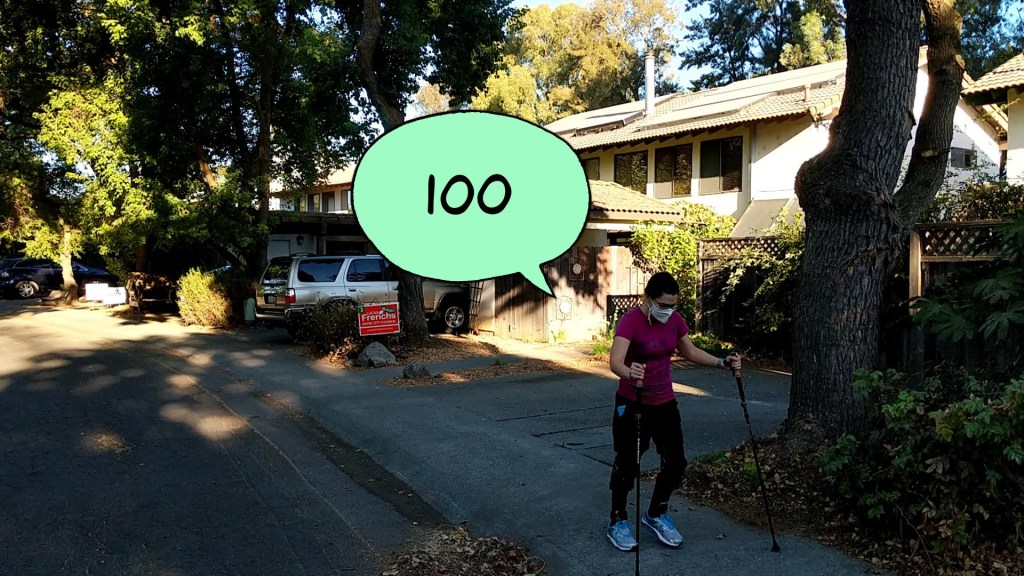
In the last three weeks, I have reached and surpassed the 100 day mark. In June, when I came home from the Hanger Clinic and marked the one hundredth day on my calendar, it felt very far away. I didn’t hope for any specific achievement, as I could not imagine what my progress would be by then. I did take a short walk outside on day 100. But it wasn’t particularly triumphant or celebratory. My husband could see that I was swinging my left leg from my hip, rather than really using my glutes and core to step.

If I were to be honest, I would also admit that, while I have technically owned my ExoSyms for more than one hundred days, I have used them for much fewer. Eighty, seventy-five days out of one hundred? That’s what the gaps signify in the “actual progress” graph below. There are periods of time where nothing happens on the ExoSym front at all.

I know, objectively, that progress is not a steady, uninterrupted line. But I didn’t truly know it until this journey.

Looking back at my notes, I see that these past three weeks haven’t all been stagnation. On September 17th and 18th, I made myself take a walk outside, that same twenty-minute loop I’ve done before, working up to walking to PT with my ExoSyms on my legs instead of on my back in a backpack. There were moments during those walks where I felt like I was reaching my regular walking speed, actually walking rather than think-stepping. That feeling of increased speed–was I finally engaging the struts properly and experiencing the energy return these ExoSyms were designed to provide? It was thrilling, for a moment. Until I stepped on a bump in the sidewalk and was thrown off so much that I nearly fell. How practical are these things going to be if I can only get them to work on perfectly flat, perfectly smooth surfaces?

I don’t have a Day 100 video, but here’s what I looked like on day 96, September 18th. I’m trying to show off my (occasionally) increased speed and my Ida B. Wells t-shirt:

Here’s the side-by-side comparison for two months and three months:

On the 23rd, I had my twelfth physical therapy appointment with ExoSyms. I told C about my falls and we discussed my pattern of losing my balance when turning, especially if I’m holding something. She gave me a new exercise to do, the clock. We have been concentrating on strengthening my weaker left side to combat the hip drop, and to encourage it to hold up my body long enough to allow my right leg to get a good step in. When I’m standing on my left foot and stepping through with my right, the right usually comes down early without a proper heel-toe because my left side isn’t doing its job.

The falls, then, are not surprising because I am again standing on my left foot, stepping with right, turning the upper body, etc. The left side needs to be able to hold me up while the rest of me functions, basically. The new exercise has me standing on the left and moving my right foot to different hours on an imaginary floor clock. I am one hundred percent holding on to furniture while I do this. For reference, I have never had the ability to stand on one foot, and if I were ever going to try to work up to it, the right would have to be my standing leg, not the left.

The whole situation is a little funny because as soon as C watched me attempt to point to twelve o’clock with my right foot, without ankle flexion and the added weight of the ExoSym, she realized that what we needed was the stability the Exo gives my on the left, but not the complication of the Exo on my right. Rather than actually taking off the right Exo and being lopsided, we kept going.

The following day, a Thursday, I did my exercises and I did my small loop outside. And that was really the last time I did much. I actually overdid it, I think, and felt sore (tailbone) and tired the next day.

Monday morning, the 28th, I was going to make myself put my Exos on after three days without them. As I did, I saw that the small metal piece screwed to the front of the right knee cuff was missing. This one has actually fallen off a few times, and I haven’t been diligent about checking and tightening the screw that holds it on. This metal piece is what the knee section locks on to to stay in place. Usually, it’s right on the floor at my feet, but this time it was nowhere to be found. I thought I could just get another one at the hardware store, but when I sent Ryan a picture and asked what it was called, he said it’s not at the hardware store and that he would send me one that day. It didn’t arrive until Friday. Could I have worn the Exos without the knee sections? Yeah. Could I have practiced the clock with just the left one on, just to see what it was like? Yeah. Did I? No. (For the record, I have in the past worn my Exos without the knee sections, and it was a fascinating combination of way less bulky and heavy but also way more unstable.)

So my Exos were all back together by Friday. Today is Sunday. I did wear them yesterday, and I even did the clock a few times. But my ExoSym life has been derailed by the rest of my life. 

Whatever we’ve got going on healthwise, stress and anxiety make it worse. Health issues can also cause stress and anxiety. So we are in a circle that is difficult to get out of. This is an ExoSym and cerebral palsy blog, and no one’s really interested in your ailments as much as you are, I know. And I’ll never know if you stop reading now.

I’ve had a low-grade sore throat for a year-and-a-half to two years-ish. It was always worse on Mondays when I had to return to work and use my teacher voice. Eventually, it got bad enough that it felt sharp, like something viral. It ended up being mild strep that time, May 2019. Months later, when the soreness hadn’t gone away, I got tested again and it wasn’t strep, so I was sent to an ENT (further months later, of course).

He could see inflammation and diagnosed me with laryngopharyngeal reflux (LPR). Since my diet is already pretty good and I don’t smoke, the best he could do was “bring down the spicy food from hot to medium,” and he got to check off that he discussed diet and lifestyle changes. Gave me a prescription for three months of reflux medication and sent me on my way. I was skeptical about this whole process because reflux can be caused by low stomach acid as well as high, and I didn’t like being put on a medication to lower it when we didn’t know what was causing the reflux in the first place. At my follow up (many months later, postponed because of COVID), the inflammation was gone, but my pain wasn’t. Because the inflammation had healed, it looked like the doctor had made the right choice, but since the pain hadn’t improved, he referred me to a gastroenterologist. I wasn’t looking forward to seeing another specialist, who probably wouldn’t find anything, so I put off making the appointment.

Then it was mid-September, and it was time for me to start teaching my groups through distance learning. I noticed a dramatic increase in my pain. Had my reflux flared? Is it strep again? It’s nearly unbearable. Anyone else get that thing where when the pain is bad enough, a headache and a touch of nausea show up, so you just feel downright ill? Sometimes I do actually vomit, as with the neck tension. I made the appointment with the GI doctor (months away, of course).

What’s funny to me is that I feel like I’m handling distance learning so much better this time around. I’ve always been an anxious person, and there’s oh-so-much to be anxious about right now, but I thought I was taking everything in stride, so to speak.

Last weekend, I read up on LPR again and cut out spicy food and acidic food, citrus, tomato products, garlic, fatty foods, chocolate. As a vegan with celiac disease who loves coconut curry and salsa, I have little enjoyment in what is left. I sleep propped up. I try over-the-counter antacids. I attempt to implement a more regular meditation practice, because, of course, along with cutting out everything with flavor, reflux sufferers should reduce stress.

Today will be the seventh consecutive day I’ve meditated, which is new for me. Thursday and Friday I managed to meditate before work, after work, and before bed. I’ve certainly never meditated more than once a day before. I’m fortunate to have the time and space to do this, and it might be exactly what I need. With yoga, pilates, meditation, and every other de-stress/mindful practice, it’s so hard for me to really believe in “the power of the breath.” I mean, it sounds pretty woo-woo. We breathe all the time. Does taking mindful breaths really change things all that much? 

I feel like I already have compassion for myself and my body, but doing all these compassionate body scans and “affectionate breathing” has been really interesting. It was a bit of a revelation to have a moment of understanding that I am not my body. I myself am separate from it. It is the vessel that I have, but it isn’t me. Of course, the reverse is also simultaneously true. Existence is complicated. 

One body scan starts with the left toes. By the time we reached my left hip, I was crying. Another started with the crown of the head, and by the time we reached the forehead, I was crying. I think we all need to lie down in the quiet darkness, take a deep breath, and listen to a gentle, calm, compassionate person guide us through our own bodies. We, all of us, need gentle, calm compassion.

I first tried mindful breathing about thirteen years ago during the relaxation section of Yoga for the Rest of Us. It’s taken me until now, with more regular practice, to actually feel the physical and mental effects, and now only sometimes. So, if you try it and think it isn’t for you, try it again.

I thought I’d leave a few of the meditations I’ve really come to enjoy down below. Some have a more professional quality than others. All have helped me.

Cerebral Palsy and Pain Management: What I’ve Tried

For the various muscle tensions and pain that come with my cerebral palsy, here’s what I’ve tried and my experiences with them.

Moist heat/cold packs: These feel nice in the moment, but offer no lasting effects. Nonetheless, I have a heating pad plugged in next to my bed at all times, and various herb/grain packs in the freezer that I use both heated and chilled. Mostly, they are comforting and make me feel like I’m doing something to take care of myself even though I know it doesn’t really help.

Muscle rubs/sprays: Various brands, most of which give a cooling sensation. Again, they don’t do much. Every once in a while, I think I can feel my neck let go slightly, for a moment. I have also used them in combination with other methods.

Various OTC pain relievers: Don’t you love it when doctors ask, “Have you tried ibuprofen?” Why, yes. Yes I have. “Did it help?” No. No it did not. If it had, I would not have felt compelled to make an appointment and get myself to this office and talk to a doctor for fifteen minutes. The truth is, I’ve never been able to tell if NSAIDs do anything. They might do a little, sometimes? For me to really know, I’d have to do the exact same scenario two ways, one medicated and one not, and directly compare them. But the time space-continuum doesn’t allow for that. Is it really true that people can take ibuprofen and actually feel better? 

Voltaren: prescription topical gel (designed for arthritis) on my knees. Nada.

Flexeril (cyclobenzaprine): This is a muscle relaxant I was prescribed for my neck, only meant to be taken for two to three weeks. I was uncomfortable with the idea of being on prescription drugs. Because it can cause drowsiness, my doctor told me to take it before bed. I did that once or twice and felt no different in the morning, so I put them in the back of the medicine cabinet. Months later, when I was having a rough neck-pain day, I decided to take one. I promptly spilled the remaining pills into the (wet and not particularly clean) bathroom sink, and that was the end of that experiment. 

Physical Therapy (childhood and adult): I had PT as a young child, and again for rehabilitation after surgery. Since my CP gives me muscles that are both tight and weak, PT focuses on stretching and strengthening, especially my hips (and hamstrings and adductors and etc.). As an adult, I’ve been referred for my SI joint, knees, and neck. None of my pain has been an acute onset as a result of injury. My pain just happens. All the issues I’ve ever gone to physical therapy for are still there. That would lead me to the conclusion that physical therapy does not work. But it’s not that simple. A physical therapist’s job is to set you up with a program you do at home, supposedly multiple times a day (ha!). Sometimes I do the program consistently for a stretch of time, and sometimes I don’t. Most often, I get home and try to replicate what we did and find that I’m straining something else in the process. Then I go back the next time and adapt it, etc. If a therapist could visit my home every morning and evening, maybe there’d be progress…? Even when I do succeed, like in stretching and strengthening my traps, that has not resulted in any noticeable decrease in my overall neck pain. While that’s extremely disheartening, I can also say that PT is probably not making anything worse overall, so I might as well keep trying it. At least I feel like I have someone who is trying to help me. And it’s my cheapest in-person option.

Ultrasound: I’ve had ultrasound done on my neck and shoulders a couple times as part of a PT session. It is meant to give a deep heat to the muscles and increase circulation. It was lovely to lie on my stomach, with the headrest set at just the right angle, and have some prewarmed goo gently massaged into my neck. Sure, the deep heat was relaxing. Maybe if it were for an hour instead of ten minutes, and I could fall immediately to sleep afterward? No lasting effects.

Pilates: I attended private pilates sessions for a number of years, even going twice a week at times. Did it help? I couldn’t tell you. I do know that I enjoyed having one-on-one time with an extremely knowledgeable and empathetic professional in a nonmedical setting. I can tell you that I became ever so slightly stronger and more flexible. But it was also during these years that the knee pain and neck pain appeared. I’m not blaming the pilates at all, just pointing out that it’s hard to measure improvement on the pain scale when new issues present themselves. I enjoyed being able to lie down while another person grabbed all the pillows and props I needed to be supported just so. I enjoyed being able to focus on a particular movement or muscle group. I enjoyed trying to apply various verbal cues to my body (“Imagine your pelvis is full of sand…”) and being cheered on: “Yesss! Yesyesyes!” As though, sometimes, I was able to do something well.

Massage: I’ve had several massages. I really enjoy the massage while it’s happening. I like that attention is paid to the palm of my hand and to my eyebrows, to muscles large and small. I like the quiet and the dark. However, I lament the whole process. Taking off my shoes and clothes, climbing onto the table, getting settled under the sheet. Having to turn from my front to my back in the middle of the session, on something raised high off the floor and narrower than a bed. And then, when I’m nicely relaxed, having to climb down off the table, put on my clothes and shoes, walk to the bus stop, stand and wait, climb into the bus, and get seated. Is any of the relaxation left by then? Not really. 

Acupuncture: I only did four sessions of acupuncture. During the first one, I found it so stressful that I was supposed to stay still with needles in me that I could not relax. In fact, I think the effort it took not to move made my muscles tighten more. The next session I did better at deep breathing and tried to relax. But I felt no difference. Repeat the whole process with clothes and table and bus from above. After two more tries, that was enough.  

Feldenkrais / Anat Baniel Method: I heard about Feldenkrais from another person with CP who was enthusiastic about its benefits. It’s about movement, biomechanics, neuroplasticity. I gave it a good try–ten sessions. The woman I worked with had never had a client with CP before. I lay on a table and she moved my body and/or I followed her instructions. I felt heavier/more relaxed into the table when we were finished, but it never lasted. If it were actually affordable, it’s something I wouldn’t be against continuing. I think mindful movement can only be a good thing. Anat Baniel is a holistic “neuromovement” method that branched off from Feldenkrais, and I did one session. Intriguing. Expensive.

Feldenkrais

Anat Baniel Method

TENS unit: I have only tried this one time. I didn’t feel comfortable using it on my neck, even though that is currently where I want relief the most. I did not like putting the sticky pads on my neck, nor the pulsing vibrations, so it did not get a fair trial. I did not feel any benefits during or after the one time I tried it.

Supplements: Curcumin with black pepper, magnesium taurate. Curcumin, from turmeric, is an anti-inflammatory and black pepper aids in absorption. Took one bottle faithfully. No difference. Magnesium is supposed to help muscle cramps. Took one (or two?) bottles faithfully. Some people with CP take supplements and do seem to notice a difference. I did not. 

Weighted Blanket: Weighted blankets have become a much-beloved item for people on the autism spectrum, and for those with anxiety. And really anyone. They are calming and comforting and help people relax and sleep better. I’ve tried two, after much searching for blankets that are not polyester and do not contain plastic beads. I faced a conundrum when choosing the weight of the blanket (based on my size and weight). Would I need a heavier one because my muscles are extra tight? Or would I need a lighter one because my muscles are weak? For me, going lighter than the recommended weight would have been better because it’s already hard enough to change positions while sleeping. With added weight, it’s a true struggle. As far as results, I get too hot while sleeping to appreciate the blanket for most of the year. When I’ve tried it, I haven’t felt more relaxed or slept better. I do enjoy it for sitting and reading or watching a movie, after the work of getting situated under something heavy–but only in winter.

CBD oil: I tried one liquid from Green Mountain (hemp), and I couldn’t tell any difference. When a new dispensary opened downtown, I went in and tried their recommendation (they rolled their eyes at Green Mountain). It was Papa and Barkley capsules. Honestly, I don’t remember if it had a bit of THC with it or not. No noticeable difference. Then I tried Charlotte’s Web, the fancy famous one helping people with seizures, pain, and all sorts of conditions. You’re supposed to take it twice a day regularly, not just as needed. So I did. No noticeable difference.

CBD lotion: No difference.

Cannabis: THC reacts on the body’s cannabinoid receptors which produces an anti-inflammatory effect. The only incarnation of cannabis I’ve tried so far is cannabis-infused dark chocolate, which contained 10mg of THC. Although I cannot say I was completely comfortable with the effects on my mental state, physically it was quite something. My limbs felt heavy and relaxed and I don’t think I felt pain. I wasn’t aware of my SI joint anymore. I carefully put myself into a hip/adductor stretch, and my knee just kept going outward (stretching more than it ever does). I could turn my head from side to side without pain and it just kept going. My thoughts went thus, “I feel a lack of spasticity. Is this what people without spasticity feel like all the time? Everyone with spasticity should be able to feel this.” One second I felt totally out of it: “Ugh, I don’t want to do this again,” and the next moment: “This is amazing. I’m so glad I have the ability to do this again.” I lay down and my husband used our electric muscle massager on my legs. I was awed by the result. My muscles were so deeply relaxed they felt heavy/not quite there. Almost like a layer of separation between me and my body. My muscles felt like they were melting at the touch of the massager. I didn’t feel a single involuntary tensing of the muscles; it’s like they were incapable of tensing. My eyeballs felt relaxed. My brain felt relaxed. “Is this what people without anxiety feel like? Or just high people?” My body weight felt like it was so deep into the bed. Like nothing was being held back in tension. Nothing was tense–all was given over. That feeling lasted a couple hours before I started to come out of it. It’s like I could feel my right hip rematerializing inside my body. I felt woozy. Sleep wasn’t magically good, but I felt more relaxed the next day than is usual, and when I stretched I could feel my muscles actually let go. It even lasted a couple days. This may have been psychological in part–the knowledge that something finally did affect me, the knowledge that relaxation is possible. It lightened my mental/emotional load. I was interested to keep trying cannabis, to see if I could have some of the physical effects without the mental ones (this is supposedly what CBD can do).

I tried a half dose. It didn’t really work. I felt a bit out of it and woozy, without the positive part. I tried taking it right before I went to bed, so that I could sleep through being high but still get the relaxation. Didn’t really work. When I took a full dose again on a bad pain day, it didn’t have the same effect either. Some pain relief without the full-body letting go feeling, but with effects I didn’t really like. I’ve tried taking nibbles of the chocolate over a longer period to simulate something more like smoking. And I’ve never again had the experience of the first time. I don’t particularly enjoy the high nor the wooziness I feel coming off of it, so it remains an enigma that I’m not fully comfortable with.

Meditation: I don’t know where my incorrect idea of meditation came from. I always had this idea that you were supposed to sit there and clear your mind. Not think about anything. Well, I knew I couldn’t do that, so I never gave meditation serious thought. I did always enjoy the Final Relaxation Pose (savasana) at the end of my Yoga for the Rest of Us DVD. The guided body scan from head to toe, a gentle voice telling me to imagine soothing comfort flowing to each muscle group. Was I in less pain? No. Was it nice? Yeah. I’ve continued to try other guided meditations, both body scans and guided imagery. I’ve learned that no one expects you to maintain a blank mind. Your mind will wander and come back. That’s okay. That’s expected. Mindfulness is about being in the moment without judgment. The great thing about guided meditation is that someone is there telling you what to think about; your mind isn’t blank, but focused instead. 

One meditation I found on youtube talks about the intention of kindness and compassion toward your body and yourself, wherever you are. “And it’s okay if you don’t feel it. We’re just practicing.” You see, we’re just practicing. I can do that. Another one I love has a guy who says my body will relax in its own time, and in its own way. More than once, I’ve just started to cry. And once or twice, I’ve felt it. A little bit of floating. It’s actually a little alarming, except that I know everything is okay. I can sit here, now, and relax one side of my face and then the other. My eye socket, my jaw. I can feel my cheek droop. I didn’t know how to do that before. If I could apply that ability to my trapezius in any kind of lasting way, my quality of life would be much improved. I have not achieved a daily meditation practice yet, but it really seems to be my best option. It’s free. I can do it lying on my bed. And it takes as little or as much time as I want, whenever I want.

Note: I have looked into, but have not tried, both Botox and Baclofen. Both of these are commonly used by children and adults with CP, though I think more in the moderate to profound range. They don’t seem like a good fit for me right now.

Further Note: Most of these one-on-one sessions with any kind of practitioner are not covered by insurance and the cost would be prohibitive for the vast majority of Americans. If cost were not an issue and I could be teleported with no effort, I would have daily pilates and massage sessions.

So What SHOULD I Hope For?

My first trip to the Hanger Clinic is coming soon. I will be casted on day one, and try out mock-ups, or “test devices” on day two. My last post included a list of actions or activities I used to be able to do. Now, let’s take a quick body scan and assess some chronic pain, shall we? Listening to someone’s aches and pains is not interesting. I know that. This catalogue is so I have my own “before.”

Feet: my left big toe started to send me sharp pain somewhere around…two?…years ago. About a year ago, I realized I was unable to step on it walking barefoot on my laminate flooring. This year, I went to my first podiatrist. He told me to wear stiff-soled shoes and thick, soft insoles. And don’t walk barefoot. I do not walk heel-toe; rather, my whole foot comes down at once, mostly on the big toe. So, I’m grinding the bottom of my toe into the ground with every step. After 38 years, I guess it’s had enough.

Ankles: these are mostly fine, unless I walk too much at once. Hooray!

Knees: One or the other of these aches often. The right started clicking and aching in June 2014, and the left followed in July. A doctor told me to ice them, twenty minutes on, twenty minutes off. What, forever? When I got referred to PT, I asked the therapist if some kind of knee support would help. She had me stand up and put her hands firmly around my knee. “Does that help?” she asked. I almost laughed. You mean if a knee support were going to help me, the pain would lessen right now? Just from that?

Hips and legs: Hips are always very tight. Sometimes I have strong, almost burning, pain in my right IT band. Other times an inner quad might hurt. Often, my right SI joint will give me sharp pain. It changes day to day, sometimes hour to hour. Sometimes I know what set it off; usually I don’t. I know I should avoid twisting while standing. Trying to do anything while bent over, wiping up a spill on the floor for example, is a really bad idea unless I take the strain off my hips and legs by holding onto something.

Back: I do not think of myself as having back pain. But sometimes at the close of a long walk, there is a pain and stiffness in my lower back that makes it hard to breathe. I stagger to a seated position and bend over my lap. A few cracks and a deep breath and I can straighten up again. I realized the other day that I “don’t have back pain” because I can make it go away. Apparently, I only count chronic pain as real pain.

Trapezius: If you’ve never looked at an image of the trapezius, check it out. It’s a giant muscle from the base of the skull, out to the shoulders, tapering to the middle spine. Since 2016, my neck and shoulders have been painfully tight. I know I have terrible posture. Telling me to sit up straight isn’t helpful. It takes a tremendous amount of energy to maintain good posture. Certainly while walking, it’s nearly impossible for me. Is PT helping? Can’t say for sure.

Jaw and ear: Yes, my jaw and ear hurt sometimes, just the right ones. It’s all connected. I think the constant neck tension is pulling my jaw and ear out of alignment. The years of extra strain on my stronger right side as it compensates for the left is taking its toll. If you’ve never had sharp, intense pain in your ear, be grateful. 

This is the state of things. Pain from head to toe. Perhaps not all directly related to cerebral palsy, but definitely indirectly affected by it. I have tried many modalities to address the issues.

The ExoSym is life-changing. All the people in the videos say so. But what about all the people who aren’t in videos? How many try out the test device and decide not to move forward? Maybe it won’t be life-changing for me. Maybe I’ll still have chronic pain and very limited balance. It won’t do a thing for my muscle spasticity. It won’t make cerebral palsy disappear. The people who put on the test device and are “pain free”  right then and there are usually people who were able-bodied before having some kind of foot or ankle injury. 

My pain comes from a lifetime of atypical body mechanics. It’s going to be a different kind of experience for me. How can an hour or two in the test devices show me how they might affect my body long-term? I don’t expect any of my chronic pain to be immediately relieved. I’ve never felt an immediate improvement in anything physical in my life. Never have I been able to report back to a doctor or therapist, “Yes, _______ definitely helps.” 

So what will the ExoSym do for me? What is a realistic hope? I hope that I feel lighter, that I can feel the “energy return” that the brace is designed to provide.

I hope that I feel something. That I can tell the devices are doing something.