Aging with Cerebral Palsy: Can I Still Move My Body Every Day at 44?

When September arrived this year, a week-long vacation to Colorado loomed. Many people would be excited at the prospect of a trip. I am mostly exhausted by the idea. Over the past months and years, I have become less and less active and more and more tired. With the heat of summer, it was easier than usual to avoid doing the things that I knew would be good for me: stretching on my dedicated physical therapy platform, going for walks, obviously, and participating in the free adaptive exercise classes online or the water aerobics classes at my neighborhood pool. The thought of leaving my home and my cat, traveling, facing airports, shuttles, a road trip, checking into and out of various accommodations that may or may not be accessible… It was all a lot, even though taking a trip was also a good thing. 

We were leaving on September 14th so when September 1st rolled around, I knew I needed to do something to prepare for walking through airports and climbing in and out of a rental car. I took a walk. Not a long walk, just fifteen minutes. But I made myself take a walk. I took off my inside shoes and I put on my outside shoes. I went down the garage steps and I opened the garage door and I maneuvered my body into my posterior walker and I closed the garage door and I walked down my driveway and I turned left onto the sidewalk and I walked. And then I turned around and came home. I parked my walker in the garage, and I climbed the two steps to the house, paused to press the button to close the garage door, stepped over the threshold, closed the door behind me. I sat on the bench, took off my outside shoes and put on my inside shoes. 

Every moment feels like work. Every step toward getting out of the house is a task that I do not want to perform. But that day, I performed those tasks, and I took a walk outside. The next day I did it again. Sometimes I waited until evening and my husband took a walk with me after dinner. One night, it was already 8:30, and I hadn’t walked yet. Ugh. But I took off my inside shoes and put on my outside shoes, and my husband and I took a walk. Not a long walk, just fifteen minutes. Just the same walk up the sidewalk to the teal house and back down to ours. I knew I wasn’t “getting in shape” for the trip, that these little walks were hardly making any difference at all, physically. This was a mental exercise more than a physical one. Could I take a walk outside, every day, for two weeks?

Yes. I could and I did. And I walked through airports. I walked in Colorado. Some days our activities barely counted as walks. We were there to visit hot springs, to sit in hot water. On those days when I was mostly sedentary, I was still outside. I was outside at some point, for some amount of time. When I returned home from my trip, I continued to take walks. Could I take a walk every day for thirty consecutive days?

Yes. I could and I did. And just so I didn’t immediately stop my streak, I took a walk on October 1st, too. Thirty-one consecutive days of activity outside of my house. I did feel proud of myself for achieving that, and I’m glad to know that I’m still able to, even now, even with my body in the state that it’s in. Honestly, I don’t know the last time that I walked every day for thirty-one days. Even during the years that I worked outside the home four days a week, I probably spent one of the other three days inside resting, reading, and online. 

I proved to myself that I can leave my house. I can go outside and move my body. Do I ever really want to? No. Nope. On beautiful days like today, I open the windows and I look outside. But do I want to make the effort to go outside? No. Nope.

Is it depression? Probably. Is it fatigue and chronic pain? Most definitely.

But I did do it, so I know that I can. I can make myself do things that I don’t want to do, because I know they are good for my physical and mental health even if I can’t feel it. But, certain things being good for my physical and mental health is not motivation enough to do them. 

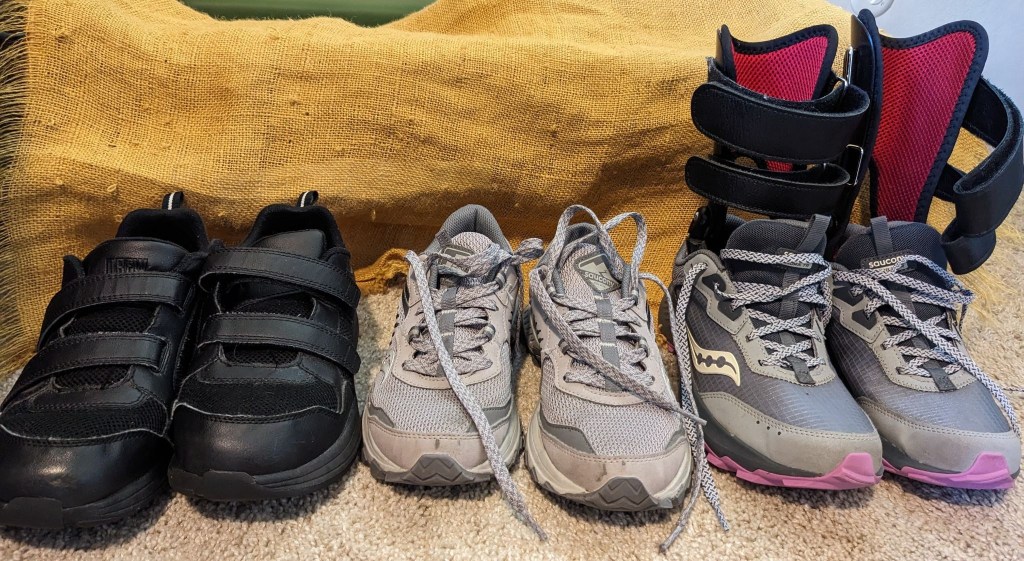
So, why did I do it this time? I think having an end-date helps: every day for thirty days, not every day for the rest of my life. Putting no distance or time requirement on myself helped. Further, giving myself permission not to wear my AFOs also helped. I worked so hard to get ankle-foot-orthoses for both feet, and they do help a little with stability. So why wouldn’t I wear them? They stay inside my shoes. I put my foot in close two straps across my shins. That is literally two more actions per foot than putting on my other pair of outside shoes. (Those have custom inserts inside the shoe.) But somehow, it’s just enough additional effort that I don’t want to do it. I really dislike that I need to wear shoes inside. But my feet need good, firm support, no slippers or slip-ons allowed. So no matter what, I have to take off one pair and put on something else. It’s already double work. Well, unless I just wear my inside shoes out, which I do if I’m just going out onto the patio for a minute. So I gave myself permission to just wear my “regular” outside shoes, which are a little more comfortable, and a little faster than the AFO ones. I removed or lessened every possible barrier, and that left me with the task itself: go the #@$! outside and walk.

Inside shoes with Velcro. Outside options without and with AFOs.

There was no great transformation or realization. I do not now love going for walks. I do not find it any easier to do it after having met that goal. No “I walked every day for 30 days and this is what happened” before and after story. I want to like it. I want to  want to do it. I want there to be a transformation or realization. Alas, I am still exactly my same self.

But I did do it. And that is something.

One of Many

I’m still here, still struggling both mentally and physically. I haven’t felt like there’s anything much I want to say. But Disability Pride Month has come around again, so here’s a link to last year’s post which still sums up things for me nicely.

I have been feeding my YouTube addiction with some new content. I already follow several people with disabilities, and YouTube recently suggested a new one to me. Brooke Eby (@limpbroozkit) who is mainly on Instagram and TikTok, I think, as her content is usually short form. She started making videos 3 years ago when she was diagnosed with ALS. I was sucked into her story because she’s a fast talker with deadpan humor and great hair.  Brooke was 29 when she started having symptoms and 33 when she was diagnosed. It started with weakness in her left leg, which is also my weakest limb. She has a video that shows the progression of her symptoms and mobility aids. She starts by wearing a small brace on the left foot, then a bigger brace and a cane, then braces on both legs, a walker, a wheelchair. In later videos, she displays her stiffening fingers, how she can no longer lift her arms, and how she discovered that with a weak core, it’s difficult to cough and blow your nose.

ALS can start in a limb, like it did with Brooke, or it can start in the throat and affect your ability to speak and eat from the beginning. Every three months Brooke goes to the hospital for her breathing test and every three months she gets to know how much worse she’s doing. When she started, her lung capacity was over 100 (out of 100), and now it’s in the 30s. Or it was when she last made a video about it. She wears her bipap (a noninvasive ventilation device) almost all the time now. And she recently got a feeding tube because even though she doesn’t need it yet, she needed to do the surgery while her breathing was still strong enough that it was safe to be under anesthesia. 

It’s been a decade since the ALS Ice Bucket Challenge, which dramatically increased awareness of ALS and raised a lot of money for research, but has not yet led to effective treatment. The average lifespan after diagnosis is two to five years. We think of ALS as a rare disease, but it is not. It occurs in 1 in 300 people. It’s just that it kills people so quickly that there aren’t many people with ALS alive at one time. 

YouTube doesn’t feed me these short videos in chronological order, and it’s so disconcerting to see a more recent one and then watch an older one in which the disease hasn’t progressed as far. First, she’s showing us tools that she uses to make her solo apartment in New York more accessible, and then she makes a video about moving back in with her parents. From watching Brooke and her dad demonstrate how they use a lift, to going back in time to Brooke putting accessible shoes on, doing her makeup and brushing her hair. It’s wild to have this video record of the speed at which ALS changes someone. Brooke says that hers is a slower-progressing form and that it’s slow enough for her to make the mental adjustments and get used to it. For me, it’s hard to watch someone show off their new electric can opener in a video from a couple years ago, and know that now she cannot grip the can opener at all. It seems that as fast as she and her family acquire the right equipment to help them live, her needs change again. One in 300. 

So why am I obsessing over Brooke’s story, checking for updates, wondering how much longer she’ll be able to use her voice? ALS reminds me so much of CP. Only it’s like the person with ALS is going through CP in ALL its forms, on fast forward: the muscle weakness and stiffness, lack of control, the various mobility aids, the need to constantly adapt. But CP doesn’t kill you and ALS does. Why haven’t we figured out an effective, accessible treatment yet?

There’s a quote, apparently by Theodore Roosevelt that proclaims, “Comparison is the thief of joy.” If we compare ourselves to other people who seem to have it better than we do, we feel sad, frustrated, jealous, inadequate, etc. But often, in the context of disability content, we’ll see lots of comments like, “I thought I had it bad, but after seeing what you’re going through, my life is looking pretty good!” It’s insensitive and insulting. Basically, “Wow, sucks to be you!” A terminal disease, while disabling, is very different from other physical disabilities. ALS does suck. We actually do need a cure for ALS. Am I seeing my cerebral palsy from a different perspective after following Brooke’s journey? Yes. I think people with CP are good at not taking the abilities they do have for granted. I have always been so very aware of, and so very grateful for, my ability to use my hands and fingers, to speak clearly, to use the bathroom alone, to roll over in bed even though it isn’t easy. But after learning more about ALS, I have also been savoring my ability to take a deep breath, to swallow, to scratch my nose. It’s a different feeling, a more accepting one. Yes, my body hurts. My throat pain is a constant because the muscles are tight. It’s true that my body can no longer do what it once did and that it will continue to decline. That is not unique to me, or to cerebral palsy. So many people are living with unpredictable, undependable, painful bodies. For so many reasons and in so many ways. I am in good company. It feels better, to not be struggling alone, but to be one of many who are living on the “my body is not typical” spectrum. When I stand up from a chair and my feet and back are so stiff and painful that I can barely straighten up and move, I try to remember that that is just fine. That is how things are, and it’s okay for my feet and back to be stiff, to hurt. It’s part of being me, of being alive. It’s as if all those years of meditation practice, about acceptance and surrender, might just be starting to mean something to me.

People with disabilities are the largest minority and the only minority that anyone can join at any time. That may sound ominous or threatening, but it is only the truth. After I watched Brooke’s videos, YouTube’s algorithm suggested other people with ALS to me. One is a 21-year-old girl, whose whole body is affected already, and who, if I didn’t know her diagnosis, I would think had CP. But she is dying, both slowly, and much too quickly. YouTube continued to suggest other people with disabilities, too, paraplegics and quadriplegics. A skiing accident, a car accident, even a hammock accident (which is more common than you think), and people’s lives become so different than they could have imagined or planned for. Every spinal cord injury is unique; there’s so much variation in how much sensation and movement is recovered. Some people are still very independent with their activities of daily living (ADL) and some people need almost complete care. And some of those people choose to share their lives online and show us what it’s like to use a catheter to pee, have a “bowel program” to poop, or have a preferred person feed them because that person takes the time to create a well-balanced bite. From an able-bodied (and probably uninformed) perspective, it’s all about walking again, but there’s so much more to life and to living than walking. 

So many people with illnesses, injuries, and disabilities don’t have the option of choosing braces today or not, walking poles today, or walker. They use the tools they need to use to live, whatever those tools are. I’m still at a place in my life and my disability where I have a choice in some ways. The choice to walk out the door without a mobility aid is gone, but options still abound in other ways. And that’s simply how life is. All these statements I’m making are not revelatory. I’ve thought these thoughts before. They’re just making a softer landing in my mind these days, and settling in.

Six Years of Searching Ends with One Simple Answer: Disability, Chronic Pain, and Horses

Like many, many adults with cerebral palsy, I learned long ago that “not progressive” means that the damage to the brain does not progress, but cerebral palsy’s effects on the body most definitely DO worsen over time. Because we are told CP is not progressive, and because most healthcare professionals don’t know much about CP, we who are living with it are on a guideless journey of mostly unpleasant discovery. Thankfully, the internet has enabled us to connect with each other. We are each other’s only companions in the dark. Does anyone else…? What do you all do when…? How do you handle…? Of course, each person’s experience with cerebral palsy is different, just like with so many other conditions that are grouped under one gigantic umbrella, so we give each other plenty of contradictory, if well-meaning, advice. By the way, people with CP are taking charge and trying to get healthcare to meet our needs. Check out Cerebral Palsy Grows Up!

Since 2019, I have been on a journey of my own that has often left me feeling in the dark. It’s all been documented here, but I want to bring all the heretofore disparate pieces together now so we can see the big picture. Bear with me and my detailed self-involvement. I want this as a record for myself and might as well put it here, too. (I mean, it is my blog of my life with a disability. What do you expect?)

Here’s a not-so-quick rundown of all the moments I’ve deemed relevant to this particular exercise, timeline-style, kind of:

-Date unrecalled (many years): TMJ (jaw) pain and sharp ear pain.

-June 2008: Neck tension episode so extreme, it caused vomiting. Constant neck and shoulder tension, onset June 2016.

-August 2014: Onset of burning toes, especially when cold or wet. Assumed Raynaud’s. (Turns out it’s not.)

-June 2018: Diagnosed with celiac disease. With positive ANA and high centromere antibody. I’ve had my celiac panel blood test done seven times so far, including the original in 2018, when my tTG result read, “ >250.” Normal is <15. Since then, despite a very strict gluten-free lifestyle, subsequent results have fluctuated between 221 and 81.2. I am happy to say that the 81.2 was from August 2024. The only reason I’m going into this much detail about celiac numbers is that the literature states that when the numbers remain high, look for additional autoimmune diseases.

-May 2019: Ongoing sore throat (months). Faint positive for strep. Took antibiotics, but the pain remained, intermittently. This set off my search. The throat pain didn’t seem connected with anything else.

-October 2019: Ongoing throat pain, now constant. Negative strep; ENT referral.

-December 2019: ENT diagnosed laryngopharyngeal reflux (LPR). Prescribed Protonix for three months. April 2020 follow-up postponed because of the COVID-19 pandemic. Unremarkable esophagram (barium swallow test).

-December 2019: I started using trekking poles to walk longer distances, preparing to use ExoSyms.

-March 2020: Sudden onset of burning forearms, tender/sore thumbs and base of thumb. Loss of grip strength. Suspected cause is trekking poles. Not better with cessation of use. Moderately improved with PT (June–September), but not back to pre-pain function. (This coincided with the pandemic lockdown when everyone’s jobs and lives were upended. I now think that the stress of the sheer number of unprecedented events in 2020 was a big contributing factor.) 

-May 2020: H pylori negative. Checked this because of throat pain and reflux diagnosis.

-July 2020: ENT follow-up. Doctor said the inflammation was gone. But the pain was still there. Referred to gastroenterology.

-September 2020: Dramatic increase in throat pain. Chest pain/burning sometimes. Occasional honking cough. GI referral moved up. Avoided acid and caffeine, tried sleeping propped up, no alcohol, etc. Tried Pepto and Mylanta; didn’t help. (This coincided with beginning “distance learning” with my elementary school students. Have you ever tried to teach six six-year-olds how to read via Zoom? This again, I now think, was connected to the unprecedented stressfulness of the world, and the US, in 2020.)

October 2020: My first upper endoscopy, which was an extremely stressful and emotional experience for me. Results stated “granular mucosa” and “reactive gastropathy with mild chronic inflammation.” No one seemed to think these were concerning or indicative of anything.

-January 2021: GI video visit follow-up. Sent back to ENT (sinuses?). 

-January 2021: ENT appointment with a different doctor. Scope showed minor inflammation. Flonase, Claritin, nasal rinse prescribed.

-February 2021: Tried Claritin and Flonase a couple weeks, didn’t seem to help. Same for nasal rinse.

-22 March 2021: Stomach pain and burning woke me up at 5am. Nausea. Throat/reflux felt very strong. Stomach pain eased some with food.

-Spring 2021–Dec 2021: I decided to try seeing a functional medicine doctor. He ordered loads of labs and diagnosed me with Chronic Inflammatory Response Syndrome due to mold exposure. Hard science re: CIRS lacking, but (inactive/prior water damage) mold was confirmed in our home. Mycotoxin urine test showed elevated levels of four mycotoxins, but the test doesn’t have the science to back it up.

-May 2021: Pop in groin. Had MRIs of lumbar and right hip. Diagnosed with labral tear, mixed type FAI, arthritis, probably trochanteric bursitis. Tried steroid injections. 

-April 2022: Sports medicine referral at UC Davis: gluteal tendonitis, lumbar facet arthropathy. Sent to PT. Referred for EMG. Tried gabapentin June-October 2022.

-March 2022: Significant increase in beverages/saliva, even food, going down the wrong pipe and causing coughing. Over the past six months? Often daily. Leaves chest hurting.

-April 2022: My PCP had originally suggested ENT or allergist for my throat pain, and we had started with the ENT. So now I asked for a referral to an allergist before deciding whether to tear apart our house to do mold remediation. I had been researching my symptoms, and on RareDiseases.org, I saw something that fit. I asked the allergist about granulomatosis with polyangiitis. He chuckled. (And was right that I didn’t have it).

-May 2022: Forearms still burning. My tTG was back to being very high. Since I also had positive ANA, I wondered if I had an additional autoimmune disease. My new PCP at UC Davis looked at my labs and history and agreed to refer me to rheumatology.

-June 2022: First visit with rheumatologist. No obvious signs of scleroderma, lupus, or other autoimmune diseases.

-June 2022: Leg EMG, nerve conduction study (ordered by sports medicine). Testing for neuropathy: findings “essentially normal.”

-July 2022: Referred to pain management by sports medicine.

-June–November 2022: Tried gabapentin, very low dose to start and worked my way up. First time consistently taking pain meds. Once I was on a standard dose, I stayed on it a while, but I didn’t notice any improvement in pain, and thought I might be starting to experience some side effects, like mild dizziness.

-July–August 2022: Spent two months away from home while brain retraining to see if there was a mold connection. No consistent change in throat pain, but interesting meditation experiences with The Gupta Program.

July 2022–January 2023: Used The Gupta Program consistently, but no lasting changes.

-September 2022: Pain management doctor discussed compounding cream, CBDa, duloxetine, baclofen pump, and lumbar radiofrequency ablation (but nerves grow back). Referred me to pool therapy, but there are no facilities I can feasibly get to.

-September 2022: Arm EMG (ordered by PCP). “Normal study” with no evidence of peripheral neuropathy.

-September 2022: Right foot and ankle x-ray, at Sutter, for sharp pain that interfered with weight bearing and a new bulge on the side of my foot, onset July 2022. Referred to PT.

-October 2022: First visit with GI at UCD, for “uncontrolled celiac disease.”

-November 2022: MRI for right ankle, at Sutter. Osteoarthritis and not much else.

-January 2023: Tested for strep just in case, before helping a family member post-op. Faint positive again, just as in 2018, but again, no change with antibiotics.

-February 2023: First neurology visit. She was amazed and concerned by my abnormal reflexes and ordered some MRIs. Sigh. Ugh.

-March 2023: Dexa scan (ordered by GI). Low bone density.

-March 2023: Cervical spine MRI (ordered by neurologist). Various mild-to-moderate degenerative changes in places and disc bulges.

-April 4 2023: First appointment with PM&R, at UCD. Fun thing about a teaching hospital is that I had a group of people analyzing and discussing all my various symptoms, and it’s the closest I’ve felt to being in an episode of House, MD. Too bad there weren’t any helpful revelations. “If it hurts, don’t do it.”

-April 11 2023: Brain MRI (ordered by neurologist) because of “abnormal reflexes” in my hands and arms. Only findings: “Small white matter lesion in right brain” that is unlikely to have caused my symptoms.

-May 24 2023: Neuro follow-up. Doctor’s notes include: Small fiber neuropathy could possibly explain her forearm sensory deficit, although she could have mild cervical sensory radiculopathy given her symptoms improved with OT and MRI of C spine did report mild disc bulging at multiple levels. Since her symptom remained stable, symptomatic care for cervical radiculopathy or small fiber neuropathy is recommended, no matter if she does skin biopsy or not. “Symptomatic care” means topical ointment or lidocaine patches.

-June 2023: Endoscopy #2, UCD this time. Very little signs of damage from celiac disease.

-July 2023: I brought up the possibility of fibromyalgia with my UCD PCP. Started Savella in September. Didn’t help. I guess it’s not fibromyalgia.

-September 2023: I was casted at my local Hanger Clinic for a left AFO (recasted and padded in February 2024). Already had one on the right side.

-October 2023: I fractured my right shoulder in a kitchen fall. First panic attack.

-March 2024: I purchased a posterior walker. Started trying it around the neighborhood. Much less labor intensive than using trekking poles, but I’m still not comfortable using it in public (it’s bulky and rattles loudly).

-April 2024: First visit to a new podiatrist. He HELPED my excruciating left big toe!

-May 2024: Appointment with a new neurologist (referred by rheumatologist?) Re: throat and arms. “You have CP.” Referred to otolaryngology and PM&R.

-May 2024: First Teledoc appointment with psychiatrist, because I’m finally open to medication for anxiety. Tried Lexapro. Didn’t seem to help. Tried Prozac next for a few months. Helped but too many side effects.

-June 2024: First Teledoc meeting with counselor. Weird and unhelpful. Had three appointments with her before trying another, who was also weird and unhelpful. Stalled on my quest to find a good therapist.

-October 2024: First visit to UCD otolaryngology for an esophagram and scope. After the scope, he said I have mild laryngeal dystonia/dysphonia. Referred to voice therapy.

-November 2024: PM&R visit #2, with new doctor. No gaggle of students this time. Just a long, detailed one-on-one session, with a few standard strength/tone assessments. Started oral baclofen. Referred to acupuncture.

-December 2024: PM&R follow-up. Increased baclofen. Referred to urology for lifelong, basically, frequency and urgency.

-13 December 2024: First appointment with voice therapist (SLP). He said it doesn’t seem like laryngeal dystonia, but rather just spasticity/increased tone. 

There’s a saying in medical school. Well, I’ve never been to medical school, but I heard this way before it was on Grey’s Anatomy, so it must be an established maxim: “When you hear hoofbeats, think horses, not zebras.” In case it isn’t obvious, this saying means that symptoms are most likely caused by a common condition, not an obscure one. You’ve got your overzealous interns coming up with rare diseases, and statistically, it’s more likely to be something that isn’t rare. Horses, not zebras.

Of course, we all secretly think we must be the one zebra in a herd of horses. Just because something is rare doesn’t mean it’s never that thing. It just means that it’s rarely that thing. Someone has to be a zebra sometime. Maybe it’s me. Having access to the internet only encourages our zebra suspicions.

According to my imperfect memory, I grew up without a primary care provider, only seeing physical therapists and an orthopedic surgeon. I never got “sick,” so I didn’t need a doctor. Okay, it’s true that my dad was a GP, so I had a live-in doctor. And he did give me stitches both times I needed them. But my point is, I was, generally, a very “healthy” kid. 

I didn’t even know how one went about getting their own primary care doctor, and it felt like a very big step for me in my twenties when I finally did it. I had my own doctor who wasn’t related to me. I had my first pelvic exam. (We in the CP community discuss this adventure regularly. Stirrups are not required!)

I was a kid who almost never needed a doctor, and now I am someone who not only has a primary care doctor and gynecologist but who, in the past six years, has also seen ENT/otolaryngology, an allergist, gastroenterology, rheumatology, sports medicine, pain management, integrative medicine, functional medicine, internal medicine, physical medicine & rehabilitation, podiatry, and neurology. There’s an undeniable element of absurdity in this list. I fully acknowledge that.

I decided to look outside family medicine and seek integrative medicine in my thirties because I was experiencing more and more chronic pain, fatigue, and general decline, and I hoped something more, well, integrative, would help. It was the integrative medicine doctor who tested me, to my surprise, for celiac disease in 2018. If I hadn’t gone to her, I think I would still be undiagnosed. I did not go to her for gastrointestinal issues, but her office took the most thorough history I have ever experienced. Because I do have celiac disease–with panel numbers that have always been out of range, no less–I have a legitimate reason to have a gastroenterologist. Because I have two markers indicating the potential development of other autoimmune disorders (again discovered by integrative medicine), I also see a rheumatologist twice a year (Although these markers were discovered in 2018, I didn’t see a rheumatologist until 2022). It’s still a little weird to me that I have these two specialists that I see regularly now, after being so outwardly healthy my whole life.

The constant throat pain that appeared in 2019 kicked off the ENT/GI journey, and the addition of the burning forearms in 2020 eventually added rheumatology and neurology to my “care team.” Various CP-related issues and injuries led me to sports medicine, pain management, podiatry, and PM&R. Sprinkled throughout were numerous procedures and MRIs that were all the more fraught for being rather inconclusive, except showing that I am, like everyone–but more and earlier–experiencing lots of “degenerative changes.”

It was June of 2022 that I switched over from Sutter Health to UC Davis. When I had chosen my first long-term primary care provider in 2012, I called up Sutter because that was the hospital in town, and I knew how to get there on the bus. I liked my doctor, and after a decade with her, it felt weird to decide to see someone else. Furthermore, because of my childhood associations, I thought of UC Davis as the place you go when you are having surgery, not the place you go for regular healthcare. But I was feeling frustrated and positively worn out, and I wanted to see if I could find answers elsewhere. I didn’t like the idea that one medical establishment could really be better than another, but I decided to find out.

Overall, my experiences at UC Davis really have been more positive than my interactions with doctors at Sutter. The doctors I’ve seen at UC Davis have been more willing to admit when they don’t know something, and therefore also seem more open and friendly, and to genuinely care, for the most part.

I saw a second neurologist in May this year after asking my primary care doctor about vagus nerve stimulation. I have continued trying to find relief for my throat pain–it’s the one thing that still feels unbearable indefinitely. I have tried lots of “acceptance and surrender” with The Gupta Program (which brings together pieces of many different systems, including Buddhism). I do agree with the Gupta Program that “what you resist, persists” (borrowed from Carl Jung). There are plenty of pain studies about meditation and mindfulness. The less you focus on pain, the better you’ll feel. And of course it isn’t easy. There are minutes and hours I don’t think about my throat, and other minutes and hours when I notice my attention on the sensation continually. 

After trying Gupta, I kept searching for answers and relief, and I’ve learned a little bit about the vagus nerve. The vagus nerve goes down both sides of the neck, and affects almost every system in the body. There is such a thing as vagus nerve dysfunction, and vagus nerve stimulation (VNS). I thought that maybe I could do 72-hour heart rate monitoring to check my heart rate variability (HRV) and the health of my vagus nerve activity, as suggested by the doctor in this video on the vagus nerve

However, when you go to a neurologist and ask about vagus nerve stimulation, they are thinking of it in the context of a surgically implant, for treatment of such varied conditions as seizures, depression, and stroke. I was not under any impression that I needed a device implanted in my body. There are many ways of stimulating the vagus nerve that are non-invasive. I just wanted to talk to someone who was knowledgeable about the vagus nerve system as a whole, and how it may or may not be affecting different parts of me.

I have been planning to write about this appointment since it happened in May. By planning, I mean avoiding. So much so, that I had several other appointments that followed it, and I thought, well, I’ll just wait until after this next one and then write about all of it. And here we are on December 31st, and I do not want this task to follow me into the new year (I’ve been writing off and on for weeks). This appointment was hard for me. It was hard because after we talked about my chronic pain and fatigue and increased muscle tone and decrease in function, and also my forearms and my throat, the doctor concluded, “You have CP.” As if this fact explains everything. I sat in the chair and I stuttered, “But, my diagnosis is mild spastic diplegia…” The notes from the appointment state that the doctor suspects “spastic laryngeal muscles.” He referred me to otolaryngology and also back to physical medicine & rehabilitation. 

I’ve held on to those words, “mild spastic diplegia,” for my whole life. I heard them as a child while doctors and physical therapists spoke over my head after testing my reflexes and my dorsiflexion and watching me walk up and back, up and back. I’ve read them in my medical records. They are the words I use to explain myself to people and to introduce myself to new doctors. Mild spastic diplegia, affecting my legs. 

Over the years I had come to accept that because my spastic diplegia influences my gait and my posture, it will therefore affect my back and shoulders and neck and jaw. However much I didn’t want my CP to affect my upper body, it does. Everything is connected. I was even adjusting to the pain and tension in my forearms being a CP thing. But my throat, too? My throat? No, no, no thank you. If my neverending throat pain is a CP thing, that means I am likely stuck with feeling like I have strep throat for the rest of my life. There, I have written it down now. It only took me about seven months.

Also in May, I had my first appointment with a mental health professional (made months before, not as a result of the neuro visit). I have been wanting to go to therapy for years. I finally decided I was ready to try medication for anxiety, and the psychiatrist I had my virtual appointment with readily diagnosed me with generalized anxiety disorder and prescribed medication. That journey will be a separate post, if I ever get around to it. But it’s been interesting, and has influenced this journey as well. Did you know anxiety meds can cause increased muscle tension? Me either, until I read the long list of possible side effects and then experienced it for myself.

In October, I went to my first otolaryngology appointment. The lovely “barium barista” who guided me through my swallow study told me the doctor I would be seeing was highly regarded. Patients from all over the country came to him when other doctors were at a loss. I talked with the doctor and he put a scope up my nose and down my throat. Then he had me say sentences like, “Please pass the peas and potatoes to papa,” and the other one that is more voiced that I forget, about rain. (That one was harder for me to say.)

He said that it looks like I have mild laryngeal dystonia. Not at the level where he would inject botox into my vocal chords (that’s what he does). I have a diagnosis! Laryngeal dystonia! It is not mold, I am not sick. I just have tight muscles. What was devastating in May almost felt like a relief in October. I think this had a lot to do with the Prozac I was trying at the time, actually. Cue some research as I learned a new word to fold into my identity:

Dr. Judy Gooch

Is it Spasticity, Dystonia or Rigidity

Spasticity and Dystonia: What does it look like?

In November, I saw a new doctor at physical medicine & rehabilitation. She thought trying oral baclofen was a fine idea. Just to recap, the pain management doctor I saw in 2022 was ready to surgically place a baclofen pump, but when I asked about oral baclofen he only said it wasn’t as effective. Two years later, I’m trying oral baclofen. It’s…doing something? On her referral to voice therapy and acupuncture, I saw that she had written laryngeal dysphonia, not dystonia. Cue more research:

Laryngeal Dysphonia from Dystonia Europe

In a talk through Dysphonia International, Dr. H. A. Jinnah said there are terms often used interchangeably: spasmodic dysphonia and laryngeal dystonia: “Laryngeal dystonia is a group of disorders and spasmodic dysphonia is one of them.” The treatment is often botox injections into the vocal cords, but the doctor I saw said mine was too mild for that. While, after seven months of sitting with it, I can wrap my mind around my “mild spastic diplegia” cerebral palsy affecting darn near every muscle group in my body at this point, I still struggle with the expression of spasticity in my throat equaling a constant, strep-throat-like pain. The various manifestations of pain in the rest of my body do not feel like this. And there is something about it being in my throat, my voice, that is less ignorable than in my extremities. My voice feels like me, and for it to hurt all the time, for me to find, not pleasure in singing along with musicals, but pain, has been really hard.  

This month I went to my first voice therapy appointment with a speech and language pathologist. He doesn’t have experience with CP, but based on my history of trying all the things and nothing having a lasting effect, he doesn’t think there’s anything he can do. Voice therapy isn’t what I need. It takes muscular strength and breath work to produce sound. He gave the example of a gramophone. The box at the bottom is the muscles, diaphragm, etc. in the torso, and the horn is the muscles in the throat. The vocal cords are just the itty-bitty needle. He’s willing to try massage and muscle taping and teach me (& spouse) to do it ourselves. There are lots of tight muscles in my throat. The pain signal comes from nerves, and there are lots of nerve endings in the throat as well. The baclofen hasn’t decreased my muscle tone enough to reduce the pain of the tension anywhere in my body. I’m back to thinking of round two of The Gupta Program to work on calming my nervous system and its hypersensitivity and constant loop of pain signals.

This year, I also watched the documentary Joan Baez: I am a Noise. I may be completely misremembering this, but I think in an interview segment she watched a clip of herself singing in her early days, and then she was asked straight out if she could still sing like that. She answered, No, I can’t sing like that anymore, and yes, I miss it. Of course, Joan is 83, not 43. I think she didn’t sing publicly for quite a while. Instead, she stayed connected to music by finding joy in dancing. And she painted, because some people get to live lives full of remarkable ability and talent like that. More recently, she has given concerts again. She seems to have reached a truce/peace/acceptance of her voice and her abilities as they are now. It is natural for us to look back and to marvel and wonder at the way things used to be, at what we used to do. For all of us. I can hardly believe I used to walk more than a mile unaided and work for hours straight and then walk some more. (In my twenties. In my thirties I vividly remember the feeling of my pelvis being full of cement and wanting to lie down on the bike path on my way home.) 

I think coming to terms with a decline in ability is perhaps easier when you’ve already come to terms with never having had full able-bodiedness in the first place. For me, it’s the pain that’s hardest. And that no matter what, it’s always there. It’s the lack of respite that is exhausting at best and overwhelming at worst. And that is why I’ve spent the last six years searching for an answer to my throat pain. In the hope that one of these things is not like the other. (Throat pain is not like all the other body pain.)

After six years of searching, I finally know that one of these things is like the other. My spastic diplegia isn’t only diplegia. I have to accept that a major part of my identity is no longer what it was. I am not who I was. We continue to be new versions of ourselves, and often we miss parts of the old ones.

I am a horse, not a zebra. I do not have some rare condition with an easy cure. I have cerebral palsy, a very common lifelong disability that affects my muscle tone. Even in my throat. 

Now that I sit here on the final day of 2024, after procrastinating and processing for the last seven months, I’m relieved to have finally written it all out. Thank you for reading, if indeed you made it this far!

May we all find moments of peace and happiness in the year to come.

How to Be a Functional Adult When Your Mind and Body Don’t Want To

Hello, my name is Danielle, and I am a YouTube addict. I love watching people declutter and organize their closets, turning chaos into something functional and nice. I love watching people mow and trim overgrown yards and sidewalks, turning chaos into something functional and nice. I watch people restore furniture and renovate houses and make food, I watch the Vlogbrothers, I watch people with disabilities share their lives, I watch dance and music. And I do it all sitting down. Or lying down. My mind and body are at rest and there are stories and journeys unlimited to jump into and I could stay there in that cocoon forever and ever amen.

Sometimes I remind myself as I click on one more video that this is my one life. Is this how I want to spend it? Is this video enriching my life in any way beyond passing enjoyment? I know it’s time to close my laptop and do other things. But it’s so hard. I know it’s not just me. I know that it’s a worldwide cultural phenomenon, with the internet in our hands, our heads bent to our phones, scrolling and scrolling and scrolling. I’ve been very careful to not join Instagram or tiktok or whatever else is out there because Facebook and YouTube are already too much. They are almost magical places where we can create our own bubbles of people who love what we love and we can immediately find a site or a video on anything that piques our interest. This kind of internet was unfathomable to me in 2005.

I think about 2005 me sometimes, and not just because I was in my twenties and had more energy and less pain. In 2005, I walked from my apartment to the public library and I logged on to a computer to check my email. I checked my beloved message boards where fans of figure skating and Broadway musicals gathered. Then I logged off and checked out books. Paper ones. Or movies on disc, or CDs! That was the time of listening to every Beatles album and finally hearing Leonard Bernstein’s MASS. Oh, my heart. The way the internet and our lives have changed since then makes my head spin and my heart ache. The internet has been a tool for so much good, for connecting people and making political movements like #metoo and #BlackLivesMatter, and so many others, globally accessible. Accessibility is one of the greatest positives of the internet. I watched Joan Baez dance on her 80th birthday! I saw the original cast of Ragtime share their memories and the cast of The West Wing come together to play trivia and encourage people to vote. These moments brought me joy. 

But my daily consumption of YouTube and Facebook does not typically make my heart sing. 2005 me could not conceive of YouTube and Facebook. 2005 me was reading, journaling, listening to music, and going outside, for goodness’ sake. (And watching a lot of TV and movies, too. Let’s not be too rose-colored about the past.) 

The title of this post is utterly laughable because I don’t know how to be a functional adult when my mind and body don’t want to. We all know what we should do. Of course we know. I know that I should go for a walk and do my PT and eat less sugar and more vegetables and put my phone down and do deep breathing. I have tried to curb my internet addiction. The truth is, I do not want to give up Facebook and YouTube entirely because there is real value in them for me. 

I have tried no phones in bed, no screen time after 9pm, only allowing myself access on one or two days a week, or only after 5pm, or for only thirty minutes a day. All of these self-imposed limits work for a while and then I gradually let them slip away.

Now that I am legitimately middle-aged, only working a few hours a week, and finally back on SSDI (hooray!), I have the kind of time so many people dream of. Everyone out there who’s working full time and raising kids, they wish for some free time to work on labors of love or to rest and read.

But what am I doing with my one life? I am existing. I am tired. Sometimes I take a shower and sometimes I don’t. Some days I cook and do laundry and some days I don’t. Some days I read and listen to music. Some days I don’t. I am not alone in this, and my company isn’t only others with disabilities.

When did we become a society that makes half-serious jokes about earning a sticker for putting on pants? When did “adult” become a verb? Why does everything feel so hard? Not just for those of us with disabilities, but for so many?

I did not create this sticker. I found it here: https://bigmoods.com/products/i-put-on-pants-today-trophy-sticker

I don’t think social media is helping, with its ocean of “morning routines” and “night routines” and “how to be productive” videos. There is literally–and this is the correct use of the word–only one task I consistently complete every day of my life. I brush my teeth. That is it, the single task that is my daily routine. I can almost add one more thing to that list. Since adopting Maddie, I have fed her and scooped her litter box. Because she, through no choice of her own, is dependent on our care, and she needs and deserves food and water and pleasant conditions in which to carry out her bodily functions, I have met those needs out of love and respect for her. But I have not done these tasks every day. On days when I’ve been injured or my knees have been hurting, my husband has taken over. (We need to help out my body by raising the litter boxes off the floor, but we haven’t gotten there yet). 

Meeting the most basic of bodily needs, my own and my cat’s, seems to be what I am capable of. Will this ever get better, or continue to slowly get worse? Even when I successfully avoid endless scrolling, it doesn’t mean I have the energy to complete the tasks required in order for us to stay clothed, and fed, with a clean-enough body and a clean-enough home. 

It’s not that I feel I must be productive. Let’s continue to dispel the idea that one’s productivity is tied to their value as a person. It’s not productivity that I want, but to live a good life, to not feel that I’ve squandered precious time, to live with care and gratitude, to be present, and to nourish and love myself and others.

I love making lists. Yes, I am absolutely one of those people who will write something on the list that I have already completed, just so that I can cross it off. The items on the list might be as simple as taking my vitamins or journaling. Lists are not only for “chores,” but also for self-care. There are so many little things to remember to do every day, even things that I genuinely want to do, or to incorporate into my life, that I just don’t seem to be able to make stick.

My latest method has been the kanban board. This method of project management is not new; there are lots of versions out there, and it can be as simple or as complex as needed. Mine is simply three columns: To Do, Doing, Done. I found a magnetic whiteboard and ordered some magnetic dry-erase rectangles to use in place of sticky notes, and I put it up right next to my desk. The idea was to have the visual there for me, and to have an interactive component (moving the magnets across the columns).

I liked it for a while, but I’ve learned that it works well for some things and not for others. I put things that I want to become part of my everyday life in the To Do column: vitamins, PT, meditation, tapping. (I set up my environment so that I have the time and space to do them, and yet…) I added in other tasks as they came up, like laundry or vacuuming or making phone calls. Then, after the billionth time I kicked some of the clutter under my desk, I added “Hang art on the walls,” and “list XYZ on Buy Nothing.”  There are big and little, short- and long-term to dos, like taking old medication to the drop-box at the pharmacy and getting caught up with printing photos and putting them into albums. Or writing a blog post and updating a website. Soon the To Do column was full and daily goals were next to long-term, procrastinator-extraordinaire projects. I stopped moving the magnets over and went back to paper lists. I look at the board guiltily. I still have not updated my website. 

Having things that I theoretically want to do mixed with things I’m actively avoiding, well, that didn’t work. Or was it the smaller daily goals mixed with the big long-term projects that didn’t work for my brain? A week ago, I got fed up with myself wasting time on YouTube, as I sat right next to my kanban board that was reminding me that I still hadn’t done any stretching or meditating that day.

These aren’t all chores, I reminded myself. These are actions my body and my mind need, and I can’t expect to ever feel any different if I don’t at least try to be consistent with at least some of them. I needed this shift in my perspective. So I created something like a kanban board, but with self-care as its only focus. True tasks, different from self-care, will go on short-term and long-term paper lists somewhere else. I find pleasure in writing with a pencil on paper, and crossing items off lists, so I’m going to keep doing that.

I’d tell you that the picture below is the rough prototype, but I’ve never been into crafting, and I’m trying to let go of perfectionism, so here we have the new system, laid right atop the old one.

The three sections are Body, Mind, and Soul. I want to stretch and do breathing and tapping and meditation. I want to journal and listen to music and put my bare feet in the grass. But often I do none of these things. I’ve learned so many kinds of mindful breathing! Just do one. So I’m trying to see if I can get myself to do just one thing (or two?) for each part of myself each day. 

If I simultaneously take the pressure off myself to do all the things every day, and also provide the visual reminder–Why, yes it would be nice to do some journaling today–maybe I’ll be more likely to do some of the things, some of the time?

Furthermore, I have once again reinstated the “YouTube only on Fridays” rule, and the “For the love of sanity, don’t click on Facebook every hour of every day” rule. We’ll see how long it works this time. Scratch that, it sounds a bit self-defeating. What I mean is “Good job, me, for setting realistic goals, for switching things up, and for trying again.”

Trying again is all we’ve got really.

Cerebral Palsy Awareness Month 2024: Free Fitness for Those with Limited Mobility

This post has been brewing for months, so here it is, finally. It’s already March, 2024, and it’s Cerebral Palsy Awareness Month, so let’s pretend my timing was completely intentional.

In August and September last year, I was settling in to our new house and discovering new free (or low-cost) resources. I was doing my best to both stay active and keep my nervous system calm, even with the heat and chronic pain and fatigue and life. I’d found a few tools I was really grateful for and I wanted to share them. Then I fractured my shoulder and I stopped doing those new things. I’m not back to them all yet, but they are still good. Good for all brains and bodies, and available to anyone with internet access.

First, I looked up free meditation apps and tried some. Since my one-year membership to The Gupta Program ended, I missed all those meditation choices. YouTube has changed things, and my favorite meditations I saved there are now interrupted by ads. The free app I like best is the Insight Timer. There are loads of different guided meditations, and you can filter by topic or length or male or female voice. I always choose body scans or a yoga nidra.

The second amazing resource I found is the AARP. No kidding. I saw a FB advertisement for a free virtual exercise class, and I looked it up. Did you know you don’t have to be over fifty or a member to participate in AARP classes? They have loads and loads! And not just exercise classes, but cooking, and educational ones, and music and film ones. It’s called the AARP Virtual Community Center and it’s awesome! So often I am overwhelmed by everything that is awful in the world, and then I find something like this, and I think, sometimes, we do things right. Sometimes, we are amazing. Use the filter to find the ones you’re interested in. I’ve done chair fitness and qi gong, and I even tried laughter yoga. That was super….weird and fascinating. I can’t use my shoulder as an excuse anymore–though five months later it’s still not back to pre-fracture function–and I’ve got to get back into trying new things!

The third thing I discovered is not free. But it’s nearly free, so I’m including it. Over the years, physical therapists and doctors have suggested water therapy. There isn’t anything in my town, and the place in the next town over doesn’t take my insurance. So, I didn’t think it’s something I’d ever be able to try. Then I looked at my city recreation page. Again. There are a couple public pools attached to parks here, and there are classes like water aerobics. But I lived on the west side of town, and the pool with the aerobics was on the east side. Now I live on the east side, so I looked it up again. I saw on the “Aquatics” calendar that there was a water aerobics class twice a week. The cost per session? Four dollars. The location? A twenty-minute walk. So even though I positively deeply dislike taking off my clothes and putting on a bathing suit and putting on my shoes and walking to a pool and switching my shoes for water shoes (or else my toes will get torn up on the bottom of the pool), climbing into a pool and climbing out of a pool and being in a wet bathing suit and switching my shoes again but with wet feet, and walking home and taking off my shoes and taking off a wet bathing suit and putting on clothes, and then rinsing out my suit and hanging it up, I had to give it a try. And don’t get me started on having to pee. I pee before I leave the house. I pee when I get there. (I hate using a public restroom in a bathing suit.) Can I make it home before I pee again, or do I have to use a public restroom in a wet bathing suit? It was positively exhausting. But the 45 minutes that I was in the water? That was good. The participants are 98% senior citizens and they all chat and know each other and are friendly, and the instructor is enthusiastic and encouraging. 

For August and September on Tuesdays and Thursdays, I was someone who did water aerobics. “Hydrotherapy” for $8 a week. And it’s year-round! In a “heated” outside pool. I didn’t know if I was still going to make myself go at 8:30am when it got cold, but it was still hot on October 3rd as I lay on the kitchen floor with a fractured shoulder. I thought, well, maybe I can still go if I’m careful. And then I realized, no, that’s not going to happen. And I haven’t been back since. Sometimes I think, my shoulder is good enough for pool therapy now, and it would probably benefit from aerobics. But I just don’t wanna face the whole process again, but colder. Someday, not now. 

My point is though, that your town or city might also have super cheap classes that you don’t know about! Go on the official website and find recreation. My town also has an adaptive recreation program, and a really active senior center. I’ve never tried to take classes there, and they are a little pricier than water aerobics, but I’m pretty sure they’d let me in even though I’m not a senior yet. I also know that people who participate in community classes are generally awesome and would likely be happy to carpool if transit options are limited.

Because I didn’t want to leave you with only two free resources and one not-free, local one, I looked up a few more. Here they are, all together:

Insight Timer app

AARP Virtual Community Center . Filter by Category rather than Date and select “Exercise & Wellness.”

Adaptive Wellness through Disability Partnerships has a calendar of classes!

The Cerebral Palsy Research Network’s MENTOR Program is free.

The National Center on Health, Physical Activity, and Disability (NCHPAD) has a free fitness program that you can register for as well. They also have some interesting videos on things like fall prevention, and a directory of programs by state and country. I find the website confusing, but there’s lots there, so poke around!

Here’s my own playlist of inclusive workouts that I like on YouTube. I’m sure there are lots more. Use search terms like “chair fitness” or “seated workouts.”

Finally, I have updated my About Danielle page and my CP and Chronic Pain pages to reflect recent events. (The government finally agrees with me that I’m disabled! Again/still. Yay!)
Happy Women’s History Month and Cerebral Palsy Awareness Month to all the women with CP out there! If you want to read books that feature cerebral palsy, check out–and add to–my cerebral palsy book list on goodreads!

Don’t Go Chasing Water Falls

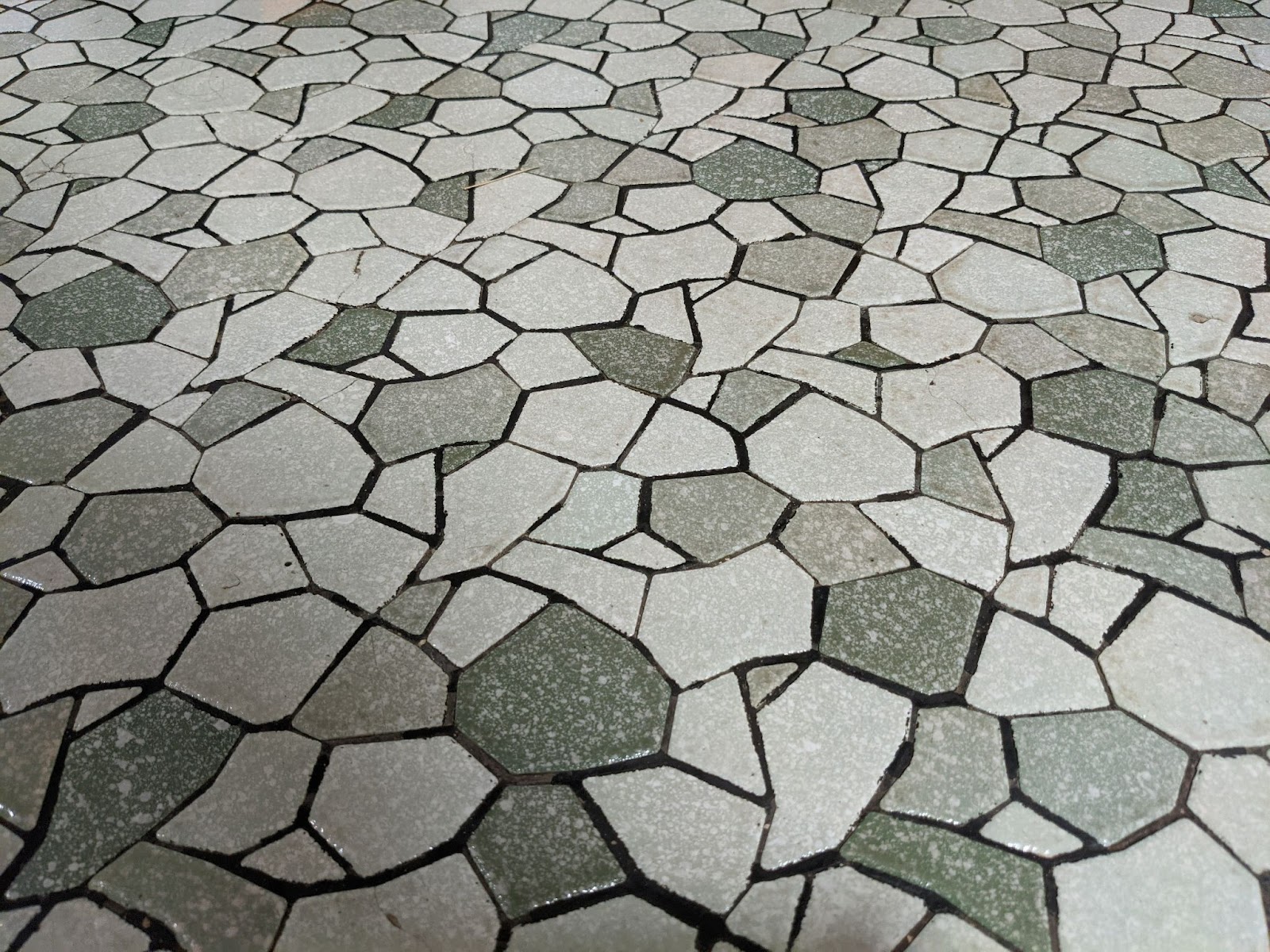
I made it into the fourth month living in our new place before falling in the kitchen. Going that long without a fall is pretty good because our kitchen has its original 1969 tile in it. I love the light and darker shades of green, but the shape and texture is a problem. It’s real tile cut in different shapes in a repeating pattern. Over the decades it’s been cracked and chipped. One spot has gone through an attempted repair and sticks up above the rest, with a mess of maybe rubber cement around it. 

The lighting isn’t great here. You’ll have to trust that it looks more green than grungy in person.

I could tell that spot in the tile was going to be a problem. My shoe kept catching on it. Fortunately, it’s right against the counter, so I’m usually already hanging on to the counter when I encounter this tile. On the day of the fall I was making myself oatmeal and I decided to return both the milk and the oats to the fridge at the same time. This is a risky and adventurous move because I know it’s safer to carry only one thing at a time and have one hand available for guidance and stability. Feeling apparently confident, I picked up the shelf-stable almond milk in one hand and the Bob’s Red Mill zip-closure package of GF oats in the other.

As I turned from the counter, I felt my shoe catch on the raised tile and milk and oats went flying as I lost my balance. Inwardly I grimaced, preparing both for the pain of impact and the potential splatter of milk and shower of oats that might be coming. On the floor, I breathed a sigh of relief and gratitude when the contents of both packages remained inside their vessels and I was not much worse for wear. I deemed my first kitchen fall a great success, and I was relieved to have gotten it out of the way, finally.

The very next day was the second kitchen fall, but this time it was a water fall. You see, we had gotten a cat. (Rest assured, this fall was not directly caused by the cat.) 

My husband and I had long wanted a cat but I was adamant that there was not enough room for a cat, her food dishes, and her litter box in our previous dwelling. In order for me to welcome an animal into my home, I had some requirements. (Remember, I grew up in a rural area, with an “animals live outside” perspective.) The biggest requirement was that we have an attached garage so that we could put a cat door in it and have the litter box outside of our living space. Lucky for us, our new house did have that, though the existing cat door had been sealed off and would need to be replaced. It took us a while to replace the door and to create an area inside the garage that was enclosed for the cat alone. I had thought about it and was afraid that she would get out when we opened the garage door or would be sleeping under the car when we tried to back out. I wanted a place in the garage to be sectioned off for her so that we didn’t have to be always nervous of where she was when we were coming and going.

After adventures in putting up cat netting and installing a new door, we took ourselves to the county animal shelter and met the only one-year-old cat who was available for adoption. No kittens for us. My other requirements were that she be small and short-haired, and amazingly, this cat checked all the boxes.

We brought her home on a Saturday and named her Maddie. On the following Tuesday morning, October 3rd, I was refilling her water dish. 

Have I mentioned our house was built in 1969? Along with the pretty, but problematic tiles, the kitchen floor is also rather…undulating. There are a couple of places that are not level underfoot. It is of course enough of an alteration in terrain for me to be hyper aware of it and for most people not to notice it much.

I want to take a moment here to emphasize that I also fell in our previous kitchen, which was indeed very flat both in terrain and in type of flooring. The problem seems to occur when I am carrying something. Even with one hand free as a guide, it is enough to throw me off, especially if I am also turning.

And so I filled her water dish, turned from the sink, and as I was passing by the refrigerator, I lost my balance. Again. My attempt to steady myself using the refrigerator was unsuccessful. This time, it was bad. I can only be grateful that I had just switched her water dish from something breakable to something metal. The dish went flying out of my hand and I–and the floor–became drenched in water. I was aware that, at the same moment my right hand made contact with the floor, it was also sliding away from me. The rest of my body landed when my arm was fully extended, my forward momentum adding additional force to the point of impact. My hand pushed against the bag of cat food, which pushed against a dining chair, and I watched, from my vantage point on the floor, as the chair tilted and finally landed on its side next to me with a clatter. What a racket-producing round of dominoes.

Again, I felt relief that I was okay, as I had not been knocked on the head or anything serious. There was pain, but nothing too terrible. But “Ow.” I realized I hurt my shoulder. My husband appeared, and I was ever-so-thankful he was working from home that day instead of the day before, as was his usual schedule. “I’m okay,” I said. “I just hurt my shoulder.” 

He righted the chair and held out his hands to me to help me up. “No,” I said, breathing heavily. “I think I need to lie here for just a moment longer.” As he started mopping up the impressive amount of water, I made jokes about this being one way to get the floor mopped. I realized that I truly was having trouble moving my right arm and that I really didn’t want to put any pressure on it. “I don’t know how to get up,” I said, struggling to bring myself to a sitting position and scoot to the edge of the tile. Bradley set a chair behind me and I managed to kneel in front of it, now on living room carpet. 

Suddenly, I didn’t feel great. Sweaty, a bit woozy. I lay my head on the seat of the chair and took deep breaths. “My fingers are starting to tingle,” I said worriedly, concerned that I had some kind of nerve injury on my right side. Then the fingers on my other hand and my toes started to tingle too and I realized I was having the same kind of vasovagal syncope response that I’d had when I attempted to donate platelets recently.

At my first-ever platelet donation, they’d told me I might feel tingly and provided Tums because the calcium helps. I ate my Tums but I only got about halfway through the donation process before awfulness descended upon me: I was sweaty, nauseated, woozy. Three or four people sprang into action, raising my feet, getting a fan, a barf bag, juice, and “syncope towels,” wet paper towels to put on the back of my neck and my forehead. I had always been fine donating blood, and I hadn’t expected platelets to be such a different experience.

The only other time I’d felt so awful was when I was in a lot of pain, from menstrual cramps in my teens and twenties, and also sometimes with neck pain. During those times, I would actually vomit, and I may or may not have passed out for a second in an elevator once. (Huge side note here, period cramps like this aren’t normal, aren’t just “part of being a girl.” If you or someone you love is vomiting or passing out from pain each month, something is wrong, and it can be helped. It could be hormonal imbalance, vitamin or mineral deficiency, endometriosis, or something else. Read a book like The Period Repair Manual; there are many resources out there now. Rather than going on the Pill, which is doctors’ default treatment option, advocate for yourself and get your body feeling better. Your pain is real, it’s telling you something, and you shouldn’t have to live in agony. Yes, I am passionate about this. Women’s pain has been dismissed for far too long.)

So I knelt there, hunched over the chair, breathing heavily and feeling a bit dizzy, knowing that I was having a syncope reaction, either from pain or stress or a combination. Bradley got me a barf bowl, and I asked for an ice pack for the back of my neck.

I did not vomit, and I eventually stabilized enough to get myself into a sitting position on the chair, awkwardly using only my left arm. “Do we need to go to the emergency room?” my husband asked. I just wanted to rest. So I took two extra strength Tylenol (after the ‘mild chronic stomach inflammation’ result of my first endoscopy, I stopped my infrequent ibuprofen use in case that helped anything), got into bed and put an ice pack on my right arm. I sat there propped up and took lots of deep breaths, feeling rather unhappy that my shoulder hurt kind of a lot.

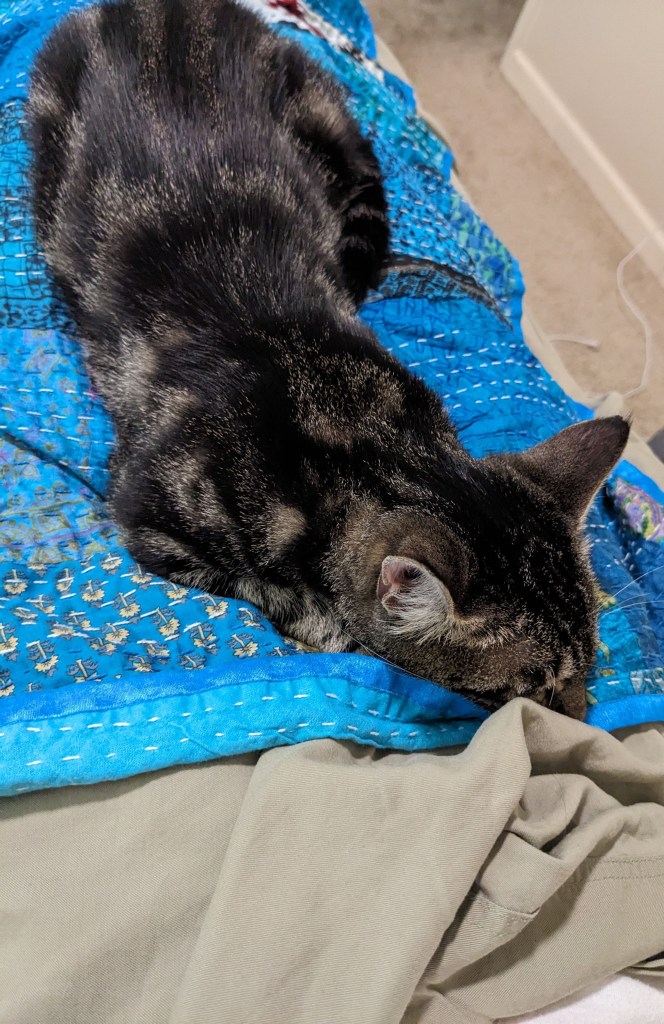
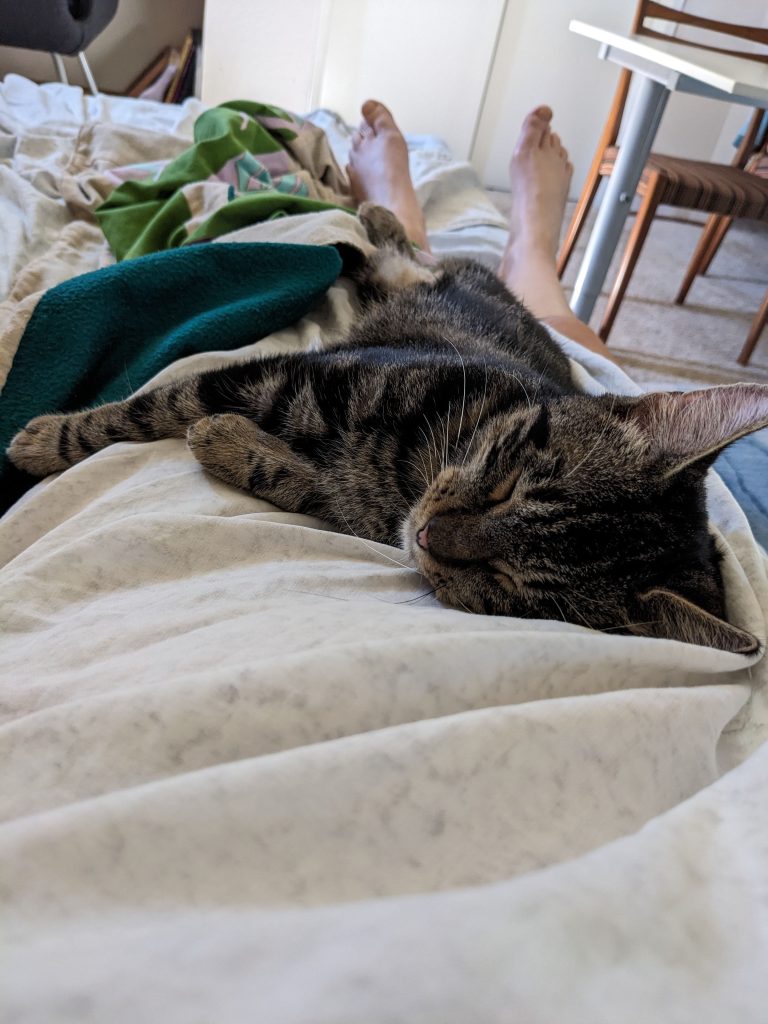
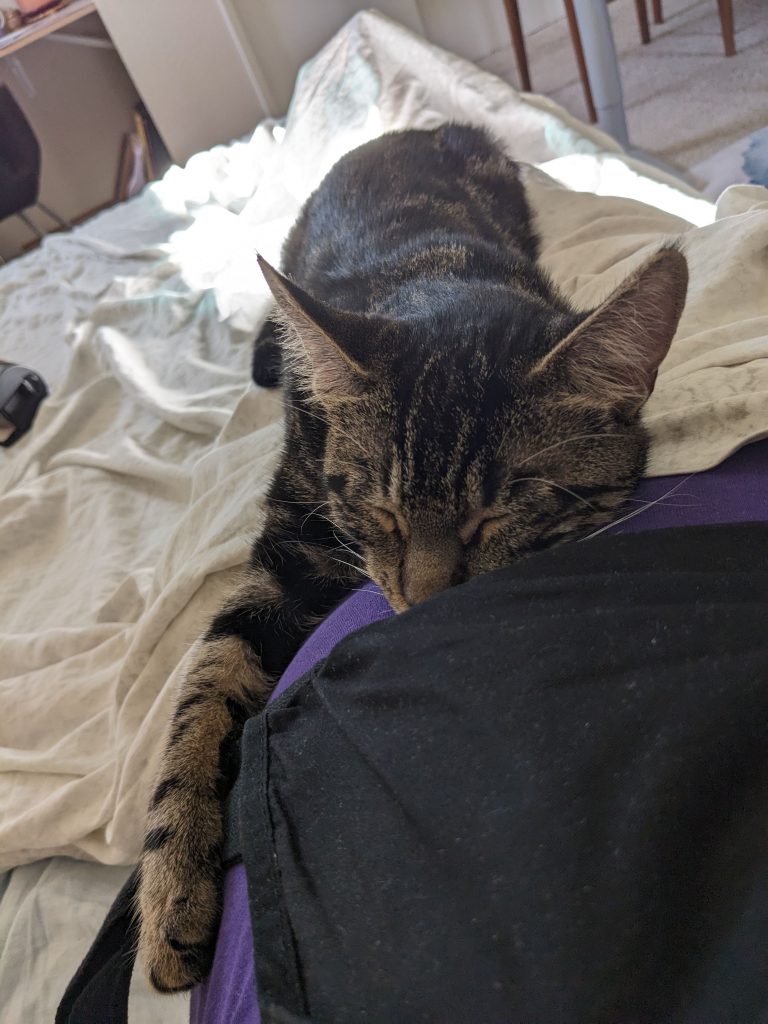
Eventually, the pain lowered a bit and Bradley brought me my laptop, since I actually had some work to do. We slept terribly that night. Maddie, our new cat, hopped right onto the bed with us right from the start. So there I was, having thought my whole life that letting your pets onto your bed was downright gross, to now having a cat asleep on my legs, as I tried to sleep on my back with an injured shoulder. (I am not a back sleeper.)

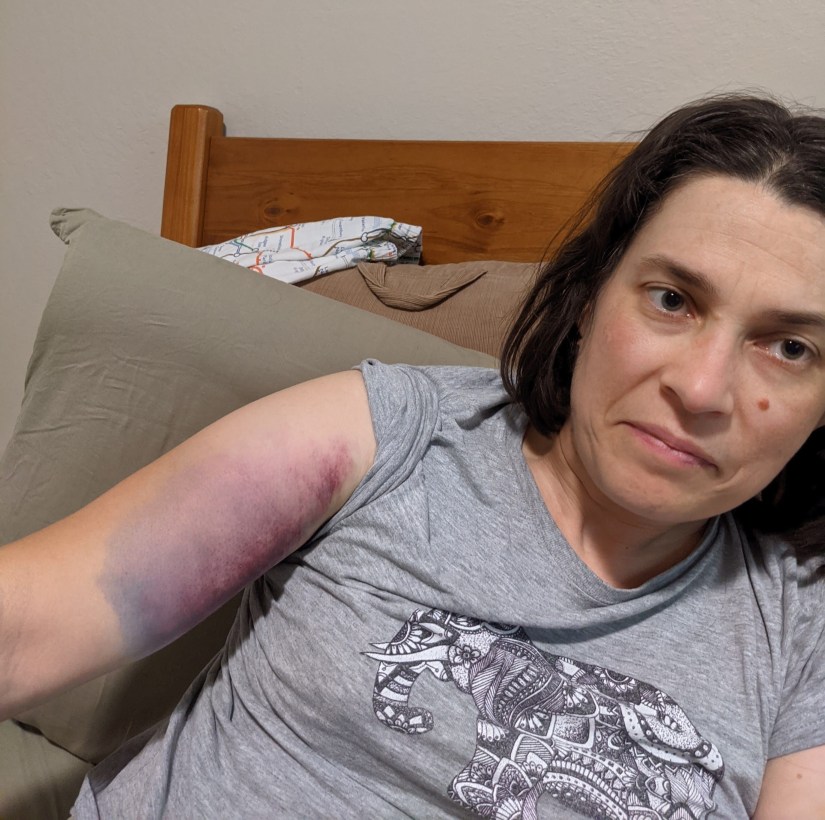
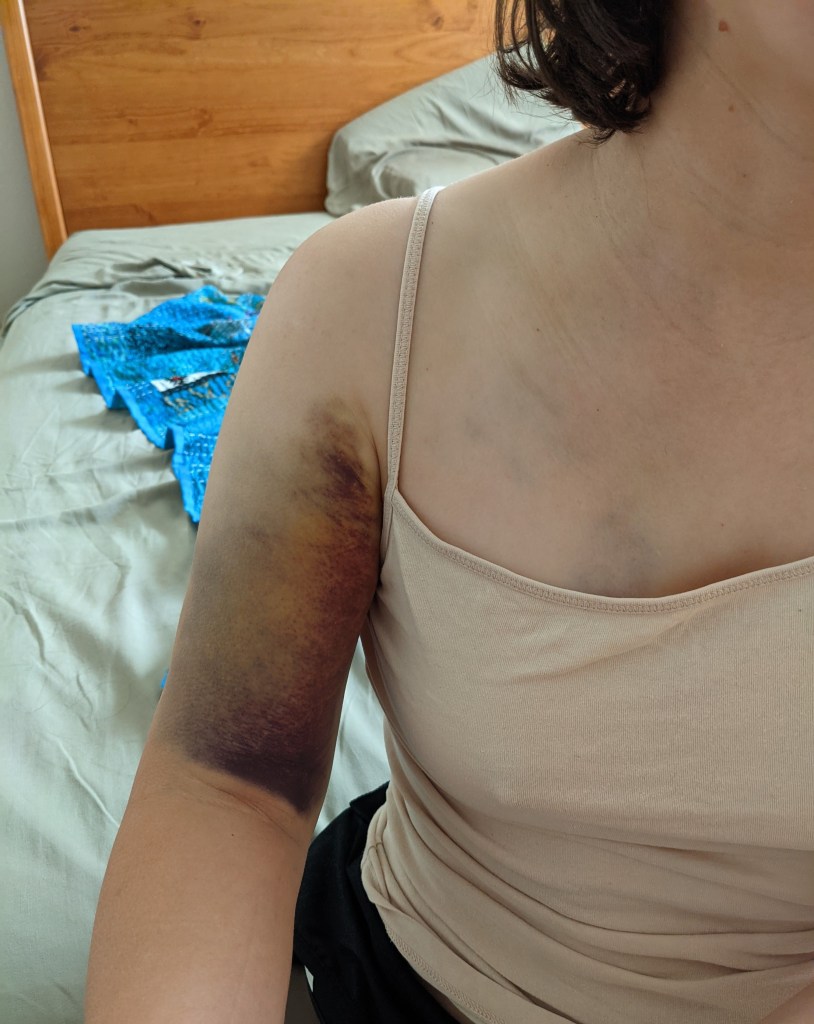
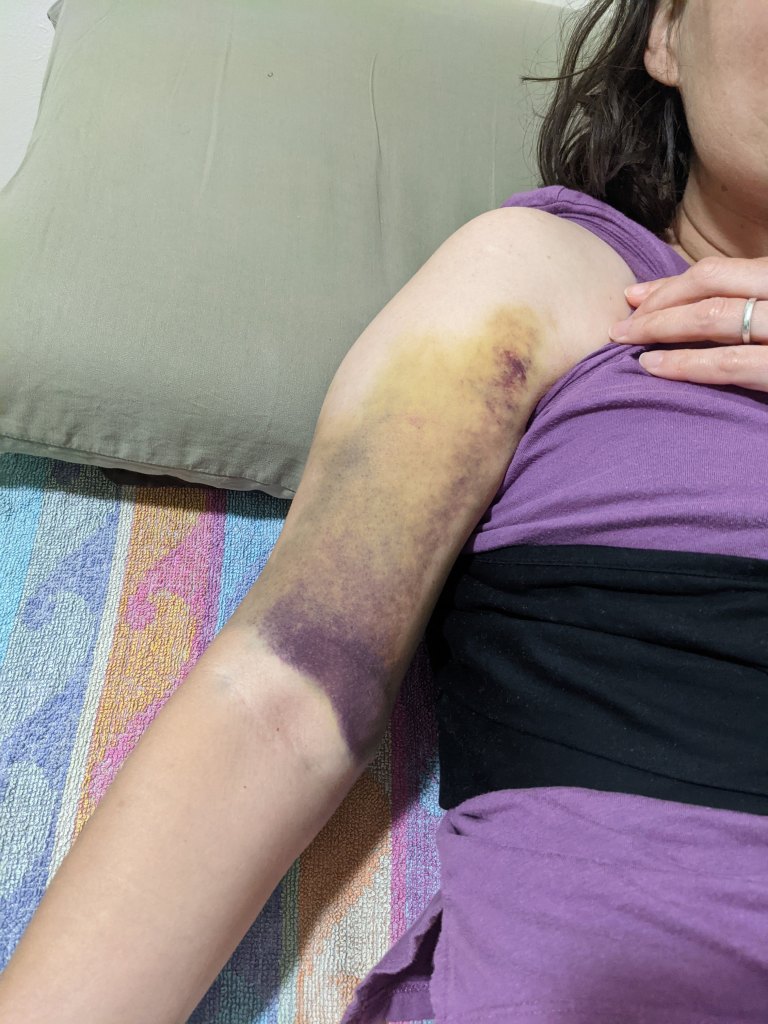
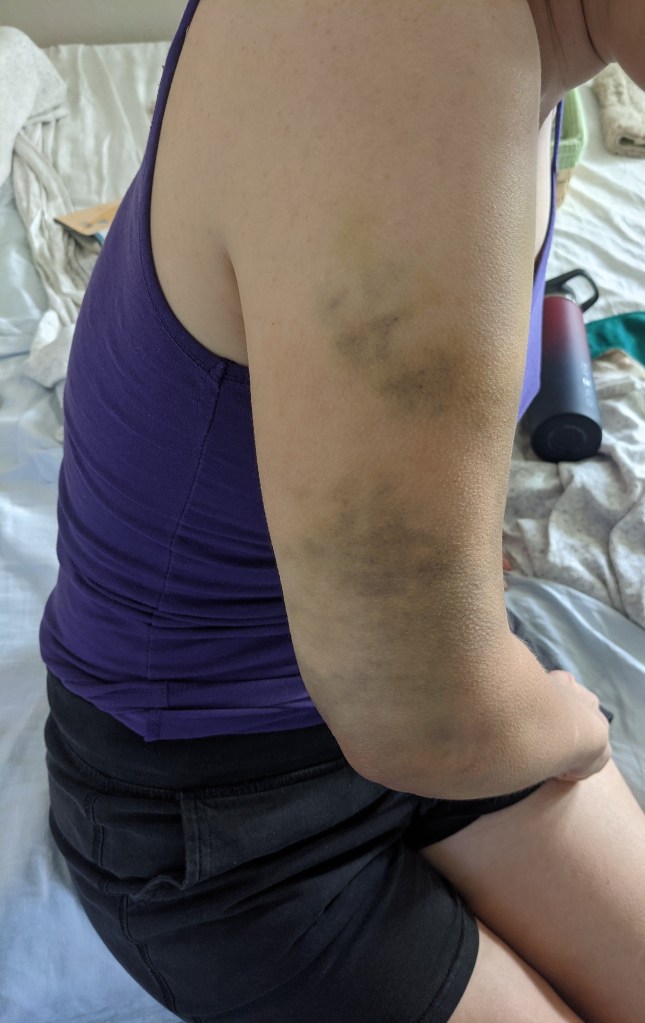
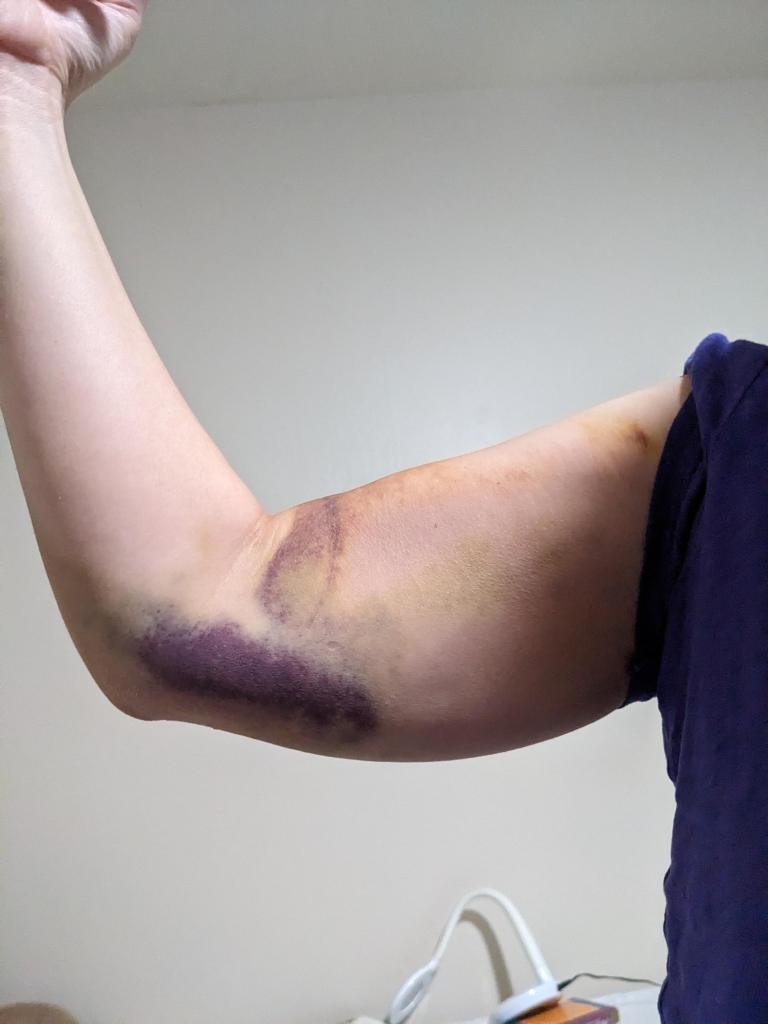
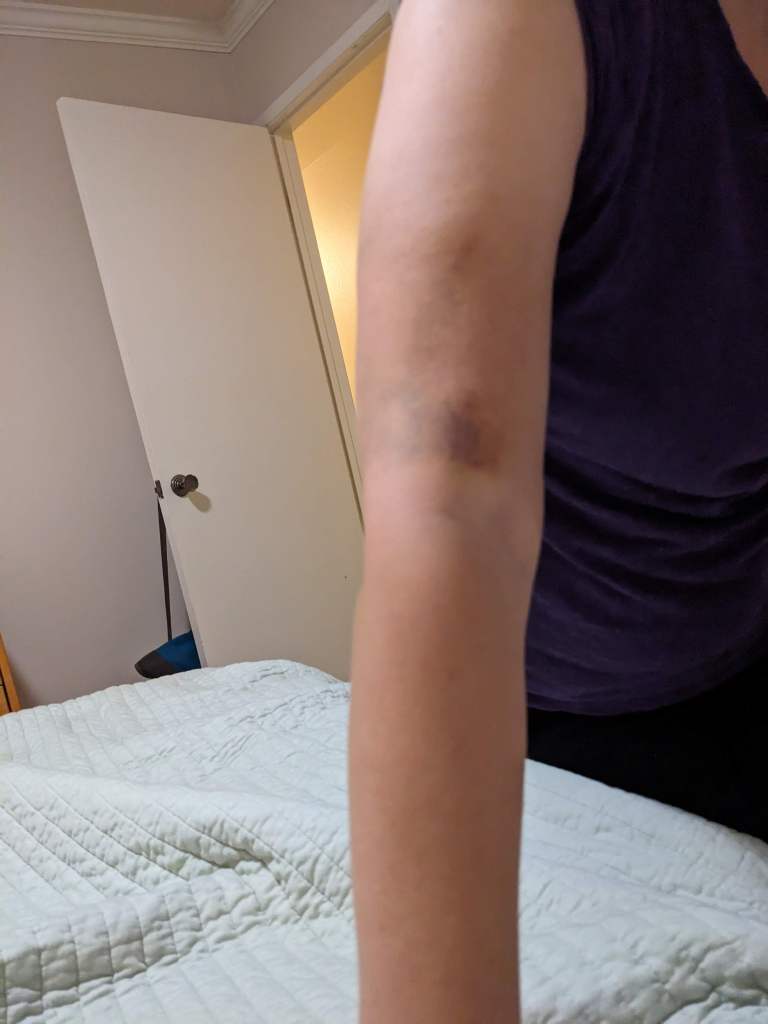
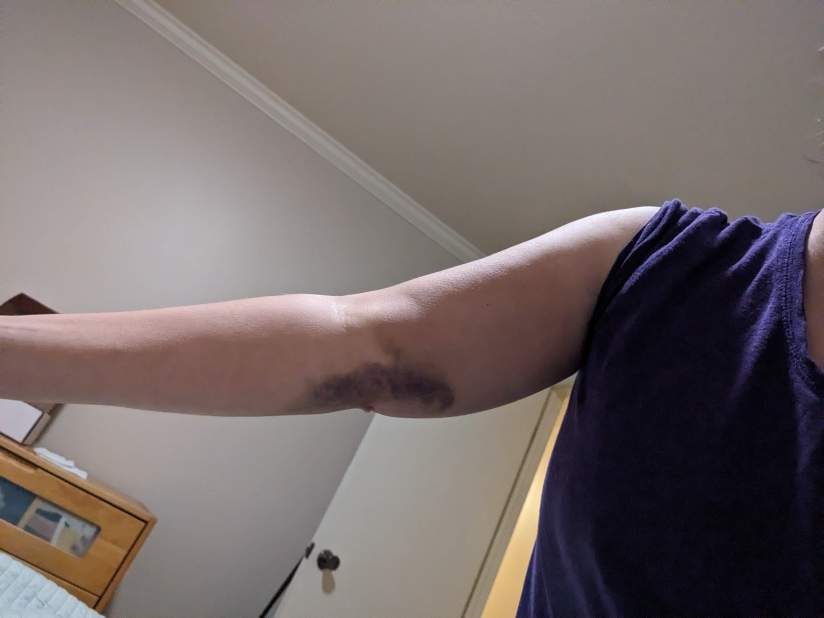
On Wednesday, the pain hadn’t lessened any further, my whole upper arm was swollen, and a bruise was starting to form on the front of my bicep near the elbow. Over the course of the day, I watched the bruise spread upward and darken into a mottled purple. I continued to take Tylenol and use ice, and I tutored my online student from bed. 

By Thursday, when I woke up and the pain and my lack of range of motion still hadn’t changed at all, I decided to get it looked at. Bradley had to take the day off to take me to my medical facility. First he had to tie my shoes for me. I took the next available appointment with any doctor there, since my PCP was out anyway. This doctor was a nice guy. It felt very different than my usual appointments to see a doctor for an acute issue with very visible signs of trauma. I could tell him exactly what happened and when, and show him the aftermath of the incident. He examined the arm, ordered x-rays, and provided me with a sling. He asked about my pain and was ready to prescribe medication. I told him I was taking extra strength Tylenol, and that I couldn’t tell if it was helping or not. But it didn’t hurt too much while I was still. When I tried to move my arm outward from my body, or if I was startled, causing myself to jolt, then it hurt a lot. People with CP often retain their startle reflex from infancy, and let me tell you, it’s not great. The doctor advised me to continue taking the Tylenol every six hours for the next week. (I’d only taken one dose the day before, but I didn’t tell him that part.)  

I’ve never worn a sling before. On one hand, it felt better to have the injured arm supported. On the other, I felt even more disabled with my dominant arm bound to my side. I walked, holding on to Bradley, to the other side of the same building to get my x-rays.

On the way home, we stopped at a CVS. We were going to need more Tylenol, and I was in desperate need of two other important items: baby wipes and stick deodorant. I often bemoan the poor design of our bodies that puts our armpits so close to our noses. I sweat. A lot. And it stinks. I’ve always run warm, and since it takes people with physical disabilities much more energy than able-bodied people to do, well, everything, I sweat even more. The couple days of 90-something-degree heatwave wasn’t helping; my sling was already feeling sweaty. 

I’m used to giving my armpits a wash at the sink when I don’t have it in me to take a shower. But that wasn’t working. My injured arm couldn’t really lift high enough for a washcloth to fit, nor was that arm able to fully scrub the opposite pit. (I tried washing my left pit with my left hand, too. Boy, was that awkward.) And I’ve got the kind of stench that needs to be really scrubbed before it’s gone. Usually twice. For deodorant, I currently have Schmidt’s in a glass container. I like it, but you’ve got to stick your finger in there and then warm up the deodorant on your fingers before rubbing it in. I also have my homemade powder deodorant in an old plastic spice jar: baking soda, corn starch, and several drops of tea tree oil. I love this, and it smells great, but again, you’ve got to sprinkle it onto your fingertips and then apply. Too painful and tricky.

In the baby supplies aisle, we discovered that some baby wipes are now called “cleansing wipes” because they’re useful for so much more than babies’ bottoms. I appreciate that. It’s long been a strategy for people with mobility issues, and chronic illness and/or pain to use wipes when showering or bathing isn’t possible. The wipes we chose were unscented and 100% plant-based. Yes, amazingly, these were not made with plastic. They were made with cotton, even with some post-consumer content. And while throwing away single-use cotton only feels slightly better than throwing away single-use plastic, it’s what was necessary for me to be able to function.  

I needed to be able to clean my armpits, yes, but let’s acknowledge that that’s not the only place on my body that needed my attention. While eating and brushing my teeth with my left hand was slow and frustrating, trying to wipe my bottom with my left hand was nearly impossible. In fact, without my right hand to stabilize myself for the proper lean, if you will, it didn’t even feel safe. (Let’s remember that my feet barely touch the floor when I’m seated, and that they don’t help too much with balance, since they’re not fully under my control.) I quickly figured out that if I did what I could with toilet paper while seated, and then for the cleansing wipe part, stood up and braced myself against the counter, I could safely and fully clean my backside. Whew. (I am aware of bidet attachments, and I know they help many with mobility issues, but that’s just not the direction I decided to go in right now.)

By the time we arrived home from our essential errand, my x-ray results were already in. I had fractured my greater tubercle (the most sticky-outy part of the shoulder). 

The doctor I had seen told me in a message to keep wearing the sling and that he was putting in an urgent referral to ortho/sports medicine. Huh. I’d managed to fracture my shoulder. Well, that was unfortunate.

I tried not to panic about what the next month or two of my life was going to look like, as I realized that Bradley was going to have to take over all of the cooking and cleaning, and also now the cat’s litter box, food, and water. Without my right hand, I felt so much more disabled.

Without my right hand as a guide, I was barely able to get myself out of bed, or reposition myself at night. Without my right hand, I could not make myself carry anything made of glass with my left. I did not want to carry anything at all because I would have no second steadying hand to use while walking. I need my hands in order to walk safely.

I was afraid of walking on the kitchen floor. I was afraid of falling again, and I tried not to imagine the pain that would flash through me if (when?) I landed on my fractured right side. I tried not to imagine taking the impact on my face in an effort to protect my shoulder.

After finding out about the fracture, I decided to convert the PT table in my office into guest bed mode and sleep there. Bradley took the foam gym tiles off the top and slid them under the mattress topper. Added sheets, and voila; I had a recovery room. This bed was lower and the mattress topper firmer than our bed, and I found it much easier to maneuver myself in and out of this guest bed. I was also steps from the bathroom instead of down the hall from it. I could toss and turn (sans actual tossing or turning) without worrying about waking Bradley. And Maddie would be sleeping on my husband’s legs instead of mine. Before he left for work Bradley, put food for me in our one plastic container on the middle shelf of the fridge so I could reach it without reaching up, and filled water bottles for me. I was able to refill my water at the bathroom sink, but it often involved a bit of wrenching to the arm when I took the lid off. 

One week after x-rays, on Thursday, October 12th, I met with the sports medicine doctor. Bradley had to leave work early and bring his laptop into the waiting room in order for me to make it to my appointment. Because we were at a teaching facility, a less experienced doctor came in first. He showed me one of my x-ray images. It looked like a very little chip was missing from the greater tubercle. I told him that the bruising and soreness extended to my collar bone and down my chest a little, and also that the area around my shoulder blade hurt quite a bit. He said that there’s all sorts of nerves involved so it’s not surprising that there’s pain in those areas. I felt that it was more likely that the muscles had been strained with the combination of full extension plus down-and-forward impact, but what do I know? I hoped that I didn’t also have a small fracture in my collar bone, but I figured treatment is probably the same if I had.

“You’ve been able to keep it pretty mobile?” the doctor asked.

“Keep it immobile?” I said, assuming I had misheard him. “I’ve kept it as still as possible because it hurts to move it.”

We then had a long discussion about pain medication, as I explained that I’m taking Tylenol, but that I’m in chronic pain from CP and have tried many things that haven’t worked, so what’s the point? He acknowledged that my experience with chronic pain complicates things but pointed out, “You have a broken bone,” and recommended that my body should have anti-inflammatories whether I could feel them helping or not. So I took ibuprofen for a while and I’m still using lots of ice packs.

When the higher ranked doctor came in, he said I had the good kind of fracture that’s not surgical and that I should start taking off the sling and doing gentle arm circles while I lean to the side and my arm hangs. It’s important to keep as much range of motion as I can to avoid “frozen shoulder.” They wanted me completely out of the sling by two weeks, three at the lastest. I felt simultaneously relieved that I was allowed to move my arm, and scared to move it.

A couple days later, on the 14th, I was carrying a glass spray bottle (it has a silicone sleeve on the bottom for added safety) into the kitchen. Dear Maddie jumps on our kitchen counter regularly, and I was making an attempt to keep it clean. As I stepped from carpet to tile, Maddie herself was near my feet and it was enough for me to lose my balance. Three things flashed in my mind at once: The glass spray bottle is going to fly out of my hands just like the water dish. I’m going to fall on Maddie. I’m going to fall on my shoulder. I reached desperately for the back of a dining chair with my left hand, my thumb and two fingers grabbing hold while the others were stuck under the plastic trigger of the spray bottle. My right arm stayed against my side, and I stayed on my feet. I let out a big breath, then another. Phew, that was close. Bradley continued on his way into the garage once he saw that I was stable.

I set the spray bottle on the counter and anchored myself there, my whole left forearm making contact as I gripped the edge. I took another deep breath. And another. I thought I was taking calming breaths to slow my pounding heart, but I realized I was kind of gulping air. My breathing didn’t feel fully in my control. I wondered if this is what it feels like to hyperventilate. Then I was crying and gulping and feeling just a little light-headed. I told myself I was okay, I was safe. No one was hurt. Nothing was broken. (Well, except my shoulder.) And still I stood there, gripping and gulping. I wasn’t ready to let go, and I didn’t feel safe. Was this a panic attack? I thought it must be.

I was deeply sad, and shaken: My shoulder hurts. I don’t feel like I can walk in my kitchen. I can’t carry things safely. Maybe we shouldn’t have gotten a cat. It’s probably time for me to get a walker, especially if we keep the cat. How do I carry things if I start using a walker in the house? Is this my life now? Already?

The days continued. Maddie staying in our bedroom so that I could try to sleep on the guest bed didn’t really work out for Bradley. We started saying, “Who gets Maddie tonight?” She was still waking up at 4:30 or 5:00am most days. So some nights, I had a cat on my pelvis as I tried to learn to become a back sleeper, and I had to be okay with pushing off when I needed to heft myself onto my left side, pillow under my right arm.

On the 18th, I washed my hair! I stood at the laundry sink in the garage because using the shower or the bathtub did not feel safe or feasible. By the 20th, I wasn’t wearing the sling at all anymore. On the 21st, I went with my husband on some errands. This was the first time I’d left the house for something other than a doctor’s appointment since the injury. I felt very tentative and unsafe walking through stores, trying to look at items with one hand and gently steadying myself with the injured one.

On the 26th, three weeks after the fracture, I moved back into the bedroom. Getting out of our bed was still a turtle-on-its-back kind of maneuver, but I felt better able to do it. With all three of us together again, Maddie let us sleep until 5:59am! 

Somewhere during this time, I fell again. I knew it would happen, and I knew it would involve Maddie. Cats weave their way back and forth in front of you. They stop in front of you as you’re walking. That’s what they do. They’re cats. I already walk with a hand on the wall or furniture most of the time, or with a hand ready to grab hold if needed. But I can’t always be within arm’s reach of a sturdy object. And people with CP often have trouble stopping forward motion. We’re essentially falling toward one wall or chair, and on to the next, and it kinda looks like walking if we make it. So, I’m walking from the couch to the kitchen table, and there’s about a foot or two of no man’s land where I’m on my own. Maddie, naturally, walks in front of me and stands still. I cannot stop, so rather than step-falling on her, I lean to the left and do a nice, semi-controlled kind of tuck-and-roll onto the living room floor. I succeed in landing safely without jolting the right shoulder. I laugh in relief and announce to my husband that I am on the floor, as from his location in the u-shaped kitchen, he did not witness my spectacular reflexes.

It took me a full month after the injury to attempt filling Maddie’s water dish again. I picked it up from one end of our small kitchen, walked past the fridge and stove, dumped it in the sink, rinsed it, filled it, and turned carefully around to retrace my steps. I crept along, inching my hand along the counter, toward the stove. When I reached it, my whole body seized up, my heart pounded, and my hand shot out to grip the stove handle. I was definitely psyching myself out. I had to be able to complete everyday tasks like this. I took a breath and made it past the jutting out bulk of the refrigerator until my free hand could grab the back of my chair at the dining table. I had made it across my kitchen with the water bowl. Barely.

On November 2nd, I had my follow-up appointment for my shoulder, just over four weeks after the fall. My bruises were still pretty visible. As I turned my arm to show the way the bruises had settled into my inner elbow and continued to drain into my forearm, the doctor was impressed with my range of motion. He said I was doing really well and assured me that the pain I was still feeling into my collarbone and shoulder blade, as well as my arm, was normal, and that I could expect to be in pain for another four or five weeks. He gave me a referral to physical therapy and sent me on my way. Good job, me, for healing well! Nice to have a fully positive appointment for a change.

Today, as I finally, finally finish this post, it is six weeks past my injury. Bones take six weeks to heal. The pain is slowly, slowly lessening. I’m still using ice packs at some point almost every day. The pain feels similar to the deep ache and lack of ability to move the arm after a vaccine, just more and constant, with sharp spikes when I do too much. The only good thing about new, acute pain is that it eclipses all the old, chronic pain, so that it’s barely part of my consciousness most of the time. 

As for the rest of things, I was able to return to my right-handed bathroom routine at around two-and-a-half weeks. I still do not use the shower, preferring the safety, relaxation, and two-free-hands-ness of sitting in the bath, which my husband has to help me into and out of. Typing with both hands came back after a couple weeks, I think. I haven’t used my trekking poles at all (which means I have barely walked outside), because that’s a very shoulder-intense activity. I very much want to sleep on my right side again, but cannot yet do so. My relationship with my kitchen, and my kitchen floor, is slowly returning to its pre-fall state, with pre-fall levels of caution and care, plus cat location awareness. I load and empty the dishwasher, I chop and stir, I fill my own water glass. But I very much prefer to sit still.

These past six weeks have been the most sedentary of my adult life, and filled with lots of dark chocolate and vegan ice cream. And I am absolutely okay with that. 

What I’m struggling with now is the same thing I struggled with when I was doing to The Gupta Program: How do I convince my nervous system that I’m safe and can get out of fight/flight/freeze mode and into the parasympathetic state when the physical obstacles and dangers I face are very real? (See my post Safety Dance for more on this.) One of the main ideas of The Gupta Program is to tell your worried part that you are safe, that “Whatever happens, I will handle it.” You’re not trying to convince yourself that everything will always go well, but that it’s okay when it doesn’t. I would try telling myself “Whatever happens, I will handle it,” and invariably, an image of myself falling outside, away from anything I could pull myself up on, would come into my mind. An image of myself getting hurt. And I would say, “When I fall, I will handle it.” (Not if, when.) “Even if I get hurt, I will be okay. My body knows how to heal.” That’s a big one in Gupta, the body healing, because the nervous system is sensing all this danger, sending all these signals like “I’m sick, I’m hurt, I’m not okay.” You’re supposed to remind yourself that your body can heal, is healing at this very moment. And so it happened. I fell, and I got hurt for real. I am healing. I don’t know how long the pain will linger, but I’m trying to stay positive and believe that my nervous system won’t turn it into something chronic even after the injury has healed, a pain loop in the brain. I want to achieve full recovery, and get back to where I was before, which was enough of a challenge to navigate in itself. The dangers are real, the pain is real, but I can handle it, right? 

Right.  

*Photos ahead* I find bruises fascinating because they can look so gruesome and then fade to nothing. I asked my husband to take lots of pictures. These are by far the worst bruises I’ve ever sustained. Please scroll on to the plethora of cat pictures if you’re not also fascinated by bruises like I am.

Day 2. Bruising starts to appear. Never mind how I look. Look at those colors! You will see that I love purple.
Day 5. Some collar bone and chest bruising appear too.
Day 10
Day 12 . Outside view.
Day 17. Inside view. Everything’s moving down and inward.
Day 28. Outside fading nicely. Sorry for the blurry focus.
Day 28. Still pretty purple on the inside.
Maddie entered our lives on 30 September 2023, age estimated at 1 year and 3 months.
She became an “I’ll lie down on you when you lie down” cat on 3 October when I climbed back into bed with a fractured shoulder. It’s hard to tell, but she’s on my outstretched legs.
I moved into the guest room and this became my view.
You can see my tutoring table on the right and my built-in work desk on the left! Maddie in the middle.
Paw on sling.
The weather finally cooled down and we’re sharing my weighted blanket.
Wanting me to leave my desk and play with her favorite shoelace. She carries it around the house in her mouth.

*The title of this post is a nod to the lyrics of the 1994 song “Waterfalls” by TLC.

The Gift of Space

I’ve always loved the idea of tiny houses. I love the way everything fits together like a puzzle, the thoughtfulness that goes into functionality and design. I love that tiny houses are the antithesis of the “more and bigger” mentality that pervades our culture, that smaller living spaces save money and energy and preserve habitat.

Ten years ago, I moved into my future husband’s 673 square foot home. Though not a tiny home, it’s a small one by US standards. This home has three rooms: a vaulted-ceiling living room/kitchen, a sizable bathroom/laundry room, and an adequate bedroom with a pretty big closet. I love the neighborhood and the transit options, and while it took some finegaling to make room for me and my stuff, we eventually made it feel comfortable and functional-ish there. When I had an editing job, I worked at the kitchen table, and when I tutored, I was able to use the community room nearby.

Then the pandemic happened, and we both needed to work from home. My husband worked in the living room, and we squeezed a tiny desk into the bedroom between the foot of the bed and the dresser for me. My part-time job at the elementary school went remote, and I know Bradley could hear every word of my phonics lessons as I attempted to teach reading over Zoom.

We needed office space. Bradley’s job stayed remote two days a week even after sheltering-in-place lifted, and the kitchen table was not a good long-term solution. We started to think about moving more seriously. I didn’t want a big place. “Just one more room,” I kept saying. Just an additional office/guest room. I certainly had no desire to clean more than one bathroom.

But when three-bedroom places came up on Zillow, my ideas started to evolve. What if I had an office too? What if I had a dedicated room where I could edit and tutor rather than making it work at the kitchen table? What if that room had a permanent space for physical therapy, so I wasn’t always trying to use the bed or floor? Beds are not an ideal surface, and the floor is hard to get down to and up from, and, let’s face it, usually needs vacuuming. It doesn’t take much of a deterrent to stop me from doing something I don’t actually want to do, and I was far from consistent with my PT.

A three-bedroom place for two people? Was it ridiculous, wasteful, upsizing so much? I struggled to justify the increased load on the planet, but still dreamed. Bradley could have a room that was just his, for work and hobbies, without having to shove everything into a closet when guests came. I could have a multi-purpose room to meet all my needs, which could also be a guest room when needed. Our bedroom would be just for sleeping. It sounded positively magical.

On July first this year, my husband and I moved from a 673 square foot home to a 1023 square foot one. Though it is far from our dream home, our 1969 three-bedroom two-bath house feels so big. There’s even an attached two-car garage. What a luxury. In order to have both a PT table (a queen platform bed with a mattress topper and foam gym tiles atop it), and a tutoring table, I get to have the primary bedroom as my office, and it feels completely extravagant and special. There was already a built-in desk, so I don’t even have to clear away my computer and piles of papers when it’s time to tutor.

There’s been a lot to adapt to in this house. The two bathrooms are both small and a bit awkward to maneuver in. Maneuverability is important when you need to pee. Grab bars went into the shower stall in one and around the bathtub in the other. We had remodeled our previous bathroom to take out the bathtub and have a barrier-free shower, but I must admit that I enjoy taking a bath and that it feels a lot safer to wash my hair sitting down than standing in the shower stall. (I’ve never liked the idea of a shower chair, and even if I did use one, the shower is so small here that there’s barely room, and nowhere to put it when someone else showers.)

There are steps to get into the house and steps down into the garage, which is where the laundry is. Laundry has always been a very laborious task for me and now I have fancy front loaders that came with the house. My legs find it excruciating to bend and crouch when removing laundry from the machines and this is something I hope will get better with time. My husband added a handrail to the garage stairs right away, and we managed to fit a storage bench in front of the laundry machines, so that I can kinda sit while crouching and reaching, though room for the washer’s open door means the bench is far away from it.

Perhaps one of the hardest things to adjust to after moving to this side of town is the lack of transit options. At our old place, a bus stop with four bus lines was steps from our house. Here, while the bus stop is close, there is only one line that serves this neighborhood. And there’s nowhere to sit while waiting. Transit riders know that taking buses is generally much slower than driving, at least in smaller towns, so we factor lots of travel time (and wait time) into our daily lives. But this particular bus line is not designed to connect to many others, so I either just miss the next bus I need, or wait 20-30 minutes for it. Or I take one bus and walk 30 minutes, which is exhausting. I recently had a twenty-minute appointment that ended up taking me four total hours to get to and from by myself. If you’re wondering why I don’t drive, you can read the About Danielle page. I also don’t want to spend money on a rideshare service when transit is free for people with disabilities, and I believe in it and want it to be better. (I wrote a letter after that four-hour debacle.)

The goal of this post is not to complain about all the new and inaccessible things I have to adjust to after moving. Rather, it’s to recognize that we are still the same people that we were before we moved. Obvious? Maybe. People (especially this person) tend to dream and then fixate on their fabricated logic: If we had more room, we’d actually have a place to put XYZ. If I had an office, maybe I’d write more/be more productive. If I didn’t have to get down on a dirty rug, I’d stretch more. When we move to a quieter neighborhood (living next to a busy bus stop has its cons), I’ll sleep better and have more energy. Et cetera.

It didn’t take me long to realize that, yes, more space is truly a wonderful gift that I’m so grateful for, and despite that gift, we are still fundamentally the same. I did not transform into some elevated version of myself. We still leave our mail in a neglected pile, still have ever-evolving drifts of crap on our tiny dining room table. (Our additional 350 square feet does not mean there’s a better dining area.) There are still phone calls to avoid making, and odds and ends to avoid unpacking. There are still endless dishes and endless laundry that we don’t stay on top of. Why do humans need to eat so often? And wear so many clothes? 

Existing and functioning still feels really hard, even with more space.

There’s so much that I love and don’t love about our new house, just as there was so much I loved and didn’t love about our old house. That’s how life goes, if you’re lucky.

And so I continue to tutor, at my dedicated tutoring table. I continue to provide my perspective as a sensitivity reader, at my built-in desk. I continue to do PT and meditate on my “therapy table.” I continue to be grateful that my living room is now separate from my kitchen. I continue to marvel at how much safer I feel emptying the dishwasher in a narrower kitchen. I am here, still me, in a new environment, making it through the days, living in an ever-constant stew of fatigue and gratitude.

June and July

June was busy, and now we’re nearing the close of July already. Here’s a “quick” recap:

On June 13th I saw my rheumatologist for my biannual visit. He checked me for any signs of new autoimmune diseases and found none. I asked him about fibromyalgia, since the cervical and brain MRIs revealed no new information about burning forearms. (Well, the neurologist presumed small-fiber neuropathy and said that fibromyalgia isn’t her area.) 

My rheumatologist pressed on various places to see if I had tender points, asked me if I was depressed and said he didn’t think I was. I was surprised and bummed about cursory fibromyalgia assessment, because tender points pain isn’t used as the main measure anymore.

On June 17th, my husband and I went to Oregon to visit family and we saw The Princess Bride, under the sky, with a live orchestra at The Britt Festival. I highly recommend this experience if there’s one like it in your area. And by your area, I mean, it’s worth traveling to a neighboring state to experience this movie with a crowd of people who love it too.

On June 20th, I had my second upper endoscopy. My first one was in October 2020 at another hospital. Now that I have my own GI doctor, he wanted to see for himself what was going on in there and why my numbers aren’t coming down. I was very anxious and upset for my first one because they gave me this paper that went over the procedure and it stated that I might feel like I’m choking, and I didn’t really understand what the whole thing was going to be like. I got loaded with extra medication, was wheeled in, told to get on my side, and then I was waking up and someone was telling me it was over. This time, while still quite nervous, I wasn’t on the verge of panic. 

I was wheeled into the room and a very nice nurse (?) told me that it would be like taking a nap, I’d be going in and out, and I’d still be able to hear and follow directions. Okay, now that had me on the verge of panic. My doctor came in and checked in with me. I had to gargle some horrible stuff to numb my throat, “for thirty seconds or however long you can stand” that I gagged on when directed to swallow. Then medicine was going into my IV, and the nurse put this thing into my mouth that keeps my tongue out of the way and prevents me from biting the camera-tube. And also from swallowing very well. So I lay on my side, trying to breathe and swallow and not panic, and not knowing how I should feel that I didn’t remember this part from the first time. When was the camera-tube coming? Would I feel like I’m choking? Would I really hear and—then I was waking up and it was done. Geez. I feel like it would be better if they don’t tell you so much scary stuff because you don’t remember anything anyway. I don’t know whether I felt like I was choking or whether I could hear them and follow directions. It’s completely gone. Drugs are amazing and terrifying. Somehow I got dressed. Vaguely remember doing that.  My husband and a nurse took me to the elevator in a wheelchair and we had to wait for it a long time. I have absolutely zero memory of any of that. 

I was relieved it was over. The results showed almost no damage. But it turns out that your symptoms, your numbers, and the state of your intestines really don’t necessarily correlate. I find that so strange and maddening. Well, I’m an obvious example: high numbers, little damage. Nothing looked off about my throat either; I’d asked him to pay attention to that, if he could. This time I wasn’t sent home with color pictures or anything about mild chronic stomach inflammation or anything. I have a follow-up video visit next month.

On June 21st, I had my third osteomanipulation appointment. I still enjoy them, and she can tell a difference in my body, but I cannot. I don’t think having them once a month is very effective, and it’s really the stretches/exercises that she assigns that do anything. No surprises there.

Also in June, I did some work as a sensitivity reader for an ongoing project to update elementary reading material. I am really happy to get to do this kind of work. It’s a great feeling to know that my perspective is not only helpful, but valued. 

On July 1st, we moved! Across town. More on that in my next post.

On July 17th, I had an appointment with my PCP. I wanted to follow up with her about all these appointments and procedures: neurology, PMR, rheumatology, GI, etc. But really, I also wanted to ask for a prescription for an AFO for my left side. The one I got for the right does help a lot, and I was frustrated and mystified by that orthopedic doctor’s resistance to providing the same support for my weaker side. I wasn’t having the same pain on that side, so I understand that part of it. But now, now both my feet just hurt. Often and a lot. Did you know that arthritis can cause a burning sensation? I didn’t, until it occurred to me to look it up. Knowing that it’s probably “just” arthritis (along with whatever was originally going on on the right side) helps me just take it as it comes and not worry too much about, you know, feeling like I legitimately can’t walk sometimes.

I also talked to my doctor about my rheumatologist’s dismissal of possible fibromyalgia and depression, which are often linked. I told her about the two individual instances in the last four years where I felt markedly better, more awake/alive. Happy. Even though the chronic issues were still there. Sometimes you don’t know that you’re depressed until you catch a glimpse of another way of existing. We had talked about trying fibromyalgia medication before, after the gabapentin hadn’t done anything, so she was open to prescribing it.

Here’s what the NIH says about fibromyalgia. It very much feels like me, and yes, I do realize that these symptoms could also be from hundreds of other conditions.

The main symptoms of fibromyalgia are:

  • Chronic, widespread pain throughout the body or at multiple sites. Pain is often felt in the arms, legs, head, chest, abdomen, back, and buttocks. People often describe it as aching, burning, or throbbing.
  • Fatigue or an overwhelming feeling of being tired.
  • Trouble sleeping.

Other symptoms may include:

  • Muscle and joint stiffness.
  • Tenderness to touch.
  • Numbness or tingling in the arms and legs.
  • Problems with concentrating, thinking clearly, and memory (sometimes called “fibro fog”).
  • Heightened sensitivity to light, noise, odors, and temperature.
  • Digestive issues, such as bloating or constipation.

I also told my doctor candidly that I had been on SSDI for a number of years before my five-year stint of part-time work. That I hadn’t returned to my job two years ago, and applied to receive disability again, but was denied. She told me to reapply. I confirmed that it was legitimate to put fibromyalgia on the application, even though I hadn’t started the medication yet (which, if it helped, would help confirm the diagnosis). She agreed and said that I should also put arthritis and assumed small-fiber neuropathy. Along with cerebral palsy, of course. The first time I qualified for disability, I was relieved but also a little insulted. I felt I could work but wasn’t getting hired. Now, I feel that I actually do qualify, and I really hope the government agrees with me. 

So that is where I am these days. All the big, nerve-racking, (expensive), procedures are over, and I’m left with management and maintenance, and a bit of hope that a new medication might, maybe this time, help a little.

Neuro Follow-Up and Being Manipulated

I recently had my neurology follow-up with Dr. X to discuss my cervical spine and brain MRIs.

She said my brain looks good and my labs look good. She said the mild disc bulges in my neck are indeed very mild and shouldn’t be causing pain. She does not want to order steroid injections for something so mild, and agree, even though I’ve had constant neck pain since June of 2016. Then she did a quick reassessment of my strength and reflexes and said they are the same (no surprise there; it’s been three months). 

The small lesion in my right brain could have been from any number of things (perhaps even CP), and we don’t have any earlier images to compare it to. It does not explain my burning forearms.

The only thing Dr. X thought it might be is small fiber neuropathy caused by celiac disease. The treatment is to manage the celiac disease through diet, which I’ve obviously already been trying to do since my diagnosis almost five years ago. I could have a skin biopsy done to confirm, but it wouldn’t change treatment, which is only symptom management. I could try gabapentin (didn’t help), physical therapy (didn’t help), or duloxetine (nope; gelatin). I could try over-the-counter lidocaine cream. Okay, sure. It’s a little frustrating to be given options I’ve already tried, but I guess I don’t expect my doctor to actually be familiar with my history. 

Johns Hopkins describes the symptoms of small fiber neuropathy as “pins-and-needles, pricks, tingling and numbness. Some patients may experience burning pain or coldness and electric shock-like brief painful sensations.” It doesn’t really sound like what I’m feeling except the burning. It’s more like a deep, painful ache that can feel sharp. Though I have had burning toes as well, since 2014, and small fiber neuropathy often begins in the feet and works its way up.  

Whatever it is, it doesn’t seem like there’s a whole lot more to do. No surprise there. 

Here’s the funny part. Dr. X asked to see me walk. I do not enjoy providing a walking sample in an exam room. There’s about three steps to the door from where I was sitting. But I got up and did it anyway, no trekking poles. As soon as I took two steps, she started saying, “Slow down.” Now, I cannot slow down, as that would take control that I do not possess. I thought she was saying slow down because I was already at the end of the room and she hadn’t had time to really see my gait. But then she said, “Be careful,” and she was up from her stool and taking my arm because she did not want me to fall. Now, English is not her first language, and I think culturally, we’ve got some big differences as well. But she’s a neurologist. The majority of patients in and out of that office were using some kind of mobility aid. Isn’t she familiar with CP gait patterns? Oy. 

When it was time for me to go, I got my poles and stood up, and there she was, trying to take my arm and telling me to be careful. And again, as I went through the door, telling me to be careful. Obviously I understand that this reaction is coming from a place of care. But. I am forty-two years old, and I have come to this exam room on my own using poles. Therefore, the other adult in the room should infer that I know how to handle myself to get safely back to the waiting area, even if I had a wheelchair and/or caregiver out there waiting for me! And she should also know that the words “be careful” have never, ever actually helped anyone, but that they do, in fact, convey loads of condescension. Goodness, thank you, doctor! That’s what I’ve been missing these forty-two years. I have never realized before that I should move with care. No one told me! But now that I know, I shall handle living in my own body much better. (I didn’t say any of that, of course.)

In other news, I’ve now had two osteopathic manipulation appointments at my local hospital. I got this referral by having an office visit with a new doctor when my regular PCP was out. It’s so nice when doctors try to help you without you asking for it. The appointment had nothing to do with CP or chronic pain, but I did mention those things. This new doctor gave me some new options, ones that I hadn’t known existed. My PCP has been my doctor since 2012 and has seen me for every new chronic pain that has come up, but she’s never suggested anything like this. As far as insurance coverage, osteopathic manipulation counts as a regular office visit and is part of my allotted physical therapy visits, unlike massage therapy, for example, which is not covered. In addition, I get a 40 minute appointment, which means at least 30 minutes of it is actually treatment, unlike with a PT session, which is 30 minutes total. 

The appointment is at the hospital, not at a physical therapy office, but the table inside the exam room is more like a PT table, with a real sheet over the crunchy paper strip.

I lie on my back and get mushed and pushed and pulled on. And I really like it. In the first session, the doctor told me the right side of my ribcage was compressed and that I should lie down flat with my right arm bent over my head to stretch it out. And I should also let my right leg relax outward when I’m lying down. Two positions to work on while lying down? That I can do. I was pretty sore afterward, but other than that, I didn’t notice any difference. 

During the second session, she worked a lot on my right hip, because that’s where a lot of my pain is. Then when she was checking my ribs she lifted my arm and said, “We’ve got to work on your forearms! When they’re tight, they pull your shoulders forward and affect your posture.” Just by touching my arm, she could feel an issue. Yes, they’re tight. Yes, I do try to stretch them. I’ve tried massage and moist heat, and taping and rolling. Nothing I do seems to have any effect. Just that first PT in June of 2020 succeeded in helping. The second PT did the same things, but it didn’t help, and neither did work with a myofascial release therapist. Hence the last three years of trying to figure out what’s going on with my forearms. Is the burning just my nervous system overreacting to extreme tightness? If so, why don’t the muscles let go even a little with stretching and/or other professional intervention? Maybe it’s not small fiber neuropathy at all. 

What if I got a full body, deep-tissue massage under general anesthesia? Doesn’t that sound like a fun experiment for my nervous system? I think it sounds like an excellent idea.  

Danielle Gets a Brain MRI: Brain MRI with Cerebral Palsy

On the night of April 11th, I had my dreaded brain MRI. The day before, I woke up with a stomach already tense. On the day of, I tried to keep busy and also stay calm. We are having exceptionally beautiful, truly spring-like weather, so I reclined in a lounge chair outside and did a meditation, a yoga nidra, and a tapping session consecutively. 

Yoga nidra is relatively new to me. It’s like a compassionate body scan, which I love, but it includes having an intention in mind and is a little more in-depth. You listen to a calming voice telling you to notice the tip of your tongue, your teeth and gums, the inside of your right cheek, the inside of your left cheek…. All through the body, each toe and finger. Then hemispheres of the body and brain. It’s interesting and takes a lot of focus and concentration. Which is exactly the point, to be grounded in the present moment and in your body. I really recommend trying it; there are lots online, and they vary in length. Here’s one I like.

As the afternoon slid closer and closer to evening, I kept imagining going into the MRI machine with the coil over my face. I didn’t know how close it would be to my face, or how close the coil would be to touching the inside walls of the machine, and I was very anxious. I didn’t feel stomach-twisty nervous, but very quiet and subdued. I didn’t know if all my nervous-system-calming prep work had helped at all. 

When I’d gotten my c-spine MRI last month, the tech told me that I should use “the mobile unit” for the brain, because it’s newer and has more “bells and whistles.” I did indeed get scheduled for the mobile unit. I hoped that the bells and whistles included headphones with which I could choose music to listen to.

Walking into a nearly empty hospital at 7:30pm is weird. But nicer than walking into a crowded hospital. We got to the room to check in, and a sign outside instructed us to go downstairs. Did that. Then the nurse (?) came and took us back upstairs, through the first darkened room, past the sign outside it, and down the length of the entire hallway. There my husband sat while I was escorted through some doors and then through doors to the outside, where, in a parking lot two “mobile” MRI units sat. They had some very solid ramps leading up to them, and I assume they are no longer mobile. They are big metal boxes that remind me of blood donation vans, but way bigger.

In a room the size of a small shower stall, I had to get undressed (except socks and underwear) and put on paper shorts and a gown. The chair took up 85% of the space, and when I lifted one leg onto the other knee to remove shoes and pants, there was no longer any room to complete the maneuver. Fun.

Too soon, I was led past the tech area and into the room with the machine. This one was close enough to the floor that I could sit on the bed part/get myself onto it without needing a stepstool to be brought over. I explained that I have cerebral palsy and have very strong reflexes in response to loud noises. Weight on my legs helps. They didn’t have additional weight in the form of blankets. The nurse put the bolster under my calves, and the tech guy strapped my legs down. A little too tightly. Once he loosened it a bit, I figured it wasn’t as comfortable as a weighted blanket–type sensation, but that it would help overall. Earplugs in. Then he put cushioned blocks on either side of my head to hold it in place. And without a word, he placed the coil next. 

The coil was over my face, the emergency squeeze ball was in my hand, and I was heading into the tube. As far as I could tell from my vantage point, the face coil was similar to the one below, but without the little screen attached over it. 

I was so relieved not to feel panic welling up within. The coil was a manageable distance from my face. With gentle pressure on both sides of my head, and a warm blanket over me, moving into the tube I felt almost…cozy? If it hadn’t been for the upcoming prolonged and unpredictable loud noises, I would have felt just fine in there. Because of the nearness of the single bar up the middle of the coil, I had to close one eye or the other to have an unobstructed view of the inside of the machine, so this time, I felt calmer keeping my eyes closed. (In my previous experiences, when I closed my eyes, my mind raced more and I felt closer to panic.)

Just like getting through last month’s cervical spine MRI, I won’t say this experience was easy. But it was easier than last time and the time before that. I was surprised to be able to think, “I’m doing this and I am okay.” The noise was still too much, and felt neverending, and I did still have images of myself breaking free of the enforced stillness and getting out, but though my mind had those thoughts and impulses, I was able to resist them and breathe through it.

The cushioned blocks holding my head still really helped me feel more secure and calm, rather than restrained as one might imagine. I was able to relax into them rather than holding myself rigid as I would without them. If I ever have to have another MRI, no matter the body part, I think I will ask for them, if they can be used without the face coil. Maybe I should try sleeping with something like that. I’m not able to sleep on my back because I feel like I have to hold my head up, but switching sides throughout the night means I wake up each time.

I came out for the contrast injection, not allowed to move at all, and then went back in for three more pictures, about ten minutes. I only heard one break in the barrage of sound, so I thought I had one more picture to go when instead, the tech appeared in my peripheral vision and I was set free. I had survived. 

When I made it back into the building, I told my husband with surprise, a lot of relief, and a little pride, “That was my best one.” 

The next day, I felt happy. I had a bit more energy than usual, and I just felt better. Happy. All the pain was absolutely still there: throat, forearms, hip, back, neck and shoulders, but I had a bit of energy anyway. I was happy anyway. I was looking forward to taking a walk rather than positively forcing myself to go because I know I should. 

I thought, well if I could feel like this every day, then I could totally “accept and surrender” and live with the pain and still feel like I was living rather than existing. That’s what The Gupta Program’s goal is–if you can make it to that state, where your nervous system is feeling safe and good, then maybe it’ll stop sending all these unnecessary danger/pain signals. I don’t know what the change was, and it only lasted for that day. Was it the sheer relief of making it through that dreaded MRI? Did I manage to get my brain a boost of the feel-good chemicals? Maybe that boost is where my brain is supposed to be at, and I need to correct a chemical imbalance… It’s not the first time I’ve had that thought. I had a similar (but even more extreme) experience several years ago, where, for one day, I was a better version of myself. My brain felt clearer. I was happy. When I worked with a group of rowdy students, I was patient without having to make myself respond in a patient way. I realized with atonishment that the kid who usually tried my patience was not having a particularly good day; it was I who was having a good day. I understood that people who were able to be upbeat and energetic in the face of a classroom full of kids must feel like this most days. They operate at a higher level of aliveness that I have only glimpsed. 

So–what’s going on in my brain? Have I got lesions or whatever else the neurologist was looking for? Here are the results:

FINDINGS: 

Brain: No evidence of hemorrhage, mass, shift, or extra axial fluid collection. No restricted diffusion. The ventricles are normal in size and morphology. A focus of abnormal T2/FLAIR signal hyperintensity in the right periventricular white matter, with differential remote sequelae of periventricular leukomalacia, migraines, posttraumatic, or less likely inflammatory causes. Flow voids at the skull base are preserved. There is no abnormal enhancement. 

Bones and soft tissues: There is a reniform-shaped T2 hyperintense lesion located immediately posterior to the left parotid gland, measuring up to 8 mm and demonstrating restricted diffusion and enhancement, likely a benign lymph node.

The note from the doctor says the “small white matter lesion in right brain” is unlikely to cause my symptoms. It’s a nonspecific finding that could be “related to headache, prior injury, et al.” Dr. X does not mention anything about the thing that is “likely a benign lymph node.” (Looked it up and the parotid gland is a salivary gland just in front of the ear.) Dr. X seems unconcerned and I was asked to schedule a follow up, which is not available until September.

So, again, I am left with, well, you’ve got hyperreflexia that suggests things that we have now ruled out, as far as spinal compression or brain lesions. Okay then. No one’s saying it could be a CP thing that I just wasn’t aware of until now. (These are upper body reflexes, and officially my CP affects my lower body.) 

I’ve been through so many information-gathering appointments, without any revelations to show for it.

Such is life.