
I made it into the fourth month living in our new place before falling in the kitchen. Going that long without a fall is pretty good because our kitchen has its original 1969 tile in it. I love the light and darker shades of green, but the shape and texture is a problem. It’s real tile cut in different shapes in a repeating pattern. Over the decades it’s been cracked and chipped. One spot has gone through an attempted repair and sticks up above the rest, with a mess of maybe rubber cement around it.
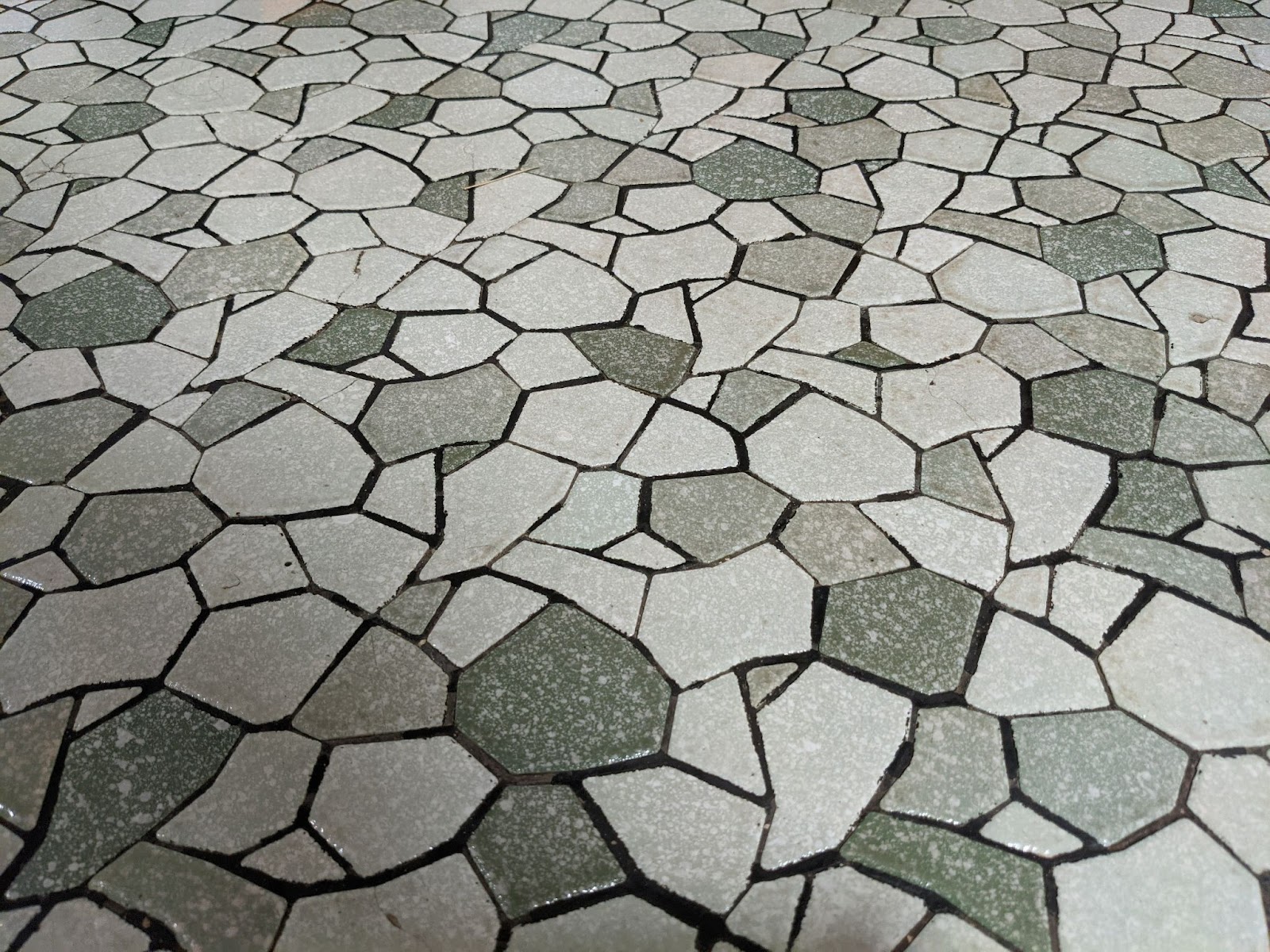
I could tell that spot in the tile was going to be a problem. My shoe kept catching on it. Fortunately, it’s right against the counter, so I’m usually already hanging on to the counter when I encounter this tile. On the day of the fall I was making myself oatmeal and I decided to return both the milk and the oats to the fridge at the same time. This is a risky and adventurous move because I know it’s safer to carry only one thing at a time and have one hand available for guidance and stability. Feeling apparently confident, I picked up the shelf-stable almond milk in one hand and the Bob’s Red Mill zip-closure package of GF oats in the other.
As I turned from the counter, I felt my shoe catch on the raised tile and milk and oats went flying as I lost my balance. Inwardly I grimaced, preparing both for the pain of impact and the potential splatter of milk and shower of oats that might be coming. On the floor, I breathed a sigh of relief and gratitude when the contents of both packages remained inside their vessels and I was not much worse for wear. I deemed my first kitchen fall a great success, and I was relieved to have gotten it out of the way, finally.
The very next day was the second kitchen fall, but this time it was a water fall. You see, we had gotten a cat. (Rest assured, this fall was not directly caused by the cat.)
My husband and I had long wanted a cat but I was adamant that there was not enough room for a cat, her food dishes, and her litter box in our previous dwelling. In order for me to welcome an animal into my home, I had some requirements. (Remember, I grew up in a rural area, with an “animals live outside” perspective.) The biggest requirement was that we have an attached garage so that we could put a cat door in it and have the litter box outside of our living space. Lucky for us, our new house did have that, though the existing cat door had been sealed off and would need to be replaced. It took us a while to replace the door and to create an area inside the garage that was enclosed for the cat alone. I had thought about it and was afraid that she would get out when we opened the garage door or would be sleeping under the car when we tried to back out. I wanted a place in the garage to be sectioned off for her so that we didn’t have to be always nervous of where she was when we were coming and going.
After adventures in putting up cat netting and installing a new door, we took ourselves to the county animal shelter and met the only one-year-old cat who was available for adoption. No kittens for us. My other requirements were that she be small and short-haired, and amazingly, this cat checked all the boxes.
We brought her home on a Saturday and named her Maddie. On the following Tuesday morning, October 3rd, I was refilling her water dish.
Have I mentioned our house was built in 1969? Along with the pretty, but problematic tiles, the kitchen floor is also rather…undulating. There are a couple of places that are not level underfoot. It is of course enough of an alteration in terrain for me to be hyper aware of it and for most people not to notice it much.
I want to take a moment here to emphasize that I also fell in our previous kitchen, which was indeed very flat both in terrain and in type of flooring. The problem seems to occur when I am carrying something. Even with one hand free as a guide, it is enough to throw me off, especially if I am also turning.
And so I filled her water dish, turned from the sink, and as I was passing by the refrigerator, I lost my balance. Again. My attempt to steady myself using the refrigerator was unsuccessful. This time, it was bad. I can only be grateful that I had just switched her water dish from something breakable to something metal. The dish went flying out of my hand and I–and the floor–became drenched in water. I was aware that, at the same moment my right hand made contact with the floor, it was also sliding away from me. The rest of my body landed when my arm was fully extended, my forward momentum adding additional force to the point of impact. My hand pushed against the bag of cat food, which pushed against a dining chair, and I watched, from my vantage point on the floor, as the chair tilted and finally landed on its side next to me with a clatter. What a racket-producing round of dominoes.
Again, I felt relief that I was okay, as I had not been knocked on the head or anything serious. There was pain, but nothing too terrible. But “Ow.” I realized I hurt my shoulder. My husband appeared, and I was ever-so-thankful he was working from home that day instead of the day before, as was his usual schedule. “I’m okay,” I said. “I just hurt my shoulder.”
He righted the chair and held out his hands to me to help me up. “No,” I said, breathing heavily. “I think I need to lie here for just a moment longer.” As he started mopping up the impressive amount of water, I made jokes about this being one way to get the floor mopped. I realized that I truly was having trouble moving my right arm and that I really didn’t want to put any pressure on it. “I don’t know how to get up,” I said, struggling to bring myself to a sitting position and scoot to the edge of the tile. Bradley set a chair behind me and I managed to kneel in front of it, now on living room carpet.
Suddenly, I didn’t feel great. Sweaty, a bit woozy. I lay my head on the seat of the chair and took deep breaths. “My fingers are starting to tingle,” I said worriedly, concerned that I had some kind of nerve injury on my right side. Then the fingers on my other hand and my toes started to tingle too and I realized I was having the same kind of vasovagal syncope response that I’d had when I attempted to donate platelets recently.
At my first-ever platelet donation, they’d told me I might feel tingly and provided Tums because the calcium helps. I ate my Tums but I only got about halfway through the donation process before awfulness descended upon me: I was sweaty, nauseated, woozy. Three or four people sprang into action, raising my feet, getting a fan, a barf bag, juice, and “syncope towels,” wet paper towels to put on the back of my neck and my forehead. I had always been fine donating blood, and I hadn’t expected platelets to be such a different experience.
The only other time I’d felt so awful was when I was in a lot of pain, from menstrual cramps in my teens and twenties, and also sometimes with neck pain. During those times, I would actually vomit, and I may or may not have passed out for a second in an elevator once. (Huge side note here, period cramps like this aren’t normal, aren’t just “part of being a girl.” If you or someone you love is vomiting or passing out from pain each month, something is wrong, and it can be helped. It could be hormonal imbalance, vitamin or mineral deficiency, endometriosis, or something else. Read a book like The Period Repair Manual; there are many resources out there now. Rather than going on the Pill, which is doctors’ default treatment option, advocate for yourself and get your body feeling better. Your pain is real, it’s telling you something, and you shouldn’t have to live in agony. Yes, I am passionate about this. Women’s pain has been dismissed for far too long.)
So I knelt there, hunched over the chair, breathing heavily and feeling a bit dizzy, knowing that I was having a syncope reaction, either from pain or stress or a combination. Bradley got me a barf bowl, and I asked for an ice pack for the back of my neck.
I did not vomit, and I eventually stabilized enough to get myself into a sitting position on the chair, awkwardly using only my left arm. “Do we need to go to the emergency room?” my husband asked. I just wanted to rest. So I took two extra strength Tylenol (after the ‘mild chronic stomach inflammation’ result of my first endoscopy, I stopped my infrequent ibuprofen use in case that helped anything), got into bed and put an ice pack on my right arm. I sat there propped up and took lots of deep breaths, feeling rather unhappy that my shoulder hurt kind of a lot.
Eventually, the pain lowered a bit and Bradley brought me my laptop, since I actually had some work to do. We slept terribly that night. Maddie, our new cat, hopped right onto the bed with us right from the start. So there I was, having thought my whole life that letting your pets onto your bed was downright gross, to now having a cat asleep on my legs, as I tried to sleep on my back with an injured shoulder. (I am not a back sleeper.)
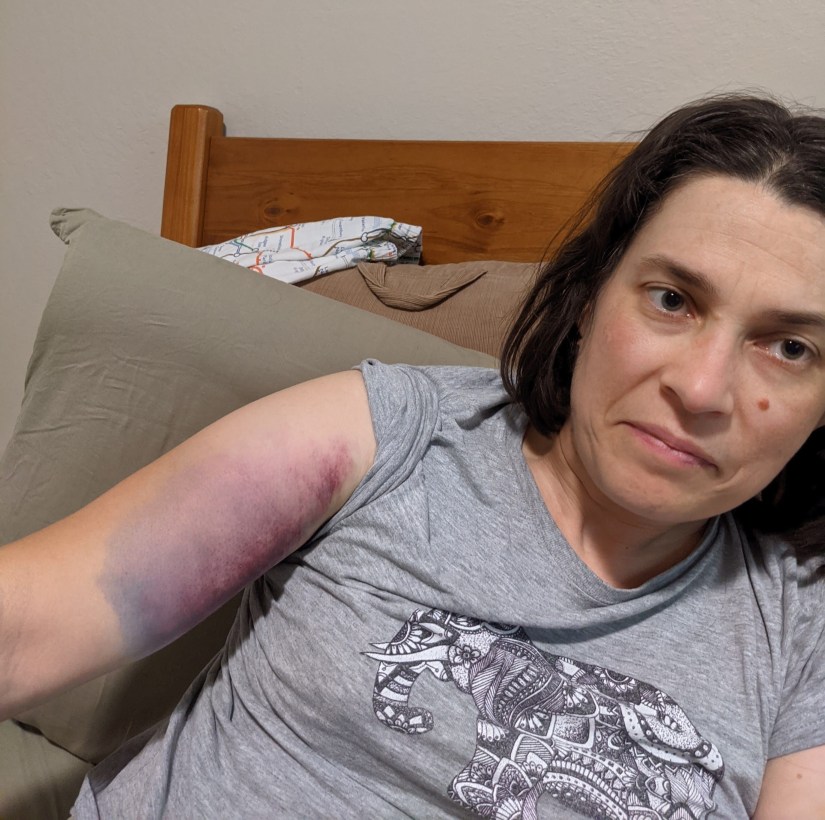
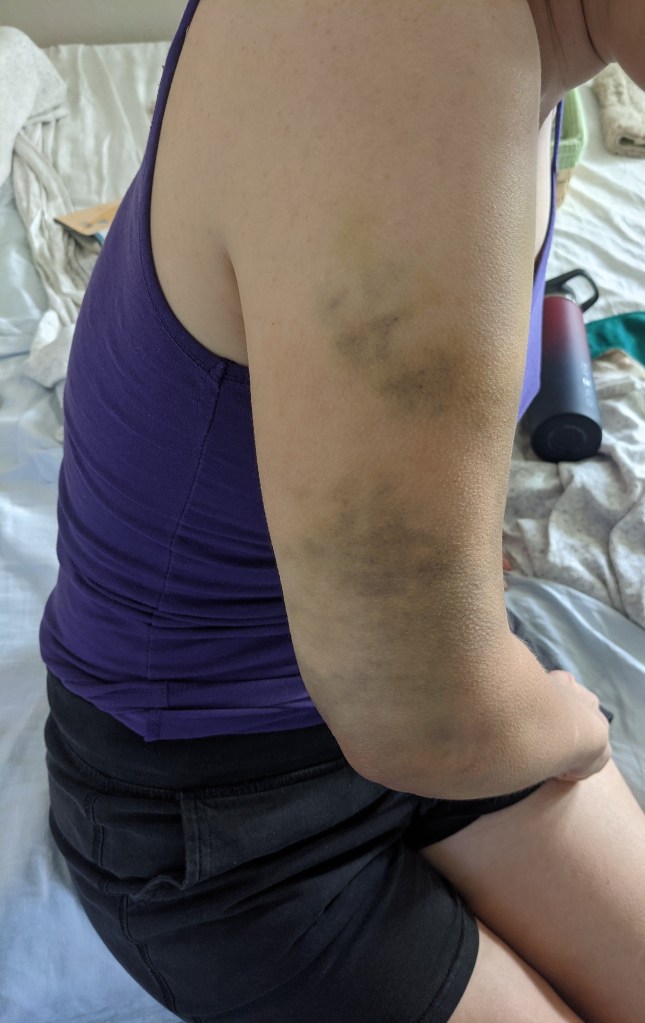
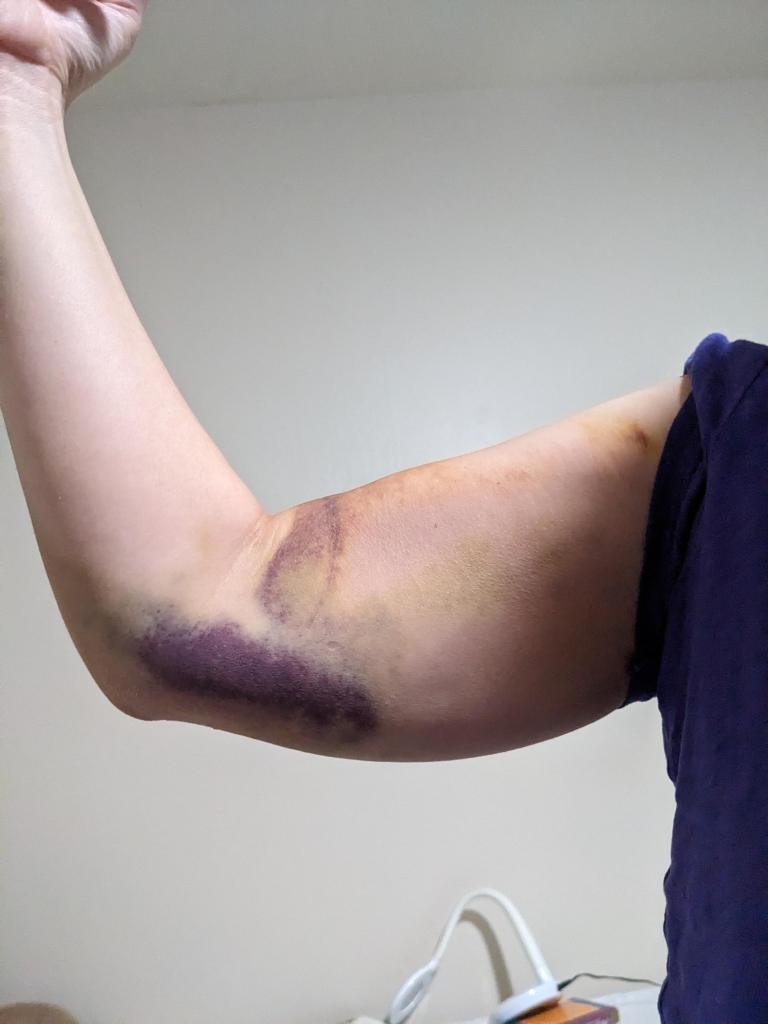
On Wednesday, the pain hadn’t lessened any further, my whole upper arm was swollen, and a bruise was starting to form on the front of my bicep near the elbow. Over the course of the day, I watched the bruise spread upward and darken into a mottled purple. I continued to take Tylenol and use ice, and I tutored my online student from bed.
By Thursday, when I woke up and the pain and my lack of range of motion still hadn’t changed at all, I decided to get it looked at. Bradley had to take the day off to take me to my medical facility. First he had to tie my shoes for me. I took the next available appointment with any doctor there, since my PCP was out anyway. This doctor was a nice guy. It felt very different than my usual appointments to see a doctor for an acute issue with very visible signs of trauma. I could tell him exactly what happened and when, and show him the aftermath of the incident. He examined the arm, ordered x-rays, and provided me with a sling. He asked about my pain and was ready to prescribe medication. I told him I was taking extra strength Tylenol, and that I couldn’t tell if it was helping or not. But it didn’t hurt too much while I was still. When I tried to move my arm outward from my body, or if I was startled, causing myself to jolt, then it hurt a lot. People with CP often retain their startle reflex from infancy, and let me tell you, it’s not great. The doctor advised me to continue taking the Tylenol every six hours for the next week. (I’d only taken one dose the day before, but I didn’t tell him that part.)
I’ve never worn a sling before. On one hand, it felt better to have the injured arm supported. On the other, I felt even more disabled with my dominant arm bound to my side. I walked, holding on to Bradley, to the other side of the same building to get my x-rays.
On the way home, we stopped at a CVS. We were going to need more Tylenol, and I was in desperate need of two other important items: baby wipes and stick deodorant. I often bemoan the poor design of our bodies that puts our armpits so close to our noses. I sweat. A lot. And it stinks. I’ve always run warm, and since it takes people with physical disabilities much more energy than able-bodied people to do, well, everything, I sweat even more. The couple days of 90-something-degree heatwave wasn’t helping; my sling was already feeling sweaty.
I’m used to giving my armpits a wash at the sink when I don’t have it in me to take a shower. But that wasn’t working. My injured arm couldn’t really lift high enough for a washcloth to fit, nor was that arm able to fully scrub the opposite pit. (I tried washing my left pit with my left hand, too. Boy, was that awkward.) And I’ve got the kind of stench that needs to be really scrubbed before it’s gone. Usually twice. For deodorant, I currently have Schmidt’s in a glass container. I like it, but you’ve got to stick your finger in there and then warm up the deodorant on your fingers before rubbing it in. I also have my homemade powder deodorant in an old plastic spice jar: baking soda, corn starch, and several drops of tea tree oil. I love this, and it smells great, but again, you’ve got to sprinkle it onto your fingertips and then apply. Too painful and tricky.
In the baby supplies aisle, we discovered that some baby wipes are now called “cleansing wipes” because they’re useful for so much more than babies’ bottoms. I appreciate that. It’s long been a strategy for people with mobility issues, and chronic illness and/or pain to use wipes when showering or bathing isn’t possible. The wipes we chose were unscented and 100% plant-based. Yes, amazingly, these were not made with plastic. They were made with cotton, even with some post-consumer content. And while throwing away single-use cotton only feels slightly better than throwing away single-use plastic, it’s what was necessary for me to be able to function.
I needed to be able to clean my armpits, yes, but let’s acknowledge that that’s not the only place on my body that needed my attention. While eating and brushing my teeth with my left hand was slow and frustrating, trying to wipe my bottom with my left hand was nearly impossible. In fact, without my right hand to stabilize myself for the proper lean, if you will, it didn’t even feel safe. (Let’s remember that my feet barely touch the floor when I’m seated, and that they don’t help too much with balance, since they’re not fully under my control.) I quickly figured out that if I did what I could with toilet paper while seated, and then for the cleansing wipe part, stood up and braced myself against the counter, I could safely and fully clean my backside. Whew. (I am aware of bidet attachments, and I know they help many with mobility issues, but that’s just not the direction I decided to go in right now.)
By the time we arrived home from our essential errand, my x-ray results were already in. I had fractured my greater tubercle (the most sticky-outy part of the shoulder).

The doctor I had seen told me in a message to keep wearing the sling and that he was putting in an urgent referral to ortho/sports medicine. Huh. I’d managed to fracture my shoulder. Well, that was unfortunate.
I tried not to panic about what the next month or two of my life was going to look like, as I realized that Bradley was going to have to take over all of the cooking and cleaning, and also now the cat’s litter box, food, and water. Without my right hand, I felt so much more disabled.
Without my right hand as a guide, I was barely able to get myself out of bed, or reposition myself at night. Without my right hand, I could not make myself carry anything made of glass with my left. I did not want to carry anything at all because I would have no second steadying hand to use while walking. I need my hands in order to walk safely.
I was afraid of walking on the kitchen floor. I was afraid of falling again, and I tried not to imagine the pain that would flash through me if (when?) I landed on my fractured right side. I tried not to imagine taking the impact on my face in an effort to protect my shoulder.
After finding out about the fracture, I decided to convert the PT table in my office into guest bed mode and sleep there. Bradley took the foam gym tiles off the top and slid them under the mattress topper. Added sheets, and voila; I had a recovery room. This bed was lower and the mattress topper firmer than our bed, and I found it much easier to maneuver myself in and out of this guest bed. I was also steps from the bathroom instead of down the hall from it. I could toss and turn (sans actual tossing or turning) without worrying about waking Bradley. And Maddie would be sleeping on my husband’s legs instead of mine. Before he left for work Bradley, put food for me in our one plastic container on the middle shelf of the fridge so I could reach it without reaching up, and filled water bottles for me. I was able to refill my water at the bathroom sink, but it often involved a bit of wrenching to the arm when I took the lid off.
One week after x-rays, on Thursday, October 12th, I met with the sports medicine doctor. Bradley had to leave work early and bring his laptop into the waiting room in order for me to make it to my appointment. Because we were at a teaching facility, a less experienced doctor came in first. He showed me one of my x-ray images. It looked like a very little chip was missing from the greater tubercle. I told him that the bruising and soreness extended to my collar bone and down my chest a little, and also that the area around my shoulder blade hurt quite a bit. He said that there’s all sorts of nerves involved so it’s not surprising that there’s pain in those areas. I felt that it was more likely that the muscles had been strained with the combination of full extension plus down-and-forward impact, but what do I know? I hoped that I didn’t also have a small fracture in my collar bone, but I figured treatment is probably the same if I had.
“You’ve been able to keep it pretty mobile?” the doctor asked.
“Keep it immobile?” I said, assuming I had misheard him. “I’ve kept it as still as possible because it hurts to move it.”
We then had a long discussion about pain medication, as I explained that I’m taking Tylenol, but that I’m in chronic pain from CP and have tried many things that haven’t worked, so what’s the point? He acknowledged that my experience with chronic pain complicates things but pointed out, “You have a broken bone,” and recommended that my body should have anti-inflammatories whether I could feel them helping or not. So I took ibuprofen for a while and I’m still using lots of ice packs.
When the higher ranked doctor came in, he said I had the good kind of fracture that’s not surgical and that I should start taking off the sling and doing gentle arm circles while I lean to the side and my arm hangs. It’s important to keep as much range of motion as I can to avoid “frozen shoulder.” They wanted me completely out of the sling by two weeks, three at the lastest. I felt simultaneously relieved that I was allowed to move my arm, and scared to move it.
A couple days later, on the 14th, I was carrying a glass spray bottle (it has a silicone sleeve on the bottom for added safety) into the kitchen. Dear Maddie jumps on our kitchen counter regularly, and I was making an attempt to keep it clean. As I stepped from carpet to tile, Maddie herself was near my feet and it was enough for me to lose my balance. Three things flashed in my mind at once: The glass spray bottle is going to fly out of my hands just like the water dish. I’m going to fall on Maddie. I’m going to fall on my shoulder. I reached desperately for the back of a dining chair with my left hand, my thumb and two fingers grabbing hold while the others were stuck under the plastic trigger of the spray bottle. My right arm stayed against my side, and I stayed on my feet. I let out a big breath, then another. Phew, that was close. Bradley continued on his way into the garage once he saw that I was stable.
I set the spray bottle on the counter and anchored myself there, my whole left forearm making contact as I gripped the edge. I took another deep breath. And another. I thought I was taking calming breaths to slow my pounding heart, but I realized I was kind of gulping air. My breathing didn’t feel fully in my control. I wondered if this is what it feels like to hyperventilate. Then I was crying and gulping and feeling just a little light-headed. I told myself I was okay, I was safe. No one was hurt. Nothing was broken. (Well, except my shoulder.) And still I stood there, gripping and gulping. I wasn’t ready to let go, and I didn’t feel safe. Was this a panic attack? I thought it must be.
I was deeply sad, and shaken: My shoulder hurts. I don’t feel like I can walk in my kitchen. I can’t carry things safely. Maybe we shouldn’t have gotten a cat. It’s probably time for me to get a walker, especially if we keep the cat. How do I carry things if I start using a walker in the house? Is this my life now? Already?
The days continued. Maddie staying in our bedroom so that I could try to sleep on the guest bed didn’t really work out for Bradley. We started saying, “Who gets Maddie tonight?” She was still waking up at 4:30 or 5:00am most days. So some nights, I had a cat on my pelvis as I tried to learn to become a back sleeper, and I had to be okay with pushing off when I needed to heft myself onto my left side, pillow under my right arm.
On the 18th, I washed my hair! I stood at the laundry sink in the garage because using the shower or the bathtub did not feel safe or feasible. By the 20th, I wasn’t wearing the sling at all anymore. On the 21st, I went with my husband on some errands. This was the first time I’d left the house for something other than a doctor’s appointment since the injury. I felt very tentative and unsafe walking through stores, trying to look at items with one hand and gently steadying myself with the injured one.
On the 26th, three weeks after the fracture, I moved back into the bedroom. Getting out of our bed was still a turtle-on-its-back kind of maneuver, but I felt better able to do it. With all three of us together again, Maddie let us sleep until 5:59am!
Somewhere during this time, I fell again. I knew it would happen, and I knew it would involve Maddie. Cats weave their way back and forth in front of you. They stop in front of you as you’re walking. That’s what they do. They’re cats. I already walk with a hand on the wall or furniture most of the time, or with a hand ready to grab hold if needed. But I can’t always be within arm’s reach of a sturdy object. And people with CP often have trouble stopping forward motion. We’re essentially falling toward one wall or chair, and on to the next, and it kinda looks like walking if we make it. So, I’m walking from the couch to the kitchen table, and there’s about a foot or two of no man’s land where I’m on my own. Maddie, naturally, walks in front of me and stands still. I cannot stop, so rather than step-falling on her, I lean to the left and do a nice, semi-controlled kind of tuck-and-roll onto the living room floor. I succeed in landing safely without jolting the right shoulder. I laugh in relief and announce to my husband that I am on the floor, as from his location in the u-shaped kitchen, he did not witness my spectacular reflexes.
It took me a full month after the injury to attempt filling Maddie’s water dish again. I picked it up from one end of our small kitchen, walked past the fridge and stove, dumped it in the sink, rinsed it, filled it, and turned carefully around to retrace my steps. I crept along, inching my hand along the counter, toward the stove. When I reached it, my whole body seized up, my heart pounded, and my hand shot out to grip the stove handle. I was definitely psyching myself out. I had to be able to complete everyday tasks like this. I took a breath and made it past the jutting out bulk of the refrigerator until my free hand could grab the back of my chair at the dining table. I had made it across my kitchen with the water bowl. Barely.
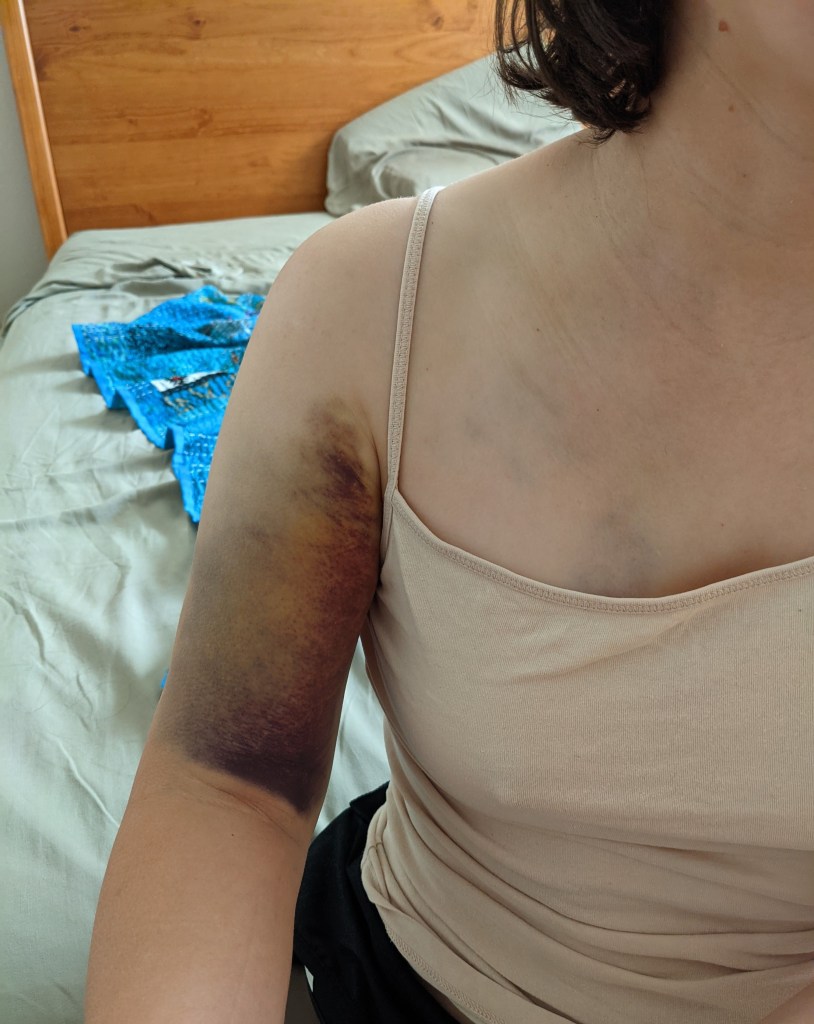
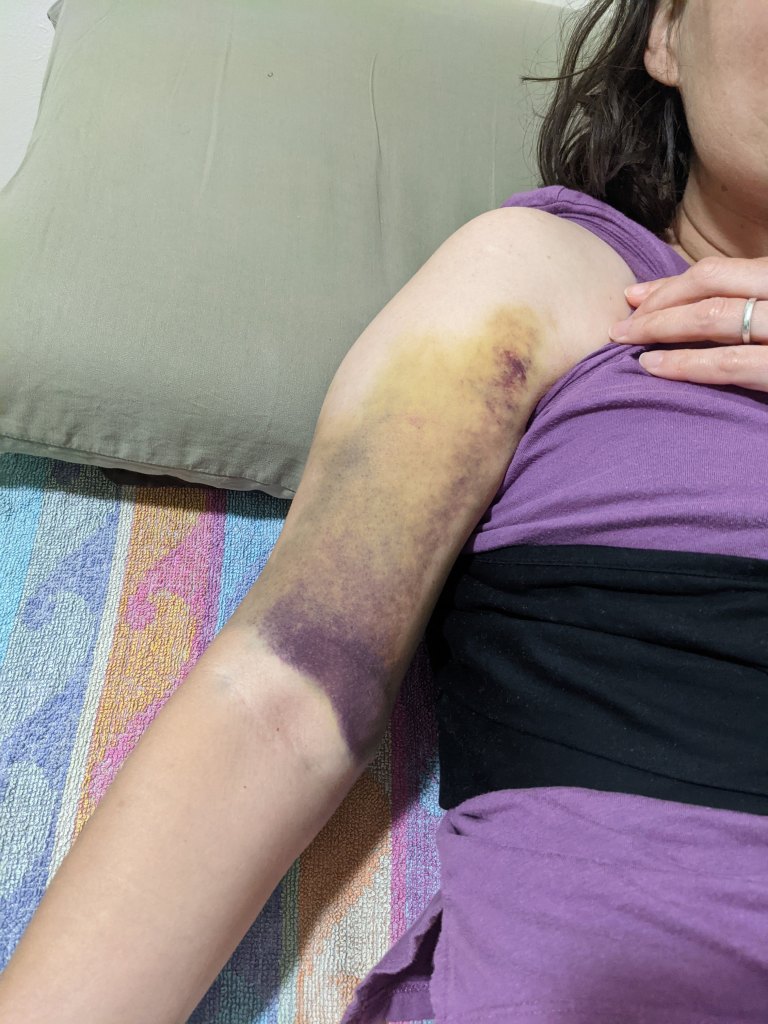
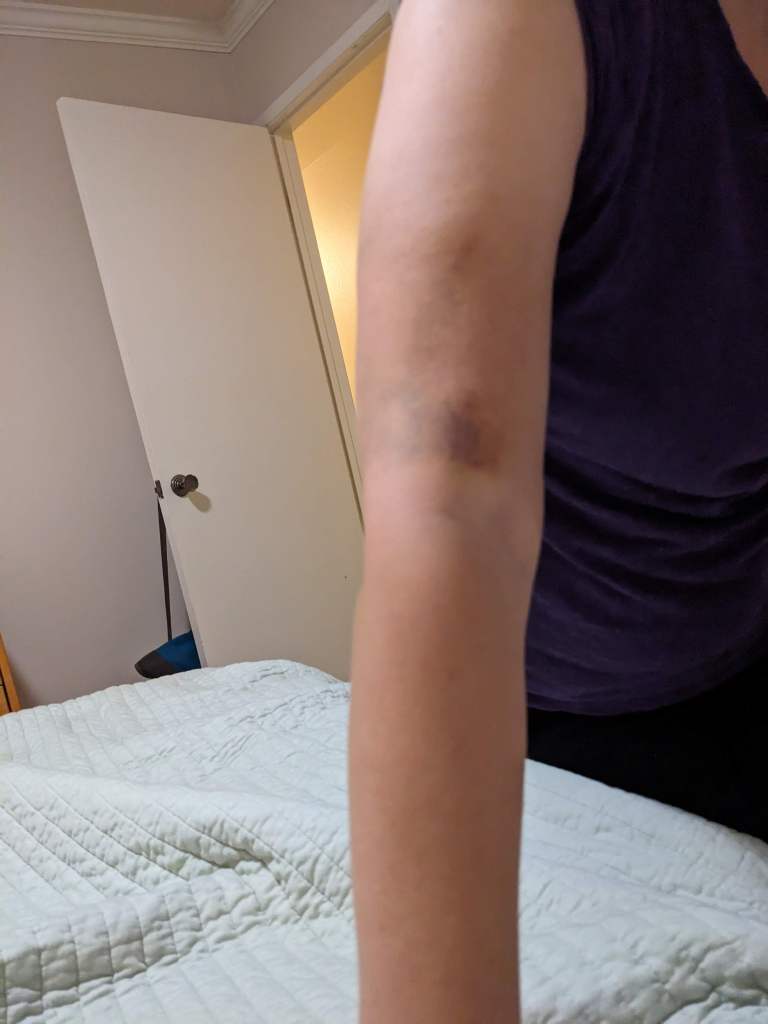
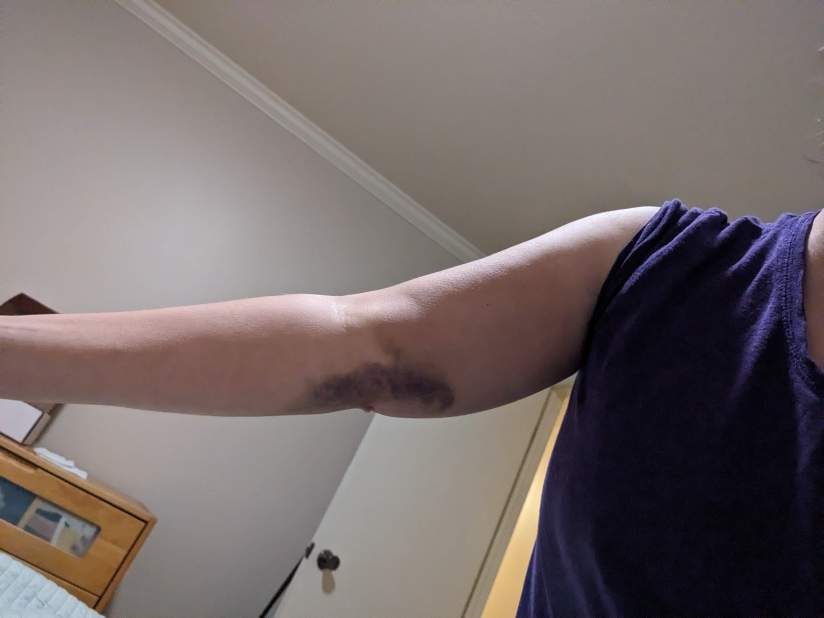
On November 2nd, I had my follow-up appointment for my shoulder, just over four weeks after the fall. My bruises were still pretty visible. As I turned my arm to show the way the bruises had settled into my inner elbow and continued to drain into my forearm, the doctor was impressed with my range of motion. He said I was doing really well and assured me that the pain I was still feeling into my collarbone and shoulder blade, as well as my arm, was normal, and that I could expect to be in pain for another four or five weeks. He gave me a referral to physical therapy and sent me on my way. Good job, me, for healing well! Nice to have a fully positive appointment for a change.
Today, as I finally, finally finish this post, it is six weeks past my injury. Bones take six weeks to heal. The pain is slowly, slowly lessening. I’m still using ice packs at some point almost every day. The pain feels similar to the deep ache and lack of ability to move the arm after a vaccine, just more and constant, with sharp spikes when I do too much. The only good thing about new, acute pain is that it eclipses all the old, chronic pain, so that it’s barely part of my consciousness most of the time.
As for the rest of things, I was able to return to my right-handed bathroom routine at around two-and-a-half weeks. I still do not use the shower, preferring the safety, relaxation, and two-free-hands-ness of sitting in the bath, which my husband has to help me into and out of. Typing with both hands came back after a couple weeks, I think. I haven’t used my trekking poles at all (which means I have barely walked outside), because that’s a very shoulder-intense activity. I very much want to sleep on my right side again, but cannot yet do so. My relationship with my kitchen, and my kitchen floor, is slowly returning to its pre-fall state, with pre-fall levels of caution and care, plus cat location awareness. I load and empty the dishwasher, I chop and stir, I fill my own water glass. But I very much prefer to sit still.
These past six weeks have been the most sedentary of my adult life, and filled with lots of dark chocolate and vegan ice cream. And I am absolutely okay with that.
What I’m struggling with now is the same thing I struggled with when I was doing to The Gupta Program: How do I convince my nervous system that I’m safe and can get out of fight/flight/freeze mode and into the parasympathetic state when the physical obstacles and dangers I face are very real? (See my post Safety Dance for more on this.) One of the main ideas of The Gupta Program is to tell your worried part that you are safe, that “Whatever happens, I will handle it.” You’re not trying to convince yourself that everything will always go well, but that it’s okay when it doesn’t. I would try telling myself “Whatever happens, I will handle it,” and invariably, an image of myself falling outside, away from anything I could pull myself up on, would come into my mind. An image of myself getting hurt. And I would say, “When I fall, I will handle it.” (Not if, when.) “Even if I get hurt, I will be okay. My body knows how to heal.” That’s a big one in Gupta, the body healing, because the nervous system is sensing all this danger, sending all these signals like “I’m sick, I’m hurt, I’m not okay.” You’re supposed to remind yourself that your body can heal, is healing at this very moment. And so it happened. I fell, and I got hurt for real. I am healing. I don’t know how long the pain will linger, but I’m trying to stay positive and believe that my nervous system won’t turn it into something chronic even after the injury has healed, a pain loop in the brain. I want to achieve full recovery, and get back to where I was before, which was enough of a challenge to navigate in itself. The dangers are real, the pain is real, but I can handle it, right?
Right.
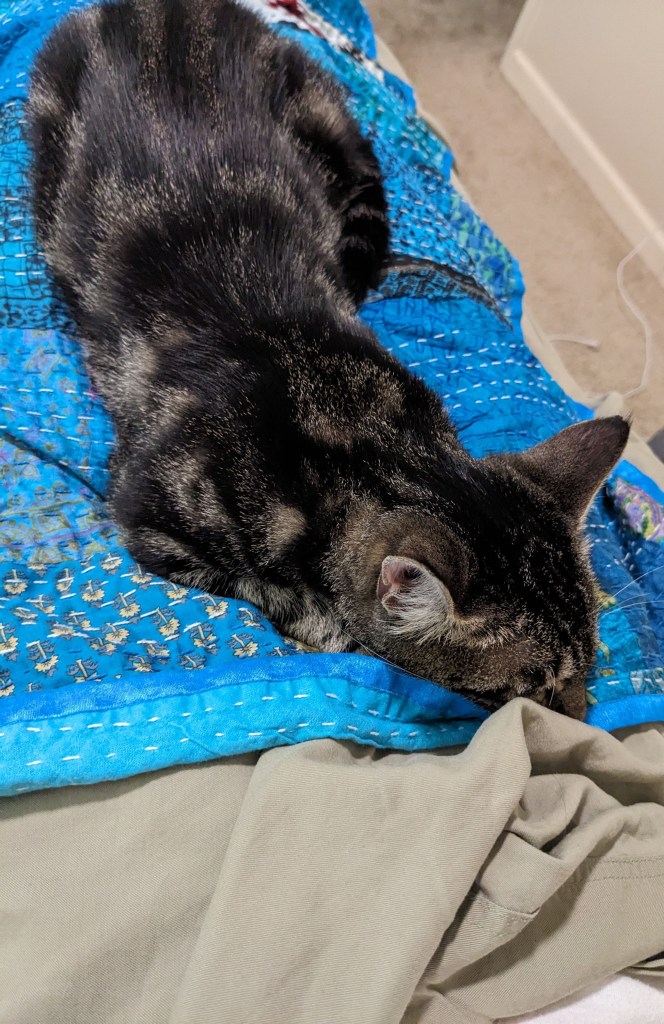
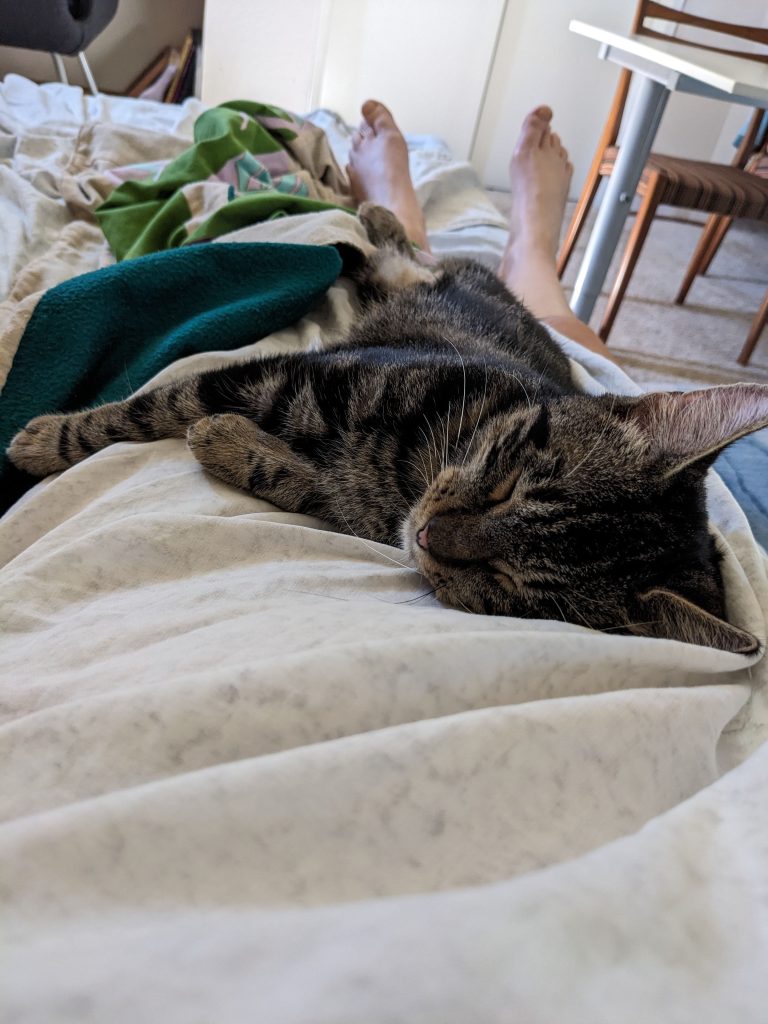
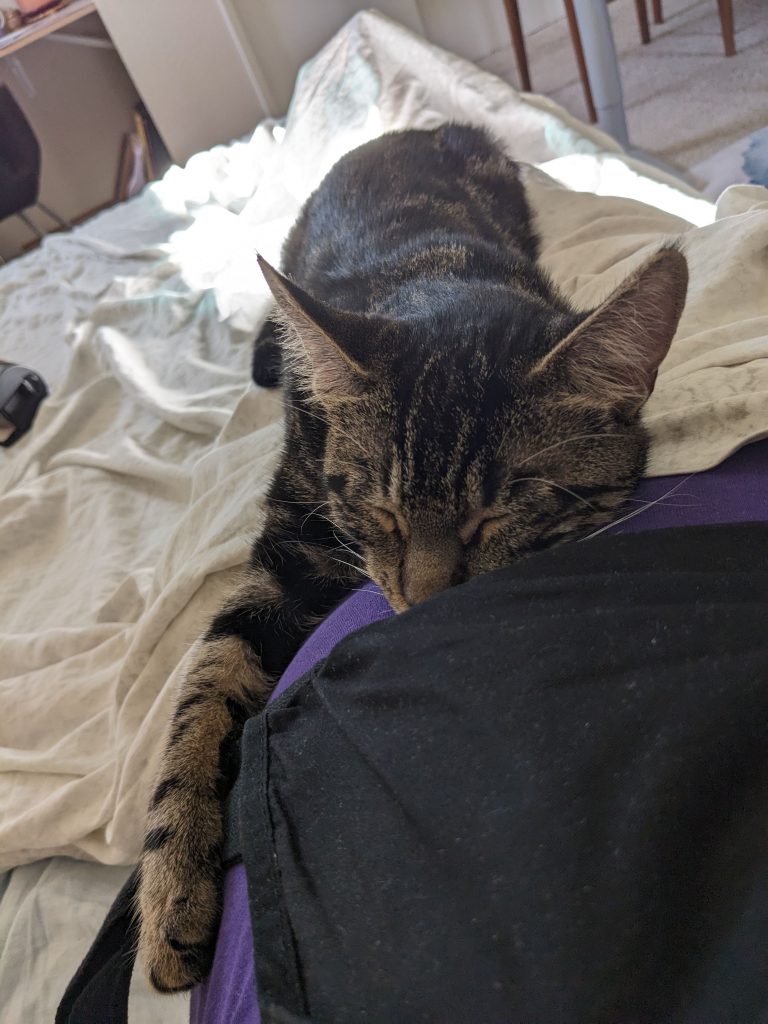
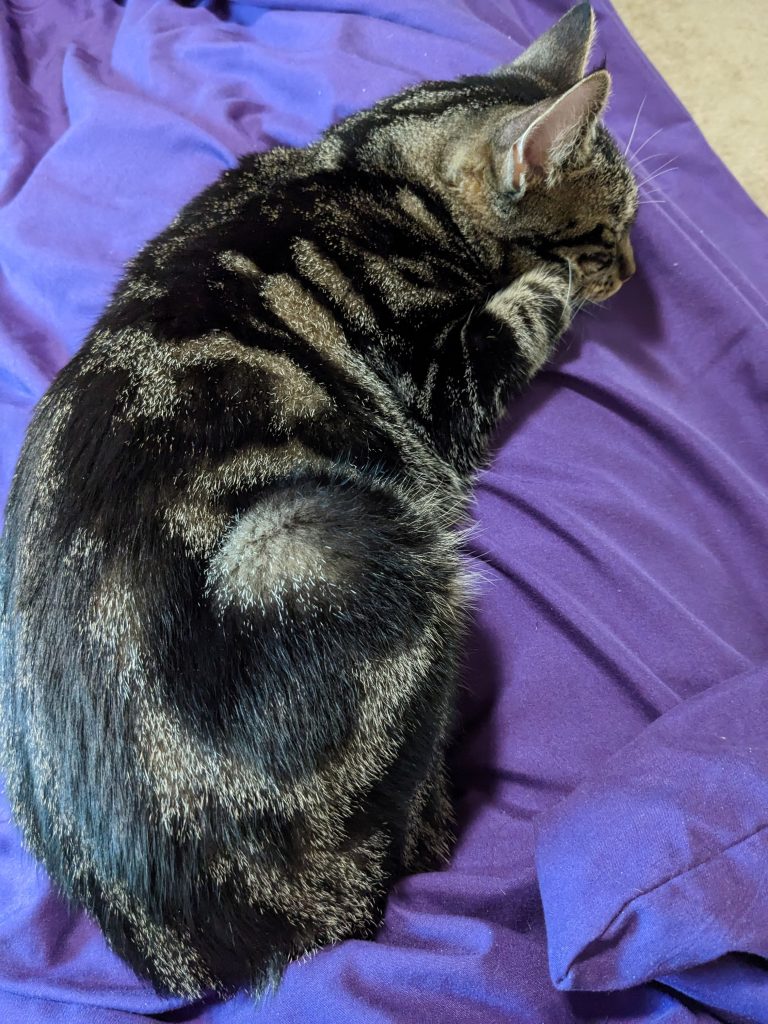
*Photos ahead* I find bruises fascinating because they can look so gruesome and then fade to nothing. I asked my husband to take lots of pictures. These are by far the worst bruises I’ve ever sustained. Please scroll on to the plethora of cat pictures if you’re not also fascinated by bruises like I am.



*The title of this post is a nod to the lyrics of the 1994 song “Waterfalls” by TLC.
 What Happened to Your Legs?