I don’t think I knew until last year that Disability Pride Month existed. When I first heard it, my ears did a double take. Disability Pride Month? Not Disability Awareness Month?
Pride is a complicated concept. In the US, we’re all about pride, in ourselves, in our country. In many other cultures, it’s not viewed as a positive thing to be proud of yourself as an individual.
When I think of pride, I think of it as being proud of something I’ve accomplished or achieved. For example, I’m not “proud to be an American” because that was all chance–I happened to be born to US citizens. I didn’t choose it or do anything to make that happen. This country has achieved lots of amazing things that I’m grateful for, and it’s also failed in lots of ways that turn my stomach and break my heart.
I was born with cerebral palsy. That was chance too. Am I proud of being disabled? No. Am I proud of some of the things I’ve achieved while living with a disability? Sure.
I think what I’ve just written is a common reaction to a month of “disability pride.” But after my initial reaction, I learned more about Disability Pride Month and understood that I was thinking of it too narrowly. To have disability pride is not only, or necessarily, to be proud of being disabled, but also to recognize that disabled populations have struggled, have been and are still marginalized, excluded, disregarded. To have disability pride is to be proud of those who have come together and fought for equality, for representation, for inclusion.
Disability Pride in the US originated to commemorate the passing of the Americans with Disabilities Act in July 1990. While there have been celebrations around the anniversary of the passing of the ADA each year, the first official Disability Pride Month was July 2015, coinciding with the 25th anniversary.
Crip Camp, a documentary that is not only about a camp for people with disabilities but more about the disability rights movement, and the incredible lengths activists went to to get the government to sign Section 504 of the Rehabilitation Act of 1973.
I’ve always loved the idea of tiny houses. I love the way everything fits together like a puzzle, the thoughtfulness that goes into functionality and design. I love that tiny houses are the antithesis of the “more and bigger” mentality that pervades our culture, that smaller living spaces save money and energy and preserve habitat.
Ten years ago, I moved into my future husband’s 673 square foot home. Though not a tiny home, it’s a small one by US standards. This home has three rooms: a vaulted-ceiling living room/kitchen, a sizable bathroom/laundry room, and an adequate bedroom with a pretty big closet. I love the neighborhood and the transit options, and while it took some finegaling to make room for me and my stuff, we eventually made it feel comfortable and functional-ish there. When I had an editing job, I worked at the kitchen table, and when I tutored, I was able to use the community room nearby.
Then the pandemic happened, and we both needed to work from home. My husband worked in the living room, and we squeezed a tiny desk into the bedroom between the foot of the bed and the dresser for me. My part-time job at the elementary school went remote, and I know Bradley could hear every word of my phonics lessons as I attempted to teach reading over Zoom.
We needed office space. Bradley’s job stayed remote two days a week even after sheltering-in-place lifted, and the kitchen table was not a good long-term solution. We started to think about moving more seriously. I didn’t want a big place. “Just one more room,” I kept saying. Just an additional office/guest room. I certainly had no desire to clean more than one bathroom.
But when three-bedroom places came up on Zillow, my ideas started to evolve. What if I had an office too? What if I had a dedicated room where I could edit and tutor rather than making it work at the kitchen table? What if that room had a permanent space for physical therapy, so I wasn’t always trying to use the bed or floor? Beds are not an ideal surface, and the floor is hard to get down to and up from, and, let’s face it, usually needs vacuuming. It doesn’t take much of a deterrent to stop me from doing something I don’t actually want to do, and I was far from consistent with my PT.
A three-bedroom place for two people? Was it ridiculous, wasteful, upsizing so much? I struggled to justify the increased load on the planet, but still dreamed. Bradley could have a room that was just his, for work and hobbies, without having to shove everything into a closet when guests came. I could have a multi-purpose room to meet all my needs, which could also be a guest room when needed. Our bedroom would be just for sleeping. It sounded positively magical.
On July first this year, my husband and I moved from a 673 square foot home to a 1023 square foot one. Though it is far from our dream home, our 1969 three-bedroom two-bath house feels so big. There’s even an attached two-car garage. What a luxury. In order to have both a PT table (a queen platform bed with a mattress topper and foam gym tiles atop it), and a tutoring table, I get to have the primary bedroom as my office, and it feels completely extravagant and special. There was already a built-in desk, so I don’t even have to clear away my computer and piles of papers when it’s time to tutor.
There’s been a lot to adapt to in this house. The two bathrooms are both small and a bit awkward to maneuver in. Maneuverability is important when you need to pee. Grab bars went into the shower stall in one and around the bathtub in the other. We had remodeled our previous bathroom to take out the bathtub and have a barrier-free shower, but I must admit that I enjoy taking a bath and that it feels a lot safer to wash my hair sitting down than standing in the shower stall. (I’ve never liked the idea of a shower chair, and even if I did use one, the shower is so small here that there’s barely room, and nowhere to put it when someone else showers.)
There are steps to get into the house and steps down into the garage, which is where the laundry is. Laundry has always been a very laborious task for me and now I have fancy front loaders that came with the house. My legs find it excruciating to bend and crouch when removing laundry from the machines and this is something I hope will get better with time. My husband added a handrail to the garage stairs right away, and we managed to fit a storage bench in front of the laundry machines, so that I can kinda sit while crouching and reaching, though room for the washer’s open door means the bench is far away from it.
Perhaps one of the hardest things to adjust to after moving to this side of town is the lack of transit options. At our old place, a bus stop with four bus lines was steps from our house. Here, while the bus stop is close, there is only one line that serves this neighborhood. And there’s nowhere to sit while waiting. Transit riders know that taking buses is generally much slower than driving, at least in smaller towns, so we factor lots of travel time (and wait time) into our daily lives. But this particular bus line is not designed to connect to many others, so I either just miss the next bus I need, or wait 20-30 minutes for it. Or I take one bus and walk 30 minutes, which is exhausting. I recently had a twenty-minute appointment that ended up taking me four total hours to get to and from by myself. If you’re wondering why I don’t drive, you can read the About Danielle page. I also don’t want to spend money on a rideshare service when transit is free for people with disabilities, and I believe in it and want it to be better. (I wrote a letter after that four-hour debacle.)
The goal of this post is not to complain about all the new and inaccessible things I have to adjust to after moving. Rather, it’s to recognize that we are still the same people that we were before we moved. Obvious? Maybe. People (especially this person) tend to dream and then fixate on their fabricated logic: If we had more room, we’d actually have a place to put XYZ. If I had an office, maybe I’d write more/be more productive. If I didn’t have to get down on a dirty rug, I’d stretch more. When we move to a quieter neighborhood (living next to a busy bus stop has its cons), I’ll sleep better and have more energy. Et cetera.
It didn’t take me long to realize that, yes, more space is truly a wonderful gift that I’m so grateful for, and despite that gift, we are still fundamentally the same. I did not transform into some elevated version of myself. We still leave our mail in a neglected pile, still have ever-evolving drifts of crap on our tiny dining room table. (Our additional 350 square feet does not mean there’s a better dining area.) There are still phone calls to avoid making, and odds and ends to avoid unpacking. There are still endless dishes and endless laundry that we don’t stay on top of. Why do humans need to eat so often? And wear so many clothes?
Existing and functioning still feels really hard, even with more space.
There’s so much that I love and don’t love about our new house, just as there was so much I loved and didn’t love about our old house. That’s how life goes, if you’re lucky.
And so I continue to tutor, at my dedicated tutoring table. I continue to provide my perspective as a sensitivity reader, at my built-in desk. I continue to do PT and meditate on my “therapy table.” I continue to be grateful that my living room is now separate from my kitchen. I continue to marvel at how much safer I feel emptying the dishwasher in a narrower kitchen. I am here, still me, in a new environment, making it through the days, living in an ever-constant stew of fatigue and gratitude.
About fifty years ago, my parents bought land on the Oregon coast. After they had four children, they built a cabin in those Oregon woods. A true cabin, with no electricity or running water. Dad painstakingly cleared a narrow path through the woods that eventually met up with a slippery, sandy, sometimes steep trail to the beach.
We all have good memories of time together at the cabin. But there is also a consensus that “Danielle doesn’t like the cabin.” Or “Danielle doesn’t like Oregon.” For me, when I thought of Oregon/the cabin (which were the same thing in my young mind), I thought of gorse.
Gorse is a shrub with pretty yellow flowers. It’s also “an invasive species of worldwide concern” and is very familiar to me. Gorse is made of thorns. Gorse is made of thorns and tree trunks are full of sap.
My siblings might have seen adventure and opportunity. For me, the Oregon woods were an unending obstacle course. And for a kid with cerebral palsy, an obstacle course isn’t fun. The springy, uneven, unpredictable forest floor, covered in twigs and branches and vines and rotting stumps and ferns and gorse. And what is there for me to steady myself with? Trees covered in sap.
I did not explore with joyful abandon. Climb from stump to stump to stand tall atop the biggest one. Build forts. Leap across streams. The forest wasn’t accessible to me. It was an environment that was difficult to participate in, to be a part of.
I’m not exaggerating when I say that my most vivid memory of being in the woods around the cabin is of falling, and lifting my hand to pluck the gorse thorns from my sticky, sap-covered palm. I do have many good memories, too, but the strongest one is landing with a sudden rustle-thud that only that forest floor can produce, and assessing the damage.
Even the ocean, when we finally made it down to the beach, wasn’t something I loved. Navigating sand is nightmarish, and the water was cold. Then I had to climb back up the steep, slidy trail. With wet sand in my shoes, chafing my toes.
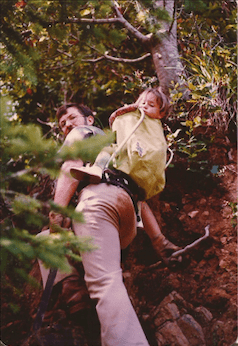
It might only be because this picture exists, but I swear I remember looking over the edge of the red, flowered rim of that backpack as my dad slid, unintentionally, on his bottom down a section of trail. 1983.
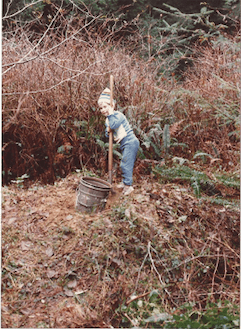
But, look! I used a shovel. Notice how hard I’m holding on to it. 1983.
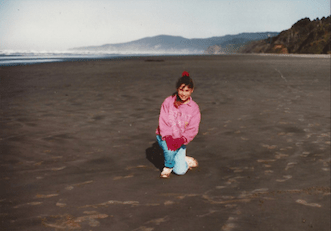
Apparently when I was ten, I could kind of do that one knee up, one down pose and not tip over. My toes dug into the sand, even when it was hard packed. That outfit, though. Rest assured that my socks matched my scrunchie. 1991.
I think the last time I slept at the cabin, I was in my early teens. When my sister got married there in 2009, and many of the guests went down to the beach, I did not even attempt to go. When I brought my own husband to see the cabin years later, he too, went down to the beach while I waited, safely seated, and imagined his trek through the trees.
When given the option to be outside or inside, I’ve mostly chosen inside. Inside is safer. Inside is easier. (Okay, both times I’ve needed stitches were inside incidents. Nowhere is safe. Just safer.)
But I also LOVE the forest. The roaring quiet. The dim coolness. The alive stillness. Trees feed the soul. You are compelled to breathe deep of the oxygen. Compelled to speak softly inside the majesty.
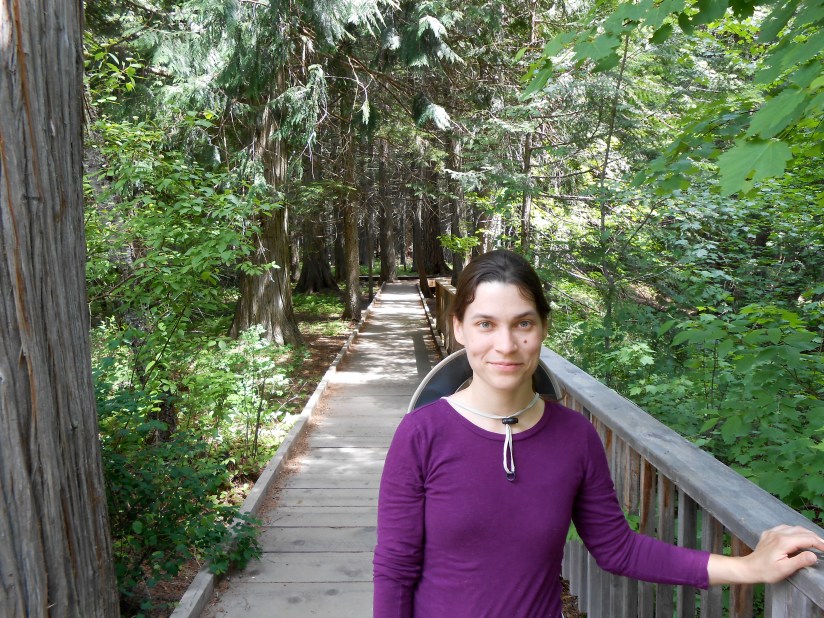
I don’t remember my first accessible hike. Not that there have been so many of them. Palisade Falls near Bozeman, Montana, in 2004, maybe. Then Glacier National Park, on a raised wooden walkway. Being able to walk beneath and among the trees without expending all my energy and concentration on staying upright is spectacular.
Sometimes I feel like I need to just be with the trees.
Glacier National Park, 2013
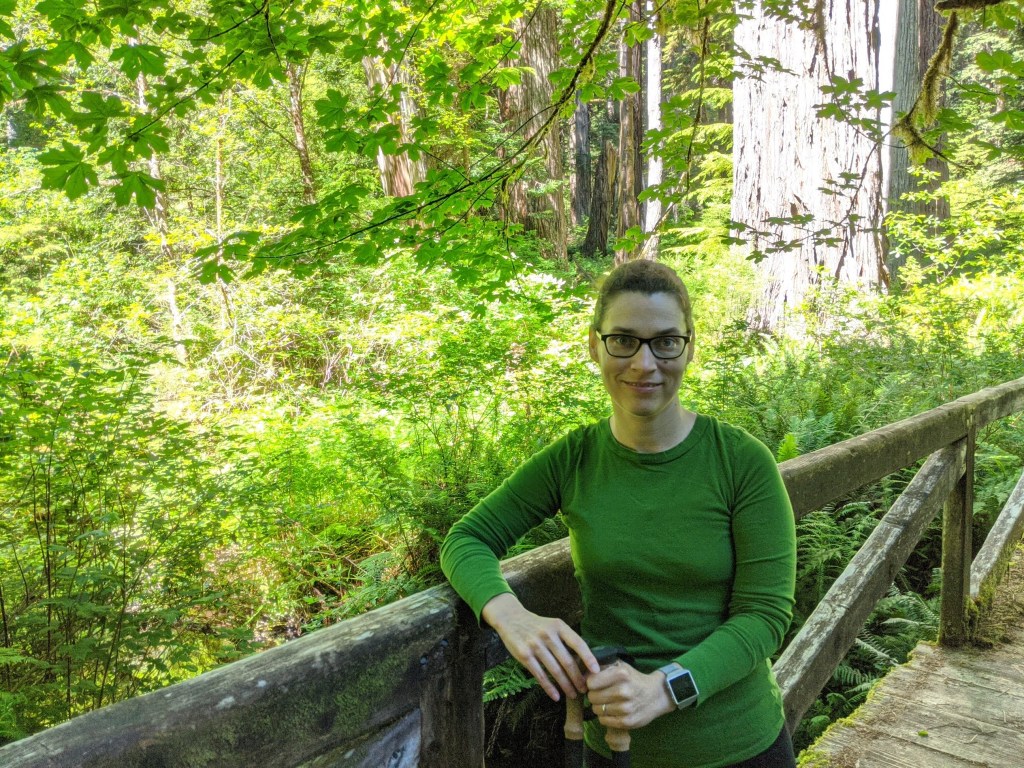
Prairie Creek Redwoods State Park, 2020.
No tree is too big for a hug.
My husband, he takes me to the trees.
Wanting to take me to the trees again, my husband found Roy’s Redwoods Preserve in Marin County. It was my second spring break of the pandemic, the second year we did not go on a weeklong trip, so a day trip we took. Now, it turns out that the name is a bit of a misnomer. While there are some redwoods in this preserve, we did not reach a place on the trails where I was truly surrounded and sheltered by them. No alive stillness for me that day. Instead, I experienced a different kind of aliveness altogether.
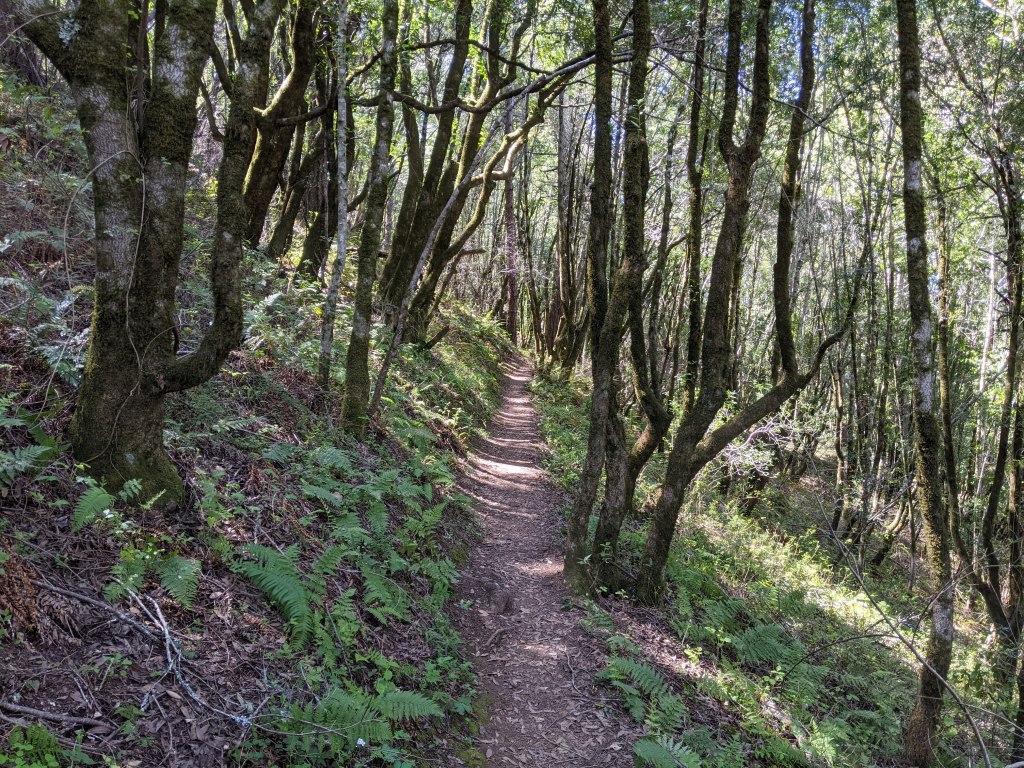
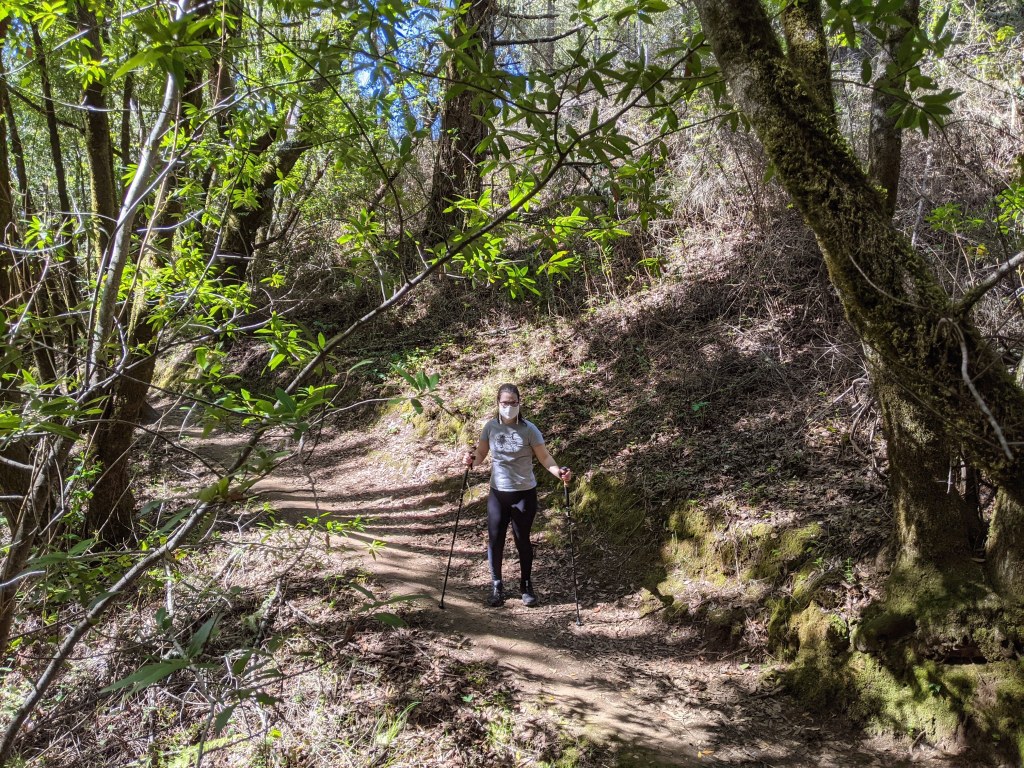
Friday, March 26, was my first real outing with both my back support and my trekking poles. I also wore really supportive shoes with a stiff sole. This was my first trail that was not officially deemed “accessible.” We chose Roy’s Redwoods Loop Trail over the Meadow Trail, because I wanted redwoods, not meadow. The trail started off fine, narrow, but flat. Soon, though, I encountered rocks jutting out of the packed dirt, and inclines. And inclines with rocks. I surprised myself by navigating up those uneven inclines and over those jutting rocks. “I did it!” I said, like a toddler learning a new skill. My husband stood near when I hesitated, ready to assist while I attempted different footings and pole placements, but, I did it all by myself.
I wondered how much harder it would get, and how much more I could actually do. And how I was going to get back down. This loop was not small and we were not planning to do the whole thing; was it already time to abort mission? But I wanted to see if I could get to the redwoods that were supposed to be on this trail, so we kept going. For the record, here’s its official description: “For a peaceful getaway, meander down Roy’s Redwoods Loop Trail.” My husband meandered peacefully, while I worked through the most challenging terrain of my adult life. The pictures don’t do it justice. I didn’t think to pause for photos on the hard bits because I was a little too busy not falling.
This is narrow. And not flat. And do you see that root?
Eventually, we emerged from the trees and found ourselves on the side of a hill. I looked down to my right and up to my left and realized I had hiked up a hill. We kept going for a while longer. We did not reach the redwoods, but we did end up meeting the Meadow Trail, so we did not have to retrace all our steps (some of which I’m pretty sure I couldn’t have handled going down).
Do you see how I’m in the middle of a HILL?
The Meadow Trail was easier, but we still had to hike in a downwardly direction. Down is much more difficult. Instead of leaning up into my poles and heaving all my weight onto them as I step, I had to place them down in front of me without falling forward with them. There were a couple of legitimately scary moments for me, but I made it down all by myself. I hiked. I’m a hiker.
We made it back down the hill. I am standing up tall in a circle of redwoods, with no weight on my poles.
I would not have been successful if we had tried to hike with me just holding my husband’s hand. I would have pulled his arm, hard, the whole time, and still not have been able to do it. Without the poles and the back brace, it would have been truly impossible. I would not have even attempted to climb over/around that first jutting rock, because I would not have been able to stay upright. Good poles, good brace, good shoes. I have found a combination of tools that give me what I need to be able to do what I cannot do alone. To my knowledge, no doctor has ever suggested back support for me. I have been given exercises to strengthen my outer hips, to combat my side-to-side shift, since toddlerhood. My entire life–Strengthen those hips! Don’t let that hip drop! It turns out that stabilizing my trunk helps so much, enabling me to focus on the glutes. Yes, I’ve been doing my glute exercises consistently for months as well, but I can’t help but wonder if we’ve been going about this whole thing backwards. Strengthen hips=stable core? Or stabilized core=ability to engage other muscles.
If you have cerebral palsy similar to spastic diplegia with hip drop, I say try some back support and see what it feels like.
I have accomplished many things I’m proud of. Not many of those are physical achievements. Physical success is not something I often experience. As I continued to navigate obstacle after obstacle on that trail, under my own power, I suddenly understood how doing physical things that are hard can be almost…fun. Meeting a challenge. Here is a time when the term “physically challenged” is appropriate. I was physically challenged by that hike, and I succeeded. And I liked it. I want to hike again. With more redwoods next time.







 What Happened to Your Legs?