Cerebral Palsy and Pain Management: What I’ve Tried

For the various muscle tensions and pain that come with my cerebral palsy, here’s what I’ve tried and my experiences with them.

Moist heat/cold packs: These feel nice in the moment, but offer no lasting effects. Nonetheless, I have a heating pad plugged in next to my bed at all times, and various herb/grain packs in the freezer that I use both heated and chilled. Mostly, they are comforting and make me feel like I’m doing something to take care of myself even though I know it doesn’t really help.

Muscle rubs/sprays: Various brands, most of which give a cooling sensation. Again, they don’t do much. Every once in a while, I think I can feel my neck let go slightly, for a moment. I have also used them in combination with other methods.

Various OTC pain relievers: Don’t you love it when doctors ask, “Have you tried ibuprofen?” Why, yes. Yes I have. “Did it help?” No. No it did not. If it had, I would not have felt compelled to make an appointment and get myself to this office and talk to a doctor for fifteen minutes. The truth is, I’ve never been able to tell if NSAIDs do anything. They might do a little, sometimes? For me to really know, I’d have to do the exact same scenario two ways, one medicated and one not, and directly compare them. But the time space-continuum doesn’t allow for that. Is it really true that people can take ibuprofen and actually feel better? 

Voltaren: prescription topical gel (designed for arthritis) on my knees. Nada.

Flexeril (cyclobenzaprine): This is a muscle relaxant I was prescribed for my neck, only meant to be taken for two to three weeks. I was uncomfortable with the idea of being on prescription drugs. Because it can cause drowsiness, my doctor told me to take it before bed. I did that once or twice and felt no different in the morning, so I put them in the back of the medicine cabinet. Months later, when I was having a rough neck-pain day, I decided to take one. I promptly spilled the remaining pills into the (wet and not particularly clean) bathroom sink, and that was the end of that experiment. 

Physical Therapy (childhood and adult): I had PT as a young child, and again for rehabilitation after surgery. Since my CP gives me muscles that are both tight and weak, PT focuses on stretching and strengthening, especially my hips (and hamstrings and adductors and etc.). As an adult, I’ve been referred for my SI joint, knees, and neck. None of my pain has been an acute onset as a result of injury. My pain just happens. All the issues I’ve ever gone to physical therapy for are still there. That would lead me to the conclusion that physical therapy does not work. But it’s not that simple. A physical therapist’s job is to set you up with a program you do at home, supposedly multiple times a day (ha!). Sometimes I do the program consistently for a stretch of time, and sometimes I don’t. Most often, I get home and try to replicate what we did and find that I’m straining something else in the process. Then I go back the next time and adapt it, etc. If a therapist could visit my home every morning and evening, maybe there’d be progress…? Even when I do succeed, like in stretching and strengthening my traps, that has not resulted in any noticeable decrease in my overall neck pain. While that’s extremely disheartening, I can also say that PT is probably not making anything worse overall, so I might as well keep trying it. At least I feel like I have someone who is trying to help me. And it’s my cheapest in-person option.

Ultrasound: I’ve had ultrasound done on my neck and shoulders a couple times as part of a PT session. It is meant to give a deep heat to the muscles and increase circulation. It was lovely to lie on my stomach, with the headrest set at just the right angle, and have some prewarmed goo gently massaged into my neck. Sure, the deep heat was relaxing. Maybe if it were for an hour instead of ten minutes, and I could fall immediately to sleep afterward? No lasting effects.

Pilates: I attended private pilates sessions for a number of years, even going twice a week at times. Did it help? I couldn’t tell you. I do know that I enjoyed having one-on-one time with an extremely knowledgeable and empathetic professional in a nonmedical setting. I can tell you that I became ever so slightly stronger and more flexible. But it was also during these years that the knee pain and neck pain appeared. I’m not blaming the pilates at all, just pointing out that it’s hard to measure improvement on the pain scale when new issues present themselves. I enjoyed being able to lie down while another person grabbed all the pillows and props I needed to be supported just so. I enjoyed being able to focus on a particular movement or muscle group. I enjoyed trying to apply various verbal cues to my body (“Imagine your pelvis is full of sand…”) and being cheered on: “Yesss! Yesyesyes!” As though, sometimes, I was able to do something well.

Massage: I’ve had several massages. I really enjoy the massage while it’s happening. I like that attention is paid to the palm of my hand and to my eyebrows, to muscles large and small. I like the quiet and the dark. However, I lament the whole process. Taking off my shoes and clothes, climbing onto the table, getting settled under the sheet. Having to turn from my front to my back in the middle of the session, on something raised high off the floor and narrower than a bed. And then, when I’m nicely relaxed, having to climb down off the table, put on my clothes and shoes, walk to the bus stop, stand and wait, climb into the bus, and get seated. Is any of the relaxation left by then? Not really. 

Acupuncture: I only did four sessions of acupuncture. During the first one, I found it so stressful that I was supposed to stay still with needles in me that I could not relax. In fact, I think the effort it took not to move made my muscles tighten more. The next session I did better at deep breathing and tried to relax. But I felt no difference. Repeat the whole process with clothes and table and bus from above. After two more tries, that was enough.  

Feldenkrais / Anat Baniel Method: I heard about Feldenkrais from another person with CP who was enthusiastic about its benefits. It’s about movement, biomechanics, neuroplasticity. I gave it a good try–ten sessions. The woman I worked with had never had a client with CP before. I lay on a table and she moved my body and/or I followed her instructions. I felt heavier/more relaxed into the table when we were finished, but it never lasted. If it were actually affordable, it’s something I wouldn’t be against continuing. I think mindful movement can only be a good thing. Anat Baniel is a holistic “neuromovement” method that branched off from Feldenkrais, and I did one session. Intriguing. Expensive.

Feldenkrais

Anat Baniel Method

TENS unit: I have only tried this one time. I didn’t feel comfortable using it on my neck, even though that is currently where I want relief the most. I did not like putting the sticky pads on my neck, nor the pulsing vibrations, so it did not get a fair trial. I did not feel any benefits during or after the one time I tried it.

Supplements: Curcumin with black pepper, magnesium taurate. Curcumin, from turmeric, is an anti-inflammatory and black pepper aids in absorption. Took one bottle faithfully. No difference. Magnesium is supposed to help muscle cramps. Took one (or two?) bottles faithfully. Some people with CP take supplements and do seem to notice a difference. I did not. 

Weighted Blanket: Weighted blankets have become a much-beloved item for people on the autism spectrum, and for those with anxiety. And really anyone. They are calming and comforting and help people relax and sleep better. I’ve tried two, after much searching for blankets that are not polyester and do not contain plastic beads. I faced a conundrum when choosing the weight of the blanket (based on my size and weight). Would I need a heavier one because my muscles are extra tight? Or would I need a lighter one because my muscles are weak? For me, going lighter than the recommended weight would have been better because it’s already hard enough to change positions while sleeping. With added weight, it’s a true struggle. As far as results, I get too hot while sleeping to appreciate the blanket for most of the year. When I’ve tried it, I haven’t felt more relaxed or slept better. I do enjoy it for sitting and reading or watching a movie, after the work of getting situated under something heavy–but only in winter.

CBD oil: I tried one liquid from Green Mountain (hemp), and I couldn’t tell any difference. When a new dispensary opened downtown, I went in and tried their recommendation (they rolled their eyes at Green Mountain). It was Papa and Barkley capsules. Honestly, I don’t remember if it had a bit of THC with it or not. No noticeable difference. Then I tried Charlotte’s Web, the fancy famous one helping people with seizures, pain, and all sorts of conditions. You’re supposed to take it twice a day regularly, not just as needed. So I did. No noticeable difference.

CBD lotion: No difference.

Cannabis: THC reacts on the body’s cannabinoid receptors which produces an anti-inflammatory effect. The only incarnation of cannabis I’ve tried so far is cannabis-infused dark chocolate, which contained 10mg of THC. Although I cannot say I was completely comfortable with the effects on my mental state, physically it was quite something. My limbs felt heavy and relaxed and I don’t think I felt pain. I wasn’t aware of my SI joint anymore. I carefully put myself into a hip/adductor stretch, and my knee just kept going outward (stretching more than it ever does). I could turn my head from side to side without pain and it just kept going. My thoughts went thus, “I feel a lack of spasticity. Is this what people without spasticity feel like all the time? Everyone with spasticity should be able to feel this.” One second I felt totally out of it: “Ugh, I don’t want to do this again,” and the next moment: “This is amazing. I’m so glad I have the ability to do this again.” I lay down and my husband used our electric muscle massager on my legs. I was awed by the result. My muscles were so deeply relaxed they felt heavy/not quite there. Almost like a layer of separation between me and my body. My muscles felt like they were melting at the touch of the massager. I didn’t feel a single involuntary tensing of the muscles; it’s like they were incapable of tensing. My eyeballs felt relaxed. My brain felt relaxed. “Is this what people without anxiety feel like? Or just high people?” My body weight felt like it was so deep into the bed. Like nothing was being held back in tension. Nothing was tense–all was given over. That feeling lasted a couple hours before I started to come out of it. It’s like I could feel my right hip rematerializing inside my body. I felt woozy. Sleep wasn’t magically good, but I felt more relaxed the next day than is usual, and when I stretched I could feel my muscles actually let go. It even lasted a couple days. This may have been psychological in part–the knowledge that something finally did affect me, the knowledge that relaxation is possible. It lightened my mental/emotional load. I was interested to keep trying cannabis, to see if I could have some of the physical effects without the mental ones (this is supposedly what CBD can do).

I tried a half dose. It didn’t really work. I felt a bit out of it and woozy, without the positive part. I tried taking it right before I went to bed, so that I could sleep through being high but still get the relaxation. Didn’t really work. When I took a full dose again on a bad pain day, it didn’t have the same effect either. Some pain relief without the full-body letting go feeling, but with effects I didn’t really like. I’ve tried taking nibbles of the chocolate over a longer period to simulate something more like smoking. And I’ve never again had the experience of the first time. I don’t particularly enjoy the high nor the wooziness I feel coming off of it, so it remains an enigma that I’m not fully comfortable with.

Meditation: I don’t know where my incorrect idea of meditation came from. I always had this idea that you were supposed to sit there and clear your mind. Not think about anything. Well, I knew I couldn’t do that, so I never gave meditation serious thought. I did always enjoy the Final Relaxation Pose (savasana) at the end of my Yoga for the Rest of Us DVD. The guided body scan from head to toe, a gentle voice telling me to imagine soothing comfort flowing to each muscle group. Was I in less pain? No. Was it nice? Yeah. I’ve continued to try other guided meditations, both body scans and guided imagery. I’ve learned that no one expects you to maintain a blank mind. Your mind will wander and come back. That’s okay. That’s expected. Mindfulness is about being in the moment without judgment. The great thing about guided meditation is that someone is there telling you what to think about; your mind isn’t blank, but focused instead. 

One meditation I found on youtube talks about the intention of kindness and compassion toward your body and yourself, wherever you are. “And it’s okay if you don’t feel it. We’re just practicing.” You see, we’re just practicing. I can do that. Another one I love has a guy who says my body will relax in its own time, and in its own way. More than once, I’ve just started to cry. And once or twice, I’ve felt it. A little bit of floating. It’s actually a little alarming, except that I know everything is okay. I can sit here, now, and relax one side of my face and then the other. My eye socket, my jaw. I can feel my cheek droop. I didn’t know how to do that before. If I could apply that ability to my trapezius in any kind of lasting way, my quality of life would be much improved. I have not achieved a daily meditation practice yet, but it really seems to be my best option. It’s free. I can do it lying on my bed. And it takes as little or as much time as I want, whenever I want.

Note: I have looked into, but have not tried, both Botox and Baclofen. Both of these are commonly used by children and adults with CP, though I think more in the moderate to profound range. They don’t seem like a good fit for me right now.

Further Note: Most of these one-on-one sessions with any kind of practitioner are not covered by insurance and the cost would be prohibitive for the vast majority of Americans. If cost were not an issue and I could be teleported with no effort, I would have daily pilates and massage sessions.

Counting Down (Again): Cerebral Palsy and ExoSyms

We are in week…ten?…of state/county sheltering in place because of COVID-19. My March 30th trip to the Hanger Clinic was postponed. I can now say (again) that next month I get my ExoSyms. I am excited and nervous, exhausted and frustrated.

Remember back in December when I finally started making myself use trekking poles so that I could be used to them when I got my ExoSyms? It turned out I really liked using them, and I was walking more and feeling really good about it.

Middle of March comes around, and I realize that my right thumb and wrist are really bothered. The soreness even travels up my forearm. I had injured my hand last September/October by repeatedly lifting a heavy bin off a shelf one-handed, thumb stretched up over the lip of the bin. When I recognized this was causing a problem, I rearranged things and figured out how to use two hands without tipping myself out of my chair. But the pain lingered and showed itself in daily life. I had trouble opening jars. I love opening jars. I’m good at opening jars. It makes me feel strong and capable. Not being able to do it is scary because it’s tangible evidence that there’s really a problem.

So, I was used to my thumb hurting when I did something strenuous, but now it was hurting when I did nothing. And…my left hand hurt too. The backs of my hands ached as I fell asleep and the inside of my wrists hurt when I woke up in the morning. It had to be the poles. My unaligned posture and muscle weakness must be causing me to put extra strain on my hands and arms as I grip the poles, try as I might to use a light touch. 

With sadness, I put the poles away to give my hands a rest. I used ice and heat and muscle rub and NSAIDs. I even bought a wrist brace with thumb support, knowing that it wouldn’t “fix” things, but that it would help me really go easy on my right hand. I knew I had to use the brace consistently for 4-6 weeks to expect any changes. It did seem to help with the pain sometimes. 

I’m going to be honest. I left off writing the post at this juncture three weeks ago. I didn’t feel like recording the minutiae of my body and its pain anymore. But here we are, and it’s almost June so I’d better just acknowledge how things stand and be done with it.

I’ll say this: don’t google “burning forearms.” Doing so will make you worry that you might have MS. I don’t think I actually have MS, but I do probably have tendonitis in both arms. I have not made a video chat appointment with my doctor, and by now I could probably make an in-person one. I just kept waiting and hoping it would get better. Instead, both arms hurt about the same now, rather than the right being worse. And the pain has traveled up the forearms into the biceps and armpit. So, you know, I used to think I had rough days, and now I don’t have a single limb that I can trust to function properly and not hurt. It’s a lot to take mentally and emotionally. Pain is draining. New pain draining and unsettling. My nose feels good. My chin too.

I don’t know how the tendonitis will affect my use of trekking poles and learning to walk with ExoSyms. I don’t know how using trekking poles will affect my efforts to heal the tendonitis.

I would like this particular journey not to have been affected by first, a pandemic, and second, new and heretofore unknowable physical ailments. I would have liked to be able to go into my week at the Hanger Clinic energized, excited, in good shape, and in as little pain as is reasonably possible.

Instead, I am here. Tired, out of it, unfocused, sad. My eyeballs want to fall into my skull. 

So, I am adjusting my hopes for the whole experience. The important thing now, I tell myself, is just to get the braces and get the training. We will work on all the rest as we can. 

A Different World

March 30th has come and gone. March 30th was “delivery day,” the day I was to receive my custom devices. At this very moment, I should be at the Hanger Clinic, doing intensive training in my new ExoSyms.

But of course, it’s a different world now. A world shut down by an actual, literal pandemic. I realized in early March that I needed to postpone my trip to Washington State, a few days before my school closed, about a week before California was given a shelter-in-place order. I asked to be rescheduled for June, but (wisely) they responded with “postponed until further notice.”

And so I wait, “doing my part” by staying home. My world is safe and quiet and springtime-beautiful. I’m watching so much amazing music and dance, as Broadway and symphonies go quiet and reemerge online. Brian May plays a Beatles song. Joan Baez sings from her kitchen. Andrew Lloyd Webber and Stephen Sondheim wish each other happy birthday. Yo-Yo Ma plays us #SongsofComfort. Ballet dancers dance in their living rooms. 

And we run out of masks and ventilators and people die by the thousands, alone. No one can visit their loved ones in assisted living homes. Our healthcare workers function in a nightmare. Thousands of children who are safer at school than at home are stuck. 

The discordance staggers me.

I am sad that my trip to the redwoods is postponed. I am so sad that I won’t see the musical Ragtime anymore. And I am sad that I am writing this instead of learning how to use my ExoSyms. 

But it will happen, whether it’s this summer or next year. All I can do is be patient.

Life is Not a Montage

I love a good movie montage. An upbeat or inspiring song begins and our protagonists embark on a series of impressive and exhausting feats over a period of many days, weeks, or months. By the song’s close, gains have been made, goals achieved. Progress. Transformation. All within the space of a single song.

My favorite montages come from 

Dirty Dancing. Johnny teaches Baby to dance. (“Wipeout” and “Hungry Eyes”)

The Cutting Edge. Doug learns to partner, and Kate and Doug push each other in training. (“Groove Master” and “Ride on Time”)

Girls Just Wanna Have Fun. Janey and Jeff learn to dance together. Janey teaches Jeff gymnastics. (“I Can Fly”)

Footloose. Ren teaches Willard to dance. (“Let’s Hear it for the Boy”)

Honorable mention:

The Mirror Has Two Faces. Rose makes a change. (“The Power Inside of Me”)

Are you seeing the theme here? Clearly, I love stories in which people learn to dance. I’ll save writing about dance for another day. Today’s topic is time and progress. 

With fewer than thirty days until my second trip to the Hanger Clinic, where I will receive and be trained in my new ExoSyms, now is my time for a montage. Time for an uplifting beat to float out of the ether and start me off. Or, if source music works better for you, time for me to pop my earbuds in and get to work:

Cut to me getting up early to stretch and strengthen. 

Cut to me attempting to plank, and side plank.

Close up on my determined face.

Cut to me walking with my trekking poles. 

Cut to me stretching out my calves while I microwave my lunch at work.

Cut to me at my PT appointment.

Planking at home.

Using my DIY balance board.

Sleeping.

Waking early to stretch again.

Making smoothies. Eating vegetables.

Planking again.

Planking again–and succeeding?

This is where the vision falls apart, with the progress and transformation. Once February arrived and I had about two months to go, I knew I needed to buckle down and really be dedicated. But I was working, and editing, and tutoring. Cooking and cleaning and laundering. Reading and sleeping. Spending way too much time online. Living my daily life. Can any regular person, who isn’t an athlete as their life’s work, maintain enthusiasm, drive, energy, commitment for so long? Well, yes. Of course there are people who do. Not montage-level dedication, sure, but there are people who set goals and reach them. I am not one of those people, historically speaking. 

I’ve always found January and February more challenging motivation- and healthwise than November and December. With the holidays approaching there’s excitement and anticipation, activity. With the holidays past, there’s winter and work, and several breaks from work which are full of Netflix and the mountain of chocolate and treats resulting from Christmas, birthday, and Valentine’s Day. There was also cake. And ice cream. As there should be. I savored the gluttony and the slothfulness, but I can’t be surprised I’m having to claw my way out of it now.

Not gonna lie–the first three weeks of February were rough for my body. It’s always an interesting exercise to try to quantify and describe pain. Last month, my piriformis and SI joints were making themselves known. I go through some periods of time when that’s not the case. When my hips just feel tight and achy, but not in pain. So when one is set off, in that sharp, strong way, it feels like, “Oh, right, there it is. What I was feeling before wasn’t really pain at all.” And I remind myself that even though I never know quite how to get things to calm down again, they eventually do. The trouble is, once these areas are aggravated, so many movements throughout the day keep them aggravated, and after one week, two, three, I was beginning to wonder if this was the time that they were just going to stay angry forever. Usually if both sides are upset, one side hurts, and then the other, throughout the day. And I’m so grateful for that. I think I might lose my grip if both hips were screaming at once. But then they did (in different ways and to different degrees) and I still have my grip. 

The pain is dynamic, changing from minute to minute. Sometimes it’s sharp, almost burning. Sometimes it feels muscular, sometimes it doesn’t. It travels down my IT band. It pulls at my inner knee. It moves down to clamp onto everything that meets at the head of my femur. Occasionally it throbs. Or it feels like a bit of stabbing, quick jolts cutting through the rest. Once or twice it has felt like what I can only describe as a second of gurgling, or a gargling. And I wonder what the heck is going on in there. 

Mostly, I stretch it and I stretch it and I breathe. The pain itself is not so bad. Never would I rate it an 8 or a 9 or a 10. Because pain can always be worse. What’s bad is that it does not stop. That I cannot help it ease. No heat, rest, NSAID, muscle rub, or stretch will provide relief. I’m very aware that I could be stretching incorrectly, and that lying in bed is sometimes the exact wrong thing to do. Sometimes I start pounding on it with the side of my fist, hardly realizing I’m doing it. I want to drive a hot poker into the pain. I want to pop my leg out of its socket and put in a new one.

Meanwhile, I have new PT exercises (that are probably aggravating things) that I am supposed to be doing twice a day (ha!) in order to make the most out of what might possibly be the most important and most challenging five days of my life. I skip them a lot.

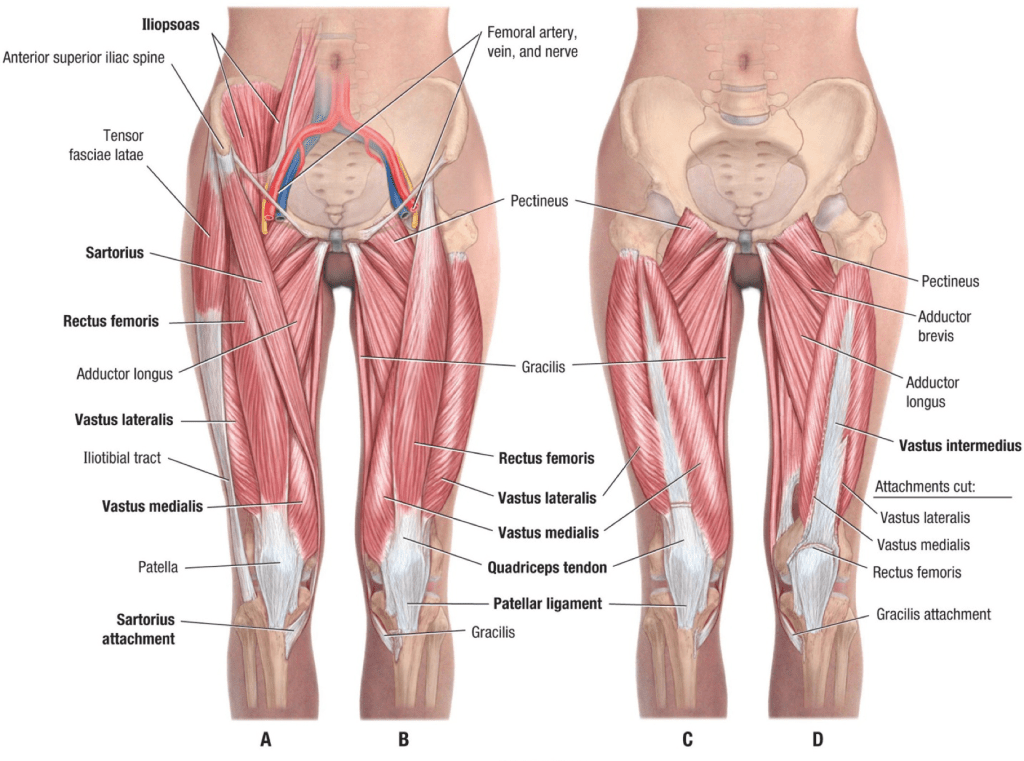
Here are some images just so we all have an idea of what I’m dealing with. On my body, obviously, there’s spasticity and lack of control. Several of these muscles have been lengthened (weakened), and there’s been a muscle transfer as well. Check out all those muscles under the gluteus maximus! Much of my pain is in that mess.

So, with March looming, I cut back on sugar, and on screen time, and I finish my editing project. I meditate and I stretch and do my exercises the best I can. One day (Sunday, February 23rd), I found a stretching position that I could manage to relax in while still maintaining it, that felt like it was hitting the spot. And it felt better. Noticeably better. I almost cried with relief and gratitude. Excitement. Triumph. Hope. Hope that I could keep these muscles and joints happy until I made it to Washington and the Hanger Clinic. Of course it hasn’t exactly gone that way. But my muscles and joints are still noticeably better than they were before. When I stretch lately, it feels like the muscles are actually stretching, instead of me fighting a brick wall. One morning after stretching, I took up my poles and did a turn about the neighborhood. As I walked, I felt a tingling at the back of my neck and down into my shoulders. Unlike anything I’ve ever felt. What is this magic? I wondered. Is my neck actually relaxing? While I’m walking? Will my neck feel less tight? Am I currently receiving the amount of blood flow to my head that I’m supposed to? There was no momentus decrease in overall neck tension, but it was a lovely moment.

The montage is a fabulous storytelling device, but real life is not a montage. I know I’m not the only one who’s ever wished to speed through (to a motivating tune) the daily grind and just finally be there–wherever the there is. Day by day, I’m nearing my “there.” And I am getting stronger. I am making progress. It’s tiny, but it’s there. My stint at the Hanger Clinic will arrive. In the meantime, I’m not living in a constant state of motivated, dedicated, driven, inspirational activity. I’m incorporating a reasonable–for me–amount of daily preparation. Could I do more? Absolutely. Will I wish I had? Don’t know. Would it really make a difference if I did? Perhaps.

What It Feels Like to Live with Cerebral Palsy

I have cerebral palsy, but it does not have me. 

Sounds nice, doesn’t it? Did it make you feel good to read that? Here’s the thing. It isn’t true. Cerebral palsy absolutely has me. I cannot turn it off or take a vacation from it.  

In my Growing Up with Cerebral Palsy post, I wrote, “Cerebral palsy just affected the way I moved about in my environment. Cerebral palsy was simply my normal.” But there really is no “just” about having a lifelong disability, is there? Cerebral palsy does not affect my movement in isolation, but has shaped who I am in a way that is inseparable from my DNA.

I am going to attempt to describe what it’s like to live with cerebral palsy. But it is like asking an able-bodied person to describe what it’s like to live without cerebral palsy, you see. We really know only our own experience. We can try to articulate it in relationship to another, but how do we know if we are accurate?

This should go without saying, but I will say it again, nonetheless. Every person experiences CP differently, with some commonalities. My CP is mild. I am always aware of that and grateful for my overall independence.

So here we go. I would characterize my life as one of uncertainty. My ability to balance consistently is tenuous at best. I cannot trust my body to hold me up. 

Imagine that you are walking down the sidewalk, and then you are suddenly sprawled on your hands and knees and they are stinging and you know there will be blood and you’re unsure if you will be able to get up by yourself. Imagine that you are standing in your kitchen, holding a cup. Suddenly, equilibrium in your body shifts, all your muscles tense and you flush with heat, your hands fly out, liquid sloshes, balance has flown, and you clutch the edge of the counter in time to keep from going down. Or, the counter is just out of reach and you’re wondering as you fall if you’ll knock your head against the cabinets, mentally bracing for the impact of your backside against the hard floor. The world is not a safe place, you see. Your body is not a safe place. Are you beginning to understand how this affects who you are–influences how you interact with space and things and people? 

Sticking to the edges, where there are fewer people to bump me, a hand always on furniture or the wall, a hand always needed as insurance instead of free to greet, or carry, or hug. Always calculating the risks involved in an action, always cautious. Will my body succeed at that or not? Do I try it? Or not? Split-second decisions all the time. Will that person move away from the railing so I can use it? Or stand from that bus seat before the bus starts moving, so I can maneuver into the seat in time? Do I have to speak up and ask?   

There is no striding confidently into the room. No standing for hours at a party, holding a plate of food or a full glass, and chatting comfortably. No stepping off a curb or over a puddle or a backpack in the aisle. No running to catch up with friends or stopping and turning with ease if someone calls my name. No giving or receiving hugs freely. 

It is not only the constant challenge of staying upright–but upright AND functional. I do not have the strength or balance to stop moving when I need to. My body will keep moving haphazardly forward with my momentum even when I need to stop. Small, uncontrolled steps to keep up with the momentum, or a hand out to stop and steady. If hands are full, then it’s the backs of the hands, the forearms, or the forehead that halt the forward motion. The forehead is not a good brake. Example: emptying the dishwasher. I’m carrying a stack of plates to the cupboard using both hands, and I don’t stop well when I arrive at the open cupboard. Elbows and wrists pitch outward toward sharp cupboard edges in an effort to save my head from using the front edge of the cabinet to stop my body crashing into the stacks of glass dishes inside. Hence, moving through life with one hand functional and one hand occupied by steadying. And only carrying two or three plates at a time.

Let’s acknowledge for a moment bodily needs like toileting and showering and menstruating and intimacy. Cerebral palsy might directly affect these things, or directly affect my ability to address or participate in them. Does CP affect my ability to retain or release urine? I do not know. I do not know if me holding my pee feels the same as you holding your pee. I can tell you that really needing to go makes getting pants down and getting seated properly, without falling on my face, a hundred times harder than when I’m not in a rush.

Emptying the dishwasher, removing a heavy pan of hot food from the oven, scrubbing the toilet. Putting on clothes and taking them off. How will my body handle this today? Will I be able to lift the hot casserole dish with one hand while using the other hand to stop my whole body from tipping forward into the oven? Will I be able to step into my underwear on the first try, or get my foot tangled the first three tries, whole body tipping forward again, leg muscles straining, one hand holding the dresser as I try to hold the leg hole open with the other, to create a wide target for my uncontrolled foot.

The constant navigation and calculation is exhausting, both physically and mentally. I perform every private action and every public interaction with some degree of uncertainty. I literally do not have physical confidence. How can that not affect who I’ve become as a person? 

I’m not trying to say that there are no confident people with physical disabilities. Of course there are. Of course there are extroverted people with cerebral palsy who may indeed walk confidently into a room. I was born a cautious introvert. And I theorize that living with cerebral palsy has intensified my caution and my introversion. 

Cerebral palsy has also made me more observant and detail-oriented. I’m probably more aware than an able-bodied person that there’s lots we can’t see about someone. I readily accept that everyone and every situation has complexities. I think I have more compassion and curiosity than I would have had without CP, and more appreciation. Of course, I’d like to believe that I would have been a kind, observant, compassionate person even without cerebral palsy, and that having CP again only intensified what was already there. 

The world is complicated and being human is complicated. And we can only ever fully know our own experience. I hope this helps you understand a small bit of mine. 

Adventures with CP and Trekking Poles

Here is a truth I’ve learned. I frequently make judgements and assumptions, and discover quite often that I am wrong. Even about myself (whom I presume to know quite well).

The past five weeks since my first trip to the Hanger Clinic have been a time of experimentation and discovery. I left Washington having been introduced to my gluteus medius and knowing that I needed to learn to use trekking poles and to strengthen my core.

One assumption I had (born of experience) was that, when walking, I was too busy staying upright and moving in a forwardly direction to change anything about my body or gait. But when I returned home, on my mile walks to work, I tried to keep engaging those gluteus medius. I tried to engage my core. I found that I’m not yet able to start off that way, nor do both at once, but I can do one of the things some of the time. Huzzah!

In fact, I succeeded in achieving and maintaining a soreness in my gluteus medius for a couple weeks straight. This may not have been ideal, and I did tweak the left a bit too much sometimes. But it’s fascinating. If I try to engage my core, my shoulders drop down and back. If I try to bring my pelvis and backside under me more (instead of crouching/shuffling), it changes my whole alignment. Just slightly, but I can feel it. If I shift my weight back on my feet a bit, different muscles engage. And I can feel it. This is big. Physical therapists have been trying to get me to use these muscles via clamshell exercises since I was about eleven. I hate clamshells. I try, I strain, it hurts, and I am not successful, only demoralized and exhausted. But after using the test devices at the Hanger Clinic, and feeling that new bilateral ache, it’s like my brain finally has a connection to these muscles. Amazing.

I made a second incorrect assumption as well, this time about trekking poles. They’ve been suggested to me before, but I had never tried them. I didn’t want to have my hands full. I didn’t want to kick them or trip on them. How much stability could two sticks really give me anyway? So against trekking poles was I, that I was researching walkers and knew exactly which one I wanted, should that become necessary. I’ve used walkers, I know them, I remember what it feels like. Safety in the familiar; fear in the unknown.

I was handed a pair of poles at the Hanger Clinic and expected to use them. With a light touch. Clearly, this was not going to happen, especially with mock ExoSyms on my legs. I’m going to have to use poles for a while after I get the real devices, so I have no choice but to learn to use them now, take one element of newness out of the equation.

This image has an empty alt attribute; its file name is img_20191230_094502011.jpg

Trekking poles and a DIY balance board

Years ago, before we were married, my husband won a pair of trekking poles at a fundraiser. They’ve sat unused at the back of a closet ever since. Until now. I walked across the living room, feeling stiff and awkward, robotic, like the Tin Man, trying to coordinate all four limbs. Put them away for a while, concentrated on my posture while walking, did my strengthening exercises every morning (okay, most mornings).

On a sunny Saturday two weeks ago, I took my poles to a very smooth stretch of bike path and practiced for a few minutes. My husband said I swayed less and stood straighter. Just like when I was wearing the test devices. Wouldn’t it be ironic if trekking poles already take me halfway to where I’ll get with the ExoSyms… Sunday we did the full mile loop around our neighborhood. So far I haven’t kicked the poles or tripped over them. Although my husband graciously volunteered to kick one out from under me when I didn’t expect it, so I could practice for unexpected occurrences. That day, it still felt awkward. Sometimes I’d take a few steps without the poles keeping up and just lift them. And I definitely list to the left sometimes. The posture feels exaggerated, like I’m some kind of marching soldier. I realize of course that it is not exaggerated, but actually a shade nearer to typical.

Monday, I took them to work with me. By the time I got there, I could feel a soreness starting between my shoulder blades. Maybe that’s good, I thought. At least I’m using additional muscles. After work, I walked half the distance to home and went grocery shopping. Put the poles in the cart. Then I stood out at a bus stop that has no bench, or tree or fence to hold on to. Without poles, I would have been holding on to the bus stop pole itself. Getting on and off a bus with poles will definitely take practice, as I need to use both hands on the bus’s handles to pull myself up into, or lower myself down out of, the bus. Didn’t go smoothly, but I did it.

Tuesday, I was VERY SORE. Shoulders, obliques, whatever the muscles around the back of my ribs are, quads, gluteus medius. Well. Okay then. These poles are definitely helping me use my body in a new way.

I also made my own balance board. Cutting board, pool noodles, and some duct tape (won’t last long). I’ve only used it a couple times so far. Once, just for a minute to try it out. The second time for longer, really trying to engage that core and glutes. It works. When I was done I sat down at my laptop, and not long after found myself loudly complaining about my sore glutes. Yikes! Small increments will be the key on that one.

I’ve continued to use the poles for long-distance walks. One woman who smiles and greets me every morning as we walk in opposite directions applauded me: “Easier! Good!” One student asked me why I have those sticks. I do feel they lend me an extra small protection on the bike path–they are a visible cue to people that I need assistance, and perhaps a wider berth when passing. I would think that my walking itself provides this cue, but I have to remember that although people can see I walk differently, they don’t know that my gait is the result of a lack of strength and balance.

Although I was wrong about walking with poles, I was also right. I dread having them while using the bus again. And yes, I have caught the tip in the gap between sections of sidewalk, and yes the plastic cap on the end stuck in the gap and came off. Yes, I did try to stick the pole back in the cap and succeed only in knocking it sideways, still stuck. Yes, I did have to turn full around and bend down and get the cap and stick it back on by hand. And, yes, I did have an audience. No, I have not practiced getting up from the ground with the poles. I know a fall will happen sometime. No, I don’t put my hands through the straps when I’m walking, because that seems like a disaster waiting to happen. But I can get a pole caught in overgrown shrubbery, and not be pulled off balance. I can pull the pole free without breaking stride. So far. It turns out that using poles can be both helpful and troublesome simultaneously, with helpful winning out overall.

This morning I used my poles to trek to a doctor’s appointment a mile away. I realized I no longer feel so awkward and robotic. I’m getting used to the incessant tapping sounds. When it gets too loud, I’m reminded to use a lighter touch. I tried not to feel embarrassed using them when I walked down the hallway with the nurse (tech? assistant?), tips loudly tap-tapping on the linoleum.

She let the doctor know that I do feel unsteady. “She has her poles with her. But she can walk short distances.” I didn’t bother to let her know I only just started using them to “train” and can walk a mile unaided. It wasn’t important. I can be someone who needs to use poles. It’s okay to own that. Many people with disabilities who eventually start using mobility aids feel that they are giving up their independence when they no longer walk by themselves, because family/society have surrounded them with that ideology. But what they discover is that they have greater freedom and more independence with that assistance. And maybe even more energy and less pain.

I will not jump that far ahead for myself, but I can say that I’m surprised in a really good way. First, that I can think about and purposefully use muscle groups while walking. Second, that I’m using trekking poles with relative ease after only two weeks–and liking it. I walked the mile home from that doctor’s appointment as well. And I did not immediately take a nap.

There’s something else. All this core work these past five weeks? Not only does my torso feel different, I can see a difference. I have no delusions of achieving some kind of ripped, athletic physique with my ExoSyms, so I did not expect a visible change in so short a time. By myself, without anything extreme or a personal trainer. I think I can see, when I engage my core in front of the mirror–dare I say it–a whisper of definition along my obliques. I keep checking to see if I can still see it, if it’s a trick of the light. 

These small changes feel so big to me, so full of possibility. I’ve learned that we are not stuck in an inevitable decline. We can change our bodies for the better. Even this body. Even my body. 

Three months until my second trip to the Hanger Clinic. What more will I discover before then?

Testing the Test Devices: First Visit to the Hanger Clinic on My ExoSym Journey

Chihuly Bridge of Glass, Tacoma

I’m back from my trip to Washington. My husband and I had a wonderful time. If you’re ever in Tacoma, I heartily recommend the Washington State History Museum and the food at Viva.

You’re never too old to enjoy an interactive museum.
“Nooo!” We learned where the phrase “Your number is up” comes from.

Our road trip to Port Townsend was beautiful and the food at Owl Sprit Cafe was delicious. I also heartily recommend heated seats if you rent a car in November.

Monday, 25 November 2019. Hanger Clinic Day One: Casting

After I checked in at the Hanger Clinic, we were shown around. The main room is a gym, lined with doorways leading to offices, a casting room, a walking room, an adjustments room, and a closet full of shoes. There’s also a little snack/break room for everyone in training where they can store their belongings and stay hydrated and fueled. And coffee, several coffee stations throughout the building. A map of the world hangs on the wall with pins in it, representing ExoSym patients.

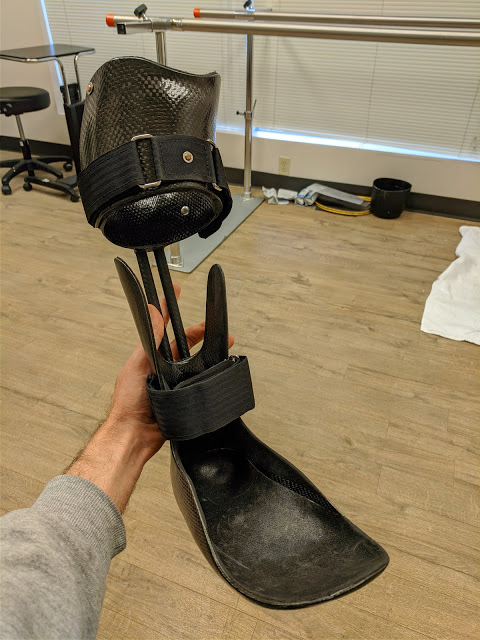
Here’s what an ExoSym looks like.

For casting, I sat in a chair at one end of a set of parallel bars. I got to hold and explore an ExoSym. It was way heavier than I thought it would be, big and bulky (probably for a grown man). I tried not to worry yet about getting used to wearing two of them.

On the floor at my feet were a container of water and a cast cutting saw. The “tickler” of my childhood. This nickname was supposed to make the noise and the blade moving toward my skin less scary. The vibrations from the saw “tickle,” get it? This thing terrified me as a kid, and I can remember crying in a panic when it was time to remove the casts for my AFOs, even though Ray (my orthotist) assured me that the saw would not cut me. 

Ryan, the prosthetist at Hanger, came in and did a few quick (seated) strength tests. It goes something like this: “Bring your knee up into my hand. Push hard. Harder. Okay, now don’t let me push your knees together…” He asked me to stand up on my toes. Which I can totally do when I’m hanging on to parallel bars. A few minutes after these tests, I could feel pain settle into my right piriformis/SI joint area. 

Then a woman came in with a laptop and asked me questions about pain and activities and what I wanted to be able to do. These are the same questions from the application, and she added to/revised my responses. I told her that I would like to be able to get back to where I was at about age twenty-five, before all the chronic pain started presenting itself. Also, I would like to have the confidence that I can get up from a fall by myself. (I’ve recently discovered that it is now VERY difficult to get up from the floor without something to pull up on, and that’s scary.)

The ExoSym program has been serving civilians since 2013, with about 4,000 patients so far. I asked how many applicants are not accepted. Somewhere around ten. Ten people who used wheelchairs most of the time and/or who didn’t have enough function to be able to really use the brace. And how many people try it out and then decide it’s not for them? I didn’t get an exact number, but sometimes a condition requires further surgery. Annika the Amputee, for example, tried the brace but was still in pain from the tumor in her foot.

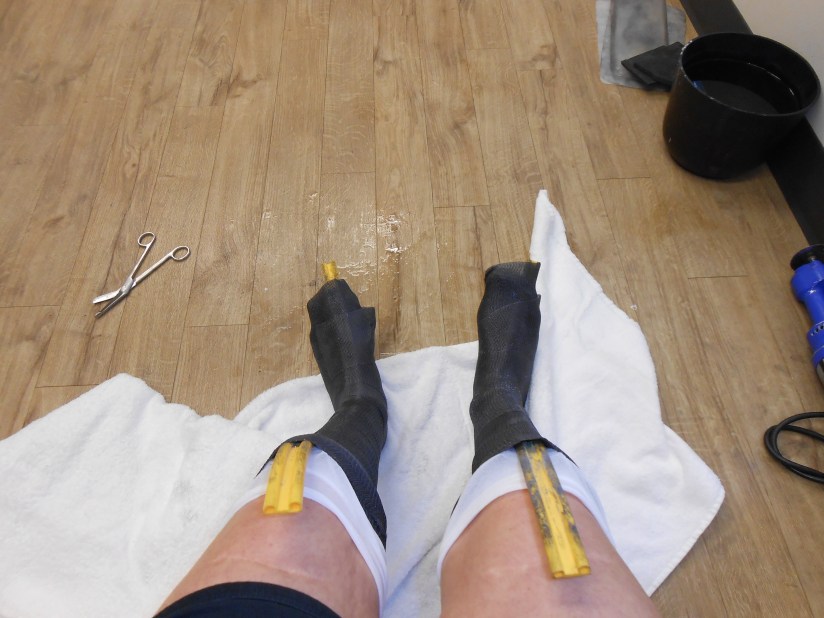
First, I had to put two nylon socks on each leg. Ryan was very quick with casting.

Getting ready for leg casting
Two layers of nylons socks. Ready for casting. Cast cutting saw–the tickler–is the blue thing on the right.

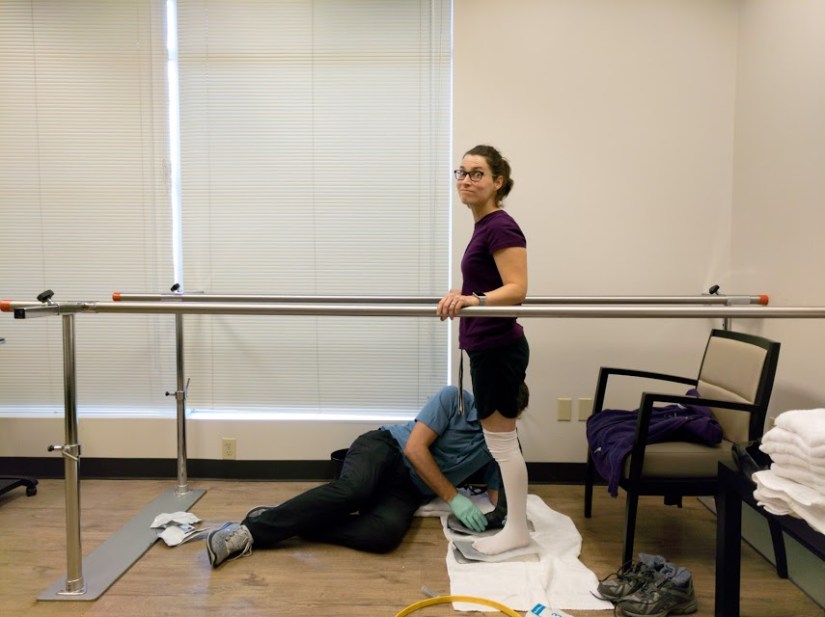
He did my right side first, while I was sitting, and then I stood up while he did the left side. This surprised me a lot, especially since he could tell when I looked up or down while he was working. If the position of my head makes a difference, isn’t one cast seated and one cast standing going to be very different? My legs certainly felt very different.

Getting casted for ExoSym devices
Thought I’d be sitting down after these adjustments, but I continued to stand for the second cast.
Being casted for ExoSym devices.
Casts are drying now.

Then it was time to cut them off. “Oh boy,” I said. “This was called the tickler when I was little.” 

“Trauma?” Ryan said sympathetically. “Now we have these thicker plastic strips, which are probably a lot different than what you had.” It’s true. Instead of small rubber (?) tubing, he used strips that were flat on one side, with a groove on the top, and quite rigid. He made quick work of getting the casts off, “unzipping” them with the strip when they were nearly cut through.

After I put my socks and shoes back on, Ryan took us on a tour of the back, where the braces are made. Everything from start to “finish” is onsite. There really is no end, because we can order replacement wedges and sleeves as necessary and Ryan will make adjustments over months or years if needed for any issues, like “changes in mass” (weight gain/loss). He made sure to give me his number and take mine so I can text him with questions and updates.

So the first day was fine. Afterward, we went to Kopachuk State Park and I tried not to stress too much about what was to come.

Kopachuk State Park

Tuesday, 26 November 2019. Hanger Clinic Day Two: Test Devices

The next day, we are put into the same casting room so I can change into shorts. Ryan asks about shoe size. And then we wait. Finally we’re led across the gym to the walking room. There seems to be only one patient in the gym. He has two devices, one with the knee joint. I want to watch his workout. The PT sets up obstacle courses, and there’s a rope hanging from a track on the ceiling to hold on to; I can hear the rope slide along the track, but I can’t see what he’s doing.

Ryan has fitted “hundreds” of CP patients with the ExoSym. He tells me I will feel weaker in the beginning. I will need to strengthen my core and my glutes, use muscles that I don’t engage with my current gait pattern. It will take two years for me to achieve full potential function. This comes as a slight shock because other ExoSymers–with congenital conditions–have been told one year. Two years of working really hard. Okay.

My two test devices.

He brings me a pair of new shoes and asks if we could lace them up. A full size bigger than my usual shoe, and extra wide. Then he leaves again. As I read on another blog: Ryan is busy. Seeing patients off who have completed their training, taking calls. He brings me a pair of sleeves to put over my knees. We put the braces on and he marks where to cut the excess off at the toes. Disappears to the adjustments room. I wonder if I have time to use the bathroom before he returns again. Just walking to the bathroom in the tight synthetic sleeves feels weird. Finally, he brings in heel wedges to put in the shoes, straps me into the braces, and finagles my feet into the shoes.

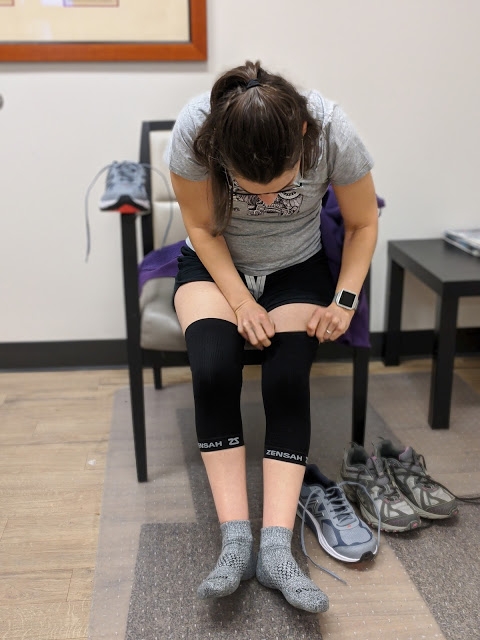
Putting on knee sleeves
Putting on the knee sleeves after lacing up some giant shoes.

I pull myself to standing using the parallel bars. I let Ryan know it feels like there’s more room around my left calf (the cast I was standing for) than my right. He checks it and says it looks good, but adds that my body is valid in perceiving that sensation, or some such diplomatic acknowledgment. Perhaps it doesn’t matter that much because the area around the calf will be open on the real devices.

I take a step. Two. Heavy. Bulky. Cumbersome. Stiff. Like casts. Or ski boots. Like trying to walk in flippin’ ski boots–with cerebral palsy. No magic. No amazing shift or change. I had hoped I would feel the “energy return.” But the test devices don’t have struts, so that part is not there yet. 

Very quickly, Ryan prompts me to take one hand off the bars, to try to glide the other hand. Hand gliding is not possible. He says he can see that I’m standing up straighter. Really? Isn’t that maybe because I’m holding on? He tells me to try walking heel-toe, use my core, take bigger strides. I clomp forward. I try. “Can you tell she’s straighter? Have you ever seen her walk heel-toe before?” he asks my husband. “Now this is only about thirty percent of what they can do,” he tells me. This doesn’t mean anything to me. I do not feel that they are doing anything but weighing me down. I feel, not just weaker, but more disabled, not less. I do not want seventy percent more of this

He gets me a pair of trekking poles. I stay between the parallel bars as he adjusts the poles and tells me to try them. It’s not that I’ve never thought about using poles before. I’ve always hesitated because–how much stability can they give me if I’m the one holding them? They seem to just complicate things. 

So I stand there in my mock braces, holding these poles, and I can’t move. “I don’t even know how to start,” I say. But somehow I do, I take steps toward the door. I have to turn around when the bars end. Turning is ridiculous. Ryan watches and says he has pointers, but he wants to see how my body responds, how my brain problem solves. He says I’m doing better than he thought I would. I don’t know whether to feel flattered or insulted. I ask him if he says that to everyone. He doesn’t.

Every time Ryan leaves the room, I try to explain to my husband what moving in these braces feels like. Everything is stiff and robotic, but also unsteady. “How does anyone learn to walk in these things?!” I wonder aloud. Let alone do anything else? 

I’ll probably need to use the poles for the first few months, Ryan tells me. How do they feel, he wants to know.

“Right now, it feels impossible to function,” I answer truthfully. Ryan might have been surprised at my bluntness (perceived negativity?). He tells me to take them off and see what it feels like without them.

It feels lighter, roomier, like I no longer have casts on my feet. It’s a relief. Am I shuffling and swaying again? Apparently. But I can’t tell because it’s the way I’ve always moved.

“You’re here for a reason,” Ryan says. “Because you want something different. I’m trying to give you a different way of moving. It’s going to take time.”

I know all of this, but I cannot see years into the future. How am I supposed to decide whether or not to move forward and get the real devices based on this? I will have five days of training upon “device delivery,” when I come back to the clinic. How much can my body learn in five days? Before they send me back home to my own physical therapist who’s never heard of the ExoSym?

I get myself back into the braces. Walk up and down, trying to move faster, take bigger strides, remember my core. Everything is loud and clunky. Very aware that my feet are not on the floor, but inside a layer of hard plastic, I do not feel grounded, literally. I take a moment to just stand, handsfree. I can lean into the braces, into the cuffs below my knees. They hold me up, and I do not start to bend toward the ground. I lean forward, side to side. I do not lose my balance. “I’m standing,” I acknowledge. “I can’t do this without them, right?” I wonder, continuing to lean and experiment. “But how do you move? How do you pick something up? Or get up from the ground?” I try taking steps without the poles, but my body isn’t strong enough. My thumbs/hands are already starting to hurt from how much I’m gripping the poles, depending on them. I make my way outside the parallel bars and my husband holds my hands, higher up than the poles. This feels better. He is strong and stable, so much better than a pair of wobbly sticks.

Walking in ExoSym test devices
I’m wearing my Kindness Elephant shirt designed by FootlessJo for some good vibes today.

Ryan encourages me to go out into the gym. I walk up and down a textured mat-pathway once or twice. “You should use a light touch with the poles,” he says. “Can you do a light touch?” I know I’m not supposed to be gripping them so hard. I cannot do a “light touch.” He can tell I’m trying. I am tired. My right heel is starting to hurt/burn. I feel done. 

I make my way back across the gym into the walking room. I’m proud of myself for going out there. No one else was there. But I had elected to stay in the walking room the first time Ryan asked if I wanted to go out into the gym. I know if I’m going to do this that I’ll be facing lots of uncomfortable moments.

Safely seated, I tell Ryan about the painful callus on the bottom of my left big toe. Yes, he could put padding there in the real devices. “It should slowly disappear over several months, but we want it to be comfortable until then.” A $20,000 fix for toe pain? Sign me up! But really. My toe becomes excruciating because I land on it foremost, with every step. When he says the callus should resolve itself, what that means is that I will be walking differently. My gait will be different. I cannot say how that will affect the rest of my body, but it will. So I have to do this. I have to find out.

Here is my favorite moment. I told him my right heel was feeling pain and pressure. I pointed out where it hurt. He felt it and then he felt inside the brace. “Oh, there’s a little bump here. I can smooth that out for you. Feel it.” Sure enough, there was a tiny, but significant, bump in the plastic that I had been standing and walking on for two hours. Triumph! A pain, a reason for the pain, and a solution to the pain. Do you know how rare that is? How satisfying? How reassuring?

Just an hour or two after we left the clinic, I felt a new soreness that I couldn’t remember feeling before. Same amount on both sides. I thought it might be the gluteus medius, the ones that I needed to strengthen. I looked it up, just to make sure. Yes, these muscles were sore, but not in pain. Just using the test devices for two hours had forced my body (without my conscious effort) to use the new, “correct” muscles. 

So here I am. Knowing that I have years of work ahead of me. No way of knowing the outcome. Right now, I feel more disabled in the things, yet I am supposed to believe that they will help me feel more able than ever before.

Goals before trip number two, when I will receive the real devices (in a few months):

-Learn to use trekking poles (with a “light touch”)

-Strengthen my core

So What SHOULD I Hope For?

My first trip to the Hanger Clinic is coming soon. I will be casted on day one, and try out mock-ups, or “test devices” on day two. My last post included a list of actions or activities I used to be able to do. Now, let’s take a quick body scan and assess some chronic pain, shall we? Listening to someone’s aches and pains is not interesting. I know that. This catalogue is so I have my own “before.”

Feet: my left big toe started to send me sharp pain somewhere around…two?…years ago. About a year ago, I realized I was unable to step on it walking barefoot on my laminate flooring. This year, I went to my first podiatrist. He told me to wear stiff-soled shoes and thick, soft insoles. And don’t walk barefoot. I do not walk heel-toe; rather, my whole foot comes down at once, mostly on the big toe. So, I’m grinding the bottom of my toe into the ground with every step. After 38 years, I guess it’s had enough.

Ankles: these are mostly fine, unless I walk too much at once. Hooray!

Knees: One or the other of these aches often. The right started clicking and aching in June 2014, and the left followed in July. A doctor told me to ice them, twenty minutes on, twenty minutes off. What, forever? When I got referred to PT, I asked the therapist if some kind of knee support would help. She had me stand up and put her hands firmly around my knee. “Does that help?” she asked. I almost laughed. You mean if a knee support were going to help me, the pain would lessen right now? Just from that?

Hips and legs: Hips are always very tight. Sometimes I have strong, almost burning, pain in my right IT band. Other times an inner quad might hurt. Often, my right SI joint will give me sharp pain. It changes day to day, sometimes hour to hour. Sometimes I know what set it off; usually I don’t. I know I should avoid twisting while standing. Trying to do anything while bent over, wiping up a spill on the floor for example, is a really bad idea unless I take the strain off my hips and legs by holding onto something.

Back: I do not think of myself as having back pain. But sometimes at the close of a long walk, there is a pain and stiffness in my lower back that makes it hard to breathe. I stagger to a seated position and bend over my lap. A few cracks and a deep breath and I can straighten up again. I realized the other day that I “don’t have back pain” because I can make it go away. Apparently, I only count chronic pain as real pain.

Trapezius: If you’ve never looked at an image of the trapezius, check it out. It’s a giant muscle from the base of the skull, out to the shoulders, tapering to the middle spine. Since 2016, my neck and shoulders have been painfully tight. I know I have terrible posture. Telling me to sit up straight isn’t helpful. It takes a tremendous amount of energy to maintain good posture. Certainly while walking, it’s nearly impossible for me. Is PT helping? Can’t say for sure.

Jaw and ear: Yes, my jaw and ear hurt sometimes, just the right ones. It’s all connected. I think the constant neck tension is pulling my jaw and ear out of alignment. The years of extra strain on my stronger right side as it compensates for the left is taking its toll. If you’ve never had sharp, intense pain in your ear, be grateful. 

This is the state of things. Pain from head to toe. Perhaps not all directly related to cerebral palsy, but definitely indirectly affected by it. I have tried many modalities to address the issues.

The ExoSym is life-changing. All the people in the videos say so. But what about all the people who aren’t in videos? How many try out the test device and decide not to move forward? Maybe it won’t be life-changing for me. Maybe I’ll still have chronic pain and very limited balance. It won’t do a thing for my muscle spasticity. It won’t make cerebral palsy disappear. The people who put on the test device and are “pain free”  right then and there are usually people who were able-bodied before having some kind of foot or ankle injury. 

My pain comes from a lifetime of atypical body mechanics. It’s going to be a different kind of experience for me. How can an hour or two in the test devices show me how they might affect my body long-term? I don’t expect any of my chronic pain to be immediately relieved. I’ve never felt an immediate improvement in anything physical in my life. Never have I been able to report back to a doctor or therapist, “Yes, _______ definitely helps.” 

So what will the ExoSym do for me? What is a realistic hope? I hope that I feel lighter, that I can feel the “energy return” that the brace is designed to provide.

I hope that I feel something. That I can tell the devices are doing something.

What I Used to Do

I used to

  • Do pull-ups. Many. When I was eight.
  • Do that bridge thing where you lie on your back with your knees bent, hands by your ears, and push up off the floor
  • Jump rope. Kind of.
  • Touch my toes (sitting with legs out straight)
  • Play “tennis” at summer camp / be a batter during PE baseball
  • Pick up nickels from the sidewalk
  • Sit cross-legged on the floor
  • Step up curbs. Even down!
  • Walk up stairs without a railing. Sometimes.
  • Walk down a stair or two with my hand hovering over the railing, just to see if I could.
  • Handcycle for miles
  • Walk without pain
  • Travel solo, knowing that I would be okay
  • Live without constant neck tension and pain
  • A little hiking, with help
  • Climb ladders
  • Jump off a diving board
  • Look over my shoulders
  • Walk comfortably in bare feet, without my left big toe trying to kill me
  • Know that I could get up off the ground if I fell
  • Carry groceries for blocks

Some changes happen so slowly we don’t even notice them. Now, I need to walk out of my way to get to a curb cut, because I can’t trust my body to take me safely up a curb (and certainly not down!). Now I walk on by nickels and dimes on the sidewalk; might just tip right over if I tried to pick them up.

I know that most every adult can look back on themselves as children and ponder their lost agility. I don’t expect that I should be able to do pull-ups the way I did when I was eight. I would like to feel confident that I can step over an obstacle in my path or pick up something off the floor. Full disclosure, I can sometimes pick stuff up without needing to hold on to something. If I’m in my own home and I give my back enough time to slo-o-o-wly bend forward, I can do it. But if I’m walking to work and someone drops something, I don’t pick it up for them. Not with my backpack on. Not when it needs to be quick. Rather than moving them out of harm’s way, I simply apologize to the worms and snails in the middle of the path, who will soon be flattened by oblivious cyclists’ tires.

It’s difficult for me to acknowledge that some of these changes have been over, not decades, but only a handful of years. I’m not doing enough, right? I’m not being consistent enough with my physical therapy, nor do I push myself enough to stay active. But sitting on the floor, on the rug in the living room, or in my bedroom. In the past, that’s where I liked to be. Didn’t I do it every day? When did I stop?

Applying for the ExoSym

I first heard about the ExoSym device from CerebralPalsyStrong, a website that started out as Teen Cerebral Palsy, run by a young woman with hemiplegia, Katy Fetters. The video of her experience and the links she shared convinced me to contact the Hanger Clinic in September 2019. There are Hanger Clinics all over the place, but the only one that does the ExoSym is in Gig Harbor, Washington. That’s where the guy who invented the device works, and he reviews every case himself.

Prosthetist Ryan Blanck designed the ExoSym in 2009. His goals were to reduce pain and restore mobility to active-duty and retired service members with limb salvage conditions as a way to avoid amputation. The device provides increased dynamics and energy return. In 2013, Ryan joined Hanger Clinic to bring the ExoSym to civilians with severe lower-extremity conditions or injuries (info from Hanger Clinic).

I emailed them expressing interest, and they responded with the application, instructions, and a long list of articles and video links about others’ experiences. Suddenly, I’m learning about a woman from New Zealand who was born with clubfeet, now walking miles, and a man with spina bifida now going hiking. And they all say the same thing: the ExoSym is life changing.

I got started on the paperwork, which was a series of PDFs I needed to print, fill out, scan, and email back. One document was a four-page questionnaire about my abilities, similar to a PT intake form where I rated my ability to perform various tasks from “extreme difficulty” to “no difficulty.” Rolling over in bed? Moderate difficulty. Squatting? Unable to perform. Sitting for one hour? That I can do. After another twenty questions about strength and range of motion (limited and limited), it was time to record a video of the way I walk. I’ve included it below so you can see it in all its glory.

Let me say this. I know that I look different than those with typical gait. Obviously. But to me, I’m just walking. I can feel that I’ve got a significant side-to-side sway if I pay attention. Do I make myself feel a bit seasick if I walk around after eating too much? Yes, yes I do. But do I really know what it looks like? No. I think many ambulatory cerebral palsians out there will relate when I say I’ve been startled by my reflection when I walk past a store window. So there’s nothing quite like walking for the camera and then watching it back. I mean, geez! Do you see that right hand? So helpfully flexing at the wrist while the fingers point? This is what I look like. It looks rather laborious, doesn’t it? It is.

I sent all my questionnaires, and my insurance info, and my photos and video. And I waited. What would Ryan say? Could the Exosym help me? Would I be a good match? Would I have one on just my left leg, the more affected side? Or both? Or would he say no, it’s not for me?

Finally, I hear back. I’m a good candidate! Excitement floods through me. But my insurance doesn’t cover it. Here is what I understand from the explanation given to me: the ExoSym has been coded by the insurance company as a regular AFO, which are much less expensive to make than the ExoSym device. If Hanger Clinic were to accept my insurance, then they, the Clinic, would be on the hook for most of the cost. Which they cannot afford to do. The woman from Hanger assured me that I could come to Washington, get casted and try the test devices, just to see if it’s worth it to move forward, at no cost. Then I could take time to save or raise money, use their in-house payment plan, and make my first payment only upon receiving the real devices. 

Okay, don’t panic. Maybe I could get a different insurance? We were just in the enrollment window for me to be added to my husband’s insurance for next year. When I email Hanger and ask whether his insurance would cover it, I receive a form reply in bold, all caps, and underlined: 

The ExoSym® program is a PRIVATE PAY PROGRAM; the current description and associated reimbursement from insurance companies does not correctly describe nor compensate for the Program. As such, we are no longer able to provide the ExoSym® Program through any private or commercial insurances with the exception of Worker’s Comp, Standard Medicare (not replacement plans), Cigna, United Healthcare Commercial Plans, our local Premera (WA/AK) only.  

Now I feel that I have been yelled at. I wonder why she hadn’t just explained this to me in the first place. I understand that they don’t want to scare potential patients away. But I also think that people need to be prepared and not have their hopes for, literally, a better (quality of) life dashed because of money. If they know the facts going in, they can start planning, saving, crowdfunding.

I know you’re wondering. How much is it? I will need two devices, and mine will come with the addition of knee joints. As of September 2019, each device (no knee) is $9,000. That’s $18,000, plus $1,704 for two knees. A grand total of $21,408 for the devices and several days of training at the clinic. Not to mention travel and lodging. No big deal for some. A very big deal for most. 

With the in-house payment plan and some very generous family members, I will be able to afford my ExoSyms, and I am so grateful.