Two Years with ExoSyms and Cerebral Palsy

On this final day of June, I want to acknowledge that I’ve had my ExoSyms for two years. Well, I’ve owned them for two years this month, but as we know, I’ve worn them for much, much less time than that.

When I was first fitted for and trained to use my ExoSyms, I was told to expect to get the full benefit from them after two years of dedicated work with them. In June 2020, I was unable to imagine what two years down the road would look and feel like. I began documenting “Day 15,” “Day 50,” “Day 100” and taking weekly videos of my progress. Eventually, I stopped counting the days.

So here’s to us. Here’s to all of us who try something new. Who invest hope and time, and perhaps many thousands of dollars into something that might make our lives better. Who have family that supports us, driving us to appointments and holding our hands. 

Here’s to us who have to acknowledge and adjust when our new adventure doesn’t go the way we thought and hoped it would. When injuries and illnesses interrupt and disrupt our vision of what our life would be.

Here’s to us. We are many.

Trees and trees and EMGs

Last year, I had scheduled additional training days at the Hanger Clinic in Gig Harbor, Washington. Then I injured my groin and started down the road of MRIs and new doctors and injections, not even wearing my ExoSyms. We did not go back to Gig Harbor in 2021, nor did we visit the Olympic Peninsula as we had planned. 

Since we were already going to be in the Pacific Northwest this year, we decided we’d finally visit the Olympic National Forest and Park (hard to tell where one stops and the other starts).

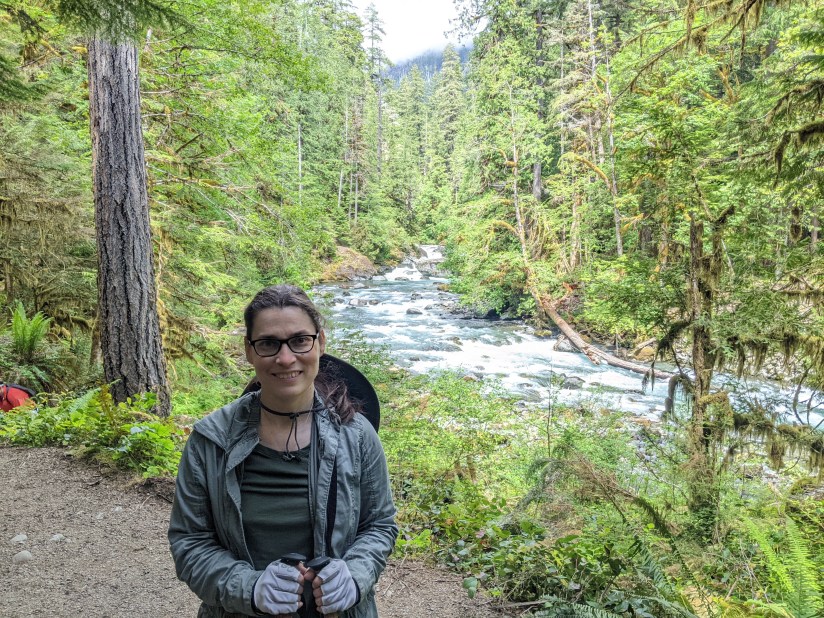
We spent two days in Union and two days in Quinault, with a stop at an “easy” trail in the Hoh Rainforest. It was an easy trail, but parts were challenging for me. If there’s a tricky (rooty and rocky) incline, I start to get very nervous about having to face it coming down. (Usually, if the trail is a loop, I do not complete the full loop). With my back more painful and overall just feeling in decline, I did not feel excitement at the challenge, nor triumph at completing difficult sections of trail that I did that first time I hiked with the triple support of good shoes/lumbar brace/trekking poles. It’s hard to enjoy the scenery when you’re concentrating on placing poles and feet safely. Additionally, some trails we did were popular, with lots of people squeezing by each other. I just felt tired and glad to be done. I’m sure I wasn’t the most enjoyable companion for the physically challenging parts of our adventure. Once, I waited on the trail while my husband went farther. Another time, I read in the car after we did an easy trail and my husband chose another trail to explore for a bit. Reading in the car while my loved one was free to go where he wanted at the pace he wanted felt really nice to me, and familiar. Almost comforting.

Here are a few rather spectacular nature photos from various locations. I’m not madly in love with moss, and there was sure a lot of it.

Nature Trail, Quinault
Hall of Mosses, Hoh Rainforest
Look at that blue water. Seriously, it looks like I’ve been green screened. At Staircase.
These pink foxgloves were everywhere
“Big Cedar,” Kalaloch
Douglas fir

I discovered that many hiking trails in a temperate rainforest are graveled. Sometimes the gravel is packed into the mud until it’s barely visible. Sometimes it’s on top of the mud. One trail even had raised beds of gravel with gaps in between. Gravel is often loose and slippery, and not the best medium for poles. Crunchy, not quiet. I hadn’t known what I would think of the rainforest. While I learned that it’s often breathtakingly beautiful and I very much enjoyed the visit, in the end I concluded that it does not make my heart sing and fill my lungs and my soul the way the redwood forests do.

One of the things I most love about being among the trees is that I am reminded that humans have not yet destroyed everything. On this adventure, I saw trees that were many hundreds of years old, even a Sitka spruce estimated to be 1,000 years old. Douglas fir so gigantic they bore no resemblance to the trees we bring inside our homes in December. Mountains and mountains full of trees and trees and trees. For that, I am grateful.

As our road trip drew to a close, my EMG appointment loomed. I had done well not worrying about it. Many weeks before, I had asked in the cerebral palsy Facebook group about people’s experiences. They ranged from “uncomfortable” to “crying the whole time.” Rationally, I understood that I would make it through it regardless, and that I had no way of knowing how I was going to respond, so there was no point in being anxious about it.

I only started to feel a tight, twisty stomach this morning as I was getting ready to leave. I think that’s pretty good. At the appointment, my husband “worked from home” in the waiting room, and I went in alone.

The doctor, Dr. J, was there with her resident, Dr. H. The resident looked like a very young woman to me, and I realized I’m now old enough to think and not say things like, “Are you sure you’re old enough to be a doctor?” They asked me to explain why I was there, and then the resident did the strength exam. Well, first they thought they were doing arms today, and I explained that the leg one was ordered first and that the arm one was an attempted add-on. Dr. J had to scroll through and find the order for my legs, and I briefly wondered whether there was going to be a problem. No, it was fine–they would do legs today, but I would have to schedule my arm appointment for another time.

Dr. H did the whole procedure, with Dr. J overseeing/coaching and sitting at the monitor. After the strength testing, Dr. H pulled a giant safety pin out of a bag of safety pins and then proceeded to prick me with it in various places, ever so slightly, to ascertain whether I had normal sensation in my legs I think. I could really barely feel it–that’s how little the end of the pin touched my skin. Then it went into the sharps container. What a waste of a brand new safety pin.

After that, the nerve conduction study began, with my right leg. For this, electrodes were stuck around my ankle/foot area. Then they administered little shocks, starting low and gaining in intensity. Dr. J told me they would become strong enough that my foot would jump. At any point I could say stop, and they would stop. I mean, that sounds pretty daunting.

It was mostly okay. At the beginning, when the shock was becoming uncomfortable, I asked, “Are we still at a low one?” And Dr. J answered, “Yes,” quite emphatically. Geez, how strong was it going to get? I really appreciated when they let me know the shock was coming, which was only on a few of them. When they moved up to my calf, that was one painful. Then Dr. J said, “We’re going to do this nine times.” Ack. And then she counted them for me. The unsettling thing was that even when they were over, the sensation lingered a little.

Next it was time for the “needle test.” The Mayo Clinic tells us, “Electromyography (EMG) is a diagnostic procedure to assess the health of muscles and the nerve cells that control them (motor neurons). EMG results can reveal nerve dysfunction, muscle dysfunction or problems with nerve-to-muscle signal transmission. During a needle EMG, a needle electrode inserted directly into a muscle records the electrical activity in that muscle.”

They would first measure the muscle activity at rest and then might ask me to do something. I asked what if I couldn’t do what they needed me to. Dr. J assured me that they’d get the information they needed. Though she hadn’t done very many of these on patients with CP, she’d done some. And after the nerve conduction study, she had a very good understanding of my spasticity and the way I would probably react to stimuli. She said something along the lines of my nerves were pretty reactive so it’s possible that I’m more sensitive to pain. And then, “Again, you’re in charge and can tell us to stop at any time. We don’t want this to be a horrible experience for you.” Yikes, right?

Thankfully, I generally have no problem with needles. And these were very small and not very painful going in. Though I did notice they were more painful the further along in the process we got, and Dr. J did say later–explaining to Dr. H why they weren’t going to do anything more–”People become more sensitized to the needle, and then it’s more painful and she’ll continue to have a spastic response.”

They started with the right leg because that’s the more symptomatic side. I lay on my back on the table. Being prone and not being able to see what was going on (but looking away when I needed to) is not a feeling I like. Too vulnerable and too much anticipation/fear of the unknown. Dr. H was great at consistently warning/preparing me: “Poke on three. One, two, three, poke.” And the needle went in as she said poke, but she said it like it was routine and no big deal, not like she was grimacing for me. Again they started down around the ankle, and I had to try to stay relaxed of course, relax my foot. I was able to do this in the beginning–go me. Maybe meditation and breathing is helping? Or maybe the gabapentin? Oh, also, I was really glad I didn’t need to undress. I wore comfortable shorts and a t-shirt and just had to remove shoes, socks, and lumbar brace.

Dr. J continually talked to Dr. H (as she was placing and then moving the needle) and looked at the screen to make sure they were getting the information they needed. She gave me lots of “Good job” comments (Sometimes, “Deep breath.”) and said, “Beautiful!” a lot when a good wavy line must have shown up on screen. Mostly it was uncomfortable and occasionally painful. Like, Uncomfortable. Pain now! That hurts! and then it was over, but still linger-y. I kept wondering if the needle was out yet. It was. 

I had to turn onto my left side a couple times. Everything that was done to the leg stayed below the knee. Then I spent quite a bit of time on my stomach with pillows under my hips and they did several placements on the low back area. Dr. J was advising Dr. H to find a particular spot and then go four finger widths, and I’m like, “People’s fingers are different widths!” But apparently, that’s still what they say and the student-doctor is still supposed to find the correct placement. Dr. H did have to take out a needle and place it in a new spot a few times throughout the whole proess. Dr. J: “That’s one finger width. It should be two.” One time she said, “Leave the needle in and take a step back.” I don’t know if she meant for Dr. H to reassess or literally step back and let Dr. J intervene. (I was lying with my face toward the wall.) I think she did step in once or twice. Dr. J did also come over and show her how to press on a muscle and then do something with the needle. 

One thing I really had trouble with was flexing my ankle (bringing toes toward me) but relaxing my foot? I think? I was asked to curl the toes and still flex the ankle. Nope. The only way to bring my foot toward me is to use my toes. I’m not sure whether they had any real trouble getting what they needed. They were definitely staying upbeat and coming up with alternative ways easily. They continued to make me feel like I was handling things well.

Then they did something on my left side and I was surprised. I had been thinking that they were going to eventually start the whole process again on the left leg, starting with the shocks. Dr. J didn’t feel that was necessary because most of my symptoms are on the right. At the end, they did something really painful that made everything spasm and then I couldn’t relax again, deep breathing and all. Dr. J said they’d gotten everything. But I don’t know if they would have continued with other locations, or if my spastic response had put an end to their data gathering.

I was surprised and relieved to be done, expecting as I was to go through it all again on the left side.

Dr. J told me that my nerves are “normal,” and everything looked good, no evidence of a pinched nerve. So that’s good news. She thinks that my issue is my joints (the hip impingement), my biomechanics (CP). Sometimes physical therapy doesn’t work. Sometimes injections don’t work.

I’d briefly gone over the history/treatment of the labral tear and impingement in the beginning, and now I told her, “Well, I’d had an orthopedic surgeon who was willing to do arthroscopic surgery, but had never done it on someone with CP and referred me to someone at UCD who could do both arthroscopic and open in case I needed open. Then my referral was denied.” Dr. J mentioned a different UCD doctor who did hip surgeries on complex patients. Now that I’m a UCD patient, maybe I’ll get that guy. 

Dr. H showed me out. I wanted to tell her, “Thank you for becoming a doctor. We need young women doctors like you. Good job learning this complicated and rather scary procedure and keeping yourself together when you made mistakes.” I hope she did. I hope she didn’t go and ruminate like I would have. I did not say those things, though. In the end, I was so relieved–I did it! It’s over!–that all I did was go find my husband and go home.

Now I’m supposed to have a followup with my sports medicine doctor, the one who ordered the test when the second steroid injection did nothing. He’ll say everything looks good. We’re back to looking at hip surgery, I think. Exactly where we were nine months ago. Ah ha ha ha. Wah.

New PT, new doctor, old tests, new pain, new results?

On May 12th, I went to my new physical therapy office. I had decided to keep the referral even though the injections hadn’t done anything for my chronic pain. 

My new physical therapist is a quiet woman with an Eastern European accent who calls everyone sweetheart. Very different from anyone I’ve had before. She’s also a little blunt, which is a little funny. She said she’s worked with several people with CP almost exactly like mine and they all improved. “You need to stretch. You need to get stronger.” To the student PT, “Look, she has no range of motion. This is neutral and it’s tight.” On and on. Explaining me to myself. I mean, I know there’s a possibility of improvement, and I know there comes a point when there’s not. At least she demonstrated a sound grasp of my mechanics. 

What I really liked was at the end. They’re very into modalities at this place. I got to have e-stim (TENS unit) put on my low back and right glute, with a giant ice pack over the whole area, a pillow between my knees, lights off and the door closed, and a little bell right next to me in case I needed anything. I assumed I was in a room rather than out in the main area (here they didn’t even have curtains between the tables) because I was a new patient, and I was grateful. I don’t think it helped at all, but it was nice just the same.

The therapist had given me similar if not identical exercises and stretches as everyone else, no surprise there. She tried to give me ones that I could do on the bed, so I wouldn’t have to get up and down from the floor, which I appreciated. Then it’s that whole, “Do these several times throughout the day. It’s just a part of your life now.” Or break up one set of ten throughout the day until you’re stronger. I have absolutely no reason not to incorporate these things into my life, and yet I don’t successfully do it. Still, I do try some days. Against my better judgment, a day or two after that appointment, I got on my hands and knees on my bed and tried to lift a leg out behind me. I knew this was too hard, even though I had done it on the table under the PT’s supervision. I knew the bed wasn’t an appropriate surface to do something that was on the edge of my ability. Even though I tried to keep my core tight, my back bowed and protested sharply. And as seems to be the way with my body these days, I acquired an additional back injury that hasn’t healed a month later. It’s really made functioning so much more painful and disheartening. So there’s that. 

Immediately following that first PT appointment, I had the allergist appointment. I brought a typed list of my throat history and all the mold testing data. I explained that I was looking for some confirmation of mold issues before we tore our house apart. I knew there wasn’t “a mold test.” I brought up my tTG numbers and the possibility of additional autoimmune diseases. I had even found one that fit so many of my symptoms–including a sore throat. He chuckled (nicely) and said no, I don’t have that.  “People with that are really sick.” But he ordered the test for it anyway. I don’t have it. He also ordered a test to see if I’m allergic to mold. It was a standard allergy panel that included five common molds from my local area (none of which were the molds in my house). I am not allergic to cat dander or pollen or any of the dozen things on that panel. But he can do skin tests anyway, if I want. I do not. He said I should get the mold in my house cleaned up anyway, because mold isn’t good for people.

At my second PT appointment two weeks later, I told her about my back and we modified some things. Then she told her student/assistant to get the cupping ready. I wasn’t super excited about that, because I’d had it done a couple times when I had acupuncture and I do not enjoy it. However, they did a very mild version, where they lubricate the cup and move it over the skin–no leaving it there to create baseball-sized marks. I also got to have the e-stim and ice pack in a dark room again. Three modalities in one appointment–ooo, nice. Did they help with the pain? No. Whatever else we did, I think I felt a little looser at the front of my hips, which is always nice and doesn’t last long, no matter how much I try to maintain it.

June 9th, I finally, finally had the appointment with my new primary care doctor–the appointment I made back in March just so I could get into the UC Davis system for my sports medicine referral. I was looking forward to a new doctor, new perspective, someone who might look over everything again and put the pieces together in a new way. Plus, she’s certified in family medicine and psychiatry, and I’m really appreciative of that combo. I was hoping I’d get a referral to rheumatology out of it. 

My new doctor had a resident with her, who took over all the typing/computer stuff, so my doctor was actually looking at me and listening to me rather than typing, and I really like that. I had typed up (on a single sheet) my top five issues and their symptoms, plus additional symptoms that may or may not shed light on anything. Yes, I’m someone with five major things, and yet I am not a hypochondriac. I put cerebral palsy as one, “mold issues” as another, etc. The thing about being a patient, though, and not a doctor, is that I don’t know for certain what the relevant information is for each column, or what I’m leaving out.

After talking to me and looking over the sheet, the doctor asked what I wanted to focus on, and I said my sore throat and burning forearms, because those are the ones that don’t make sense. Because my forearms burn and at the beginning I had lost grip strength and I have constant neck pain, she thinks it may be a nerve issue. Get this, she recommends I get the nerve conduction study/EMG on both arms! Ack. And they proceeded to try to add it to the one for my legs coming up at the end of the month. Let’s just torture all the limbs, shall we? I was a little stunned that she already recommended this kind of procedure. (In my mind, I’m connecting it to mold because it started literally when we began sheltering in place. But obviously, if you don’t go with mold, there’s a different cause.) And I realized, after the initial appointment for my arms with my prior primary care doctor, and the PT that helped with grip strength but didn’t stop the burning, I haven’t followed up. So maybe I have a pinched nerve in my neck.
We discussed my chronic pain(s), and everything I’ve tried that hasn’t worked. She said, “I can think of five medications right now that might help you. So let’s start with the one that has the potential to do the most good for the most issues.” So now I’m taking gabapentin. I was offered this once before, years ago, and decided not to take it. This doctor talked me through it though: “We start you on the lowest dose and if you tolerate it well, gradually increase it. If you have side effects, you’ll stop taking it and the side effects will stop. It’s a relatively low-risk thing to try.” Sounds reasonable. Ironically, the most common side effects are tiredness and feeling unstable/dizzy. Great, because it’s not as if I’m not already exhausted and unstable.

We also talked about my throat, all the treatment I’ve been through, the tTG numbers. They looked at the pictures I brought of my upper endoscopy.  I conveyed my frustration over the two ENTs treating me for two very common conditions (reflux and general inflammation) and then throwing up their hands. She wants to send me to gastroenterology. I only saw a GI doctor for the endoscopy and the follow up on video. So being sent to a GI sounds fine. But I was disappointed that she didn’t feel rheumatology was warranted.

She did notice that I put positive ANA under the autoimmune column on my sheet and asked what other tests that integrative medicine doctor had ordered. I didn’t remember, but directed them to June 2018 when I had loads of testing and was diagnosed with celiac. 

I have looked over these tests many times over the years, and googled each flagged result. I remember mentioning CREST to the GI doctor when we were about to do the upper endoscopy in October 2020. “CREST? You have CREST? You should see a rheumatologist,” he said. “Oh,” I said. “Well, I have Raynaud’s.” I didn’t know if I really had CREST, but I remembered that the R was for Raynaud’s and that I have that (we assume). 

My new doctor and her resident scrolled through my labs from 2018 and talked to each other, and I heard my doctor say, “Oh! You can go to rheumatology.” That integrative medicine doctor had ordered the tests in 2018 that my new doctor would have ordered before confirming the need for a rheumatologist. “You have a high centromere antibody. Has anyone talked to you about that?”

The answer is no. When I got home, I read back through the notes on the test results from the integrative doctor in 2018. I was a new patient, so she’d ordered a full work up, and there were lots of results to go through. She never said anything about that one. I probably figured since I had the R in CREST and that Raynaud’s is not a big deal, that there wasn’t anything that needed to be done, and I never asked anyone about it directly. Though clearly I’d looked it up at some point, and told the GI doctor I had CREST. Here’s what it says right on the test result from Sutter Hospital:    

Centromere antibody is virtually diagnostic for the scleroderma variant known 

as CREST (calcinosis, Raynaud’s phenomenon, esophageal dysmotility, 

sclerodactyly, and telangiectasia).

This doctor asked if I had any skin concerns and studied my hands. No doctor has ever inspected my hands that way before. Ooh, she’s good, I thought. Really examining the patient and looking for signs, rather than just sitting at the computer. After I came home and looked up CREST again, I realized she was looking for symptoms of sclerosis. Notice that the E in CREST has to do with the esophagus. So far, I haven’t had difficulty swallowing, and nothing mentions chronic sore throat, so we’ll see if there’s anything there. Also, apparently now it’s “formerly CREST” and is officially called “limited systemic sclerosis.” It’s rare and doesn’t sound great because it can mess with your organs and all, so… 

Since seeing that integrative medicine doctor in 2018, I’ve seen my PCP, two ENTs, a GI doctor, a functional medicine MD, and an allergist. Seven doctors. It seems as though the original doctor who ordered the test dropped the ball, and no one picked it up. I don’t know if or how things would have been different if I’d gotten a rheumatologist referral four years ago. No use in thinking about that.   

As I was writing this, I received a notification that my rheumatologist referral had been processed and I could call and make an appointment. So I did. There’s one available tomorrow at 11am. Or in September. So I took the one for tomorrow.

Now it’s tomorrow, and it’s 10pm. We left the house at 10:15am to arrive at 10:45 for our 11am appointment. I filled out the pages of new-patient forms (they were not looked at). My doctor didn’t arrive until almost noon. He gave me an elbow bump and apologized multiple times for the wait. He was with us for about an hour and it felt very thorough. Went through all the symptoms and pains, even ones that don’t seem related to each other. (This rheumatologist is also an orthopedic surgeon!)

We talked a lot about my burning forearms and burning toes. He looked at my toes. He looked at my capillary nail folds on my hands. A dot of clear soap at the base of each nail, a light, and a little magnifying glass. Fun. This was to check for sclerosis. He looked at my scalp and at my throat. He looked through my previous labs. 

He came to a few conclusions: He doesn’t think I have Raynaud’s because there’s no color change. The burning toes and the forearms seem like neuropathy. Even with the positive ANA and the centromere antibody thing, I have no signs of systemic sclerosis. Well, I have two mild ones, but no skin changes. At this time, he sees no active autoimmune disease. I do have a possibility of developing lupus or sclerosis, so I will see him every six months for a bit.  He doesn’t know why I have a sore throat. And he doesn’t know why my tTG has gone way back up. He even said something like, “Well, this probably wasn’t a very satisfying visit. But it’s good to know you don’t have another autoimmune disease.”

So there we are. He ordered a few labs, mostly because I’m new and don’t have any labs in UCD’s system. And he referred me to a neurologist. That’s right, I got another referral. Maybe the next one will be able to help me. 

I did my labs in the same building. I had to do a urinalysis, and I have to say–I did my best one yet. It’s difficult to do a clean catch when you’ve got to hold yourself up in a kinda squat with one hand and manage the cup properly with the other. I didn’t even get any pee on the outside of the cup! Go me.

I’m not super hopeful about the new referral. But I’ve never been to a neurologist (well, at least not that I remember), so it should be an interesting experience.

It does feel like referral after referral, getting passed around, no one knowing how to help me. Such is life with chronic issues. I’ll keep trying to calm my central nervous system and try not to think about the EMG coming up at the end of the month.
