
April has been so busy and so much has not yet been documented. This blog comes to you in several parts. First, let’s back up.
ExoSym Costs
My ExoSyms were paid off in February. For two Exos with two knee sections, the grand total was $21,408.00 USD. All the patient’s responsibility (no insurance), we were told. We paid half up front ($10,704). This half was for one Exo and one knee section, two separate accounts (though I didn’t realize that at the time).
At the clinic, when we handed over the first half, we (read: my dad) asked if the clinic would bill insurance for the knee sections, just to see. They did, and our insurance did cover those. So the portion of our half-up-front payment that was meant for one knee section was applied to the second Exo.
We opted for the nine-month “in-house payment plan” to pay the rest in installments. There is nothing official about the in-house payment plan, however, so I still received a general Hanger Clinic bill for the remaining amount with no mention of installments. The bill itself was very confusing to me, as it was only for the two Exos ($18,000), and stated that we’d paid $9,000, with no explanation regarding the knee sections (because of the different accounts, see?). Later, I tried to match up my insurance statement with my Hanger bill and make various seemingly random figures have meaning. The bottom line is, rather than paying another $10,704 over nine months, I paid $7,842. And by “I paid,” I mean that my parents then insisted on reimbursing me. Thank you, parents.
I am vaccinated!
As someone who works in education, I received my first dose of the COVID-19 vaccine on February 19th. My second was March 19th. I had the Moderna, and did not have any reaction other than a very sore arm. While I waited for the dreaded chills, etc. that did not come, I began to wonder whether my immune system is terrible or whether the vaccine was faulty. It turns out that a large portion of the population doesn’t have a strong reaction and everything is most likely fine.
ExoSym Practice
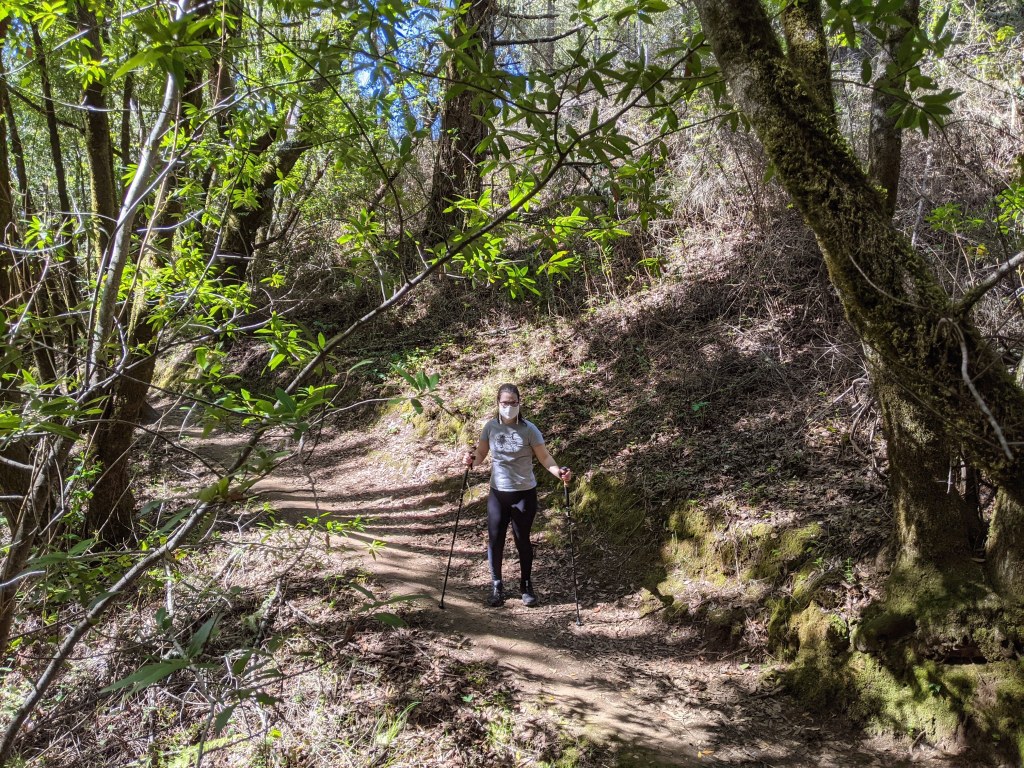
I have put on my Exosyms and completed a short practice session outside with back brace and poles every day since March 18th. That’s 44 consecutive days counting today. I am both proud of that and surprised by it. Some days feel good, and some days are harder. Usually, I need to recover from making it from my front door out to the sidewalk. That sounds silly, but there’s a section of incline in our path, and inclines are really hard with no ankle flexion. Some days, I can reach the sidewalk and keep walking. Do my three up-and-backs. I like to stop in between though, check my posture (using my shadow since I don’t have a mirror), do a moment of mountain pose, practice standing without weight on my poles. Some days it’s a chore, and some days it’s an exercise in curiosity. Can I feel my glutes today? Is my pelvis under me? Am I able to speed up? Reduce the strain on my forearms? Does it feel better if I try it this way or that?
One morning my usual stretch of sidewalk was not available, so I went out to the bike path instead. In the early days, I walked this bike path toward my PT office, with the goal of eventually being able to make it all the way there and then do PT in the Exos. (Ha!) It has been many months since I’ve worn Exos on this path. The bumpy blacktop undulates up and over tree roots. Navigating such an uneven surface creates a “wobbly colt” response in me. I think it’s the lack of ankle flexion again, and the unpredictability. My body just doesn’t know what it’s doing anymore. I have been feeling so much stronger that I didn’t expect that wobbly feeling again, but there it was. It wasn’t as bad as before, but I was still a little surprised and disappointed. Not much I can do about it, though. Except keep practicing, of course.


It’s hard to tell, but the bike path on the right is a lot bumpier than the sidewalk on the left.
Back Pain
The reason I stopped wearing my Exos back in November was the back injury (from picking up something off the floor weirdly, Exos on) that turned into constant pain. An x-ray revealed mild arthritis, but that was obviously there before. I did not feel safe walking, and I knew I couldn’t add the weight and bulk of Exos to that. Bought a back support in March and have worn it almost every waking moment since. It’s great; I actually feel supported in it, and that’s a good feeling. However. When I take it off at night, I’m in more pain than I was before I started wearing it. I was afraid to put my Exos on because they would make my back hurt more. That has turned out to be true. My physical therapist figures it’s because I’m more active and suggests ice. Great. The way I roll over in bed is not helping (rolling over for this cerebral palsian is kinda twisty and archy). I tried sleeping in the brace once. It may have helped some, but I don’t like the idea of wearing it twenty-four hours a day.
I Hiked Again
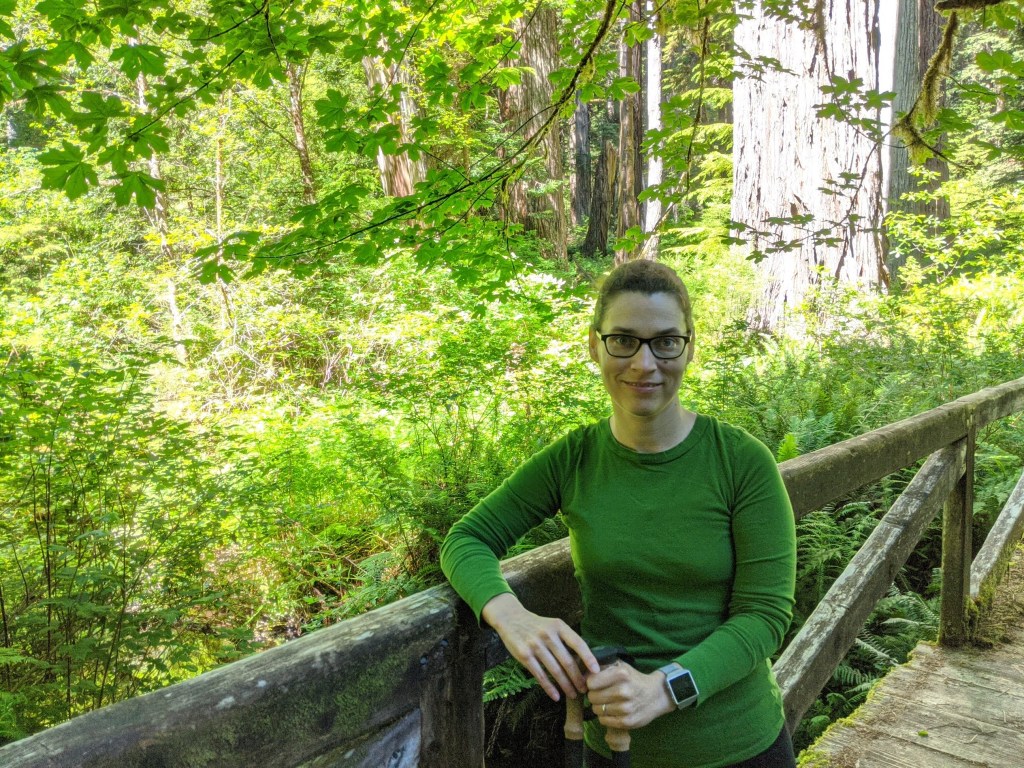
On April 10th, my husband and I went to Reinhardt Redwood Regional Park in the East Bay. It was a busy spot, but a lovely day. Cool in the shade and warm in the sun. Our path was rockier than was enjoyable for good stretches of time, but mostly flat, and we did see more redwoods. I completed one mile, from our car to another lot. Then my husband went back to the car and picked me up.


Myofascial Release Therapy
As soon as I knew the date of my second dose, I calculated the days until full efficacy and scheduled my first-ever myofascial release session for soon after. It turns out my neighbor is a physical therapist who is certified in MFR techniques, and she’s worked with many people who have cerebral palsy. I’m choosing to believe that the fact that we’ve lived next door to each other for almost eight years and I didn’t know this until I saw a flyer confirms only that I’m an introvert and not that I’m truly anti-social.
Here’s why fascia is important, courtesy of Johns Hopkins:
Fascia is a thin casing of connective tissue that surrounds and holds every organ, blood vessel, bone, nerve fiber, and muscle in place. The tissue does more than provide internal structure; fascia has nerves that make it almost as sensitive as skin. When stressed, it tightens up.
Although fascia looks like one sheet of tissue, it’s actually made up of multiple layers with liquid in between called hyaluronan. It’s designed to stretch as you move. But there are certain things that cause fascia to thicken and become sticky. When it dries up and tightens around muscles, it can limit mobility and cause painful knots to develop.
I’m pretty sure my fascia is a thickened, dried up and/or sticky, tightened mess.
I’ve had three sessions so far. My neighbor, A, doesn’t use any of those metal scraping tools that break capillaries. The release technique that she uses is gentle, skin-to-skin, sustained manual pressure. She’ll find a spot that’s tender and stay on it for five minutes or more. Five minutes. Any kind of stretching or trigger point work I’ve had so far has stayed on one place for 30, 60, or 90 seconds. She stays on a knot without forcing it, waiting to feel it release; the fascia and muscles tell her what to do and where to go next.
She’s worked on my hips, psoas, quads, and arms. Is it weird to lie in the semi-darkness while someone sits with you, hands not moving but simply firmly on a muscle for minutes and minutes? No. It’s rather nice. I am busy deep breathing, trying to relax and stay that way, and she is busy concentrating on the fascia.
The muscles of my lower body don’t want to relax. If pressure is applied, they tend to contract against that pressure in response (without my consent). During the session, sometimes I feel a muscle start to let go and then a spasm will sweep through. I hesitated to use the word spasm because I tend to think of those as painful, and this isn’t. But Merriam-Webster tells me that a spasm is “an involuntary muscular contraction,” and that is exactly what happens. The muscles do this: “Relax. Relax. Relaaax. Rela–CONTRACT!” It’s like they can’t handle it, can’t let themselves unclench. Like we have to trick them into thinking it’s safe to let go.
Sometimes I’m able to hold a contraction at bay. I can feel it wanting to take over against the gentle-firm pressure. It’s such an odd feeling. Sometimes I’ll try to stave it off, and just one leg will clench instead of both.
So my neighbor sits with me and my fascia and my contracting muscles, and she doesn’t force anything. She exists with me and my body in that time and that space and she accepts what is and coaxes small changes. And that is worth a lot.
She is also very good at trying to address my specific trouble spots. I would really like to regain my full grip strength and not have so much pain in my thumb and forearm. (I’ve been attributing this to pole use, because what else?)
Last June, I went to my first hand therapy appointment and that OT massaged the underside of my forearm and taped my thumb/wrist/forearm. I didn’t feel any different and went home without expectation of any improvement. Soon after, my neck started to tingle, and my extreme neck and shoulder tension was vastly reduced, for about a week. It felt like a near-miracle. I told A this story, and she’s worked on my forearm and taped my wrist twice, with no changes. Sigh. I think my brain must just refuse to relinquish the feedback loop: “You tricked me into relaxing once, but I know your ways now and I shall not surrender! Mwah ha ha!”
Does Anyone Know What Day It Is?
During the month of April I was busy every single weekend. Just so we’re clear, even without a pandemic, my preferred weekend activity is not having one. Along with my part-time job as a reading paraeducator, I’m also a freelance copyeditor. Sometimes, I actually get an editing job. Last summer, I became the editor for a newsletter that comes out three times a year. I’m not yet clear on its publication schedule, so when I get an email with a dozen articles attached that says, “It’s time for another issue,” I’m surprised. That happened, and then a friend of a friend contacted me to edit a dissertation, with a week turnaround time. Yikes! I said yes and then I worked before work and after work and through a weekend to finish it early and go back to the newsletter.
What’s more, my husband has recently gone back to his office two days a week instead of just on Wednesdays. So every Tuesday when he’s not at home, it feels like Wednesday. With changes at my day job, tutoring, PT, myofascial release, achieving daily ExoSym practice, TWO editing projects, AND a husband who keeps leaving the house, well, I’ve been a little out of it.
The Glute Evolution
In November 2019, I was introduced to my gluteus medius when I tried out the ExoSym test devices. In August 2020, I started to feel them really come alive. Now, I can feel my glutes working more than ever before.
My physical therapist continues to be impressed by my progress. At my last session on April 14th, he did some pretty “aggressive” stretching. When I got up from the table, I felt a bit wet-noodly. Like I really might need to sit down. That’s never happened before. But I couldn’t sit down because I needed to walk home and edit.
The combination of the stretching, the yoga, and maybe even the myofascial release already–it’s all doing something. I feel like the bit more range of motion I’ve achieved in my hips (and the added stability with the back brace) is giving me an actual stride rather than an always-bent-at-hip-and-knee clomp, clomp, clomp.
I’m using my glutes, you see. I can feel them contracting together. My backside and I have a whole new relationship. When I’m standing at the kitchen counter washing dishes, chopping vegetables, pouring something–anything that uses two hands–I am leaning my belly into the counter to hold myself up. This posture is obviously not great for several reasons. Now, I remind myself that my body can hold itself up without the counter’s assistance. I stand there and I chop up carrots and I feel my muscles holding me up. I remind myself not to cheat by resting my wrist against the counter. It takes a lot of concentration and effort to stand up tall and not cut off the tip of my finger, so it’s not an all-the-time thing yet.
But the weirdest thing is this: I didn’t realize the muscles weren’t working before. I’ve tried to articulate it previously, and I’ll do it again. My PT puts me in a modified plank and tells me to squeeze my buns together. I do, and I feel it. I’m doing the thing. But it’s like the volume was on low and I didn’t know it.
Those of you who have full use of your hands: it’s like if someone told you to lift your hands, palms down. On a continuum, A is to do it with your fingers relaxed. Z is to do it with energy through your fingers, stretched out taut. If the goal is to do Z, you do your darndest and still only make it to about G, but you think you’re at an N or an M. You have no idea what an N or M feels like, let alone Z. It’s inconceivable that Z even exists.
I know my glutes are still at the beginning of the alphabet, but it’s astonishing to discover the world of D, E, and F. I was doing yoga the other day, in my modified warrior one pose (holding on to the back of a chair). The muscles down the back of my bent leg were firing away. And I said, “Oh my god, my glutes!” so loud that my husband wondered if I was okay. Yes, just amazed.

The other morning I was doing my PT on the living room rug (as I have done for the last 44 days!). I was doing my side leg lifts with bent knees. These are hard. My glutes immediately start burning very strongly, and it takes a while for the burn to dissipate. In the beginning I was supposed to aim to get about a fist of space between my knees, and that was extremely challenging. It felt like an invisible thick rubber band was around my knees and I was fighting against it.
I’ve realized lately that the burn isn’t so strong, nor so immediate. And as I’ve said, my glutes are actually squeezing together. I know I’ve been getting better at these.
So I lift my leg, and it just keeps going up. I’m shocked. I stare at the space between my knees, space that I’m creating (and maintaining!) under my own power. And this is my left leg (the weaker one). I had to call my husband over to come see. My hips really are loosening up. And maybe there really is something to tight and dried up fascia limiting mobility. I was lifting my leg up higher than ever before (at least in the last two or three decades) and it felt easy enough that I didn’t realize I was doing it. Like it kept going up all by itself, without strain. Do you know how weird that feels?
My glutes are evolving, but I don’t know if my core is. All this ExoSym work is supposed to come from the glutes and the core. So far, I’m not great at coordinating all this within a step cycle, but I do try to “squish” with each step. I don’t know if my core is getting stronger but it’s just not as obvious because I’ve always had a little more control over/awareness of my core than my glutes. Or if I still have a 2019 core instead of a 2021 core.
There is still so much work to be done, so much tiredness, and a constant ebb and flow of pain from various sources. But continue to work I shall, with curiosity and gratitude.
And just so that last bit doesn’t sound too eye-rolly, know that there will be a fair bit of moaning and groaning, too.






 What Happened to Your Legs?