
20 July
Throughout my physical therapy career, people have been telling me I sink into my hip, or drop the hip. When they demonstrate, I have this moment of recognition: “Oh, hello, me. There you are.” It’s a little bit amazing to see myself reflected in them, and to know that I am seen and understood enough to be replicated.
It happened throughout training week, and it’s been happening throughout PT since I’ve been home as well: “We want to get from this”–demonstrates uneven pelvis–“to this”–magically evens out pelvis.
I see it. I understand it. I know I do the first one. I cannot make my body do the second one.
We practice shifting weight from one leg to the other while keeping the core and glutes strong. When I am on my left foot, my right hip sinks. I cannot really feel this.
“Try to bring that hip up. Press into my hand.”
My brain is a complete blank. It has nothing to communicate to the right hip. My brain does not know how to bring the right hip up.
“How do I do that?” I ask. “Which muscles am I supposed to be using to do that?” I ask more specifically.
It’s the left glute medius that’s supposed to be doing it. The one that I’m using to stand on, already engaging it as much as I can.
I have these two truths, and I don’t know how to balance them:
- I am only one month in, and I will get stronger.
- I have cerebral palsy. We are working on exactly the same stuff I’ve always worked on, but with giant braces and poles added to the mix. Sometimes I want to say, “Hey, I still have CP under these things, you know!” You can put ExoSyms on the CP, but you can’t take the CP out of the ExoSym wearer. Or something.
The good thing about my physical therapy is that it’s connected to my hospital system. That means I have access to the after visit summary and notes for each session just as if it were a doctor’s appointment. Still taken aback by my experience of utter nothingness when asked to perform an action, I click on the notes for that morning’s therapy session.
I can read what C writes as her own record, with all the professional vocabulary. She writes about Trendelenburg gait a lot. I look it up. That’s what “hip drop” is. I’ve probably been told before. It’s quite something to see drawing after drawing of what I look like. And that it has a name. I look at the images and read descriptions of it, but still have a hard time understanding the mechanics in relation to my own body. A positive Trendelenburg sign (hip drop) indicates weakness on the opposite side. I think I’ve always assumed that since my left side is weaker, that must be the side that drops more. (Since I don’t actually feel it as it’s happening, nor connect the mirror image of someone demonstrating it to my own body.) Also let’s be clear: both hips are weak; the left is weaker.
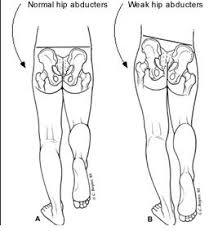
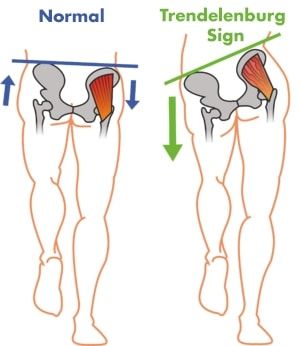

After the morning’s PT and afternoon’s research, I really want to understand what this means for me. All these years of people showing me my side-to-side sway, telling me I have muscle weakness and increased tone, and my nodding, yes, that’s true, that’s what I look like. But I still don’t really get it–or get how I’m supposed to do anything about it. After all, the small amounts that I’ve increased my strength over the years have not resulted in a noticeably more even gait. How much is it actually possible to change what’s always been there?
What’s more, I experience my CP as muscle spasticity and lack of balance, not weakness. How do you know that your muscles are “weak” if you’ve never known what “strong” feels like?
I stand in front of our full-length mirror with my Exos on, shirt pulled up and shorts tugged low so I can really see my hips. Right hand on furniture for support. I practice weight shifting. The mirror helps some, but it still feels like a disconnect between the image and my body. (Perhaps this is some sort of sensory/processing thing?) I don’t know how to make the image do what I want.
Concentrating on my core and my glutes, working in almost slow motion, I happen to look down at my hips the moment that shift to the left happens. I see it and I feel it. As I put weight on my left foot, I see my left hip shift out and up past center, with a bit of a twist. My left hip goes up. My right hip falls. I do it again to confirm. Repeat it to show myself I can do it on purpose–and undo it. There it is. My hip drop. My positive Trendelenburg sign. The muscles around my hip are not strong enough to hold my left side up over my foot and everything shifts and collapses. But I can cheat it back into place using my right side and my hand to help. Hips level again, I tell myself, This is where my muscles are supposed to hold me; this is what upright feels like. It’s only taken thirty-nine years for my body and my brain to connect this way.
Let’s revisit my two truths above: I have the capacity to strengthen muscles. Cerebral palsy does and always will affect those muscles. Truth three: The future is unknowable.
Right now, ironically, I am unable to imagine what it would feel like to walk in my Exos as easily as I walk without them. And yet, the Exos have the potential to help me be more “able” than I’ve ever been. I cannot imagine it, but I believe it’s there.

 What Happened to Your Legs?