Life with ExoSyms Days 50–62: They’re Alive!

3 August–15 August

On Monday, August 3rd, I notice more low back pain than usual. Enough that walking is pretty painful. The pain in my left upper hip/torso is easing, so it’s kind of like the pain just moved around back. As I’ve said, I won’t be surprised by any new pain that arises during this process. But it does make me feel like I’m not being very successful at increasing core strength. My back should be hurting less as I become stronger, not more.

Since Thursday the 6th of August, I can feel my glutes in a new way. What I mean is, I feel as though there are muscles in there that weren’t there before. It’s very odd, because I didn’t know that I wasn’t feeling them–you know? I thought I was. The clamshell, the bridge, even planking. All of these are exercises I’ve been doing for years. When Jared at Hanger and C, my physical therapist, tell me, “Squeeze your buns together,” by gosh I do it. Usually, I lose whatever core engagement I had, but I do feel that I’m squeezing my buns. 

But this is what happens on Thursday the 6th of August. I am doing my side lying leg lift on the left, with my knees bent. I am supposed to hold the lift with my knees at 90 degrees, then move my knees away from my body, still bent, lift and hold again, etcetera, for a total of one minute. This has been very challenging. But this day, when I lift my left leg and hold, yes the burning starts right away, but eventually there is also just more. More squeezing, more engagement. I can feel the muscle contracting inside my body. Once that engagement happens, it’s easier to hold my leg up, to lift it higher, to keep my core engaged. There’s less IT band burning and less upper body compensation. It’s another moment of “Oh, this is what it’s supposed to have felt like all this time.” 

Imagine that someone hands you a heavy box. You hold it in your hands, fingers, wrists, and arms straining. Suddenly, another hand joins yours and helps you lift the box. So much better, right? Now imagine that the helping hand is actually your own. You thought you were using both, but you’d only been using one. That’s the best way I can think to describe it. 

So why has it taken so long, when I’ve been given these same exercises over and over all my life? It’s the ExoSyms. Spending two hours in the test devices last November introduced me to my glutes medius. These muscles that I’d never felt before were sore simply from walking in the devices, without any conscious effort to engage my glutes.

Now the conscious ability is there. I can squeeze my buns lying down. Standing up while brushing my teeth. Sitting here at the laptop. I can contract one and then the other. When I’m doing my leg lift and I engage them both, it feels so different than it did before. So much more draws together inside. I have ample enough padding that I don’t think I’d be able to see or feel the movement from the outside, but it’s there. My bottom, backside, tush, derriere, the muscles in there–they’re alive! Do I have absolute command over them now? Nope. It still takes a few tries, a little delay before they do my bidding most times. But when you’ve never felt anything different–and you don’t know that there is something different to feel–when a change happens, it’s really something. 

Friday the 7th of August I veto the walking video update because of the back pain. 

I am in San Francisco visiting family for a while, and I have a reprieve from schlepping back and forth to PT and OT for the next few weeks.

Saturday I feel like my back might be improving, so I add the standing modified plank/squish back in.

Sunday it feels like the left upper side pain is returning so I take the plank back out. I do about an hour of weight-shifting and walking practice and my new butt muscles are tired.

By Monday the 10th of August, I feel like my back has recovered to its normal levels of stiffness/soreness. One week of back issues is much better than several weeks of the side pain. 

On Tuesday, I try doing five or six short sessions throughout the day again. (Notice how I don’t succeed in increasing the number of sessions.) I do lots of SLOW walking practice, trying to focus on the left glute/no hip drop. That leads to me putting added pressure on my right pole, and my forearm and thumb, and they are burning by evening.

Wednesday, I lay off the poles to give my arms a break, except for one short walk outside. I do wear my Exos around the house for most of the day. 

Thursday I don’t use the poles either, but I do try several trips up and down some carpeted stairs. That’s exhausting, and not great on my knees. Most of the day I’m sitting at a desk with my Exos on. My right wrist is much more crunchy than usual and my forearm still burns.

Saturday the 15th of August, I do another short walk outside in the morning. It’s heatwave time in California now, so when I make it back inside, off come the ExoSyms and the sweat-soaked knee sleeves, and they don’t go back on after that.

We did manage a short video update after skipping one the week before. Without much outside practice, there’s probably not a marked improvement from the last one. Suddenly, I’m entering my third month of life in ExoSyms.   

Day 62

And here’s a side-by-side comparison at month one and month two. Doesn’t look or feel like a big difference for me.

Day 33 versus Day 62

Life with ExoSyms Days 37–49: Keepin’ On

21 July–2 August

No great revelations or fantastic progress lately. 

On Tuesday, July 21st, I try breaking up my walking practice into smaller chunks throughout the day to see if I can keep the quality up instead of wearing myself out doing an hour at once. The idea is to add in more chunks, so that I’m doing higher quality walking, and more of it overall. 

Turns out, I really dislike being on a schedule like that. I tried walking for ten minutes every hour. It’s ideal, really, to get up and walk around at regular intervals. I know this. But I don’t like it. I think I only did an hour total anyway. Was it better quality than doing an hour at once? Not sure.

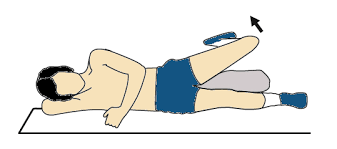
Wednesday I have my sixth PT session. We add an exercise to my home program where I lie on my right side, legs bent at 90 degrees and lift the left leg up, keeping the foot level with the knee. This is a variation of the hated clamshell that targets the glutes. Then I move my knees farther away from my body with each one, still keeping them bent. I am supposed to hold it 5–10 seconds at a time, for a minute total. I find this exercise, while better than the clamshell, still incredibly difficult. The muscles from hip to knee on my outer thigh begin to burn almost instantly, and I barely feel it in my glutes, which is where I’m supposed to feel it the most. I am nowhere near being able to do a minute total yet. We also add a tailbone lift onto the pelvic tilts to work back toward a bridge. 

The dreaded clamshell.
Leg lift. My bottom leg is also bent. I’m supposed to maintain at least a fist of space between my knees. This is nearly impossible.

I also have my second ever OT session for my wrists. The woman who worked magic with cocoa butter in June has moved to another office. The new guy uses a plastic tool, like a scraper, to massage my forearms. He gives me a series of isometric exercises to do. I am hopeful for the improvement in my neck and shoulders that I felt last time, but it does not happen.

This is what I write in my physical therapy journal after returning from PT, doing my home program (mat work), and putting my Exos back on: “So deeply tired. Any walking practice would end with me on my face.”

On Friday, July 24th, I send my fifth update video to Ryan. He is encouraging, telling me that I look good, that the pain on my left side that I’ve experienced all week should lessen as I become stronger.

Day 40.

I notice as I practice walking and “marching,” that the marching is becoming easier. This is something I was assigned at my first PT session on July 8th, standing with my poles and lifting up one leg and then the other (while trying not to let the hip drop). The poles did not give me enough stability to lift my knees high. Now I can do it.

Monday July 27th, I have my seventh PT session. I remove my Exos and we go over ways to improve my left leg lift to target the glute rather than the whole outer quad. I also strain my neck and shoulders with the effort. C suggests I do a different exercise when I feel my neck and shoulder tense. I try to explain that my neck and shoulders engage regardless of the exercise I’m doing. She explains that we want to undo that pattern. I understand that, but is that achievable? I feel stuck.

I notice that when I’m on my knees (as when I’m getting up from the mat after exercises at home), that’s when I can really feel my glutes engage. I also have a wider base for balance. I ask C whether it’s a good idea to do weight shifting practice on my knees. She says sure and we try some stuff out. I’m glad that sometimes I bring in ideas that she may not have thought about.

On Tuesday, I manage to put my Exos on nice and early and go for a walk outside. “Outside” has begun to loom large in my mind, and I need to make sure I practice walking both in- and outdoors. Is it that I’m in “public”? Is it that I’m alone, depending on passing strangers if I fall? Why does it feel so different? Partly mental, partly physical. I do twenty minutes, and, yup, it feels stiff and lopsided like always.

Wednesday is my eighth PT session. I put on my Exos early and go for another twenty minute walk outside first. Then my husband drives me to PT, so I already have my Exos on when I get there! A one-minute ride feels extravagant, but it’s really nice. We work on my “turn out.” I try putting my foot on a pillowcase on the smooth floor and sliding the toes outward. Go slow, and hold it there with energy. No thirty reps like with Jared during training week. It’s very apparent when I’m standing in my natural state that my toes point outward and my knee points inward. The consensus is that toes out is better than toes in (my childhood gait, pre-surgery), and that we’d like to get the knee to track better with the toes.

I don’t know how to make my knee go out there. On the right, it’s much less profound, and I can press into my Exos and move my own knee. But on the left? Nope. Another complete brain blank. How bizarre it is to be able to understand and execute something challenging on the right, and have nothing there on the left. Even within my own body, I’m unable to translate a movement from one side to the other (so far?). As you might imagine, the wonky alignment on the left puts significant pressure on my knee, which leads to some tweaking and pulling and pain. So there’s that.

In my next OT appointment, the therapist sets aside the idea that my wrist and thumb issues developed from trekking pole use and takes another tack. After I reiterate my trouble with opening jars he thinks maybe I have thumb arthritis. He tells me to use proper tools instead of straining the muscles, and gives me some “theraputty” exercises. I don’t think I have arthritis, but I’m game to work on hand strength.

I am free of PT for a couple weeks while my therapist is away, and I have graduated to once-a-week sessions when we resume.

It’s been two weeks of left upper hip/torso pain, but it is improving. Left knee tweaky. SI joints are a bit off. Practice continues.

Somehow, it’s August, and I send my sixth walking update to Ryan.

Day 49.

Life with ExoSyms Day 36: You Can Put ExoSyms on the CP, but…

20 July

Throughout my physical therapy career, people have been telling me I sink into my hip, or drop the hip. When they demonstrate, I have this moment of recognition: “Oh, hello, me. There you are.” It’s a little bit amazing to see myself reflected in them, and to know that I am seen and understood enough to be replicated.

It happened throughout training week, and it’s been happening throughout PT since I’ve been home as well: “We want to get from this”–demonstrates uneven pelvis–“to this”–magically evens out pelvis.

I see it. I understand it. I know I do the first one. I cannot make my body do the second one.

We practice shifting weight from one leg to the other while keeping the core and glutes strong. When I am on my left foot, my right hip sinks. I cannot really feel this. 

“Try to bring that hip up. Press into my hand.”

My brain is a complete blank. It has nothing to communicate to the right hip. My brain does not know how to bring the right hip up.

“How do I do that?” I ask. “Which muscles am I supposed to be using to do that?” I ask more specifically.

It’s the left glute medius that’s supposed to be doing it. The one that I’m using to stand on, already engaging it as much as I can.

I have these two truths, and I don’t know how to balance them:

  1. I am only one month in, and I will get stronger.
  2. I have cerebral palsy. We are working on exactly the same stuff I’ve always worked on, but with giant braces and poles added to the mix. Sometimes I want to say, “Hey, I still have CP under these things, you know!” You can put ExoSyms on the CP, but you can’t take the CP out of the ExoSym wearer. Or something.

The good thing about my physical therapy is that it’s connected to my hospital system. That means I have access to the after visit summary and notes for each session just as if it were a doctor’s appointment. Still taken aback by my experience of utter nothingness when asked to perform an action, I click on the notes for that morning’s therapy session.

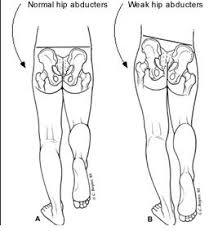
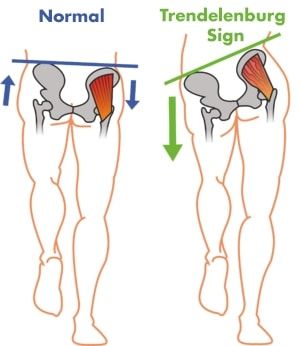
I can read what C writes as her own record, with all the professional vocabulary. She writes about Trendelenburg gait a lot. I look it up. That’s what “hip drop” is. I’ve probably been told before. It’s quite something to see drawing after drawing of what I look like. And that it has a name. I look at the images and read descriptions of it, but still have a hard time understanding the mechanics in relation to my own body. A positive Trendelenburg sign (hip drop) indicates weakness on the opposite side. I think I’ve always assumed that since my left side is weaker, that must be the side that drops more. (Since I don’t actually feel it as it’s happening, nor connect the mirror image of someone demonstrating it to my own body.) Also let’s be clear: both hips are weak; the left is weaker.

After the morning’s PT and afternoon’s research, I really want to understand what this means for me. All these years of people showing me my side-to-side sway, telling me I have muscle weakness and increased tone, and my nodding, yes, that’s true, that’s what I look like. But I still don’t really get it–or get how I’m supposed to do anything about it. After all, the small amounts that I’ve increased my strength over the years have not resulted in a noticeably more even gait. How much is it actually possible to change what’s always been there?

What’s more, I experience my CP as muscle spasticity and lack of balance, not weakness. How do you know that your muscles are “weak” if you’ve never known what “strong” feels like?

I stand in front of our full-length mirror with my Exos on, shirt pulled up and shorts tugged low so I can really see my hips. Right hand on furniture for support. I practice weight shifting. The mirror helps some, but it still feels like a disconnect between the image and my body. (Perhaps this is some sort of sensory/processing thing?) I don’t know how to make the image do what I want.

Concentrating on my core and my glutes, working in almost slow motion, I happen to look down at my hips the moment that shift to the left happens. I see it and I feel it. As I put weight on my left foot, I see my left hip shift out and up past center, with a bit of a twist. My left hip goes up. My right hip falls. I do it again to confirm. Repeat it to show myself I can do it on purpose–and undo it. There it is. My hip drop. My positive Trendelenburg sign. The muscles around my hip are not strong enough to hold my left side up over my foot and everything shifts and collapses. But I can cheat it back into place using my right side and my hand to help. Hips level again, I tell myself, This is where my muscles are supposed to hold me; this is what upright feels like. It’s only taken thirty-nine years for my body and my brain to connect this way.

Let’s revisit my two truths above: I have the capacity to strengthen muscles. Cerebral palsy does and always will affect those muscles. Truth three: The future is unknowable. 

Right now, ironically, I am unable to imagine what it would feel like to walk in my Exos as easily as I walk without them. And yet, the Exos have the potential to help me be more “able” than I’ve ever been. I cannot imagine it, but I believe it’s there.

Day 1 versus Day 33

Life with ExoSyms Days 15–35: Physical Therapy Begins

29 June–19 July

Once I settle in at home, I realize that any kind of shoulder/neck release that I had felt before the trip to Hanger is definitely gone. I am sad. I need to schedule a follow-up OT appointment to have another forearm massage. (And hope it creates magic again.)

I do set up my first physical therapy appointment. I had been doing some pre-ExoSym prep in the early part of the year, but I hadn’t seen my therapist since March because of shelter-in-place orders.

The Sunday prior to my Wednesday appointment, my husband and I do some reconnaissance. My PT office is walking distance from my house. Or it was. Without ExoSyms, it takes me thirteen minutes, along a not-very-smooth bike path. Lots of undulations and patched cracks. With an eye on the time, we set off. I want to see how many streets I have to cross (how many curb cuts I have to navigate). The good news is, there’s only one set. The bad news is, I don’t make it all the way to the office because I also have to make it back home. After practicing the curb cuts, we turn back and cut over one block to try neighborhood sidewalks instead of the bike path.

I still feel stiff and lopsided. It’s like my left leg refuses to function. Several times I stop moving and try to gather myself, remember how to walk. It is very hot and I am very tired. And I am literally saying to myself, “What is my body doing? Go forward!”

We make it home and record another video update for Ryan before I go inside and take the ExoSyms off for the rest of the day. We estimate that, had I made it all the way to the office, it would have taken thirty minutes. Walking in my ExoSyms to my appointment is definitely out, as I predicted it would be.

July 5. Day 21.

When Wednesday morning, July 8th, arrives, I put on my knee sleeves and my non-Exo shoes. My big shoes and knee sections fill up a large backpack and my ExoSyms are strapped to the outside. Mask on. Check. Sunhat. Check. I get the backpack on, take up my poles, and try to fit myself sideways through the doorway, carbon fiber Exos knocking against the glass front door on my way out. With the poles, the walk is no problem. Except that I can’t see because of the glasses-and-mask situation. 

At the office, nice and early, I have my temperature taken, answer no to all the questions, and then maneuver myself into a seat. Set poles down. Take off hat. Take off backpack. Take off shoes. Get the darn braces out of the darn straps. Pull up the knee sleeves that had pooled attractively around my ankles. Brace. Shoe. Other brace. Other shoe. Knee section. Knee section. Sanitize hands because I had to touch the bottom of my shoes. Put original shoes in backpack. Backpack on. Stand. Get poles. I am ready to be called back.

I fill my therapist (let’s call her C) in on training week and the time since, how things feel, what I’ve been doing, how much I’m wearing them.

I get the impression that she thinks I’m not wearing them enough. I should have them on whenever I’m awake. Yeah, that’s the goal. But not yet. I admit that I’m doing Jared’s ab exercise without them on. It’s so much easier to slide my feet in socks than it is to put something slippery under my shoe and switch it back and forth between sets since I can barely lift my weighed-down legs. Again, C thinks that whatever I’m doing, I should be wearing my Exos. They are part of me now. And we don’t want to reinforce any of the “compensatory patterns.” I understand this. We’ll see if I can force myself to get up and down from the floor in all my gear to do these ab exercises. 

To the two exercises I’m doing from Jared, we add a standing plank-type thing where I practice my “squish,” and some marching in place, weight-shifting practice. Well, the marching was downgraded to standing and holding on to the counter while I weight shift, trying to keep my hips level.

I go back to the lobby and schedule twice-a-week appointments for the remainder of July. Then I sit down and do everything in reverse so I can carry my ExoSyms back home. Sigh.

On Friday, the 10th, I have my second appointment. We do the baseline strength tests to see where I’m at. All the, “Push against my hand. Now don’t let me push your knees in” type things. They wear me out. Immediately, when I begin to walk home, I feel extremely tired and sore. We also add the dreaded bridge to my “home program.” The bridge sounds simple, and it is, if you’re not doing it right. Lie on back, bend knees, and lift bottom. However. Rather than simply “lift bottom,” I am supposed to tuck my pelvis (the “squish”) and “peel my tailbone up off the mat one vertebrae at a time.” Don’t tense neck or shoulders. Hold for several breaths. Then lower back down, one vertebrae at a time. The down is definitely a plop. Usually, this exercise aggravates my SI joints. But it is exactly the thing to do to strengthen the muscles around the SI joints. Go figure. Sure enough, after this session, my left SI joint starts to flare.

I have been given the bridge to strengthen my outer hips/glutes since the dawning days of my physical therapy career. And here we still are. Because those muscles always have been (and always will be) weak. But I can make them less weak.

July 10. Day 26.

Monday, the 13th, I have my third appointment. The thing about aggravating the SI joint is that once it’s angry, it stays angry. We don’t practice the bridge this time; we just do the pelvic tilt and hold it without lifting the tailbone. That’s challenging enough to get right anyway. After that, still on my back, I bend one knee and try to let it move side to side slightly without letting my hips come up along with it. This also employs the squish. The goal is to get the leg moving independently of the pelvis. C says that these two exercises are probably going to be more comfortable without my Exos on. Ah ha! Validated! She has realized rather quickly that my being weighed down by clunking, clattering carbon fiber is not always conducive to accurate, focused exercise. 

One thing I notice is that since I have to take my Exos off to walk home from PT, I definitely don’t feel like putting them back on again once I get home. But I need to actually do the home program, ideally doing the exercises several times throughout the day. With lots of walking practice. 

I tend to suit up again in the late afternoon and do one long practice session. But because “ten good steps are better than 100 bad steps,” C suggests I break it up into shorter chunks throughout the day to not wear myself out, eventually adding more chunks overall. She recommends that I keep a journal of what I’m doing and how I feel as I try out different combinations of walking time.

Because I like notebooks, and I have the perfect one, I do this.

By my fourth session on Wednesday, the 15th, my SI joint flare gets worse and better throughout the day, and my low back starts to hurt. We practice on stairs a bit, and also on powering through the step to take longer strides, with poles of course. I succeed in coming home from PT (these are really only about 25 minutes), doing my no-Exos stretching and exercises, and then putting my Exos back on to do the rest of the exercises and walking and weight-shifting practice in the afternoon. 

July 17. Day 33.

Some days, I have my Exos on for eight hours. I am mostly sitting in front of my computer. Saturdays, I just want to rest and read and watch Netflix. So I do.

Although my SI joint pain seems to be abating, my low back hurts, and so does my left side. My upper hip, almost my torso. This is not a pain I usually have. But I’m changing the way I move and walk. And right now, the ExoSym and knee section are just too much for my left side to handle well, so I won’t be surprised at any new pain that arises. 

At home, I move around without poles, and it feels easier some days than other days. When I’m washing dishes or chopping a vegetable, I have to remind myself not to lean against the counter. I have to remember that I can stand up now. Sometimes I turn it into a challenge for myself: Can I chop this pepper and transfer it into the pan without using a hand to assist? Can I fill the water glass and set it on the table? Often, the answer is yes.

It’s hard to believe I’ve had my Exos for more than a month already.