Note: I have cerebral palsy (mild spastic diplegia) and came to Hanger Clinic for bilateral ExoSyms with knee sections. Not many people have two Exos with two knee sections. Your experiences might vary widely from mine, especially as far as mobility in the first days.
After my test device trip, I knew I would need trekking poles. I practiced with them months beforehand and brought them with me for training week. They have some there for you to use, but if you need them for training, chances are you will need your own when you leave.
Be prepared to wait. Use the time for bathroom/water/food even if you think it’s only going to be a minute. The first day, I was there for several hours and didn’t drink anything or have a bathroom break. The room with the cubbies (where my water bottle and snacks were) is at the other end of the gym from the restrooms. And I could hardly walk once I had the Exos on, so I felt a little bit stuck.
Be prepared for a schedule different than the one they email you beforehand. I was able to come in earlier on several of the days. For me, the test device trip was our sightseeing trip. This one was all work (and rest).
Tell Ryan as soon as you realize if something doesn’t feel right. He’s booked throughout the day, so he was trying to make adjustments for me as well as see other patients, and the wait-time was long. The earlier he knows, the earlier the chance you have of getting out of there.
Ryan and Jared have different styles and approaches, and you might hear pointers and ideas that seem to be in opposition. It’s a lot to take in.
If you have a support person with you, ask them to take notes for you and put a star by the cues that work well. We hear so much information throughout the week, and we’re supposed to synthesize so many actions simultaneously.
Ask your support person to take a lot of pictures and video. Not only is it great to have documentation of where you started, it will also be helpful if you can record Ryan or Jared as they are explaining how to do a particular movement, especially to share with your physical therapist when you are home.
Do go back to the clinic to work and practice as much as you can. Two of the days I had good, long sessions alone, and it was really what I needed. Especially as an introvert. It takes time to process and apply all that we’re learning. Plus, most of us don’t have parallel bars and a mirror at home. I really miss practicing with parallel bars.
Jared has thousands of hours of experience, but he only just met you. He doesn’t know you or your body yet, and there’s really no time to build that relationship. It’s an opportunity for you to try to be more like the person you want to be (for me, braver), but he also won’t know when he’s reaching your limit unless you tell him. He only started figuring out the strategies that worked best for me, both physically and psychologically, on the last day. We finally start to get to know each other and then our time is at an end.
Jared will ask you if you have any goals before you get started, so if you don’t want to be caught unprepared, think of a few ahead of time.
Wide Shoes Only is more than a recommendation. I highly urge you to do what you can to go there.
If you are flying, try to leave lots of room in your luggage or bring an extra suitcase. I would not have wanted to wear my Exos through an airport or on a flight, and two Exos with two knee sections take up a lot of space. There will also be extra knee sleeves and heel lifts, plus the shoes that fit your Exos, and any additional shoes you buy.
When I complete my training week at the Hanger Clinic, I have this idea that I need to keep up the momentum. The whole summer is ahead of me, and I have nothing but time. I need to wear my ExoSyms for a minimum of two hours in the morning and two hours in the afternoon, just like at the Clinic, and build up from there.
And then there’s two days of driving, and a trip to the redwoods. Then I’m tired and it’s hot and I haven’t been home in ten days. First, I’ll rest. I’ll practice later. Already, I’ve lost the momentum. Life is not a montage.
Even though it’s nowhere near four hours a day, I do practice walking in my ExoSyms. I can move around the house in them without poles, but I find that I am lurching from furniture to furniture. It’s almost as if I’m wearing roller skates, and I don’t know how to stop. Or steer. It’s hard for my brain to realize I have more balance in these, not less. That I can let go of the table and stand up straight.
After the unexpected calf swelling, it’s taken a full week for my calves to feel like they fit properly into the cuffs, that the cuffs can close without squeezing them.
I’m doing the ab exercises that Jared assigned. And I took a couple furniture sliders from my parents’ house to use under my feet for the exercise he had me doing on rectangles of carpet. Pointing my toes inward and then outward. The hardest thing ever. I am definitely not doing thirty. Maybe I’ll work my way up to that.
On Friday June 26th, a week after leaving Hanger, I send videos to Ryan of me walking with and without poles. The first of many weekly updates. I have so much work ahead of me.
Saturday, it’s cooler, so I take myself outside to practice walking. My husband comes with me in case I face-plant because there’s no way I can get up by myself (yet. I hope it’s yet.) It feels so different, walking outside. Textured sidewalk, uneven blacktop. My left side feels so stiff. I am lopsided. I cannot seem to move in a functional manner. So much work. It’s a full week later, and it doesn’t seem very much improved. I spend about an hour walking up and down outside.
I am finally brave enough to try putting my wrists through the straps on my poles and twisting them tight before gripping the handles. Both Ryan and Jared suggested this method to give my wrists more support. It seems very dangerous in the event of a fall, but it really does help my wrists and make me feel more stable.
Inside, I put on my Leonard Bernstein playlist and practice for another hour. I have about a dozen steps of floor space from the front door to the table. Do a lap. Pause. Wiggle-dance. Lap. Pause. Wiggle-dance.
This week I discover that I can:
Stand up from a chair with no hands. I can do this without ExoSyms sometimes, if the chair is supportive enough and exactly the right height. It usually takes a few tries and is the result of momentum rather than actual ability. It still might take a couple tries with the ExoSyms, but they definitely give me a boost. When I discovered I could do it, I did it over and over and started laughing. Standing up is fun.
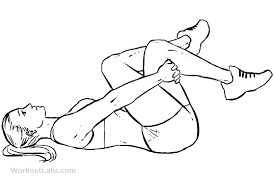
Stretch my hamstrings while standing. Usually, I stretch my hamstrings lying on my back with one leg in a yoga strap. I really dislike this position because it’s a strain on the rest of my body to pull my leg up. Sometimes, I do a modified downward dog instead, but it’s not as good a stretch. With my ExoSyms on, I can put my heel on the floor out in front of me and bend toward it, toes up. The brace keeps my ankle flexed, so the stretch is really good. So simple. I can stretch my hamstrings ten times a day now, if I want.
The Sunday following training week was another travel day, from Oregon to California. I did not wear my ExoSyms in the car, for comfort and for the previous laborious/yucky experience of using a public restroom.
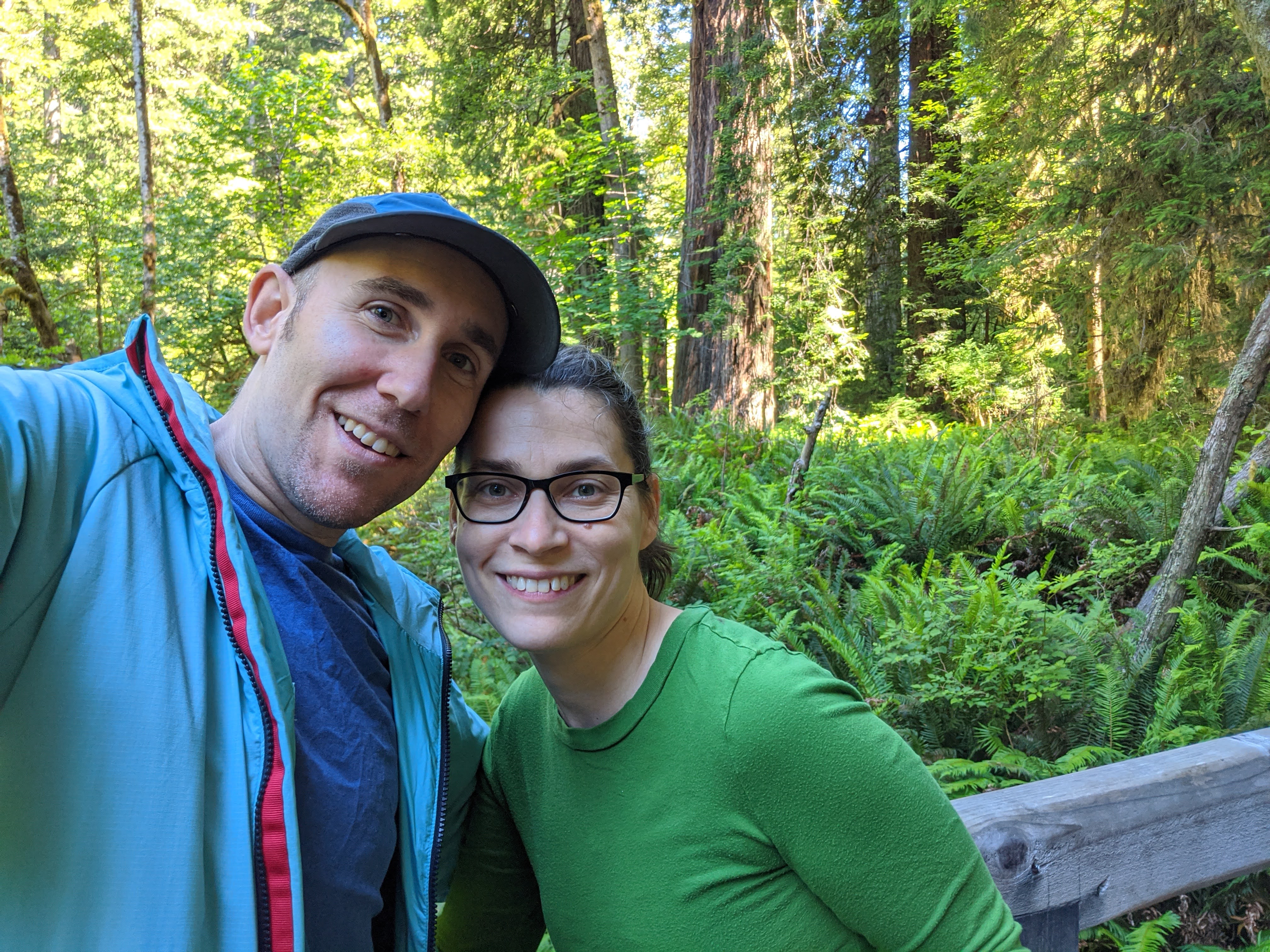
My husband and I were reunited, and he was taking me to the redwoods. We checked into our cabin and ate some dinner. Then it was finally time to show him my Exosyms. I had put them on that morning, about twelve hours earlier, for a few minutes of practice before the long car trip to meet up with my husband. I put on my brace sleeves. Then the right device, and–I couldn’t close the knee cuff! I really squeezed my calf, trying to close the top part of the brace. It simply would not close. Not just a little–there was quite a gap. My mind raced: Okay, I’ve been sitting in the car all day. Too much salt. Not enough water. Do calves really bloat/swell this much? My calves are supposed to shrink now, not get bigger!
The left side was a little better, but didn’t close all the way either. I was still able to Velcro the cuffs “closed” and attach the knee sections over them and practice walking for a few minutes. There are bound to be changes and surprises, but it was a little disconcerting for this to happen as soon as I left Hanger. I didn’t want to have to think about sending them back for adjustments already. I resolved not to panic and to just wait it out.
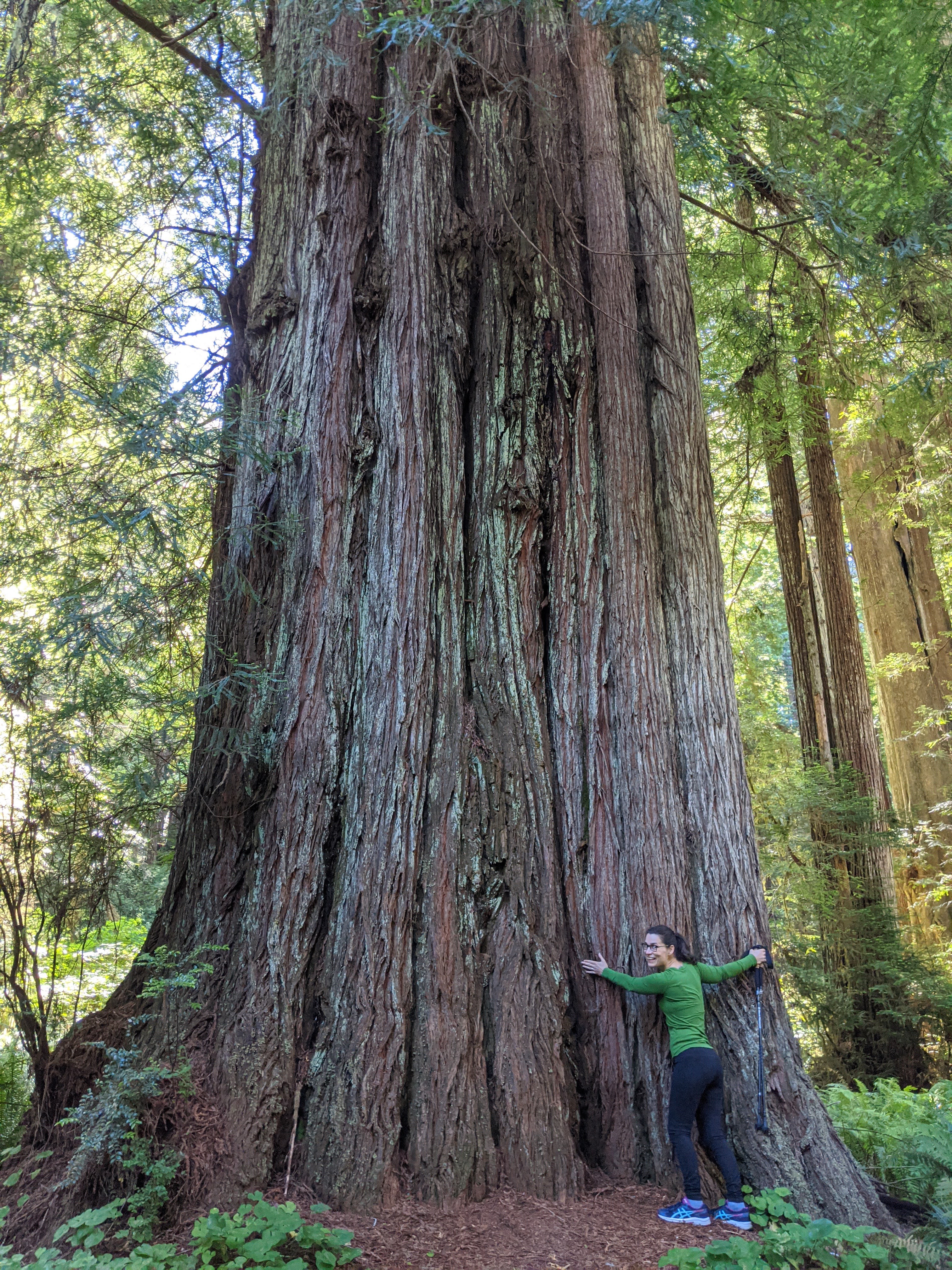
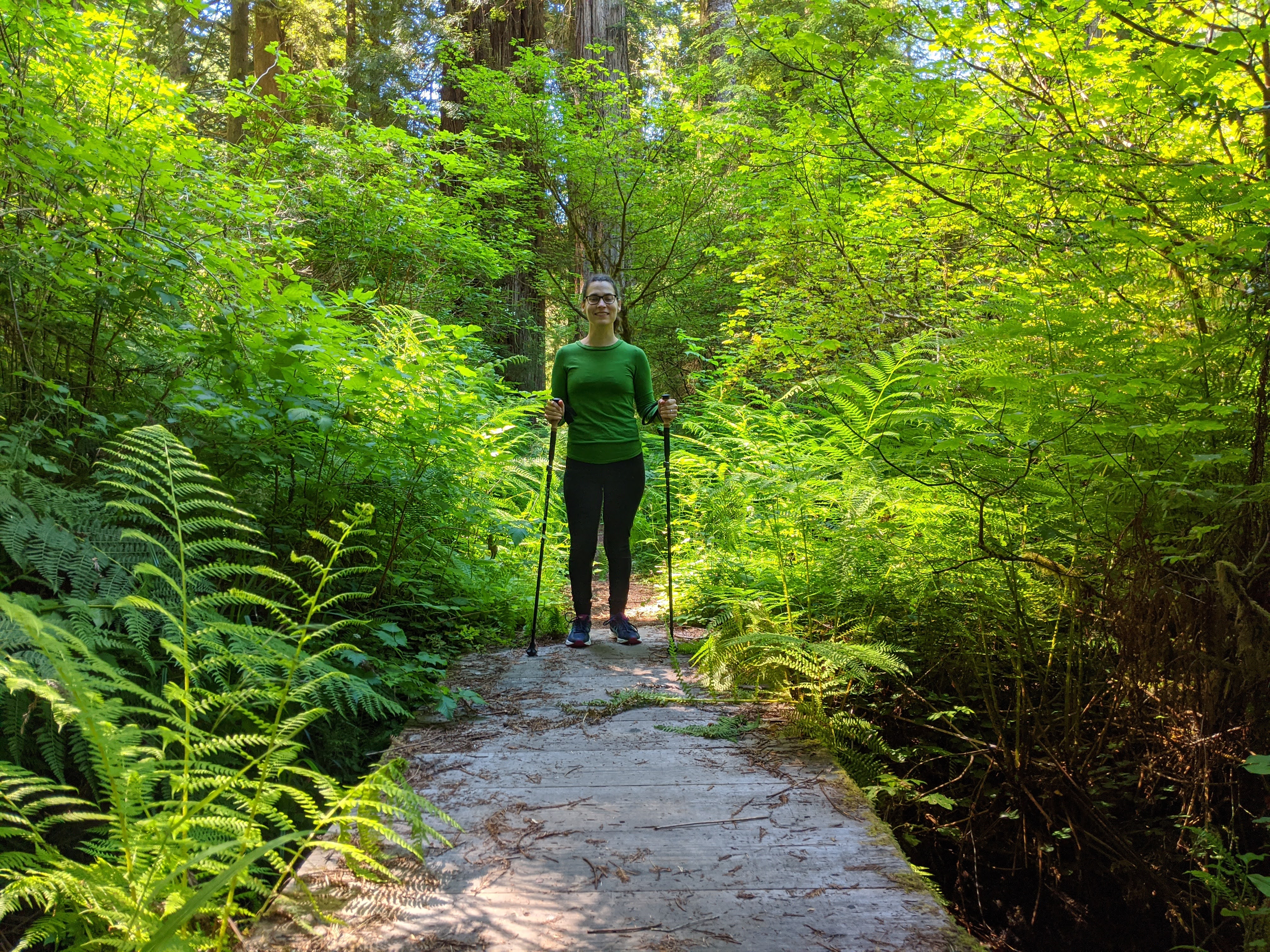
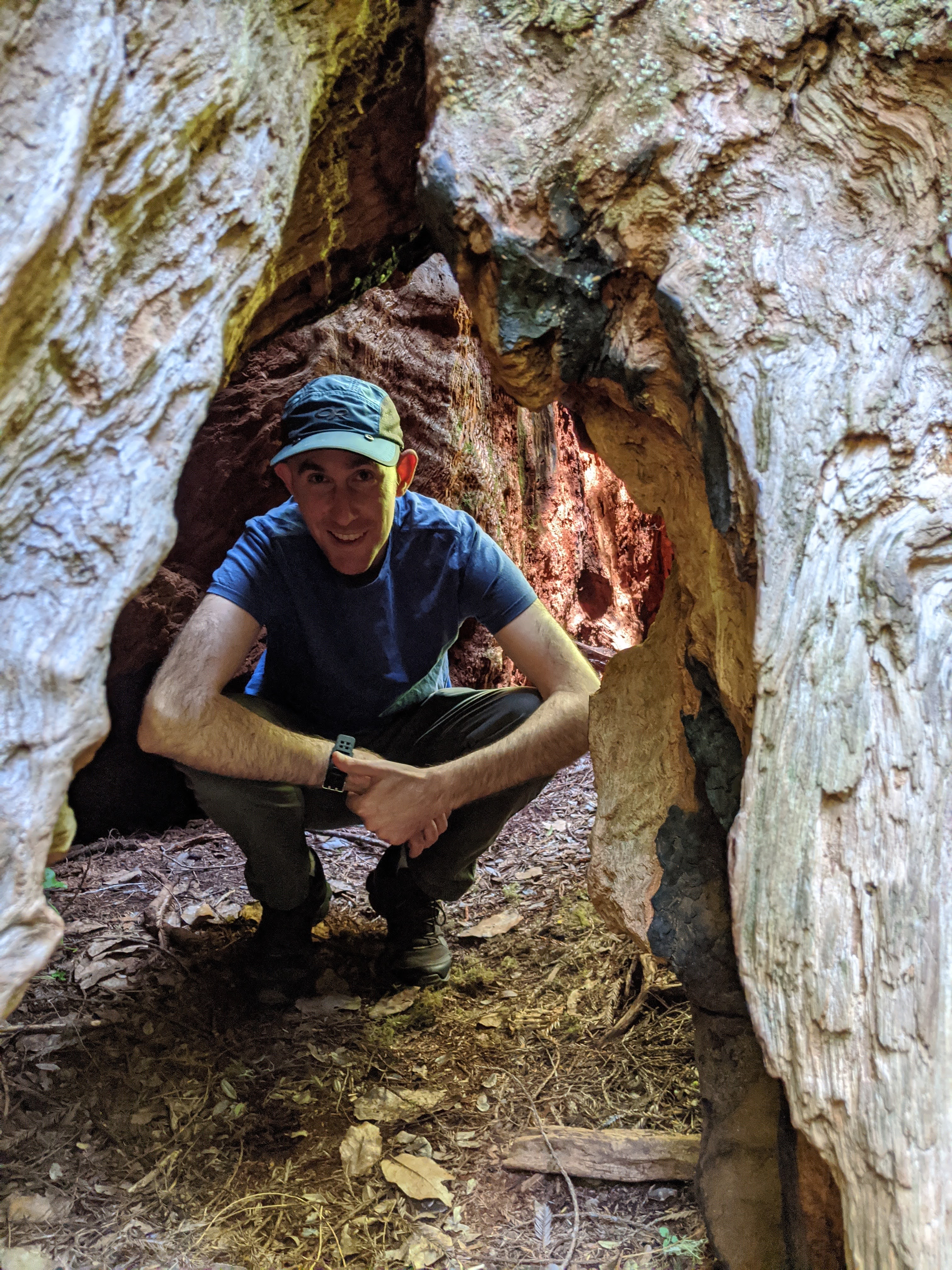
Monday morning we drove on an aptly named scenic parkway to Prairie Creek Redwoods State Park to try to find the accessible trails we’d read about. I did not even contemplate trying to wear my ExoSyms out in the wild, but this would be the first time I used my trekking poles to “trek.”
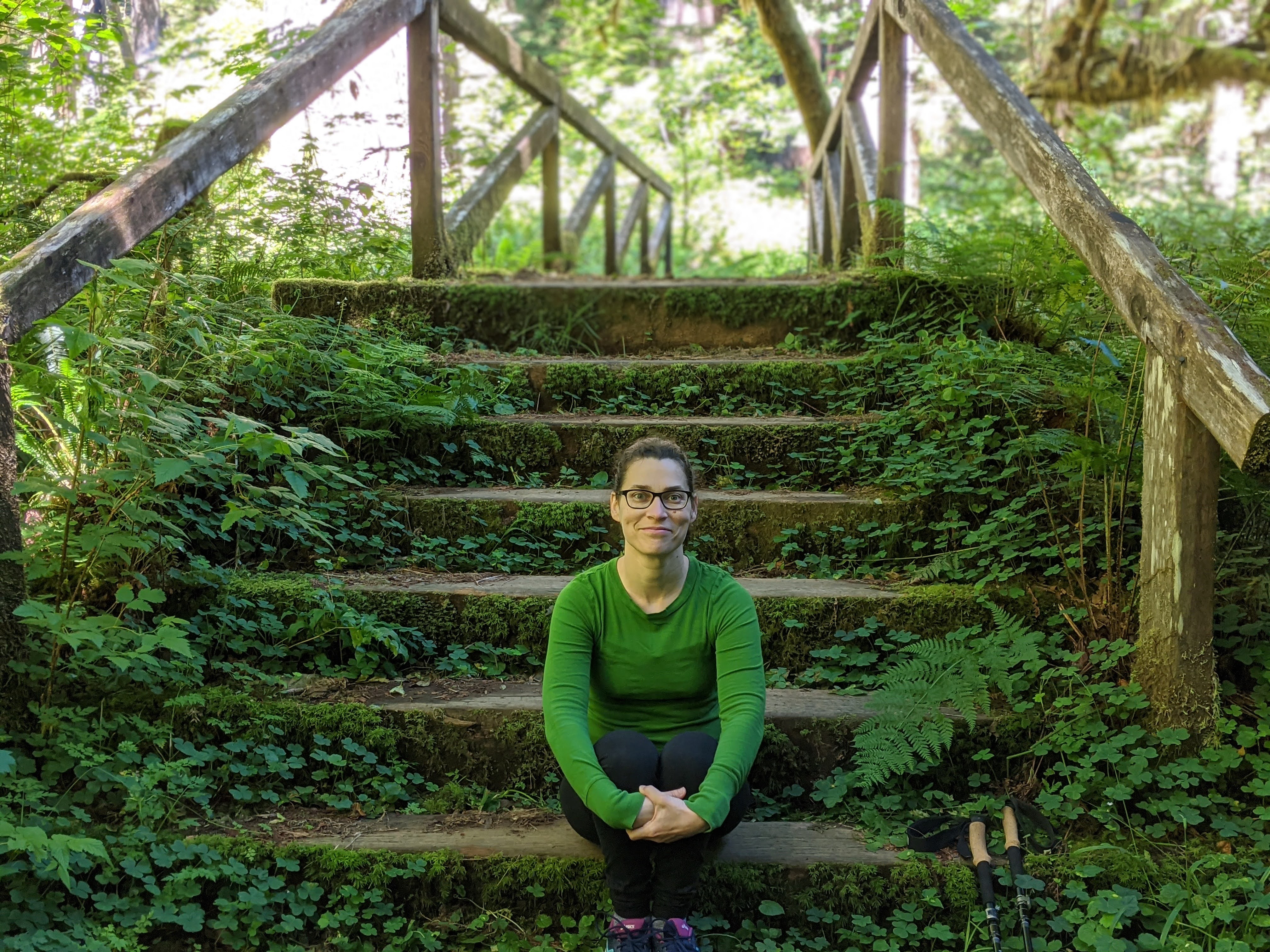
I tried to do my “squish” (engage my core), keep my poles close to my body, and keep my shoulders back and head up. Because I was holding my poles, I was not holding my husband’s hand as I would have been without them. And by “holding my husband’s hand,” I mean, gripping it, pulling it, nearly dislocating his shoulder. I even tried going up a step or two with just the poles before resorting to the (overgrown) handrail. We went over wooden bridges, and lots and lots of roots, and I did just fine. We saw snails and frogs. The air was cool. The trees were magnificent. And it was good.
After that, it was finally time to return to my life at home. With ExoSyms.
If you are on an ExoSym journey, you will hear a lot of talk about the store Wide Shoes Only in Renton, WA, about thirty-six miles from the Hanger Clinic in Gig Harbor.
We were not about to add seventy-two miles round trip to our drive south to Oregon the day we left Gig Harbor. But the discomfort I was experiencing on the top of my right foot and the continued recommendations from Ryan convinced us we should go.
Of course, the store was closed because of COVID-19, but we left a message and the owner got back to us, scheduling an appointment for us at 10am Saturday.
We packed up and I suited up, and we arrived in Renton early. By then, I needed to use the bathroom, so we drove to a waterfront park and pulled up near a picnic area with public restrooms. I approached the dreaded ramp out of the parking lot with snail-like speed, realizing with alarm that I had practiced stairs during training, but we never got to inclines! Ryan had mentioned something about going sideways, so I tried that. Kind of. Eventually, I made it to the restrooms. Give yourself lots of extra time in the beginning to reach important destinations like these.
Here’s something I’m not wild about. I got into the stall, settled my poles against the wall so they wouldn’t fall over, got the door closed, situated self on toilet, peed, got up. Then I had to handle my poles again. BEFORE WASHING MY HANDS. There’s no way around it until I can walk short distances without poles. I suppose while the pandemic lasts, there won’t be that many public restrooms in my future anyway.
Back at Wide Shoes Only for our appointment, Dominic measured my feet with my ExoSyms on. This man is a shoe professional and he is enthusiastic about it. Ryan is the ExoSym inventor and expert, and Dominic is the ExoSyms-with-shoes expert. No other shoe salesperson will know anything about ExoSyms until you walk in with yours and teach them. So Dominic taught me how to buy–and wear–shoes with ExoSyms.
First, Ryan doesn’t stock half-sizes at the Hanger Clinic, so do not take the shoes that Ryan provides for training week as the right shoes for you. It’s so important to be properly fitted; shoes that fit correctly make a difference in your ExoSym experience. It’s more than a little unfortunate that most of us are probably learning to walk (and work out) in ill-fitting shoes.
Second, the shoe shape (the “last”) is more important than the shoe size. Two different New Balance size 8s will feel different because they are different shapes. Pay attention to the model. Select a shoe with a roll bar for stability.
Huh. Look at that. It says “roll bar” right on the shoe.
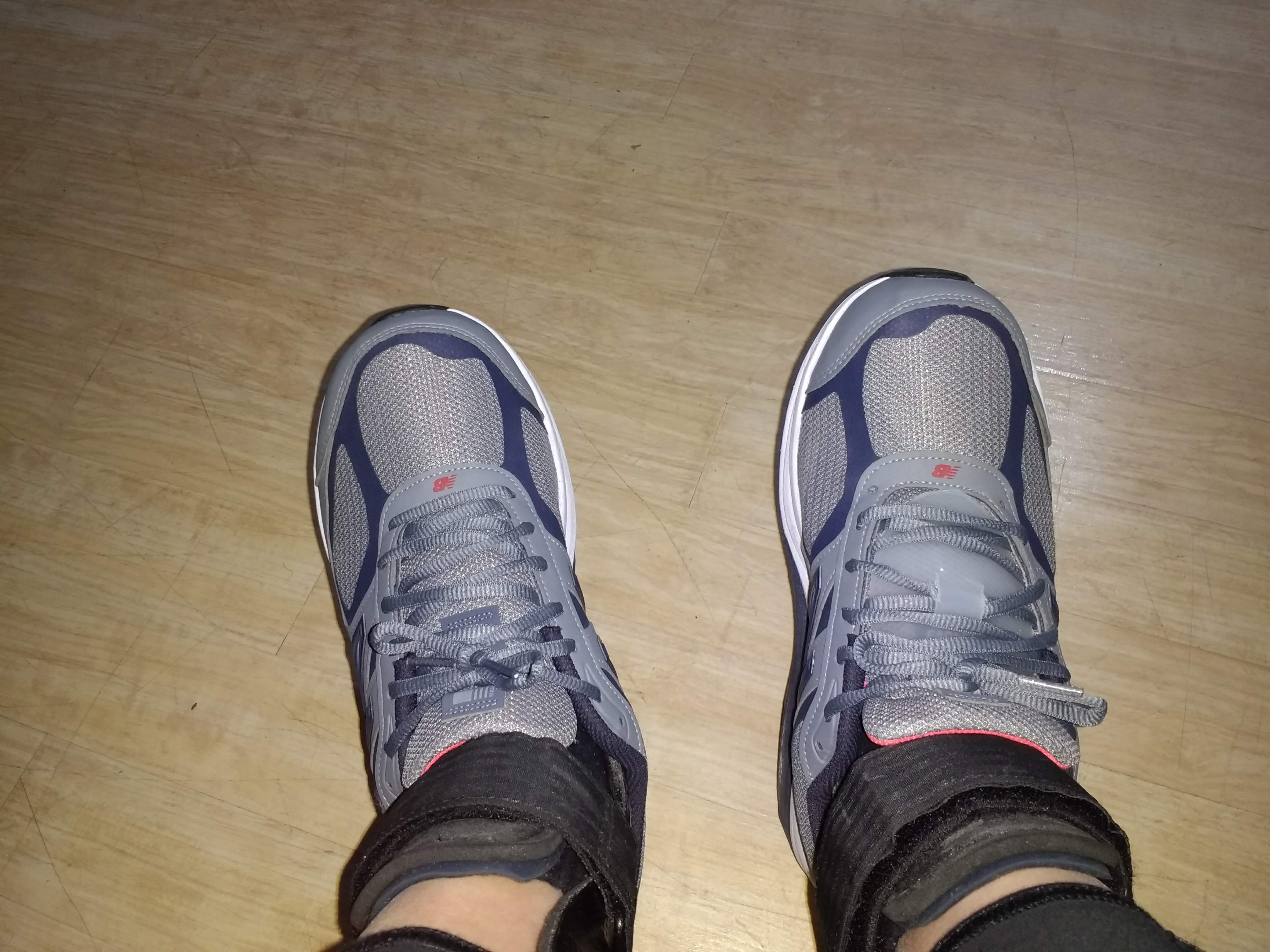
Without ExoSyms, I wear an eight, with a narrowish foot. It’s definitely easier to deal with shoes if you have two Exos and don’t have to split sizes. I also have two heel lift inserts that are the same height and will need to be worn with whatever footwear I’m choosing. Ryan put me in a 9 2E (left photo). Dominic put me in an 8.5 4E, the widest (right photo). Shoes that are too long will cause you to walk toes out and swing your leg around (think walking in flippers). I definitely do this, though I’m sure it’s not just because my shoes were a little big. Because of the lace guard that Ryan had given me for pain on the top of my right foot, Dominic showed me how to lace my right shoe completely differently. I had been wearing the 2Es with the laces as loose as they could be with barely enough left to tie. Dominic made sure I tapped my heel on the floor before tying my shoes very tightly at the ankle. A snug fit ensures that the brace doesn’t slip forward and backward in the shoe with each step. I was nervous it would be too tight and uncomfortable, but Dominic knows what he’s doing.
I hate shopping for shoes. If I find a pair I like, I’ve been known to buy two pairs so I don’t have to shop again for a while. I especially find it unbearable when the salesperson tries to help me put the new shoes on, bent over on their rolling seat with me trying to get my foot onto the slanted front. My foot goes stiff when it’s being wrangled into a shoe, so I usually say, “I’ll do it.” With Dominic and the ExoSym, my foot was already encased in the stiffest material imaginable, so it didn’t matter if it flexed involuntarily, and he had no problem getting shoes on and off for me. What a lovely, calm, unawkward experience it was to have the store to ourselves as well.
I left with so much new knowledge and three pairs of shoes. I have New Balances for every day, a “casual” pair, and “dressy” pair. The latter two will probably last me many years because they won’t be worn very frequently.
The takeaway: Do what you can to go to Wide Shoes Only and get fitted properly. It’s probably good to call so you can come in at a quieter time. Take what you learn home with you to your local stores. Leave room in your luggage for new shoes.
After he knows your size and your needs, you can also email Dominic about a shoe that you like the look of, and he will help you find a similar one that will work for you.
I’m so glad we took the extra time and miles to not only support a family business, but also to get me a good shoe education.
Training Day Five: Friday 19 June. 9:30–11:30, 2:00–4:00
Last night I fell asleep to a soothing voice intone, “Now we begin our body scan…” I hope all these meditations I don’t manage to stay awake for still help me subconsciously. Burning upper back woke me in the night.
This morning, I wait for the text from Ryan to let me know that my knee sections have been delivered. I am nervous; it feels like such a long build up. Jared has warned me, “It’s a lot of equipment. It’s going to seem heavy.” Ryan has assured me, “You’re going to make so much progress.”
I eat only a banana as I wait for the text. We’d hoped for 8am. I put on the longer brace sleeves I’d been given on Wednesday with my ExoSyms, so I am ready to just add the knee sections when we get there. At 9am, I get the text: they’re here.
At the clinic, my knee sections are sitting on the counter in the room with the long parallel bars. They seem really big.
Before we put them on, I let Ryan know that the additional adjustments he’d made to my right ExoSym the day before for burning in the heel were now causing painful pressure on the top of my foot. He takes my right shoe and relaces it, skipping the very bottom holes and adding a plastic lace guard to distribute the pressure of the laces across my foot. This does help, and we’re ready to go.
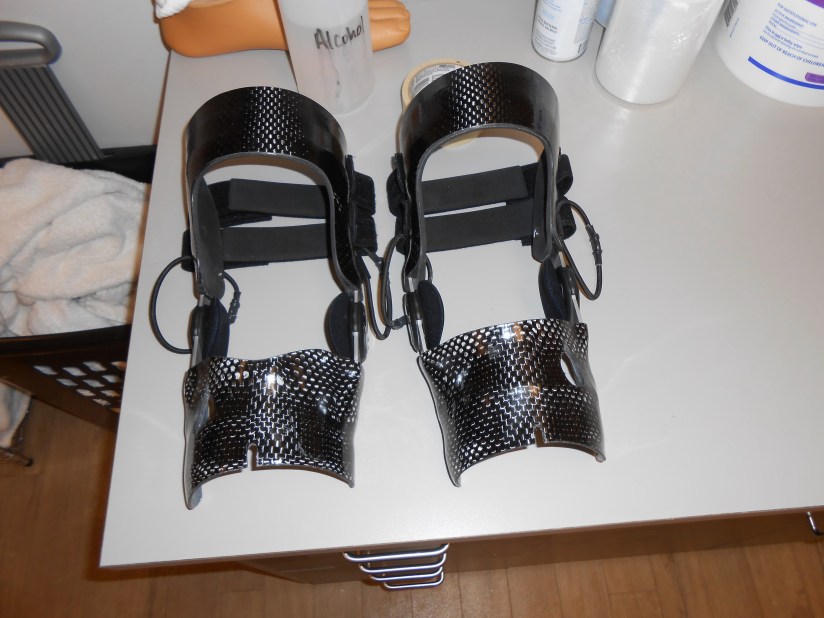
The knee sections are quite complicated to attach. Ryan shoves them over/onto the knee cuff of the ExoSyms, carbon fiber scraping against carbon fiber. Then he tries to show me how to shove the two openings in the lower piece of the knee sections over the waiting rivets on the knee cuff just right, like latching Oshkosh overalls. “There, that’s what I made you,” he says, and we’re all relieved that everything seems to be in working order now. I fasten two Velcro straps around the back of both thighs and Ryan hooks two hamstring assist bands around the metal pieces at the back of the knee cuff.
Up I stand, between the bars. My right foot feels indescribably weird. My toes are pointing out to the right, torquing me into an alignment I’d never felt before. It’s very uncomfortable, with pressure in all sorts of places, like my foot is on crooked, like I’d been casted for a broken bone incorrectly and this wonky cast needs to be cut off pronto. Instead, I’m asked to walk in it. My brain is scrambling and I ask why my toes are pointing out, voice a bit high. Ryan tells me everything looks good; it’s just that I’m more typically aligned. And that I can move my foot so it’s not pointing outward, shift from the hip. Of course, right, I can move my own foot. With effort, I get my toes pointing in a more forwardly direction. Simultaneously, there’s all sorts of sensations going on around my thighs. Rolling movements? But firm, especially around the back. Ryan had told me that the knee sections would give me more proprioception (body awareness) and stability. I hadn’t really understood how. I wasn’t prepared for everything to feel so weird. As I step, the cuff across the front of the thigh and the straps around the back put pressure into my leg at different points–constant feedback.
It takes a much shorter time than I was expecting for my brain to stop interpreting my right leg as #$@&!. My left side feels pretty good! Though it still doesn’t do as well as the right because the left is my weaker side. I wish my right side could feel as happy as my left. I quickly adjust to whatever is happening to my thighs and realize–I like it. It’s like a firm hug and a massage at once. I’m relieved that the added weight doesn’t feel “too heavy,” and I think in part it’s because I have two devices instead of one. With one, I’m sure the Exo side must feel weighed down in comparison.
Jared comes in for training and Ryan tells him before leaving that I walked with no hands yesterday.
“Can I see your new skills?” Jared asks.
I walk without using the bars for a few steps to show him my progress.
His response? “Are you using your squish?”
“Probably not,” I admit.
“I didn’t think so.”
So much for my new “skills.” Learning to walk in a new way is like learning to write in cursive after painstakingly getting the hang of printing. Smoothly connecting all the letters–all that processing needs to happen so quickly in order to make the word you want.
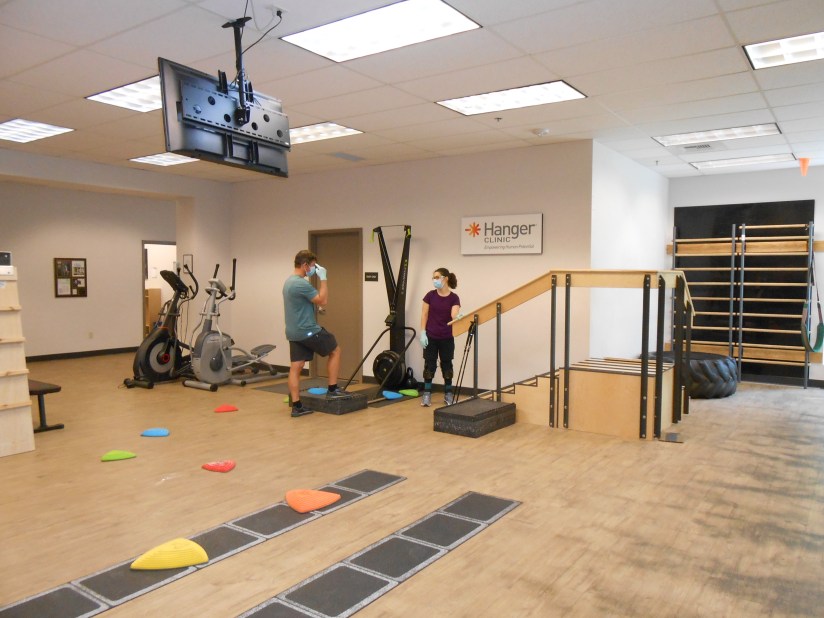
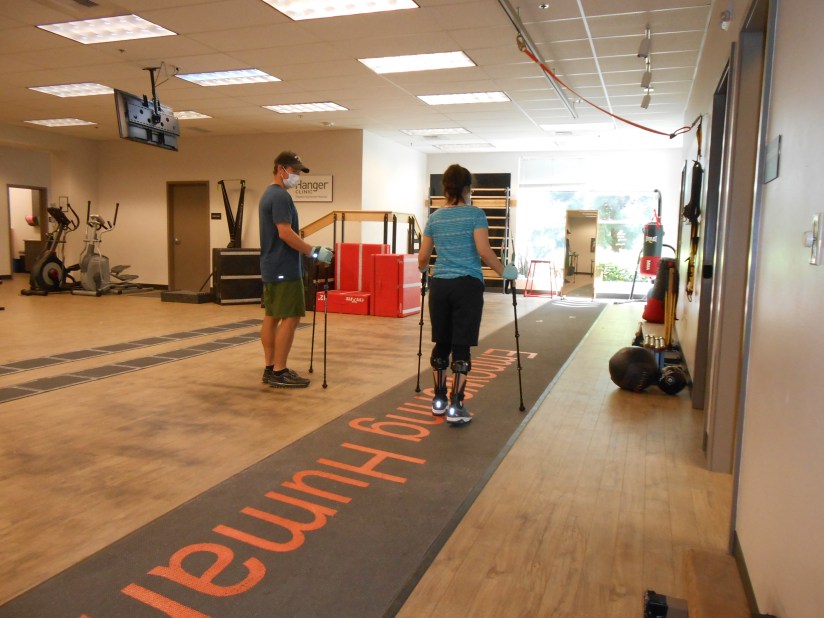
I walk up and down between the bars, and Jared makes me switch to walking backward pretty quickly, to work more on the hamstrings. Then he brings in a large red gymnastics-type block for me to push out into the gym, on my toes, hips forward. Down and back the length of the gym. He tells me we’re going to practice stairs, which means I need to walk over there. After a few steps, he gives me one pole. It’s his way of “tricking” me into trying more no-hands walking, sneaking it up on my subconscious rather than telling me: “Try to walk to the stairs without poles.”
The best moment I have all week comes next. This is the moment I really know these devices are doing something for me, even now when I’m not strong enough to use them properly. I’m standing in the gym–freestanding, nothing near me to grab–and my muscles tighten up as they do, knees bend. I am now off balance and pitch forward toward the floor. I think, here it finally comes, my first fall. This will be a great first fall because I’ll just tip right over, nice and easy. But I don’t. I hang there, more bent at the waist than I ever remember being without falling.
“You okay?” Jared asks mildly from somewhere above me.
“Yeah?” I say, disbelieving even as I successfully straighten up. What just happened? How am I still up here and not down there? How are they doing that?
We work at a set of practice stairs. One is a shallow set and across the landing and down the other side is a standard set. I muscle my way up, using the railing on one side and the wall on the other. There is a technique to learn for going down, though. With no ankle flexion, I have to position one foot with the ball and toes off the step, and step down with the other, ideally landing with that foot halfway off the next step. Meanwhile, the foot that was halfway off the first step has tilted off of it and is swinging through, ready to land correctly on the next one down. I absolutely understand the logic and can picture it in my mind. But. Short legs and spasticity do not lend themselves to stairs in the first place. For me, it’s more like plonk the foot down, position it correctly after two or three tries, plonk the other foot down…
Up again. Then down the standard set. Then up, and down the shallow set backward. Then up, and down backward. “Look up,” Jared prompts. Step. “Look up.” Step. “Look up.” Up and down again and again. With rests on a giant tire a couple times. He doesn’t tell me “Do ten,” but instead tells me, “Let’s take a break,” based on my body language. He’s figuring out how to adjust his approach just in time for our work together to be over. Five sessions isn’t a lot.
We go back to the weight lifting frame for more balance work. On the balance board, I cannot take both hands away from the bars. Jared asks if we’ve done the belt yet. I’m delighted to get another chance to put on the belt with the pole down my back. Still cannot take my hands away. I suggest getting off the balance board and just standing on the small block it’s on. Jared assents, but it’s a no go. “Look up,” Jared says. “Squeeze your buns.” He reminds me to squeeze my buns every time I feel unstable and start to crouch and collapse inward. It does help me straighten up and get my center of gravity back where it’s supposed to be. Again he wonders if it’s fear, though hastens to acknowledge that fear is real. I know there’s a psychological element at play. I tell him that I can stand in my ExoSyms and raise my arms above my head when I’m alone in the hotel room. He turns his back so no one is watching me, but of course it’s not the same, and I still can’t let go of the bars with both hands. Below you’ll find a series of clips, from the first near-panic moments of walking through the balance practice.
I push the red block up and down the gym one more time. Jared says it was nice working with me and thanks me for putting in good effort (or something like that). He realizes after a few days of working with me that I “do a lot of my work on the inside.” Probably in reference to my unexpected crying moment.
My last training session is over. We didn’t do as much today, my only day with knee sections.
Back at the hotel, we eat lunch. I don’t get a good nap, but rest with ice on my back. As I get ready to go back to the clinic for another solo session, I time myself. It takes a full ten minutes to put all four pieces and shoes on.
At the clinic, I am in the same room as the day before, with the short parallel bars. I ask for a mirror, and Ryan rolls one in. The mirror will help me know whether or not I’m successfully combating my hip drop. Perceptions are definitely faulty. One day this week when Jared was trying to get me to maintain level hips while on the balance board, I did my squish, held myself as level as I could, and asked, “Am I level?” Jared shook his head, came over, and moved my hips into a level position. Oh. I was way off. What’s more, I couldn’t re-create the proper posture on my next try, and Jared ended up bringing over a mirror.
Today, Ryan tells me to do some laps with two, one, and no hands. Some “fast,” and some slower, with concentration. He tells me to put all my weight on the standing leg and swing the other through, especially on the left. At least, that’s what I get out of his directions as he speeds away to meet other patients.
I tuck my shirt into my shorts, so I can see my hips better, and see when I tighten my core. Up and back six steps. Fast, slow. Different hands. Try to swing my leg forward without cheating by swinging out to the side and around. I explore balance. Focus on using my core properly to help bring the leg through, try to keep my squish, and squish in time with my steps. As I practice, I think that maybe Jared was having me do a lot that was simply too advanced, or that I wasn’t able to synthesize and apply fast enough. I start to understand better today what he wanted from me two days ago. Five days, ten hours really, is such a small amount of time to learn so much. I need much more repetition and reteaching of key concepts.
I continue to work, getting to know my devices, which after all, I’ve only had in their complete form for a handful of hours.
Then it’s time to take them off. Ryan shines them up for me. Gives me a stack of spare heel lifts for my shoes and several sets of hamstring assist bands. He shows me how to screw them into my devices in case one breaks. Ryan also removes the inner hamstring assist bands, leaving the outer ones. He will let me know when he thinks I’m strong enough to use both bands, based on the videos I send.
We go to his office for a bit of a debrief. I tell him about the lingering pain in the right foot. He says he can take the arch back down a little to relieve the pressure on top, but he thinks it will settle over time. I can always send it for adjustment if it’s needed. I decide to go with Ryan’s assessment and not make any further adjustments right now.
Ryan tells me this process will take patience and commitment, which I have shown a lot of this week. He reiterates that this is a partnership, and that I need to make sure my physical therapist gets in touch with him.
After I put my forest green pin in the world map, training week is over. Whew. Now I’m just supposed to wear them every day for the rest of my life. No big.
I have a big balance check before I even make it out of the lobby. Still so far to go to be comfortable just with walking.
Still, I made it through, and I do know it’s going to get so much better. Right now, I literally can’t imagine what it will feel like to walk easily, with a steady gait without poles. But I believe it will happen one day.
Anyone who knows me well would agree that I am cautious, do not take any physical risks, am rather skeptical in general, and pass judgments and make assumptions that are incorrect on a regular basis. These traits do not amount to the best recipe for personal growth. So, good job, me. Good job for trying hard things.
Training Day Four: Thursday, 18 June. 9:30–12:30, 2:15–4:00.
I wake up on this morning, having had enough upper-back-tension pain yesterday, in the night, and this morning–and knowing that I won’t have the knee sections–that I just want to get today over with. With these two significant bumps in the road, I’m feeling done. Ready to rest. But I have to do it.
What a doozy.
Ryan texted last night and this morning to check on my back. At the clinic, he asks how I’m doing. I tell him I’m doing better than yesterday. Pain is about a four. He does not like that at all and talks to Jared about having more of a recovery day. I am a little surprised. A four is pretty good. I thought we’d do the regular stuff, with fewer reps. But they seem intent on trying to help the pain go away. This belief that we can successfully improve the pain is a little bewildering to me. Especially here, with all the military connections, I figured it would be a “Work through the pain!” kind of environment.
Jared and I stay in a side room with parallel bars. He asks if I’ve ever had an adjustment. “Like at a chiropractor? No.” I’ve thought about it, but I’ve never been comfortable with that whole relax-on-command-even-though-you-know-I’m-about-to-do-something-sudden-to-your-body idea. He describes what he’s proposing, assures me no one has ever had a bad experience with it, and asks if I’d like to try it. Sure, might as well. I stand between the bars and put my hands behind my head (that is a challenge). Then he stands behind me and somehow reaches around me and up behind my head too. I then lean back into him, give him all my weight, and crack, crack, crack, he lifts me off my feet for a second. And one more time, crack crack. Do I feel much different? No. But it is satisfying to hear all those cracks.
We stand against a wall with the parallel bars in front of us. He wants me to flatten the small of my back against the wall (knees bent), and then push against the bar to flatten my back all the way up, doing a kind of chin tuck at the end to stretch out my neck. It’s really hard to maintain the pelvic tilt and do all the rest. The bar is a little too far away for me to use it effectively. Jared tries attaching big foam bolsters around the bar to make the distance smaller. When that doesn’t work, we spend a lot of time taking this huge long bar out of its three legs, flipping it over so it extends toward me more, and trying to get it back into its three legs at the same height again. All so I could push off of it to do a stretch that I can’t really feel stretching anything. This chin-tuck neck stretch is something I was given years ago. Why am I not just lying down to do this?
He asks about the (semi) daily stretches I already do, several for the upper back and shoulders, and quads, calves, hamstrings, and hips. “Well, those all sound good.” Yes, and even though I’ve improved at them, my body doesn’t feel noticeably better.
We go out into the gym to work on the exercise my physical therapist calls, “T-bar with bobble head.” At home, I lie on a yoga mat, knees bent, arms straight up, Theraband in my hands. I then take my arms out into a T until my hands reach the floor. Shoulder blades are back and down “in my back pocket.” Once I’m in the T, I shake my head. This is to get the neck to relax while still engaging the traps. My shoulders blades are squeezed together, chest out. Does my neck relax? No.
Jared has me try variations of this. I lie down under a parallel bar. He drapes a giant, thick, stretchy band over the bar. It has so much resistance, I can barely move it. He has to add an extra loop so it’s longer.
Trying to work on a foam roller.
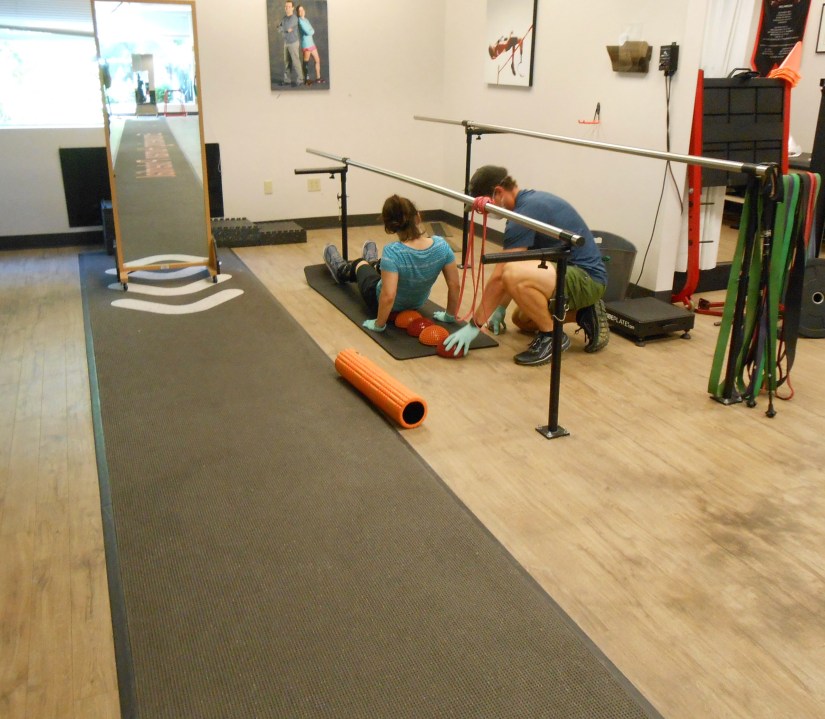
I try lying on a foam roller. It supports my spine while my feet stay on the floor. But it rolls too much for me to balance well. (Or, I am unable to balance well, so it rolls too much.) Jared tells me to carefully lower myself to the floor. I scoot/roll/slide gracefully off the roller. “Or that,” Jared says. Hey, that is “carefully lower” in CP Land.
They don’t have a half roller anymore because it got destroyed as an element in obstacle courses. So Jared improvises with a line of spiky half ball things up my spine. I like these. They feel pretty good.
Spiky balls are nice.
“I’m realizing that’s about as high praise as you give,” Jared says.
Well, I mean, ExoSym training week is not a place for tons of great fun. Maybe for other, once-able-bodied people. Not for CPers with spastic diplegia. I do ten reps with the band on the spiky balls.
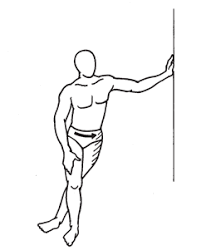
Jared also shows me a standing piriformis stretch that I really like. See? Really like. You stand on the side you want to stretch and cross the other leg over (or the picture shows behind) the standing leg. Then you just stick your hip out and twist your upper body until you feel a good stretch. I twist and bend over the parallel bar, holding on with both hands.
Twist the upper body and bend at the waist.
This one is not easy. But it is better with a foot against the couch.
So much easier than getting down onto the floor and somehow achieving the right amount of stretch by pulling on my own leg. “It’s a good stretch, and I don’t have to get on the floor,” I say, wondering why no one had shown me this before.
“I’m sensing that’s a big thing with you,” Jared remarks.
At first I’m surprised that it’s not immediately clear that getting down onto and up from the floor is indeed a big thing with me, but then I remind myself that although Jared can see the way I move–and understands the mechanics very well–that doesn’t mean he knows what it feels like to operate this body. I wonder if he’s familiar with Spoon Theory?
It’s time to get to walking again. Jared talks about putting all my weight on the stepping leg and swinging the other one forward–letting the device swing it forward if I’m doing it right. We talk about my poles. Apparently, I haven’t been moving opposite arm and leg together consistently. I’ve been doing Pole. Foot. Pole. Foot. Four separate movements. I know I’ve had the poles pretty far out in front of me to create a wide base for stability, like the four legs of a chair. But this instinct has me leaning forward, straining my arms, and not keeping my weight into the devices. I understand that I need to be standing straighter, with the poles closer to me. It makes sense. That doesn’t mean I can actually do it yet.
Jared shows me options for pole technique. Poles in unison, like a skier. (Nope.) Or alternating hand and foot, like I thought I was doing. He wants me to keep my elbows by my sides and angle the poles back, which puts my wrists in a much better position. “Use them to propel you forward!” I’m not ready to be propelled forward. I completely understand the why behind this method. But I cannot do it. When I angle my poles back, I cannot move. I cannot step forward with the support behind me instead of in front of me.
Jared continues to explain and encourage, and I keep trying, taking deep breaths, emotions running high. I do not have the balance or strength yet to move this way. I put my poles back again. “There! That’s good!” he says, even though my lower body has not moved. I feel one hundred percent truly and actually stuck with the poles in the “correct” position.
Have you ever had the experience of helping a child with math, or something else they struggle with? You’re explaining with enthusiasm, thinking it’s rightfully complex but things are going well, and then the child is crying. Frustrated? Overwhelmed?
I keep trying to breathe through my feeling of “I literally cannot do this.” I try to simply let him know my present reality of “I don’t have the stability to do this right now.” The tears come anyway. I am grateful that my mask and glasses cover my weepy face and my snot.
Jared politely ignores the tears and acknowledges my struggle. He wonders if it’s a mental block/fear.
I say, “Maybe partly, but it also feels legitimately physical.”
He asks if I’d be willing to try it in between the parallel pars, lowered to hip height and positioned closer together. Yes, of course, I’ll try again. Jared leaves me in the safety of the bars and goes to meet another patient. I am able to use the bars to steady myself without letting go of the poles, so I’m more comfortable trying the new technique. But I still really struggle with the mechanics of it all with my muscles so weak.
I’ve only been at it a few minutes when Ryan stops by to check in and release me from this PT session. He asks how I’m doing.
“Physically, better. Emotionally, it’s been a tough day.”
“What about it has been tough?”
“Trying to do stuff I just can’t do yet,” I answer, getting a bit teary again. I always say “yet” or “right now.” I understand I am at the beginning.
Ryan acknowledges that I have emotions to process. “And I’m all for that.” He reminds me again that it’s a process. That I’ll be sending videos to him every week, that he’ll still be there. He wants me to know that I’m doing well, that I’m actually doing better than other CP cases he’s had. He assures me of this. Asks how I feel about it.
When it’s clear that he’s waiting for an answer, I say, “Um. Well, it’s kind of irrelevant because we’re not supposed to compare ourselves to people.” I would have liked it to come out more eloquently than that, but it didn’t.
I wasn’t upset that I was doing badly or that other people had done better. I wasn’t upset that I couldn’t do this thing. I’ve lived my whole life with limitations. I have no problem recognizing my limits, and I had no delusions that they would disappear. It wasn’t that I couldn’t do it–I’ve got that down. I was overwhelmed because all of Jared’s effort, expertise, enthusiasm, and good intentions were focused on me alone, and I was being asked/urged to do these things right now. I needed more practice, more time, to process and to try, without pressure.
Ryan tells me to go eat and rest and that I’m welcome to come back after lunch. “How do you feel?”
“Right now I don’t want to,” I acknowledge. “But I know I need to use this time.”
“You don’t have to.” He really means it. “I’ll leave it up to you.”
Of course I have to come back. We didn’t come all the way here for me to decide to not keep working.
I switch to my regular shoes and Dad and I walk back to the hotel. I am able to use my poles slanted back and alternating on this walk. After lunch I go straight to sleep, still feeling emotional. I wake up with drool on my pillow. Good nap.
In the afternoon, Dad walks me back to the clinic, and I go in alone. I change into my ExoSyms in the lobby and manage to put my backpack away in the room with the cubbies (first door on the right) by myself and make my way across the gym. I have the room with the really short parallel bars, a chair at one end. I practice with the poles between the bars. I’m able to do the slanted thing somewhat, sometimes.
I realize that what I need is to fall. I need to experience a fall. I need to know what it sounds like–carbon fiber clattering together–and what it feels like. It needs to be somewhere I know I can get back up. Not here, on linoleum. In the ExoSyms, even with poles, several times a day, I have the full-body clench, loss-of-balance moment, but so far I’ve caught myself. A fall will happen. The certainty of it looms, couched in suspense and the unknown.
Ryan checks in and advises me to step and squeeze my glute, really focusing on a good heel-toe on the left. I set aside my poles, and I am left alone to practice between the parallel bars. Six steps. Turn. Posture. Relax toes. Again. Trying to do hips forward like Jared said and glutes like Ryan said. Calm and careful. Feeling better.
I just needed time and a safe space to make friends with my devices. Slow, curious. No hurry. No audience or analysis. I stand between the bars, spend time learning how far forward or backward I can shift my weight before my balance goes. Yes, I can let go of the bars and raise my arms when I’m alone.
I practice getting my weight over my hips and keeping it there with each step instead of hinging forward. Squeeze each glute. Put all the weight into one foot, and let the other swing through, heel-toe. Forge new neural pathways. Walking feels different when I successfully use these techniques. Not so much like cement ski boots. Good different. Better.
I walk up and back for about an hour and a half, taking pauses in the chair. I feel like I can start experimenting with taking one hand off the bar. My left side locks up and I can’t swing my right leg through. But a few times I get it. Two steps with just one hand hovering over the bar before I lose it.
If I move my arms like a power walker, it helps me keep my forward momentum, even though my left leg wants to tense up and halt everything. I have a tiny taste of achieving an actual walking stride. I try again and again. I’m just finishing a full length of the bars with no hands when Ryan checks in.
He is properly excited for me and praises my accomplishment with feedback: “What you did with your arms looked better than with your sticks!”
I do a few more laps with poles to continue to try to coordinate those, already stiffening up and losing my rhythm. Ryan, like Jared, suggests putting my hands through the straps and twisting the straps to give my wrists support. I mention my concerns about falling with my wrists through the straps. “Don’t fall,” he says. If that isn’t perfect able-bodied advice.
I get the right ExoSym adjusted again because the heel still burns. Fortunately, it doesn’t take an hour this time, and then we walk back to the hotel.
Food, ibuprofen, journal, meditation, sleep. Day four complete.







 What Happened to Your Legs?