
Disclaimer: This post and the ones that follow are going to recount my ExoSym Training Week at Hanger Clinic in great detail. They are meant to be a record for me and provide an account for CPers who are embarking on their own ExoSym journey.
I’m back from the Hanger Clinic with my ExoSyms.
Burning question: Was I able to walk out of there, ready to start my new life wearing the devices all the time?
Short answer: No. It’s going to be a very long process.
Saturday and Sunday are travel days. When we left off, I was lamenting new arm/wrist/thumb pain. And then I was marveling at improvements after an OT session. I have kept up with my new stretches pretty well, even though it feels a little silly to exercise my thumb. I love that I can do these stretches sitting at a table. No getting onto the floor and contorting and straining. Just movin’ my thumb. During the long hours in the car from California to Washington, I am amazed that my shoulder blades feel somehow lubricated. That when I stretch my neck, I can feel the muscles stretch rather than stay clenched in tension. I just hope it will last.
As a point of reference, here is what I look like in mid-June walking on my own and with poles. (After seven months of trying to work on core and glute strength with a home program set up by my PT.) I don’t often see myself walking, and honestly, it doesn’t feel as tough as it looks. It’s my normal. But man, that looks laborious. With the poles, I can see that I’m standing taller, with less side-to-side sway.
Training Day 1: Monday, 15 June. 9:30–2:15.
Monday morning, I feel curiosity and a cautious anticipation. It’s just going to be how it’s going to be. Mostly, as I do my stretches, I am super happy that my body is feeling pretty good, that my neck still feels like the vise has loosened.
My parents and I (my husband stayed home working this time) walk the few blocks from our hotel to the Hanger Clinic, where we are required to don not only masks, but also gloves. I quickly realize my cloth mask isn’t going to work with my glasses if I also want to see, even though it was supposed to mold to my nose. So I switch to the disposable provided. Hands are immediately sweaty. Not the most fun way to begin, but I appreciate the extra caution.
Prosthetist and ExoSym creator Ryan Blanck begins the day reiterating everything from my first trip last November. I have some permanent limitations and I have some weaknesses that have occurred, not because of the original cerebral bleed at birth, but because of the resulting body mechanics and compensations. For example, I have spasticity (increased muscle tone) that’s not going anywhere. I also have a weak core, but I should be able to strengthen that. It’s nice to hear someone tell me a lot that I already know about my body because it’s rare to meet someone who really understands how CP works. The devices are designed for a stronger, future me. It will be tough in the beginning and it will take time. Ryan also emphasizes that we are partners in this, for years to come. He wants text updates and weekly videos showing my progress. He wants to be in contact with my physical therapist. And he really means it.
At 10am, he brings in my ExoSyms, real carbon fiber now, with struts and all. He also brings in my shoes and heel lifts that go inside them from last November. He helps me put the devices on and checks the fit. “I’ll be impressed if you get the shoes on,” he says as he walks out the door to another patient. Maybe he just likes setting people up for success. Shimmy the shoe back and forth until it goes over the heel of the device, and it’s not too hard. He did let me know that it’s easier to do one device and one shoe before starting on the other leg, otherwise your carbon-fiber covered feet just slip everywhere.


Yes, the devices are heavy and bulky. They still feel like ski boots, but this time I am prepared for that. Ryan is still not in the room, but I pull myself up between the parallel bars and start walking up and down. Heavy, awkward, loud. But now I know that I need to learn to use them and to build up muscles over time. I am not able to imagine, right now, what it will feel like to move in them more freely, but I believe that it will happen.
When Ryan returns, it’s time to get casted for the knee sections. Aha, that explains why there is a cast cutting saw and casting supplies by my chair. Somehow it didn’t occur to me that the knee sections are just as customized as the ExoSyms themselves. Ryan starts by wrapping my leg in plastic wrap, starting at the bottom of the knee cuff on the ExoSym and going all the way to my upper thigh. It’s certainly an interesting, rather intimate experience. We roll the legs of my shorts up, with my consent. I can barely stand with my legs far enough apart for him to squeeze the roll of plastic between and around my thighs. After the plastic wrap comes the plaster. Then I have to stand there, keeping my knees as straight as possible while the casts dry.
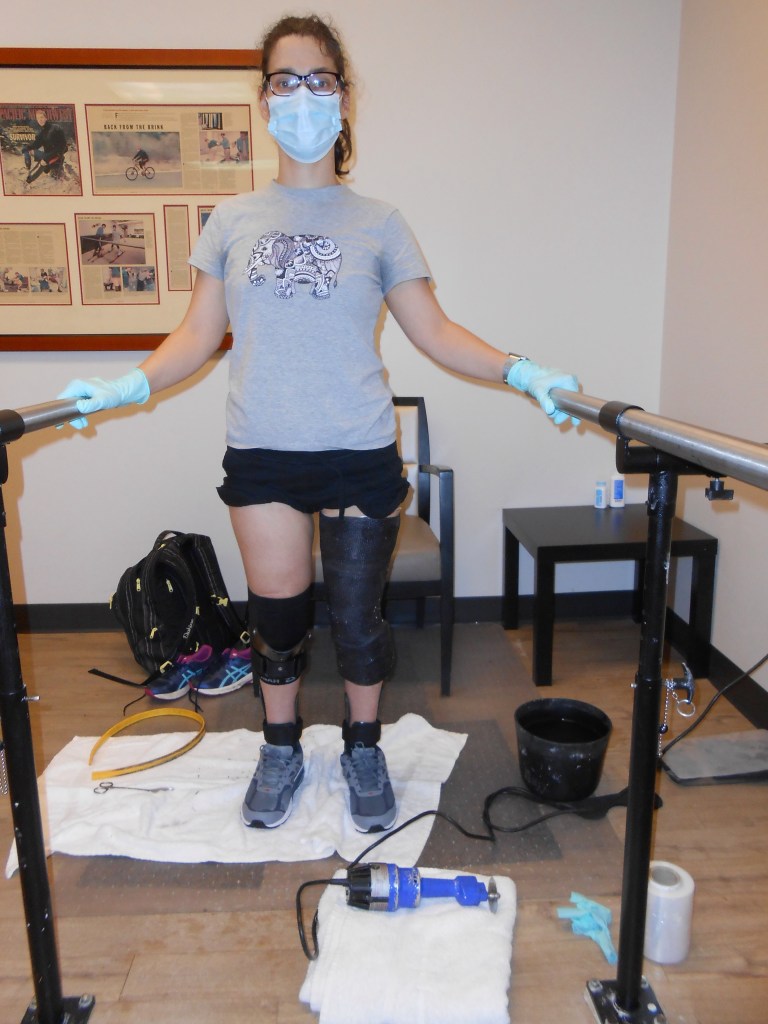
The yellow strips that he uses to guide the saw are up the back of my leg this time, so I cannot see him as he cuts the casts off. I grip the parallel bars tightly as the saw starts up, and the noise of it cutting into the plaster, combined with the intense vibration, takes me straight back to getting casted for AFOs as a child. The dreaded “tickler.” It does actually tickle, because the back of my thigh is very ticklish. But not in a good way. At all. I breathe through it, and one and then the other are done. Ryan takes the casts away and I practice walking more, with my poles this time.
Next, we go out to the front desk to hand over the cashier’s check for half the total amount. (I chose the in-house payment plan of half up front and the other half spread over nine months.) Thanks, Mom and Dad. I sign some papers and receive a hard copy for myself.
Then we return to the gym area. During this time, because of COVID-19, they ask that patients only have one support person in the gym, so Mom and Dad take turns being the photographer/videographer.
Ryan introduces us to Jared, the physical therapist. He then introduces me and my cerebral palsy to Jared. Ryan recommends training on flat surfaces only until my knee sections are ready, and then he’s off to other patients. Jared tells me a little about himself and his approach. He lets me know that, though he may seem like a drill sergeant sometimes, he has enough in his repertoire that if there’s something I’m not comfortable with, he will be able to adapt it. He reiterates that these devices are designed for a future, stronger me. He realizes that sometimes our minds understand actions that our bodies don’t know how to do yet. He asks what I want out of training, and I tell him my three goals: walking, stepping up and down (as from a curb or bus), and getting down onto and up from the floor.
We go over to the parallel bars, and the first thing he teaches me how to do is “load” the devices. This means leaning into the knee cuffs, putting your weight into them and keeping it there throughout the step. First, he has me lean forward onto my hands until my heels come up. Then I take steps on the balls of my feet, trying to keep my shins into the cuffs and engage my core. Next I come down from the balls of my feet, and I’m supposed to do the same thing–no leaning forward. I’m doing better keeping my weight into the device with one side than with the other. Jared demonstrates what I’m doing wrong, and I try to fix it. Then he gives me a different verbal cue, and that works better. I am praised for being able to modify my gait successfully. Synthesizing verbal and visual instructions into a physical outcome is no joke.
After learning to load the devices, it’s time to work more on core engagement. Jared asks if I’m willing to try wearing a tight belt with a pole down my back. Sure. When he returns with the equipment, he asks my permission to put the belt around my waist. When I say yes, he does so, and tightens it. It’s REALLY tight. The pole goes between my shoulder blades and through the belt, creating a gap at my lower back. Jared puts a mini bottle of baby powder into the gap, telling me to squish the bottle using my core. Let me be clear. Intellectually, I understand the action. It’s a pelvic tilt. I have never been able to do this well, especially while standing. (My pelvis is busy when I’m standing, and you want me to tilt it?)
I don’t know that I actually squish the bottle, but my back contacts it, at least. As I “squish,” my heels come up off the floor. This is what everyone means when they say “engage your core” when walking. It actually helps power each step. Huh.
Jared tells me, “Do 100 please.” Then he amends, “You already did ten, so do ninety more.” So I stand there holding on to the parallel bars and do ninety more squishes. Jared had already let me know that he only counts to one, so I knew to keep track myself and never ask him what number I’m on. When I make it to 100, I walk. It takes several tries to put the squishes together with walking between the bars.
Next Jared gives me my poles and takes off my corset. I immediately feel like I’ve lost the squish, even though I’m keeping my weight into the knee cuffs. I ask if it’s possible to cheat somehow, because I seem to be doing it, even though I can’t feel it. Jared assures me that there are several indicators that I am doing it correctly and asks for one of my poles to demonstrate. I hand it over and I feel, right at that moment, as if I’m teetering on the edge of staying upright. I can barely listen and feel a little panicky. I want to reach out and take my pole back from him. Relief floods me upon its return.
I walk along the gray walkway really trying to load my devices, really careful and concentrating. Then he asks me to walk as fast as I can, without thinking about all that. It’s maybe half my typical speed? I don’t know. Extremely slow and laborious. And not yet possible at all without poles.
We return to the parallel bars and Jared has me step up onto a very low box and down. Up again and down backwards. You can see in the video that I do a double take at that. (Yes, we did discuss how Ryan distinctly said flat surfaces only.) I can do this, stiffly and slowly, as long as I am holding on tightly with both hands.
I tell him at some point, during some activity, that my toes are gripping and my calves are tightening up. Ah, he says, in recognition. He has me step up onto an electric vibration plate next to the parallel bars. I hold on to one bar with both hands, nervous. I have heard of these, but I’ve never used one. He asks whether I want him to start in at full speed, or go low to high. I say start low. He turns it on, and before I can process any sensations, it’s all the way up. Holy moly! Almost indescribable. My vision is vibrating. My brain. If I shift, I feel it in my vertebrae. By turns amazing and completely unpleasant. Jared leaves me there, vibrating for two minutes or more. This is a very long time. When he returns, I am more than ready to get off. I suppose it could relax me if it didn’t freak me out.
We try to do more balance work, like raising my arms above my head. My toes are relaxed for one or two seconds before they grip up again. Lastly, he tells me to grip a very thick band in both hands that’s looped around one bar and raise it straight up. This I cannot do at all, but I am stronger on one side than the other. Jared is noting how my body functions.
My first session with Jared is over! I practice walking some more while waiting for Ryan. When he asks how everything is going, I tell him that my right heel is burning, and my left a little, too. He has me take off my ExoSyms to make some adjustments. We wait a long time, about an hour. If Ryan tells you “a few minutes,” be prepared to wait longer.
He brings back my ExoSyms with more arch support, to offload the heel. When I put them back on, the arches feel very noticeable, hard and uncomfortable, but the heels are better. Soon, I don’t notice the arches so much. Ryan bids us goodbye, telling me to do ten good steps in the hotel room, without letting the left hip sink. “Ten good steps are better than 100 bad ones.” It’s 2:15 by the time we leave, and we’d been there since 9:30. Lesson: If something hurts, tell Ryan as soon as you realize it, just in case he’s less busy then. Also, if you have downtime and you’re mobile, use it for restroom/water/food, even if you think it’s just going to be a minute. You’ll probably have plenty of time.
Recall that we had walked to the Hanger Clinic from the hotel. Recall that I had just put on my ExoSyms again to check the heel/arch. Mom and I walk out of the clinic, so relieved to take off our masks and gloves and breathe freely again. I figure I might as well try walking back to the hotel. I don’t want to sit down and take everything off and switch to my other shoes. It’s not that far, and it’s flat. Sure.
As soon as we leave the building and reach the parking lot, I realize it’s a bad idea. I am tired. I can’t remember any of the pointers I’ve been given, and my gait feels so uneven. Like I’m lopsided. Then I reach the first curb cut–up–and I almost fall over backward. Unlike any experience I’ve had. No wonder Ryan told me to stay on flat surfaces. There is no ankle flexion when in an ExoSym, and inclines need a special technique. I haven’t learned to do that yet. There are several more curbs to come. I walk so slowly, inching along, trying not to panic at the course I’ve set myself on.
We make it to the hotel, finally. And I’m never doing that again.
I am very tired, and I have VERY sore glutes medius. Food, ibuprofen, journal, meditation, sleep. Day one complete.

 What Happened to Your Legs?
Wowowow! You’re doing it!!! So exciting. Sending love.
LikeLike
Thank you!
LikeLike