Training Day Three: Wednesday, 17 June. 10:30–12:30, 3:15–4:15.
Today was a day.
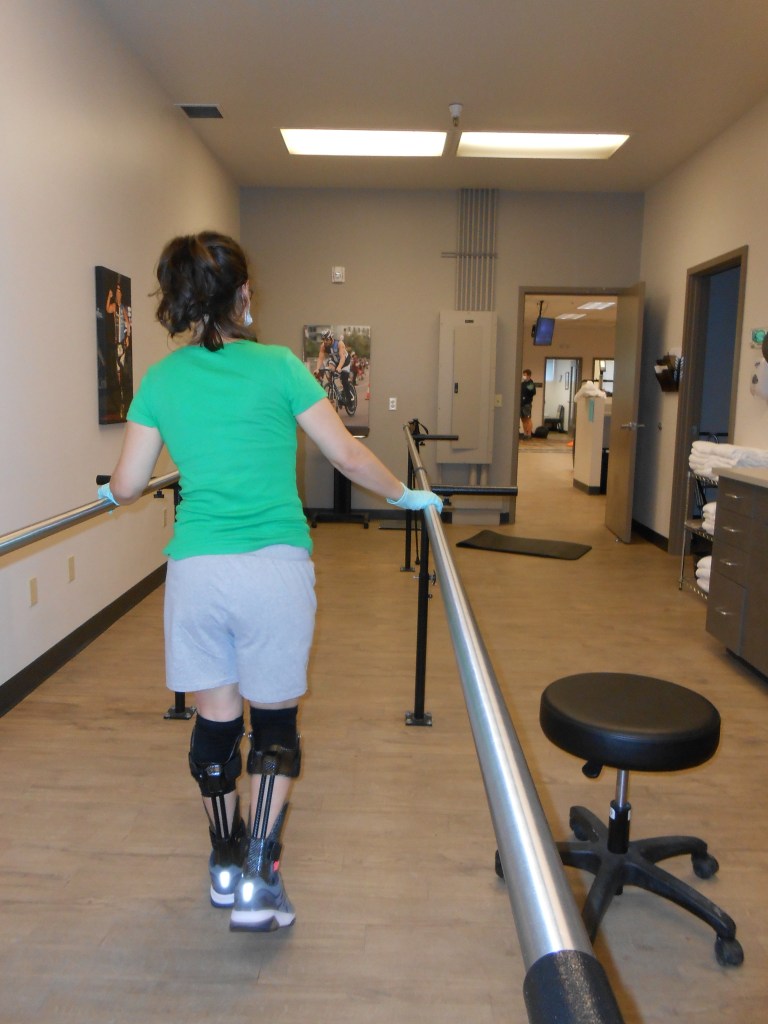
The hoped-for, early morning knee sections delivery does not happen, so we go to the clinic for my regular PT session with Jared. I “warm up” in a room with parallel bars, while Jared finishes up with someone else in the gym. Ryan stops in and tells me the knee sections aren’t ready yet, but he hopes they will be in the afternoon.
With Jared, I start with the ab work that we figured out yesterday. Three sets. At the parallel bars, Jared puts a rectangle of cardboard under one foot. It has carpet on the bottom, so it should slide easily on the linoleum. The goal is to slide the rectangle backward without bending my knee. I do not understand how this is possible. My right foot gets it sometimes, but my left foot can’t quite do it. My right glutes/piriformis area cramps up with the effort, and I start to beat on it with the side of my fist. Like I do. Jared disappears and returns with a massage gun. After I say I’m willing to try it, he puts it right where I point and turns it on. It sounds like a jackhammer. It feels like way too much, but it is more effective than my fist.
It wasn’t this exact one, but you get the idea.
Next, Jared gets another carpet, so I have one under each foot. As I grip a parallel bar with both hands, I try to move my toes out and toes in. I can hardly move the carpet, and I feel it in my glutes and inner thigh. “Do thirty,” he says.
Right now, my left knee collapses inward quite a bit. These rotation exercises are to help strengthen the outer hip so that my knees won’t tangle with each other. In the CP world, this is called a “scissor gait.” With the knee sections on, there will be bulky equipment there to exacerbate the issue. Jared warns me that many patients are surprised at how heavy they are, how much equipment it is to get used to, and that people can sometimes feel emotionally weighed down as well. “We call these devices instead of traditional braces because it’s a whole system. The knee sections, the hamstring assists are optional. You might wear just the left until that side is stronger like the right, and then wear both.” He’s trying to prepare me, wants me to know it doesn’t have to be all at once. I appreciate that. And I wonder what hamstring assists are? I’m ready to come back and find out in the afternoon.
The last thing I do with Jared is stepping over “hurdles.” I say “hurdles,” because you will see in the video that the hurdles have been completely flattened. I practice taking bigger/higher steps, supposedly using my abs and doing my squish. I really don’t know how to coordinate hands, feet, abs. Up and back six times, never really getting the hang of it.
I am very good at stepping ON the hurdles, but not quite OVER them.
Ryan takes my ExoSyms to prep them for the knee sections and tells us to come back at 3pm.
At the hotel, we eat lunch and I take a nap. When I wake up at 2:30, the muscles between my shoulder blades are extremely tight. The pain is quite strong, quite bad. I’m used to having neck and shoulder tension, but pain like this, right between the shoulder blades, is new to me. I take some deep breaths and ask my dad how to stretch that area. He shows me how to raise my arms up by my ears, cross my hands, and intertwine my fingers while keeping my head up. When I try it, I just can’t do it. It burns so much. I’m crying now, taking huge, deep breaths not really on purpose. My arms and hands tingle. My heart pounds. I take an ibuprofen while Dads rolls a frozen water bottle over my back. Still gulping air. Feeling shaky, a little ill. It’s time to go back to the clinic, but Dad tells me to lie down so he can do the ice treatment a little longer. We won’t be keeping Ryan waiting; he has plenty to do.
We walk the few blocks back to the clinic. (My mom has the car in Seattle.) I wonder if I’m going to make it. Still taking huge breaths, but my heart rate is down now. After we get there and get on our masks and gloves, the ibuprofen seems to be kicking in. I love how sometimes medicine seems to actually help now. What a concept.
I feel a lot better, though still quite tight, by the time I sit down next to my devices. Ryan says there’s “something weird” going on with them.
Ryan has added a layer of dense foam padding on the inside of the knee cuffs. This is much better, feels firmer holding me up. I had been wondering why the cuffs had so much space between them and my shins. They now also have metal pieces coming out of them in a few places on the outside. I assume for the knee sections to attach to somehow.
But he takes a knee section, puts the top part over my thigh, and just looks at it. Says he’s never experienced anything like this in ten years. A “knee section” is two pieces that connect at a hinged knee. Everything is made in-house at Hanger. But he sends the knee parts to California to get riveted together because he doesn’t have a riveter at the clinic. Whoever riveted my pair has connected the left bottom piece to the top right piece and vice versa. A human error. And there’s nothing Ryan can do about it except overnight them to California to get fixed and have them overnighted back. Which means I will have my complete devices on my last day. One day of training instead of three. Great. It’s not his fault, and he’s very apologetic. It’s frustrating, but we can’t do anything about it.
I tell Ryan about my muscle tension and he puts me on the vibration plate for a couple minutes. He has me practice walking for a bit and gives me some stretches for my back. Then I change back into my regular shoes and we walk back to the hotel.
I think Ryan has a more incremental approach than Jared. Ryan: “Go slow. Rest. Get used to them.” Jared: “Do thirty, please.” We really don’t know what my limitations are. I had no idea I was straining my back so much. I need to ease up tomorrow because this is awful.
Food, more ibuprofen, more ice, journal, meditation, sleep. Day three complete.
I start the morning with a check-in/ pep talk from Ryan: The body, the mind, and the ExoSym are like three different sheets of music. They’re all doing different things and they need to come together as one. It’s a big ask for me to use muscles I’ve never used before.
While I wait for Jared, Ryan gives me the assignment of walking up and down the length of the gray walkway with poles, in front of a mirror to watch for hip drop. I’m looking forward to continuing to work on my squish and load the devices properly. I hope I get to use the pole-and corset combo again. But it turns out that I’m in for completely different stuff today.
Jared arrives and tells me to continue walking: 10 up-and-backs. Before I finish, he stops me and asks me to walk backward. I knew I’d be asked to do many things I am not comfortable with. That’s the point. I told myself before I came that I would attempt everything without making a big deal out of it. Walking backward first thing on day two is a big ask. I can’t help but remind Jared that I usually have a hand holding on to something at all times. That it feels very likely that I’ll fall over backward in these things. I’ve already had a few suddenly-off-balance, full-body clenches. Not to back out or protest, exactly. Just to let him know that this isn’t going to go smoothly.
My legs aren’t strong enough to step backward without my upper body leaning forward to try to help. “Try not to hinge at the waist,” Jared says. Yeah, no kidding. I put enormous pressure on my hands/wrists/arms leaning so much on the poles. Plus, these things are heavy. Jared tells me to put my hips forward. When I lean my upper body forward, I am not “loading” the devices anymore; my weight comes away from the knee cuffs instead of going into them. I need to do so much work on my core.
I have over two minutes on the vibration plate today. I feel it in my teeth. It’s so weird and exhausting. But nice? When I step off, my lower legs feel completely heated up. The synthetic sleeves under the braces are so hot.
Next, it’s time for balance work. I stand between two vertical metal bars (like for lifting a barbell while standing). Put my feet together and apart. Try to take my hands off the bars. Step up onto a small block. Jared brings over a mirror so I can see if I’m keeping my hips level. I am not. My body and brain do not know how to correct this. Now take one hand off the bar, then the other. My toes and calves clench and my knees want to buckle.
The only thing my body really refuses to do is let me raise my arms over my head or out in front of me. I’m not ready to let go of the bars for that long yet. Mental block or physical limitation? Both, I think. Perhaps I could have done it were I not on the block, or if I were between parallel bars instead. Next, we try the balance board, again trying to stand level and take one hand away.
Following that, I do some ab work on the floor. That means that I have to get down onto the floor. Jared uses a bench and shows me a couple different positions. One is spreading legs far apart and bending one knee. That one is definitely out. The other is going into a lunge position and bending the back knee to the floor. I try that one. Before my back knee is down to the floor, the ExoSym on the front leg bites into the back of my calf. Hmm. Once I’m kind of kneeling, I’m kind of stuck. I’m supposed to move one hand from the bench to the floor and lower myself down the rest of the way. I do it, ExoSyms clattering together as I position myself on my bottom somehow.
Clear view of the struts up the back.
We try several positions for me to engage my core well. I end up on my back with one leg bent, one straight, a folded yoga mat under the extended foot so it will slide even with my shoe on. I bring the extended leg in and back out, keeping my core engaged, trying to use my hamstring but actually kinda tweaking the front of my hip.
Jared has another patient, so he brings the bench and mat into a side room with parallel bars. He assigns me 9 more sets (eight on the right, twelve on the weaker left). In between each set, I am to stand up (haul myself up using the bench), walk up and down between the bars, and get myself back down onto my back with my foot correctly positioned on the folded mat. Nine times. Sure, no problem. Ryan pops his head in and asks how I’m doing. From the floor, I say I still have seven more. I mean seven more complete sets, but the next time he comes in, I’m up between the bars, and he plucks the mat off the floor and starts sanitizing it. I feel very relieved. My right side is starting to hurt anyway. You can see in the video that Ryan has me progress to only using one hand on the bars. He’s encouraging about my hip drop. Then he tells me he’ll see me tomorrow. I still had four or five more sets to go. Don’t tell Jared.
Walking with two hands and then one. In between sets of ab work on the floor.
I am supposed to come back early in the morning to get my knee sections. I am nervous because I know that they will add so much more bulk and weight. But I’m also ready because they keep telling me how much progress I will make with knee sections. They should be ready by 8am. I will wait for a text from Ryan to confirm.
Food, ibuprofen, journal, meditation, sleep. Day two complete.
Disclaimer: This post and the ones that follow are going to recount my ExoSym Training Week at Hanger Clinic in great detail. They are meant to be a record for me and provide an account for CPers who are embarking on their own ExoSym journey.
I’m back from the Hanger Clinic with my ExoSyms.
Burning question: Was I able to walk out of there, ready to start my new life wearing the devices all the time?
Short answer: No. It’s going to be a very long process.
Saturday and Sunday are travel days. When we left off, I was lamenting new arm/wrist/thumb pain. And then I was marveling at improvements after an OT session. I have kept up with my new stretches pretty well, even though it feels a little silly to exercise my thumb. I love that I can do these stretches sitting at a table. No getting onto the floor and contorting and straining. Just movin’ my thumb. During the long hours in the car from California to Washington, I am amazed that my shoulder blades feel somehow lubricated. That when I stretch my neck, I can feel the muscles stretch rather than stay clenched in tension. I just hope it will last.
As a point of reference, here is what I look like in mid-June walking on my own and with poles. (After seven months of trying to work on core and glute strength with a home program set up by my PT.) I don’t often see myself walking, and honestly, it doesn’t feel as tough as it looks. It’s my normal. But man, that looks laborious. With the poles, I can see that I’m standing taller, with less side-to-side sway.
Training Day 1: Monday, 15 June. 9:30–2:15.
Monday morning, I feel curiosity and a cautious anticipation. It’s just going to be how it’s going to be. Mostly, as I do my stretches, I am super happy that my body is feeling pretty good, that my neck still feels like the vise has loosened.
My parents and I (my husband stayed home working this time) walk the few blocks from our hotel to the Hanger Clinic, where we are required to don not only masks, but also gloves. I quickly realize my cloth mask isn’t going to work with my glasses if I also want to see, even though it was supposed to mold to my nose. So I switch to the disposable provided. Hands are immediately sweaty. Not the most fun way to begin, but I appreciate the extra caution.
Prosthetist and ExoSym creator Ryan Blanck begins the day reiterating everything from my first trip last November. I have some permanent limitations and I have some weaknesses that have occurred, not because of the original cerebral bleed at birth, but because of the resulting body mechanics and compensations. For example, I have spasticity (increased muscle tone) that’s not going anywhere. I also have a weak core, but I should be able to strengthen that. It’s nice to hear someone tell me a lot that I already know about my body because it’s rare to meet someone who really understands how CP works. The devices are designed for a stronger, future me. It will be tough in the beginning and it will take time. Ryan also emphasizes that we are partners in this, for years to come. He wants text updates and weekly videos showing my progress. He wants to be in contact with my physical therapist. And he really means it.
At 10am, he brings in my ExoSyms, real carbon fiber now, with struts and all. He also brings in my shoes and heel lifts that go inside them from last November. He helps me put the devices on and checks the fit. “I’ll be impressed if you get the shoes on,” he says as he walks out the door to another patient. Maybe he just likes setting people up for success. Shimmy the shoe back and forth until it goes over the heel of the device, and it’s not too hard. He did let me know that it’s easier to do one device and one shoe before starting on the other leg, otherwise your carbon-fiber covered feet just slip everywhere.
Putting on my ExoSyms for the first time
Ready to take my first steps
Yes, the devices are heavy and bulky. They still feel like ski boots, but this time I am prepared for that. Ryan is still not in the room, but I pull myself up between the parallel bars and start walking up and down. Heavy, awkward, loud. But now I know that I need to learn to use them and to build up muscles over time. I am not able to imagine, right now, what it will feel like to move in them more freely, but I believe that it will happen.
ExoSyms are clunky and loud. But you can see the heel-toe gait that I feel rather indifferent about in this moment.
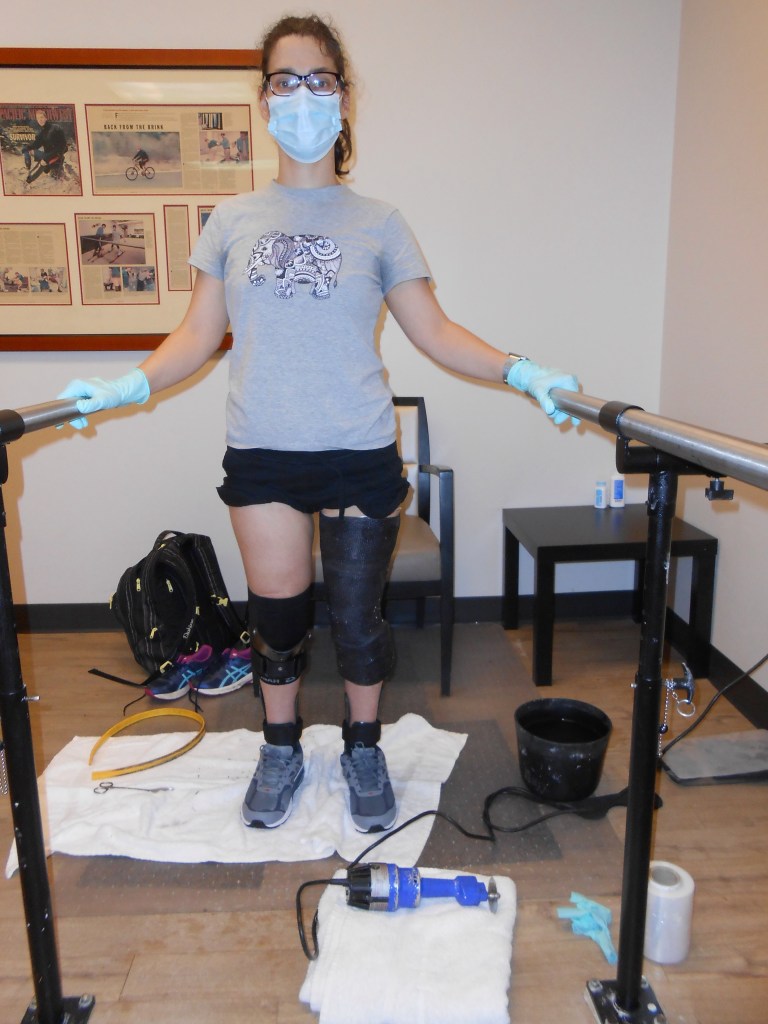
When Ryan returns, it’s time to get casted for the knee sections. Aha, that explains why there is a cast cutting saw and casting supplies by my chair. Somehow it didn’t occur to me that the knee sections are just as customized as the ExoSyms themselves. Ryan starts by wrapping my leg in plastic wrap, starting at the bottom of the knee cuff on the ExoSym and going all the way to my upper thigh. It’s certainly an interesting, rather intimate experience. We roll the legs of my shorts up, with my consent. I can barely stand with my legs far enough apart for him to squeeze the roll of plastic between and around my thighs. After the plastic wrap comes the plaster. Then I have to stand there, keeping my knees as straight as possible while the casts dry.
The yellow strips that he uses to guide the saw are up the back of my leg this time, so I cannot see him as he cuts the casts off. I grip the parallel bars tightly as the saw starts up, and the noise of it cutting into the plaster, combined with the intense vibration, takes me straight back to getting casted for AFOs as a child. The dreaded “tickler.” It does actually tickle, because the back of my thigh is very ticklish. But not in a good way. At all. I breathe through it, and one and then the other are done. Ryan takes the casts away and I practice walking more, with my poles this time.
Trying to walk with poles
Next, we go out to the front desk to hand over the cashier’s check for half the total amount. (I chose the in-house payment plan of half up front and the other half spread over nine months.) Thanks, Mom and Dad. I sign some papers and receive a hard copy for myself.
Then we return to the gym area. During this time, because of COVID-19, they ask that patients only have one support person in the gym, so Mom and Dad take turns being the photographer/videographer.
Ryan introduces us to Jared, the physical therapist. He then introduces me and my cerebral palsy to Jared. Ryan recommends training on flat surfaces only until my knee sections are ready, and then he’s off to other patients. Jared tells me a little about himself and his approach. He lets me know that, though he may seem like a drill sergeant sometimes, he has enough in his repertoire that if there’s something I’m not comfortable with, he will be able to adapt it. He reiterates that these devices are designed for a future, stronger me. He realizes that sometimes our minds understand actions that our bodies don’t know how to do yet. He asks what I want out of training, and I tell him my three goals: walking, stepping up and down (as from a curb or bus), and getting down onto and up from the floor.
We go over to the parallel bars, and the first thing he teaches me how to do is “load” the devices. This means leaning into the knee cuffs, putting your weight into them and keeping it there throughout the step. First, he has me lean forward onto my hands until my heels come up. Then I take steps on the balls of my feet, trying to keep my shins into the cuffs and engage my core. Next I come down from the balls of my feet, and I’m supposed to do the same thing–no leaning forward. I’m doing better keeping my weight into the device with one side than with the other. Jared demonstrates what I’m doing wrong, and I try to fix it. Then he gives me a different verbal cue, and that works better. I am praised for being able to modify my gait successfully. Synthesizing verbal and visual instructions into a physical outcome is no joke.
After learning to load the devices, it’s time to work more on core engagement. Jared asks if I’m willing to try wearing a tight belt with a pole down my back. Sure. When he returns with the equipment, he asks my permission to put the belt around my waist. When I say yes, he does so, and tightens it. It’s REALLY tight. The pole goes between my shoulder blades and through the belt, creating a gap at my lower back. Jared puts a mini bottle of baby powder into the gap, telling me to squish the bottle using my core. Let me be clear. Intellectually, I understand the action. It’s a pelvic tilt. I have never been able to do this well, especially while standing. (My pelvis is busy when I’m standing, and you want me to tilt it?)
I don’t know that I actually squish the bottle, but my back contacts it, at least. As I “squish,” my heels come up off the floor. This is what everyone means when they say “engage your core” when walking. It actually helps power each step. Huh.
Jared tells me, “Do 100 please.” Then he amends, “You already did ten, so do ninety more.” So I stand there holding on to the parallel bars and do ninety more squishes. Jared had already let me know that he only counts to one, so I knew to keep track myself and never ask him what number I’m on. When I make it to 100, I walk. It takes several tries to put the squishes together with walking between the bars.
Next Jared gives me my poles and takes off my corset. I immediately feel like I’ve lost the squish, even though I’m keeping my weight into the knee cuffs. I ask if it’s possible to cheat somehow, because I seem to be doing it, even though I can’t feel it. Jared assures me that there are several indicators that I am doing it correctly and asks for one of my poles to demonstrate. I hand it over and I feel, right at that moment, as if I’m teetering on the edge of staying upright. I can barely listen and feel a little panicky. I want to reach out and take my pole back from him. Relief floods me upon its return.
I walk along the gray walkway really trying to load my devices, really careful and concentrating. Then he asks me to walk as fast as I can, without thinking about all that. It’s maybe half my typical speed? I don’t know. Extremely slow and laborious. And not yet possible at all without poles.
We return to the parallel bars and Jared has me step up onto a very low box and down. Up again and down backwards. You can see in the video that I do a double take at that. (Yes, we did discuss how Ryan distinctly said flat surfaces only.) I can do this, stiffly and slowly, as long as I am holding on tightly with both hands.
I tell him at some point, during some activity, that my toes are gripping and my calves are tightening up. Ah, he says, in recognition. He has me step up onto an electric vibration plate next to the parallel bars. I hold on to one bar with both hands, nervous. I have heard of these, but I’ve never used one. He asks whether I want him to start in at full speed, or go low to high. I say start low. He turns it on, and before I can process any sensations, it’s all the way up. Holy moly! Almost indescribable. My vision is vibrating. My brain. If I shift, I feel it in my vertebrae. By turns amazing and completely unpleasant. Jared leaves me there, vibrating for two minutes or more. This is a very long time. When he returns, I am more than ready to get off. I suppose it could relax me if it didn’t freak me out.
We try to do more balance work, like raising my arms above my head. My toes are relaxed for one or two seconds before they grip up again. Lastly, he tells me to grip a very thick band in both hands that’s looped around one bar and raise it straight up. This I cannot do at all, but I am stronger on one side than the other. Jared is noting how my body functions.
My first session with Jared is over! I practice walking some more while waiting for Ryan. When he asks how everything is going, I tell him that my right heel is burning, and my left a little, too. He has me take off my ExoSyms to make some adjustments. We wait a long time, about an hour. If Ryan tells you “a few minutes,” be prepared to wait longer.
He brings back my ExoSyms with more arch support, to offload the heel. When I put them back on, the arches feel very noticeable, hard and uncomfortable, but the heels are better. Soon, I don’t notice the arches so much. Ryan bids us goodbye, telling me to do ten good steps in the hotel room, without letting the left hip sink. “Ten good steps are better than 100 bad ones.” It’s 2:15 by the time we leave, and we’d been there since 9:30. Lesson: If something hurts, tell Ryan as soon as you realize it, just in case he’s less busy then. Also, if you have downtime and you’re mobile, use it for restroom/water/food, even if you think it’s just going to be a minute. You’ll probably have plenty of time.
Recall that we had walked to the Hanger Clinic from the hotel. Recall that I had just put on my ExoSyms again to check the heel/arch. Mom and I walk out of the clinic, so relieved to take off our masks and gloves and breathe freely again. I figure I might as well try walking back to the hotel. I don’t want to sit down and take everything off and switch to my other shoes. It’s not that far, and it’s flat. Sure.
As soon as we leave the building and reach the parking lot, I realize it’s a bad idea. I am tired. I can’t remember any of the pointers I’ve been given, and my gait feels so uneven. Like I’m lopsided. Then I reach the first curb cut–up–and I almost fall over backward. Unlike any experience I’ve had. No wonder Ryan told me to stay on flat surfaces. There is no ankle flexion when in an ExoSym, and inclines need a special technique. I haven’t learned to do that yet. There are several more curbs to come. I walk so slowly, inching along, trying not to panic at the course I’ve set myself on.
We make it to the hotel, finally. And I’m never doing that again.
I am very tired, and I have VERY sore glutes medius. Food, ibuprofen, journal, meditation, sleep. Day one complete.
My trip begins tomorrow, and I spend next week at the Hanger Clinic in Gig Harbor, Washington, learning to use my ExoSyms.
But first, I must document yesterday, June 10. At 9am I went to my first occupational therapy appointment for my wrists/hands/thumbs. I gave her the whole story about using trekking poles and then having pain and not using them (for months with no improvement). And now I need to use them, so I need help. From behind masks, we did the strength and range-of-motion baseline assessments. My therapist told me that it sounds like I have several things going on (yay). She gave me exercises for De Quervain’s tendonitis and the radial nerve. Showed me how to massage the palm side of my forearm with two tennis balls taped together. I’ve never thought about those muscles being tight before, but she said they were. She massaged them with cocoa butter, which was the first time I’ve had human contact from someone other than my spouse in three months. She showed me how to tape my thumb and wrist and also approved of the brace I’d tried. Made adjustments to my trekking poles to try to keep my wrists in a good position. Sent me on my way. Productive appointment.
Later in the day, my neck and shoulders–the whole trapezius–began to feel different. Tingly. A little like the clamp on my neck that’s been pulling my head and shoulders painfully toward each other for four years was…loosening. Some. I got down onto the floor and carefully went through the stretches I’d been given years ago (and still attempt regularly). And I felt actual stretching, not just fighting against tension. Huh. Perhaps this was how it was supposed to be all along. Perhaps this is why physical therapists often seem a bit skeptical/frustrated when I tell them stretching only feels the same or worse. Because I’m supposed to feel this instead of that. Maybe now all those things I’ve tried before will actually work? Quick, somebody give me some Flexeril! Kidding. Sort of. After stretching, I meditated (third consecutive day!). And darned if I didn’t achieve a full-body floaty relaxation. Wow. What’s going on? This morning, when I sat down to put on my shoes, I think it was just a bit easier to bend over and reach and pick up my shoe from the floor.
So what did it? Did I just need someone to massage my forearm with something that smelled like chocolate? I’ve had my forearms massaged before. Maybe not for that long in just that way. I am getting better at meditating. Maybe that’s it. Distance learning is finally over for the summer. Maybe that’s it.
It’s not as though my neck pain is gone. There’s still a long way to go. But now I know that less pain is possible. That I can continue to work to loosen the clamp.
It’s ExoSym time! I’m trying to be excited and positive, but honestly, I’m scared of how hard this is going to be. I’ve never asked my body to do something like this, and I don’t know how it’s going to handle it. I cannot expect to strap them on and go like so many others. Another ExoSymmer with cerebral palsy pointed out that it’s a little like having surgery. A period of rehabilitation must follow. There might be pain; there will definitely be soreness. We have to give ourselves time to adjust and build our strength. Weeks. Months. Years.
Megan, who blogs at Wheatfield Ramblings, has very helpful advice for people who are just starting their ExoSym journey. One tip she gives is come with goals. Here are mine:
During my week at the clinic, I would like to learn how to:
Walk
Step up and down, as with a curb or onto and off of a bus
Get down onto and up from the floor
After all, I have to start at the very beginning. It’s a very good place to start.
You know how there are dog years and human years? A thirteen-year-old dog is old, but a thirteen-year-old human is not.
There is also cerebral palsy time. Generally speaking, people with physical disabilities use more energy than their able-bodied peers to do the same tasks. I don’t know for certain how much more energy I use to walk a mile than a nondisabled person. But I’m pretty sure it’s a significant amount. My fitbit says my heart rate is 90 or more, while my husband’s is in the neighborhood of 70.
Spoon Theory was originally coined by Christine Miserandino when she was trying to explain to a friend what it feels like to live with lupus. It’s meant to help someone understand invisible disabilities, or conditions that are disabling but are not immediately visible. It has since been applied to disabilities in general, and some even embrace the term “Spoonie.” I do not, because I do not need any cutesyfication of my life.
Spoon Theory goes something like this. Everyone starts out the day with a certain number of spoons. Various tasks use up various numbers of spoons. When you’re out of spoons for the day, you are done. Let’s say I have twelve spoons. For me, taking a shower uses up two spoons, getting dressed one, putting on shoes, one. Getting to work could be one or two or three, depending on whether I walk or bus and whether I have a seat on the bus or stand. So let’s say I’ve used up six spoons and it’s only 8:30 in the morning. Time to start my day. Able-bodied people maybe use–one or two? So, I don’t shower in the mornings. I conserve those spoons for the work day and shower later. Cooking takes spoons. Standing, chopping, getting chopped food into pot without spilling. Going back and forth for ingredients and utensils. Emptying the dishwasher, as I’ve described before, takes spoons. Laundry. Spoons. If you sleep well, you can replenish your spoons. If you don’t, you may start out the next day with fewer spoons. Chronic pain affects sleep, etc. etc. Some days might be better than others and you seem to use fewer spoons on the same tasks.
Story time: I stayed with my sister for a week and did the cooking. We picked out some tasty new recipes that were more complex than my usual beans-and-rice fare. Her kitchen is way bigger than mine and I didn’t know where anything was. Sure, new recipe, bigger kitchen, and new layout will take some getting used to. But wait, the stove is in the corner, with no countertops next to it. It’s one of those cool antique gas ones, and I literally cannot touch its surface safely once the burner is going. So I’m supposed to bring a dish of mixed ingredients/liquids over to a bubbling pot and pour it in. Remember, I have trouble stopping my body’s forward motion. Enough with the excruciating minutiae. The meal took many spoons.
Sometimes I feel like I should/could be doing more. I work 23 hours a week (well, I did when school and tutoring were held in person). I know that all of you who work full time and more can hardly imagine the luxury of working part time. So much time to fill with all the things you actually want to be doing!
But really, when I make it through the day, even if that day ends at “only” 2pm, I feel done. Twenty-three hours in CP time has to be close to forty in able-bodied time.
Most nights, I call from the bedroom to my husband in the living room, “Did I make it?”
And he’ll respond, “9:02.”
“Yes! Good night.”
Sometimes, it will only be 8:43, and I’ll have to make myself stay awake for seventeen more minutes.
Functioning takes energy. Fatigue is real. Pain is real. Working part-time is okay. A person’s value is not measured by how many paid hours are in their day. That’s a hard one, American people, but it’s true.
Not all disabilities are immediately apparent like mine. I’ve had to grow and learn and discover that there are many, many conditions out there that are disabling. What’s more, chronic conditions are loads of unpredictable fun. People can feel okay to walk one day, and need assistive equipment another.
If someone uses disabled seating, or restrooms, or parking–believe them. Remember that you do not know this person or what they live with or what it feels like to inhabit that body and that brain. Let’s all try to be kinder, more empathetic. Let’s all try to imagine others complexly.
For the various muscle tensions and pain that come with my cerebral palsy, here’s what I’ve tried and my experiences with them.
Moist heat/cold packs: These feel nice in the moment, but offer no lasting effects. Nonetheless, I have a heating pad plugged in next to my bed at all times, and various herb/grain packs in the freezer that I use both heated and chilled. Mostly, they are comforting and make me feel like I’m doing something to take care of myself even though I know it doesn’t really help.
Muscle rubs/sprays: Various brands, most of which give a cooling sensation. Again, they don’t do much. Every once in a while, I think I can feel my neck let go slightly, for a moment. I have also used them in combination with other methods.
Various OTC pain relievers: Don’t you love it when doctors ask, “Have you tried ibuprofen?” Why, yes. Yes I have. “Did it help?” No. No it did not. If it had, I would not have felt compelled to make an appointment and get myself to this office and talk to a doctor for fifteen minutes. The truth is, I’ve never been able to tell if NSAIDs do anything. They might do a little, sometimes? For me to really know, I’d have to do the exact same scenario two ways, one medicated and one not, and directly compare them. But the time space-continuum doesn’t allow for that. Is it really true that people can take ibuprofen and actually feel better?
Voltaren: prescription topical gel (designed for arthritis) on my knees. Nada.
Flexeril (cyclobenzaprine): This is a muscle relaxant I was prescribed for my neck, only meant to be taken for two to three weeks. I was uncomfortable with the idea of being on prescription drugs. Because it can cause drowsiness, my doctor told me to take it before bed. I did that once or twice and felt no different in the morning, so I put them in the back of the medicine cabinet. Months later, when I was having a rough neck-pain day, I decided to take one. I promptly spilled the remaining pills into the (wet and not particularly clean) bathroom sink, and that was the end of that experiment.
Physical Therapy (childhood and adult): I had PT as a young child, and again for rehabilitation after surgery. Since my CP gives me muscles that are both tight and weak, PT focuses on stretching and strengthening, especially my hips (and hamstrings and adductors and etc.). As an adult, I’ve been referred for my SI joint, knees, and neck. None of my pain has been an acute onset as a result of injury. My pain just happens. All the issues I’ve ever gone to physical therapy for are still there. That would lead me to the conclusion that physical therapy does not work. But it’s not that simple. A physical therapist’s job is to set you up with a program you do at home, supposedly multiple times a day (ha!). Sometimes I do the program consistently for a stretch of time, and sometimes I don’t. Most often, I get home and try to replicate what we did and find that I’m straining something else in the process. Then I go back the next time and adapt it, etc. If a therapist could visit my home every morning and evening, maybe there’d be progress…? Even when I do succeed, like in stretching and strengthening my traps, that has not resulted in any noticeable decrease in my overall neck pain. While that’s extremely disheartening, I can also say that PT is probably not making anything worse overall, so I might as well keep trying it. At least I feel like I have someone who is trying to help me. And it’s my cheapest in-person option.
Ultrasound: I’ve had ultrasound done on my neck and shoulders a couple times as part of a PT session. It is meant to give a deep heat to the muscles and increase circulation. It was lovely to lie on my stomach, with the headrest set at just the right angle, and have some prewarmed goo gently massaged into my neck. Sure, the deep heat was relaxing. Maybe if it were for an hour instead of ten minutes, and I could fall immediately to sleep afterward? No lasting effects.
Pilates: I attended private pilates sessions for a number of years, even going twice a week at times. Did it help? I couldn’t tell you. I do know that I enjoyed having one-on-one time with an extremely knowledgeable and empathetic professional in a nonmedical setting. I can tell you that I became ever so slightly stronger and more flexible. But it was also during these years that the knee pain and neck pain appeared. I’m not blaming the pilates at all, just pointing out that it’s hard to measure improvement on the pain scale when new issues present themselves. I enjoyed being able to lie down while another person grabbed all the pillows and props I needed to be supported just so. I enjoyed being able to focus on a particular movement or muscle group. I enjoyed trying to apply various verbal cues to my body (“Imagine your pelvis is full of sand…”) and being cheered on: “Yesss! Yesyesyes!” As though, sometimes, I was able to do something well.
Massage: I’ve had several massages. I really enjoy the massage while it’s happening. I like that attention is paid to the palm of my hand and to my eyebrows, to muscles large and small. I like the quiet and the dark. However, I lament the whole process. Taking off my shoes and clothes, climbing onto the table, getting settled under the sheet. Having to turn from my front to my back in the middle of the session, on something raised high off the floor and narrower than a bed. And then, when I’m nicely relaxed, having to climb down off the table, put on my clothes and shoes, walk to the bus stop, stand and wait, climb into the bus, and get seated. Is any of the relaxation left by then? Not really.
Acupuncture: I only did four sessions of acupuncture. During the first one, I found it so stressful that I was supposed to stay still with needles in me that I could not relax. In fact, I think the effort it took not to move made my muscles tighten more. The next session I did better at deep breathing and tried to relax. But I felt no difference. Repeat the whole process with clothes and table and bus from above. After two more tries, that was enough.
Feldenkrais / Anat Baniel Method: I heard about Feldenkrais from another person with CP who was enthusiastic about its benefits. It’s about movement, biomechanics, neuroplasticity. I gave it a good try–ten sessions. The woman I worked with had never had a client with CP before. I lay on a table and she moved my body and/or I followed her instructions. I felt heavier/more relaxed into the table when we were finished, but it never lasted. If it were actually affordable, it’s something I wouldn’t be against continuing. I think mindful movement can only be a good thing. Anat Baniel is a holistic “neuromovement” method that branched off from Feldenkrais, and I did one session. Intriguing. Expensive.
TENS unit: I have only tried this one time. I didn’t feel comfortable using it on my neck, even though that is currently where I want relief the most. I did not like putting the sticky pads on my neck, nor the pulsing vibrations, so it did not get a fair trial. I did not feel any benefits during or after the one time I tried it.
Supplements: Curcumin with black pepper, magnesium taurate. Curcumin, from turmeric, is an anti-inflammatory and black pepper aids in absorption. Took one bottle faithfully. No difference. Magnesium is supposed to help muscle cramps. Took one (or two?) bottles faithfully. Some people with CP take supplements and do seem to notice a difference. I did not.
Weighted Blanket: Weighted blankets have become a much-beloved item for people on the autism spectrum, and for those with anxiety. And really anyone. They are calming and comforting and help people relax and sleep better. I’ve tried two, after much searching for blankets that are not polyester and do not contain plastic beads. I faced a conundrum when choosing the weight of the blanket (based on my size and weight). Would I need a heavier one because my muscles are extra tight? Or would I need a lighter one because my muscles are weak? For me, going lighter than the recommended weight would have been better because it’s already hard enough to change positions while sleeping. With added weight, it’s a true struggle. As far as results, I get too hot while sleeping to appreciate the blanket for most of the year. When I’ve tried it, I haven’t felt more relaxed or slept better. I do enjoy it for sitting and reading or watching a movie, after the work of getting situated under something heavy–but only in winter.
CBD oil: I tried one liquid from Green Mountain (hemp), and I couldn’t tell any difference. When a new dispensary opened downtown, I went in and tried their recommendation (they rolled their eyes at Green Mountain). It was Papa and Barkley capsules. Honestly, I don’t remember if it had a bit of THC with it or not. No noticeable difference. Then I tried Charlotte’s Web, the fancy famous one helping people with seizures, pain, and all sorts of conditions. You’re supposed to take it twice a day regularly, not just as needed. So I did. No noticeable difference.
CBD lotion: No difference.
Cannabis: THC reacts on the body’s cannabinoid receptors which produces an anti-inflammatory effect. The only incarnation of cannabis I’ve tried so far is cannabis-infused dark chocolate, which contained 10mg of THC. Although I cannot say I was completely comfortable with the effects on my mental state, physically it was quite something. My limbs felt heavy and relaxed and I don’t think I felt pain. I wasn’t aware of my SI joint anymore. I carefully put myself into a hip/adductor stretch, and my knee just kept going outward (stretching more than it ever does). I could turn my head from side to side without pain and it just kept going. My thoughts went thus, “I feel a lack of spasticity. Is this what people without spasticity feel like all the time? Everyone with spasticity should be able to feel this.” One second I felt totally out of it: “Ugh, I don’t want to do this again,” and the next moment: “This is amazing. I’m so glad I have the ability to do this again.” I lay down and my husband used our electric muscle massager on my legs. I was awed by the result. My muscles were so deeply relaxed they felt heavy/not quite there. Almost like a layer of separation between me and my body. My muscles felt like they were melting at the touch of the massager. I didn’t feel a single involuntary tensing of the muscles; it’s like they were incapable of tensing. My eyeballs felt relaxed. My brain felt relaxed. “Is this what people without anxiety feel like? Or just high people?” My body weight felt like it was so deep into the bed. Like nothing was being held back in tension. Nothing was tense–all was given over. That feeling lasted a couple hours before I started to come out of it. It’s like I could feel my right hip rematerializing inside my body. I felt woozy. Sleep wasn’t magically good, but I felt more relaxed the next day than is usual, and when I stretched I could feel my muscles actually let go. It even lasted a couple days. This may have been psychological in part–the knowledge that something finally did affect me, the knowledge that relaxation is possible. It lightened my mental/emotional load. I was interested to keep trying cannabis, to see if I could have some of the physical effects without the mental ones (this is supposedly what CBD can do).
I tried a half dose. It didn’t really work. I felt a bit out of it and woozy, without the positive part. I tried taking it right before I went to bed, so that I could sleep through being high but still get the relaxation. Didn’t really work. When I took a full dose again on a bad pain day, it didn’t have the same effect either. Some pain relief without the full-body letting go feeling, but with effects I didn’t really like. I’ve tried taking nibbles of the chocolate over a longer period to simulate something more like smoking. And I’ve never again had the experience of the first time. I don’t particularly enjoy the high nor the wooziness I feel coming off of it, so it remains an enigma that I’m not fully comfortable with.
Meditation: I don’t know where my incorrect idea of meditation came from. I always had this idea that you were supposed to sit there and clear your mind. Not think about anything. Well, I knew I couldn’t do that, so I never gave meditation serious thought. I did always enjoy the Final Relaxation Pose (savasana) at the end of my Yoga for the Rest of Us DVD. The guided body scan from head to toe, a gentle voice telling me to imagine soothing comfort flowing to each muscle group. Was I in less pain? No. Was it nice? Yeah. I’ve continued to try other guided meditations, both body scans and guided imagery. I’ve learned that no one expects you to maintain a blank mind. Your mind will wander and come back. That’s okay. That’s expected. Mindfulness is about being in the moment without judgment. The great thing about guided meditation is that someone is there telling you what to think about; your mind isn’t blank, but focused instead.
One meditation I found on youtube talks about the intention of kindness and compassion toward your body and yourself, wherever you are. “And it’s okay if you don’t feel it. We’re just practicing.” You see, we’re just practicing. I can do that. Another one I love has a guy who says my body will relax in its own time, and in its own way. More than once, I’ve just started to cry. And once or twice, I’ve felt it. A little bit of floating. It’s actually a little alarming, except that I know everything is okay. I can sit here, now, and relax one side of my face and then the other. My eye socket, my jaw. I can feel my cheek droop. I didn’t know how to do that before. If I could apply that ability to my trapezius in any kind of lasting way, my quality of life would be much improved. I have not achieved a daily meditation practice yet, but it really seems to be my best option. It’s free. I can do it lying on my bed. And it takes as little or as much time as I want, whenever I want.
Note: I have looked into, but have not tried, both Botox and Baclofen. Both of these are commonly used by children and adults with CP, though I think more in the moderate to profound range. They don’t seem like a good fit for me right now.
Further Note: Most of these one-on-one sessions with any kind of practitioner are not covered by insurance and the cost would be prohibitive for the vast majority of Americans. If cost were not an issue and I could be teleported with no effort, I would have daily pilates and massage sessions.





 What Happened to Your Legs?