Adventures with CP and Trekking Poles

Here is a truth I’ve learned. I frequently make judgements and assumptions, and discover quite often that I am wrong. Even about myself (whom I presume to know quite well).

The past five weeks since my first trip to the Hanger Clinic have been a time of experimentation and discovery. I left Washington having been introduced to my gluteus medius and knowing that I needed to learn to use trekking poles and to strengthen my core.

One assumption I had (born of experience) was that, when walking, I was too busy staying upright and moving in a forwardly direction to change anything about my body or gait. But when I returned home, on my mile walks to work, I tried to keep engaging those gluteus medius. I tried to engage my core. I found that I’m not yet able to start off that way, nor do both at once, but I can do one of the things some of the time. Huzzah!

In fact, I succeeded in achieving and maintaining a soreness in my gluteus medius for a couple weeks straight. This may not have been ideal, and I did tweak the left a bit too much sometimes. But it’s fascinating. If I try to engage my core, my shoulders drop down and back. If I try to bring my pelvis and backside under me more (instead of crouching/shuffling), it changes my whole alignment. Just slightly, but I can feel it. If I shift my weight back on my feet a bit, different muscles engage. And I can feel it. This is big. Physical therapists have been trying to get me to use these muscles via clamshell exercises since I was about eleven. I hate clamshells. I try, I strain, it hurts, and I am not successful, only demoralized and exhausted. But after using the test devices at the Hanger Clinic, and feeling that new bilateral ache, it’s like my brain finally has a connection to these muscles. Amazing.

I made a second incorrect assumption as well, this time about trekking poles. They’ve been suggested to me before, but I had never tried them. I didn’t want to have my hands full. I didn’t want to kick them or trip on them. How much stability could two sticks really give me anyway? So against trekking poles was I, that I was researching walkers and knew exactly which one I wanted, should that become necessary. I’ve used walkers, I know them, I remember what it feels like. Safety in the familiar; fear in the unknown.

I was handed a pair of poles at the Hanger Clinic and expected to use them. With a light touch. Clearly, this was not going to happen, especially with mock ExoSyms on my legs. I’m going to have to use poles for a while after I get the real devices, so I have no choice but to learn to use them now, take one element of newness out of the equation.

This image has an empty alt attribute; its file name is img_20191230_094502011.jpg

Trekking poles and a DIY balance board

Years ago, before we were married, my husband won a pair of trekking poles at a fundraiser. They’ve sat unused at the back of a closet ever since. Until now. I walked across the living room, feeling stiff and awkward, robotic, like the Tin Man, trying to coordinate all four limbs. Put them away for a while, concentrated on my posture while walking, did my strengthening exercises every morning (okay, most mornings).

On a sunny Saturday two weeks ago, I took my poles to a very smooth stretch of bike path and practiced for a few minutes. My husband said I swayed less and stood straighter. Just like when I was wearing the test devices. Wouldn’t it be ironic if trekking poles already take me halfway to where I’ll get with the ExoSyms… Sunday we did the full mile loop around our neighborhood. So far I haven’t kicked the poles or tripped over them. Although my husband graciously volunteered to kick one out from under me when I didn’t expect it, so I could practice for unexpected occurrences. That day, it still felt awkward. Sometimes I’d take a few steps without the poles keeping up and just lift them. And I definitely list to the left sometimes. The posture feels exaggerated, like I’m some kind of marching soldier. I realize of course that it is not exaggerated, but actually a shade nearer to typical.

Monday, I took them to work with me. By the time I got there, I could feel a soreness starting between my shoulder blades. Maybe that’s good, I thought. At least I’m using additional muscles. After work, I walked half the distance to home and went grocery shopping. Put the poles in the cart. Then I stood out at a bus stop that has no bench, or tree or fence to hold on to. Without poles, I would have been holding on to the bus stop pole itself. Getting on and off a bus with poles will definitely take practice, as I need to use both hands on the bus’s handles to pull myself up into, or lower myself down out of, the bus. Didn’t go smoothly, but I did it.

Tuesday, I was VERY SORE. Shoulders, obliques, whatever the muscles around the back of my ribs are, quads, gluteus medius. Well. Okay then. These poles are definitely helping me use my body in a new way.

I also made my own balance board. Cutting board, pool noodles, and some duct tape (won’t last long). I’ve only used it a couple times so far. Once, just for a minute to try it out. The second time for longer, really trying to engage that core and glutes. It works. When I was done I sat down at my laptop, and not long after found myself loudly complaining about my sore glutes. Yikes! Small increments will be the key on that one.

I’ve continued to use the poles for long-distance walks. One woman who smiles and greets me every morning as we walk in opposite directions applauded me: “Easier! Good!” One student asked me why I have those sticks. I do feel they lend me an extra small protection on the bike path–they are a visible cue to people that I need assistance, and perhaps a wider berth when passing. I would think that my walking itself provides this cue, but I have to remember that although people can see I walk differently, they don’t know that my gait is the result of a lack of strength and balance.

Although I was wrong about walking with poles, I was also right. I dread having them while using the bus again. And yes, I have caught the tip in the gap between sections of sidewalk, and yes the plastic cap on the end stuck in the gap and came off. Yes, I did try to stick the pole back in the cap and succeed only in knocking it sideways, still stuck. Yes, I did have to turn full around and bend down and get the cap and stick it back on by hand. And, yes, I did have an audience. No, I have not practiced getting up from the ground with the poles. I know a fall will happen sometime. No, I don’t put my hands through the straps when I’m walking, because that seems like a disaster waiting to happen. But I can get a pole caught in overgrown shrubbery, and not be pulled off balance. I can pull the pole free without breaking stride. So far. It turns out that using poles can be both helpful and troublesome simultaneously, with helpful winning out overall.

This morning I used my poles to trek to a doctor’s appointment a mile away. I realized I no longer feel so awkward and robotic. I’m getting used to the incessant tapping sounds. When it gets too loud, I’m reminded to use a lighter touch. I tried not to feel embarrassed using them when I walked down the hallway with the nurse (tech? assistant?), tips loudly tap-tapping on the linoleum.

She let the doctor know that I do feel unsteady. “She has her poles with her. But she can walk short distances.” I didn’t bother to let her know I only just started using them to “train” and can walk a mile unaided. It wasn’t important. I can be someone who needs to use poles. It’s okay to own that. Many people with disabilities who eventually start using mobility aids feel that they are giving up their independence when they no longer walk by themselves, because family/society have surrounded them with that ideology. But what they discover is that they have greater freedom and more independence with that assistance. And maybe even more energy and less pain.

I will not jump that far ahead for myself, but I can say that I’m surprised in a really good way. First, that I can think about and purposefully use muscle groups while walking. Second, that I’m using trekking poles with relative ease after only two weeks–and liking it. I walked the mile home from that doctor’s appointment as well. And I did not immediately take a nap.

There’s something else. All this core work these past five weeks? Not only does my torso feel different, I can see a difference. I have no delusions of achieving some kind of ripped, athletic physique with my ExoSyms, so I did not expect a visible change in so short a time. By myself, without anything extreme or a personal trainer. I think I can see, when I engage my core in front of the mirror–dare I say it–a whisper of definition along my obliques. I keep checking to see if I can still see it, if it’s a trick of the light. 

These small changes feel so big to me, so full of possibility. I’ve learned that we are not stuck in an inevitable decline. We can change our bodies for the better. Even this body. Even my body. 

Three months until my second trip to the Hanger Clinic. What more will I discover before then?

Testing the Test Devices: First Visit to the Hanger Clinic on My ExoSym Journey

Chihuly Bridge of Glass, Tacoma

I’m back from my trip to Washington. My husband and I had a wonderful time. If you’re ever in Tacoma, I heartily recommend the Washington State History Museum and the food at Viva.

You’re never too old to enjoy an interactive museum.
“Nooo!” We learned where the phrase “Your number is up” comes from.

Our road trip to Port Townsend was beautiful and the food at Owl Sprit Cafe was delicious. I also heartily recommend heated seats if you rent a car in November.

Monday, 25 November 2019. Hanger Clinic Day One: Casting

After I checked in at the Hanger Clinic, we were shown around. The main room is a gym, lined with doorways leading to offices, a casting room, a walking room, an adjustments room, and a closet full of shoes. There’s also a little snack/break room for everyone in training where they can store their belongings and stay hydrated and fueled. And coffee, several coffee stations throughout the building. A map of the world hangs on the wall with pins in it, representing ExoSym patients.

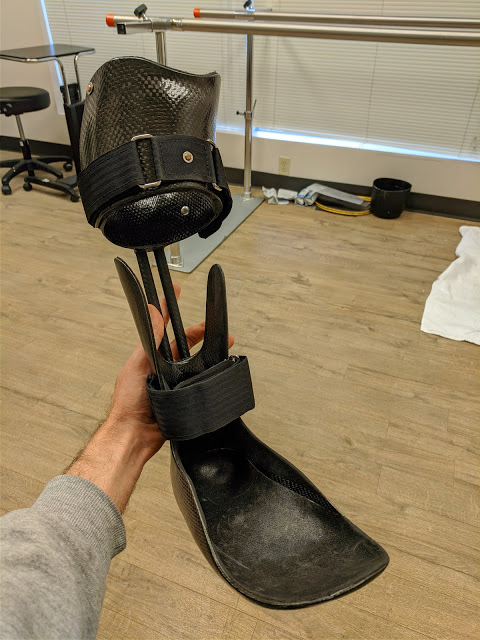
Here’s what an ExoSym looks like.

For casting, I sat in a chair at one end of a set of parallel bars. I got to hold and explore an ExoSym. It was way heavier than I thought it would be, big and bulky (probably for a grown man). I tried not to worry yet about getting used to wearing two of them.

On the floor at my feet were a container of water and a cast cutting saw. The “tickler” of my childhood. This nickname was supposed to make the noise and the blade moving toward my skin less scary. The vibrations from the saw “tickle,” get it? This thing terrified me as a kid, and I can remember crying in a panic when it was time to remove the casts for my AFOs, even though Ray (my orthotist) assured me that the saw would not cut me. 

Ryan, the prosthetist at Hanger, came in and did a few quick (seated) strength tests. It goes something like this: “Bring your knee up into my hand. Push hard. Harder. Okay, now don’t let me push your knees together…” He asked me to stand up on my toes. Which I can totally do when I’m hanging on to parallel bars. A few minutes after these tests, I could feel pain settle into my right piriformis/SI joint area. 

Then a woman came in with a laptop and asked me questions about pain and activities and what I wanted to be able to do. These are the same questions from the application, and she added to/revised my responses. I told her that I would like to be able to get back to where I was at about age twenty-five, before all the chronic pain started presenting itself. Also, I would like to have the confidence that I can get up from a fall by myself. (I’ve recently discovered that it is now VERY difficult to get up from the floor without something to pull up on, and that’s scary.)

The ExoSym program has been serving civilians since 2013, with about 4,000 patients so far. I asked how many applicants are not accepted. Somewhere around ten. Ten people who used wheelchairs most of the time and/or who didn’t have enough function to be able to really use the brace. And how many people try it out and then decide it’s not for them? I didn’t get an exact number, but sometimes a condition requires further surgery. Annika the Amputee, for example, tried the brace but was still in pain from the tumor in her foot.

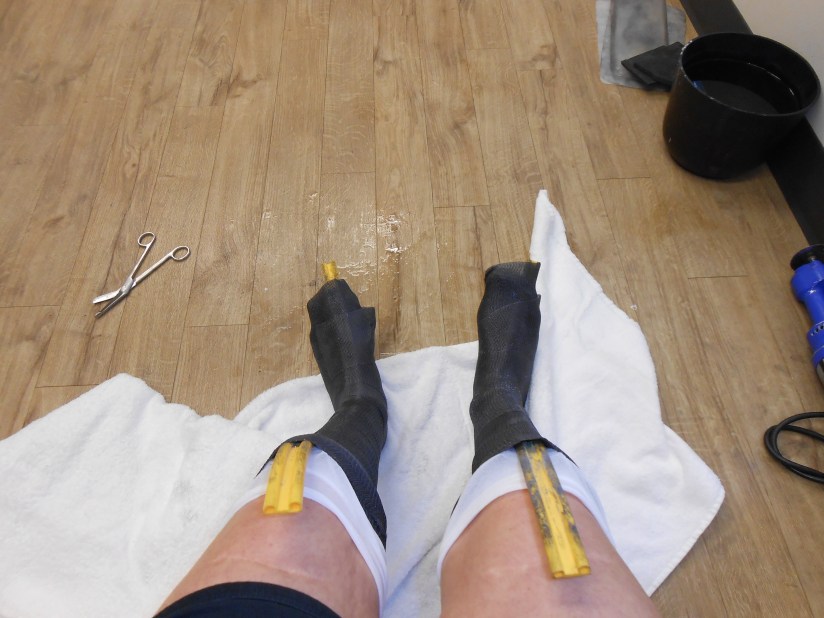
First, I had to put two nylon socks on each leg. Ryan was very quick with casting.

Getting ready for leg casting
Two layers of nylons socks. Ready for casting. Cast cutting saw–the tickler–is the blue thing on the right.

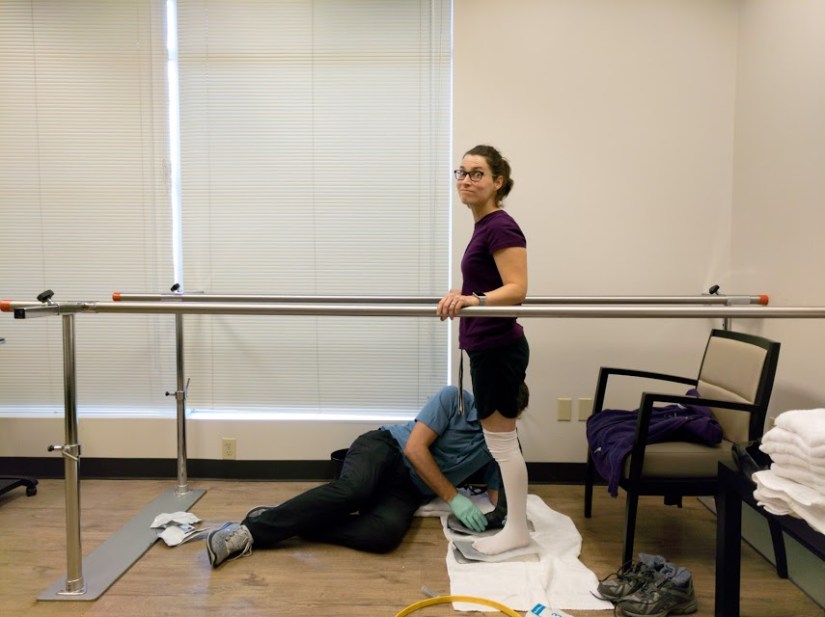
He did my right side first, while I was sitting, and then I stood up while he did the left side. This surprised me a lot, especially since he could tell when I looked up or down while he was working. If the position of my head makes a difference, isn’t one cast seated and one cast standing going to be very different? My legs certainly felt very different.

Getting casted for ExoSym devices
Thought I’d be sitting down after these adjustments, but I continued to stand for the second cast.
Being casted for ExoSym devices.
Casts are drying now.

Then it was time to cut them off. “Oh boy,” I said. “This was called the tickler when I was little.” 

“Trauma?” Ryan said sympathetically. “Now we have these thicker plastic strips, which are probably a lot different than what you had.” It’s true. Instead of small rubber (?) tubing, he used strips that were flat on one side, with a groove on the top, and quite rigid. He made quick work of getting the casts off, “unzipping” them with the strip when they were nearly cut through.

After I put my socks and shoes back on, Ryan took us on a tour of the back, where the braces are made. Everything from start to “finish” is onsite. There really is no end, because we can order replacement wedges and sleeves as necessary and Ryan will make adjustments over months or years if needed for any issues, like “changes in mass” (weight gain/loss). He made sure to give me his number and take mine so I can text him with questions and updates.

So the first day was fine. Afterward, we went to Kopachuk State Park and I tried not to stress too much about what was to come.

Kopachuk State Park

Tuesday, 26 November 2019. Hanger Clinic Day Two: Test Devices

The next day, we are put into the same casting room so I can change into shorts. Ryan asks about shoe size. And then we wait. Finally we’re led across the gym to the walking room. There seems to be only one patient in the gym. He has two devices, one with the knee joint. I want to watch his workout. The PT sets up obstacle courses, and there’s a rope hanging from a track on the ceiling to hold on to; I can hear the rope slide along the track, but I can’t see what he’s doing.

Ryan has fitted “hundreds” of CP patients with the ExoSym. He tells me I will feel weaker in the beginning. I will need to strengthen my core and my glutes, use muscles that I don’t engage with my current gait pattern. It will take two years for me to achieve full potential function. This comes as a slight shock because other ExoSymers–with congenital conditions–have been told one year. Two years of working really hard. Okay.

My two test devices.

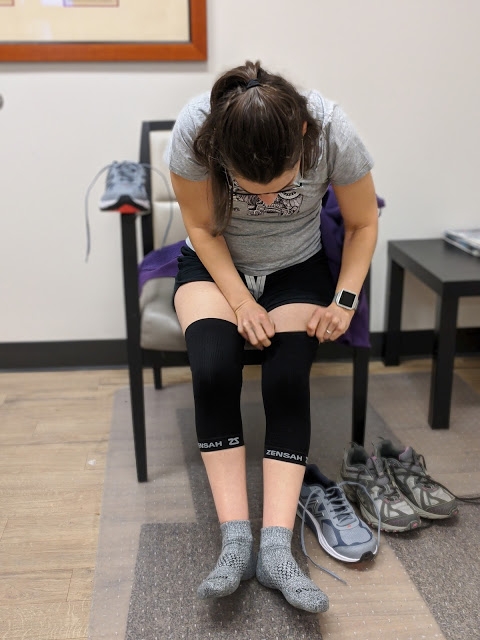
He brings me a pair of new shoes and asks if we could lace them up. A full size bigger than my usual shoe, and extra wide. Then he leaves again. As I read on another blog: Ryan is busy. Seeing patients off who have completed their training, taking calls. He brings me a pair of sleeves to put over my knees. We put the braces on and he marks where to cut the excess off at the toes. Disappears to the adjustments room. I wonder if I have time to use the bathroom before he returns again. Just walking to the bathroom in the tight synthetic sleeves feels weird. Finally, he brings in heel wedges to put in the shoes, straps me into the braces, and finagles my feet into the shoes.

Putting on knee sleeves
Putting on the knee sleeves after lacing up some giant shoes.

I pull myself to standing using the parallel bars. I let Ryan know it feels like there’s more room around my left calf (the cast I was standing for) than my right. He checks it and says it looks good, but adds that my body is valid in perceiving that sensation, or some such diplomatic acknowledgment. Perhaps it doesn’t matter that much because the area around the calf will be open on the real devices.

I take a step. Two. Heavy. Bulky. Cumbersome. Stiff. Like casts. Or ski boots. Like trying to walk in flippin’ ski boots–with cerebral palsy. No magic. No amazing shift or change. I had hoped I would feel the “energy return.” But the test devices don’t have struts, so that part is not there yet. 

Very quickly, Ryan prompts me to take one hand off the bars, to try to glide the other hand. Hand gliding is not possible. He says he can see that I’m standing up straighter. Really? Isn’t that maybe because I’m holding on? He tells me to try walking heel-toe, use my core, take bigger strides. I clomp forward. I try. “Can you tell she’s straighter? Have you ever seen her walk heel-toe before?” he asks my husband. “Now this is only about thirty percent of what they can do,” he tells me. This doesn’t mean anything to me. I do not feel that they are doing anything but weighing me down. I feel, not just weaker, but more disabled, not less. I do not want seventy percent more of this

He gets me a pair of trekking poles. I stay between the parallel bars as he adjusts the poles and tells me to try them. It’s not that I’ve never thought about using poles before. I’ve always hesitated because–how much stability can they give me if I’m the one holding them? They seem to just complicate things. 

So I stand there in my mock braces, holding these poles, and I can’t move. “I don’t even know how to start,” I say. But somehow I do, I take steps toward the door. I have to turn around when the bars end. Turning is ridiculous. Ryan watches and says he has pointers, but he wants to see how my body responds, how my brain problem solves. He says I’m doing better than he thought I would. I don’t know whether to feel flattered or insulted. I ask him if he says that to everyone. He doesn’t.

Every time Ryan leaves the room, I try to explain to my husband what moving in these braces feels like. Everything is stiff and robotic, but also unsteady. “How does anyone learn to walk in these things?!” I wonder aloud. Let alone do anything else? 

I’ll probably need to use the poles for the first few months, Ryan tells me. How do they feel, he wants to know.

“Right now, it feels impossible to function,” I answer truthfully. Ryan might have been surprised at my bluntness (perceived negativity?). He tells me to take them off and see what it feels like without them.

It feels lighter, roomier, like I no longer have casts on my feet. It’s a relief. Am I shuffling and swaying again? Apparently. But I can’t tell because it’s the way I’ve always moved.

“You’re here for a reason,” Ryan says. “Because you want something different. I’m trying to give you a different way of moving. It’s going to take time.”

I know all of this, but I cannot see years into the future. How am I supposed to decide whether or not to move forward and get the real devices based on this? I will have five days of training upon “device delivery,” when I come back to the clinic. How much can my body learn in five days? Before they send me back home to my own physical therapist who’s never heard of the ExoSym?

I get myself back into the braces. Walk up and down, trying to move faster, take bigger strides, remember my core. Everything is loud and clunky. Very aware that my feet are not on the floor, but inside a layer of hard plastic, I do not feel grounded, literally. I take a moment to just stand, handsfree. I can lean into the braces, into the cuffs below my knees. They hold me up, and I do not start to bend toward the ground. I lean forward, side to side. I do not lose my balance. “I’m standing,” I acknowledge. “I can’t do this without them, right?” I wonder, continuing to lean and experiment. “But how do you move? How do you pick something up? Or get up from the ground?” I try taking steps without the poles, but my body isn’t strong enough. My thumbs/hands are already starting to hurt from how much I’m gripping the poles, depending on them. I make my way outside the parallel bars and my husband holds my hands, higher up than the poles. This feels better. He is strong and stable, so much better than a pair of wobbly sticks.

Walking in ExoSym test devices
I’m wearing my Kindness Elephant shirt designed by FootlessJo for some good vibes today.

Ryan encourages me to go out into the gym. I walk up and down a textured mat-pathway once or twice. “You should use a light touch with the poles,” he says. “Can you do a light touch?” I know I’m not supposed to be gripping them so hard. I cannot do a “light touch.” He can tell I’m trying. I am tired. My right heel is starting to hurt/burn. I feel done. 

I make my way back across the gym into the walking room. I’m proud of myself for going out there. No one else was there. But I had elected to stay in the walking room the first time Ryan asked if I wanted to go out into the gym. I know if I’m going to do this that I’ll be facing lots of uncomfortable moments.

Safely seated, I tell Ryan about the painful callus on the bottom of my left big toe. Yes, he could put padding there in the real devices. “It should slowly disappear over several months, but we want it to be comfortable until then.” A $20,000 fix for toe pain? Sign me up! But really. My toe becomes excruciating because I land on it foremost, with every step. When he says the callus should resolve itself, what that means is that I will be walking differently. My gait will be different. I cannot say how that will affect the rest of my body, but it will. So I have to do this. I have to find out.

Here is my favorite moment. I told him my right heel was feeling pain and pressure. I pointed out where it hurt. He felt it and then he felt inside the brace. “Oh, there’s a little bump here. I can smooth that out for you. Feel it.” Sure enough, there was a tiny, but significant, bump in the plastic that I had been standing and walking on for two hours. Triumph! A pain, a reason for the pain, and a solution to the pain. Do you know how rare that is? How satisfying? How reassuring?

Just an hour or two after we left the clinic, I felt a new soreness that I couldn’t remember feeling before. Same amount on both sides. I thought it might be the gluteus medius, the ones that I needed to strengthen. I looked it up, just to make sure. Yes, these muscles were sore, but not in pain. Just using the test devices for two hours had forced my body (without my conscious effort) to use the new, “correct” muscles. 

So here I am. Knowing that I have years of work ahead of me. No way of knowing the outcome. Right now, I feel more disabled in the things, yet I am supposed to believe that they will help me feel more able than ever before.

Goals before trip number two, when I will receive the real devices (in a few months):

-Learn to use trekking poles (with a “light touch”)

-Strengthen my core